Instead of with 〜の代わりに
Grammar: Comparison and Contrast
代わりに marks something that stands in for something else. It can mean “instead of”, “in place of”, “as a substitute for”, “on behalf of”, or “in exchange for”, depending on the relationship between the two parts of the sentence.
Usage Notes
The phrase before 代わりに names what is replaced or compensated for. The following clause gives the substitute action, person, or return favor.
Formation
View formation details
-
Verb plain form + 代わりに
- 行く代わりに電話した
- "I called instead of going"
-
Noun + の + 代わりに
- 兄の代わりに私が行く
- "I'll go in my older brother's place"
-
な-adjective + な + 代わりに
- 便利な代わりに高い
- "it is expensive in exchange for being convenient"
-
い-adjective + 代わりに
- 安い代わりに時間がかかる
- "it takes time in exchange for being cheap"
Substitution
The most direct use of 代わりに is replacement. The first part names what is not used or not done, and the second part names what takes its place.
- 雨なので、散歩する代わりに家で映画を見た。
- Since it was raining, I watched a movie at home instead of taking a walk.
For nouns, use の代わりに.
- 砂糖の代わりに蜂蜜を使った。
- I used honey instead of sugar.
On Someone’s Behalf
When the noun is a person, の代わりに often means that someone acts in that person’s place.
- 母の代わりに買い物へ行った。
- I went shopping in my mother’s place.
This does not automatically mean the action was kind or helpful. It simply says that one person filled the role that another person would normally have filled.
Tradeoffs
代わりに can also describe a tradeoff: one good or bad point is balanced by another.
- この部屋は狭い代わりに家賃が安い。
- This room is small, but in exchange the rent is cheap.
In this use, the second part is often a compensation for the first part. It is close to “on the other hand”, but with a stronger feeling that the two points balance each other.
Examples
Not a replacement with 〜の代わりに
Grammar Explanation: Instead of with 〜の代わりに

Yotsuba’s father plans to take her to see fireworks. When Jumbo hears that Yotsuba’s neighbor, Asagi, had previously invited her to use sparklers, Jumbo says Yotsuba needs to invite Asagi to see the fireworks as a thank-you. She heads next door to ask, but Asagi already has plans to see the fireworks with a friend, so Yotsuba invites Ena instead, and agrees for Ena’s friend Miura to come along. Yotsuba returns home and assures Jumbo that Asagi will go to see the fireworks. They head out the following day.
- よつば:
- 「あさぎのかわりにみうらつれてきた」
- “I brought Miura instead of Asagi.”
- ジャンボ:
- 「代わりになんねーーーよつ!!」
- “She's not a replacement!!!”
Picked up in my place with 〜の代わりに
Grammar Explanation: Instead of with 〜の代わりに
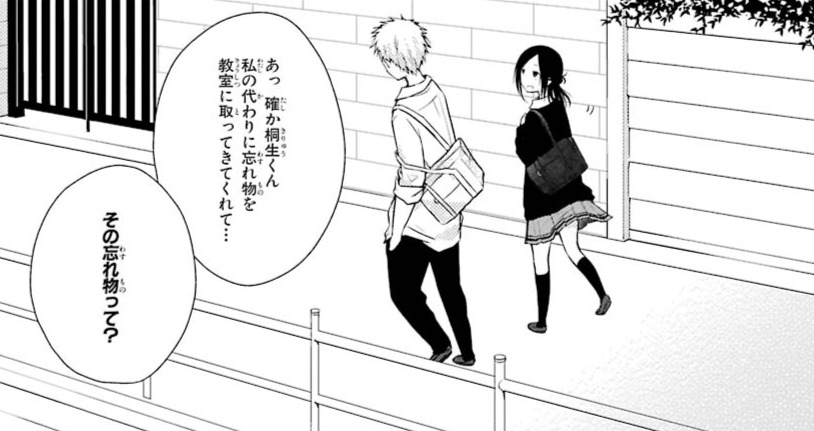
Fujimiya was able to work around forgetting her friends every Monday by using a journal to record her time spent with Hase. After Fujimiya discovers she can remember Hase’s friend Kiryuu, Hase gets jealous and reacts poorly. The following Monday, Fujimiya arrives at school with no memory of Hase or her journal, and Hase isn’t able to regain her trust. After school, Kiryuu walks with Fujimiya. Without mentioning Fujimiya eating lunch with Hase each day, he asks about how she spent her lunches last week. She isn’t certain. Without mentioning that Fujimiya previously had forgotten her journal at her desk and classmates found it, Kiryuu questions her about the after-school event.
- 藤宮:
- 「あっ 確か桐生くん私の代わりに忘れ物を教室に取ってきてくれて…」
- “Ah, right… Kiryuu, you went to the classroom and picked up my forgotten item in place of me, didn't you…?”
- 桐生:
- 「その忘れ物って?」
- “That forgotten item was...?”