〜っぽい turns a word into an い-adjective meaning “kind of like” it, or “prone to” it. 子供っぽい is “childish” or “kid-like”, 白っぽい is “whitish”, and 忘れっぽい is “forgetful”.
In casual speech, it can also follow a whole clause to make a guess: 明日、雨降るっぽい, “looks like it’s going to rain tomorrow.”
Usage Notes
っぽい conjugates like any い-adjective: っぽくない, っぽかった, っぽくて, and っぽく before a verb. It goes straight before a noun with no な: 子供っぽい服.
Most っぽい words are everyday vocabulary, but a guess after a whole clause is very casual. Avoid that use in formal writing and formal speech.
Whether a っぽい word is a criticism depends on the word. 子供っぽい said of an adult is a put-down, but 大人っぽい said of a teenager is a compliment, and colors are neutral.
The suffix is ぽい, and the small っ is usually added before it. Spellings without the っ, like 犯人ぽい, turn up in casual writing, for example after ん.
Some lookalikes aren’t this っぽい: 空っぽ (“empty”), しっぽ (“tail”), ちっぽけ (“tiny”), いっぽう, よっぽど, and ぽいっと or ポイ捨て (tossing something away).
Formation
View formation details
Noun + っぽい
子供っぽい服
"childish clothes"
Color + っぽい
白っぽい車
"a whitish car"
Verb stem + っぽい (a few verbs only)
最近、忘れっぽい
"I've been forgetful lately"
い- or な-adjective stem + っぽい (some adjectives)
安っぽい時計
"a cheap-looking watch"
Plain clause + っぽい (casual guess)
スマホ、壊れたっぽい
"looks like my phone's broken"
っぽく + verb
大人っぽくなった
"became more grown-up"
Having the Feel of Something
After a noun, っぽい says something has the look, feel, or behavior you’d connect with that noun. 子供っぽい is “childish” or “kid-like”, 大人っぽい is “grown-up”, and 男っぽい is “manly” or “boyish”.
Many of these words are critical, and 子供っぽい said of an adult usually is. But っぽい itself isn’t negative: 大人っぽくなったね is a compliment to a teenager.
The new word is an ordinary い-adjective, so its tense goes after っぽい: 子供っぽかった, “was kid-like”.
Example 1 of 3: Wanting to photograph means with 〜たがる
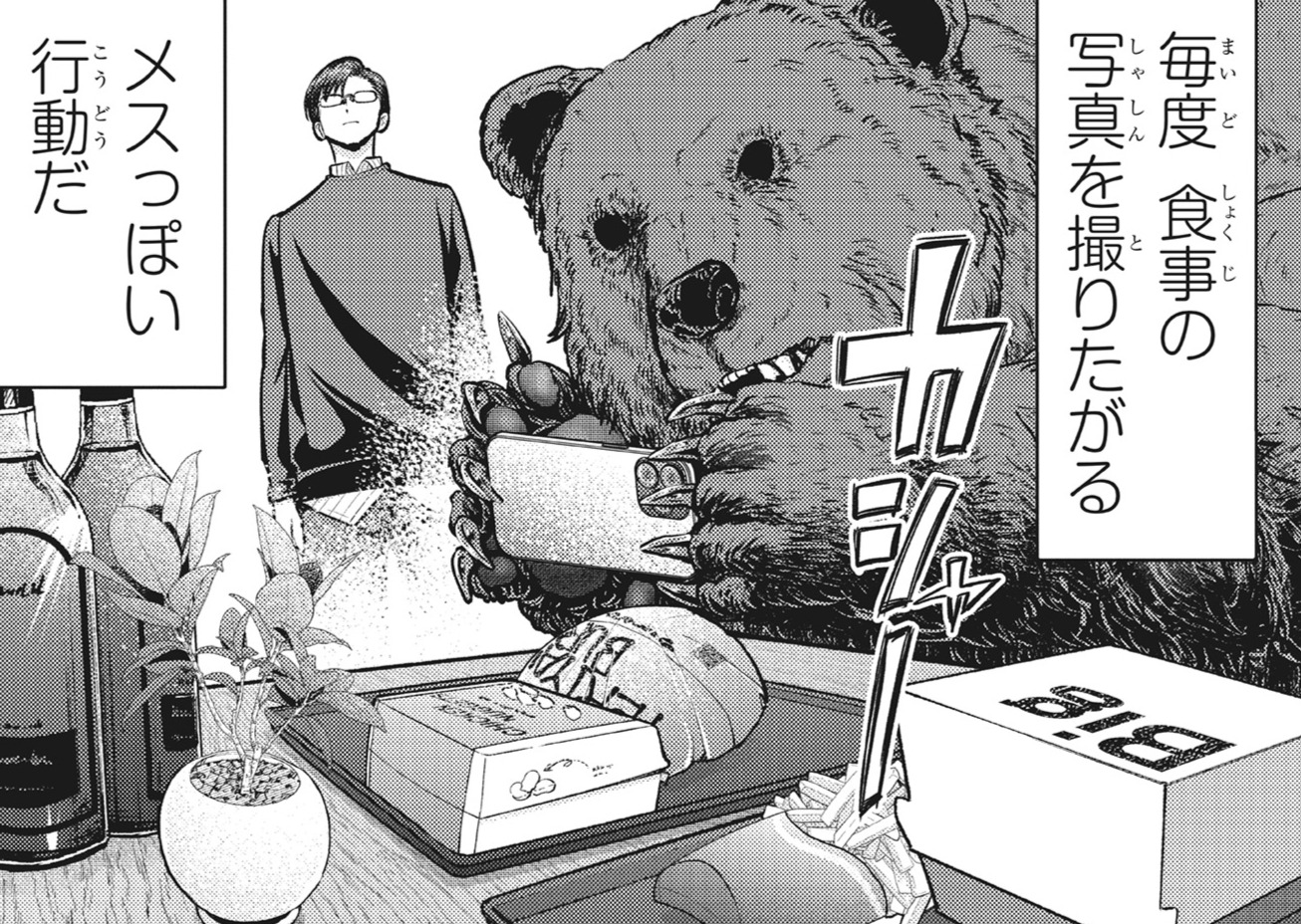
Kumada observes the bear that’s been living in his apartment for a while now, trying to determine from its personality traits whether it’s male or female.
A bear has been living in Kumada’s apartment, and he’s trying to work out whether it’s male or female. It photographs every meal before eating. メス is the word for a female animal, and Kumada files the habit under メスっぽい行動だ, “that’s female-like behavior.” っぽい describes the behavior, which then counts as a clue to the bear’s sex.
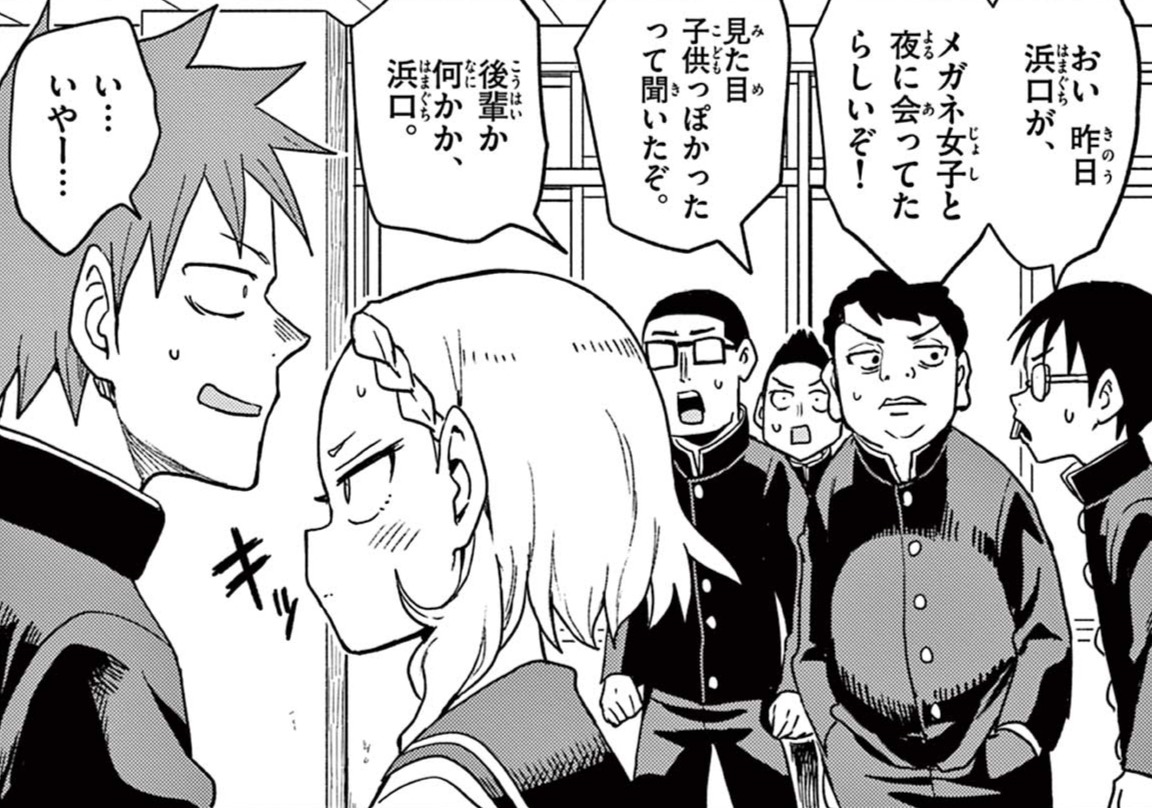
On a nighttime walk, Hamaguchi sees Hokujou casually dressed and wearing glasses. She’s fine with Hamaguchi seeing her like this, as they’ve known each other for a long time, but she tells him not to tell their classmates. At school the next morning…
高尾:
「おい 昨日浜口が、メガネ女子と夜に会ってたらしいぞ!」
“Hey, I heard Hamaguchi was hanging out with a girl in glasses last night!”
Hamaguchi was seen out at night with a girl in glasses, and the next morning his classmates are passing on the rumor. 見た目子供っぽかった is “she looked like a kid.” 見た目 limits it to her looks, not her behavior, and the next classmate guesses she’s a 後輩, a younger student. The past tense comes after っぽい, as with any い-adjective.
Example 3 of 3: Looking grown-up with hair tied back with 〜っぽい
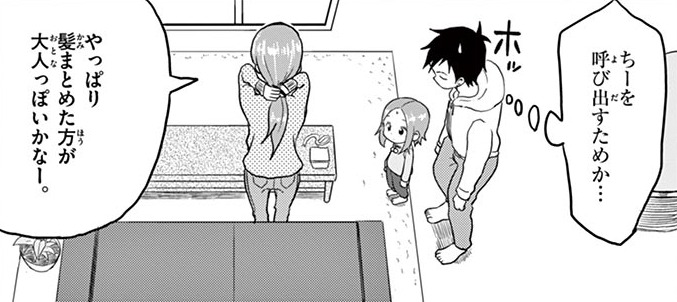
Chii has run off with Takagi’s hair tie. On Christmas Eve, Takagi calls out that a scatterbrained Santa left a present behind. When Chii opens the box, a knitted bear springs out at her. Takagi wonders aloud whether Santa found out about the hair tie, and Chii hands it back.
西片:
「ちーを呼び出すためか…」
“So it was to get Chii to come out...”
高木:
「やっぱり髪まとめた方が大人っぽいかなー。」
“I guess I do look more grown-up with my hair tied back, huh?”
Chii has just handed back the hair tie she ran off with. Takagi holds her hair together behind her neck and muses that it looks more 大人っぽい, “grown-up”, this way. She’s already an adult, so っぽい is about the look the hairstyle gives her, and here it’s a compliment.
Full of Something
With some nouns, っぽい means “full of it”, with a lot of it, often more than you want. 水っぽいスープ is watery soup, and 油っぽい food is greasy. Other common ones are 粉っぽい (“powdery”), ほこりっぽい (“dusty”), and 熱っぽい (“feverish”, running a slight temperature).
These are usually complaints. The soup isn’t like water. It has too much water in it.
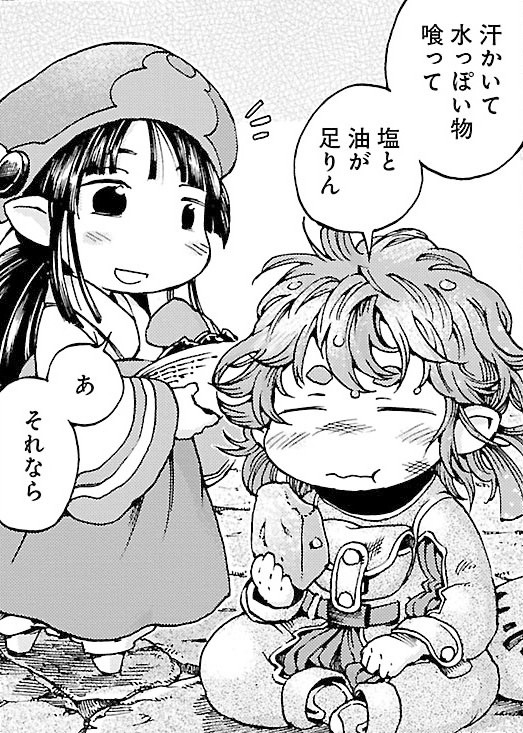
Hakumei has spent the day helping the carpenters’ guild repair a stone wall, while Mikochi helps cook for the crew. When the work stops for a break, everyone gets slices of a huge watermelon.
ハクメイ:
「汗かいて水っぽい物喰って 塩と油が足りん」
“I've been sweating and eating watery stuff. I'm short on salt and fat.”
Hakumei has been sweating all day on a building job, and the crew’s break snack is watermelon. 水っぽい物 is “watery stuff”, food with a lot of water in it. She isn’t faulting the watermelon. She’s saying it can’t give her the salt and fat she’s craving.
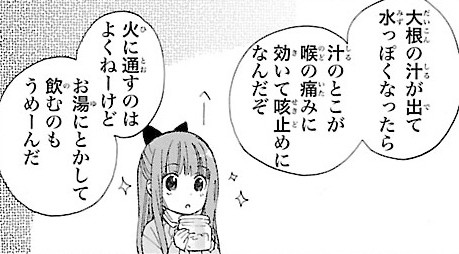
Moka has a sore throat. Hinata brings her chopped daikon that was left to steep in honey in a sealed jar. Moka tastes it and is surprised that it’s sweet.
日向:
「大根の汁が出て水っぽくなったら 汁のとこが喉の痛みに効いて咳止めになんだぞ」
“Once the daikon juice comes out and it gets watery, the juice is good for a sore throat and works as cough medicine.”
「火に通すのはよくねーけど お湯にとかして飲むのもうめーんだ」
“Heating it's no good, but it's tasty stirred into hot water, too.”
Hinata is teaching Moka to make daikon syrup, chopped daikon left to sit in honey. 水っぽくなったら is “once it gets watery”, after the daikon’s juice thins the honey. Here the wateriness is a good sign, since that juice is what soothes a sore throat.
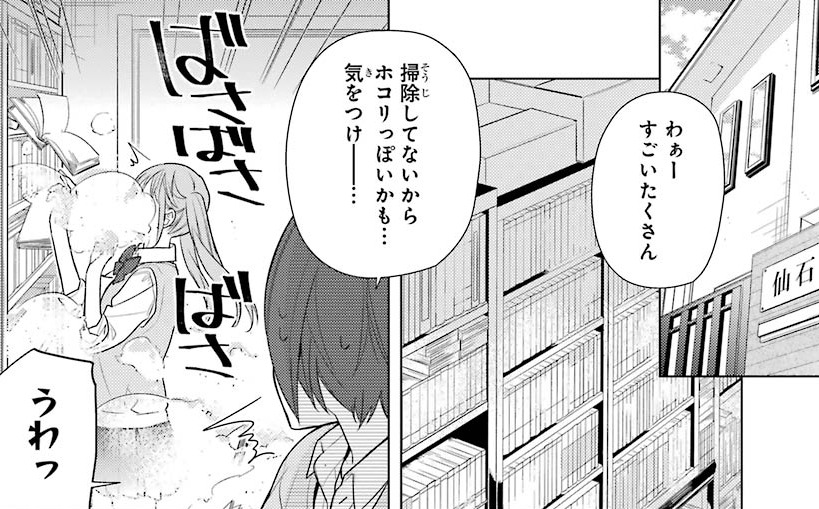
Sengoku has been lending books to his classmate Ayasaki. When he mentions that his parents’ books fill a whole room at home, she says she’d love to see it, and he invites her over.
綾崎:
「わぁー すごいたくさん」
“Wow, there are so many!”
仙石:
「掃除してないからホコリっぽいかも… 気をつけ——…」
“I haven't cleaned, so it might be dusty... Be care—...”
Sengoku shows a classmate the room where his parents keep their books. 掃除してないからホコリっぽいかも is “I haven’t cleaned, so it might be dusty”. ホコリ is “dust”, and the room is full of it, as she finds out a moment later.
Colors
After a color, っぽい means “-ish”: 白っぽい is “whitish”, 黒っぽい服 is “dark clothes”, and 茶色っぽい is “brownish”. It’s handy when you can’t name the exact shade, as in a witness’s 黒っぽいコート, “a dark coat”.
Color words with っぽい are neutral. There’s no complaint in them.
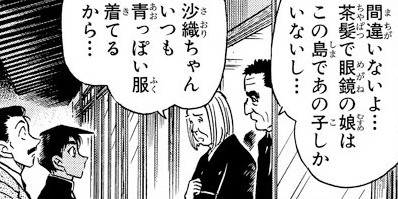
Naoko has been murdered during Sumi’s wake, and Kogoro tells the islanders that the killer took her Dugong Arrow, a sacred arrow from the island’s festival. Saori is missing, and she had also said she lost her arrow, so she may have been killed too. Then an elderly woman says she saw Saori near the Mermaid Falls on the morning of the festival, and other villagers say they spotted her there as well. Heiji asks whether it was really Saori.
お爺さん:
「間違いないよ… 茶髪で眼鏡の娘はこの島であの子しかいないし…」
“It was her, all right... She's the only girl on this island with brown hair and glasses...”
Villagers at the wake say they saw the missing Saori, and a woman explains how she knew it was her. Saori always wears 青っぽい服, “bluish clothes”. The villagers only caught glimpses of the girl, and っぽい gives the color loosely, without naming an exact shade.
Example 2 of 2: Brownish and blackish dyes with 〜っぽい
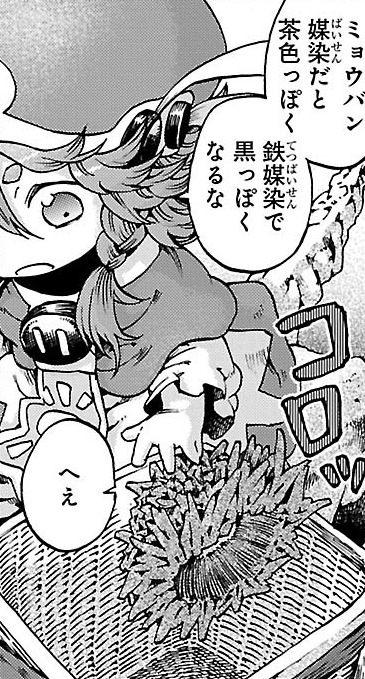
Mikochi is making Sen new clothes and thinks darker colors would suit her, so she sends Hakumei and Sen to gather dye materials such as sawtooth oak. Hakumei shows Sen that sawtooth oak is just acorns. When Sen asks whether acorn caps can really dye cloth, Hakumei says yes. You dye with the shells, caps, and twigs, then finish the cloth in a mordant, a solution that fixes the color.
ハクメイ:
「ミョウバン媒染だと茶色っぽく 鉄媒染で黒っぽくなるな」
“With an alum mordant, it turns brownish, and with an iron mordant, it turns blackish.”
Hakumei is explaining to Sen how to dye cloth with acorns. The color depends on the mordant: alum makes it 茶色っぽく, “brownish”, and iron makes it 黒っぽく, “blackish”. Both take the く form before なる, like any い-adjective.
Being Prone to Something
After a verb stem, っぽい describes someone who does that easily and often: 忘れっぽい is “forgetful”, 怒りっぽい is “quick to anger”, 飽きっぽい is “quick to lose interest”, and 惚れっぽい is “quick to fall in love”. It’s a trait, not one event.
Only a small set of verbs does this, and they’re mostly about faults. Learn them as words. You can’t add っぽい to any verb stem: there’s no 食べっぽい.
Example 1 of 2: Admitting to being forgetful with 〜っぽい
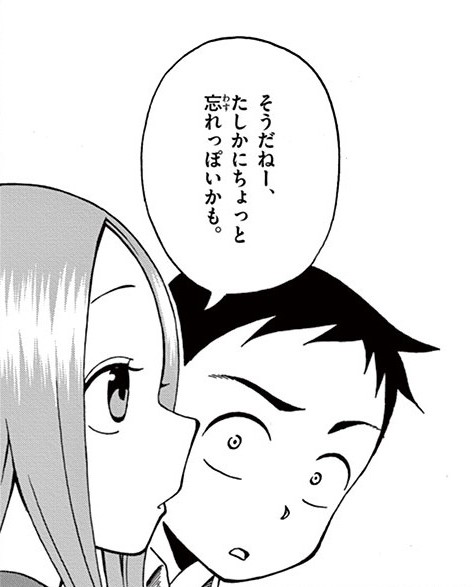
Takagi forgot both her umbrella and her raincoat, so she and Nishikata are walking home together under his umbrella. Hoping to finally tease her for once, Nishikata points out that it’s rare for her to forget anything. He asks whether she’s secretly a klutz.
高木:
「そうだねー、たしかにちょっと忘れっぽいかも。」
“Hmm, you're right. I might be a little forgetful.”
Nishikata is sharing his umbrella with Takagi, who forgot hers, and he asks if she’s secretly a klutz. 忘れっぽい is “forgetful”, from the stem of 忘れる. It names a habit, not today’s slip, and with ちょっと and かも she admits she might be a little forgetful.
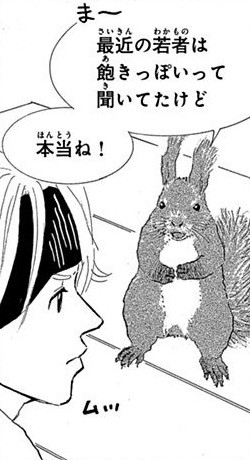
Masaki is training as a coffee roaster, but so far the work is sorting coffee beans by hand alongside the squirrels at the roastery. He slides in just in time again this morning, and soon after they start sorting, he grumbles that it’s nothing but hand-picking every day.
エゾリス:
「ま〜 最近の若者は飽きっぽいって聞いてたけど 本当ね!」
“Well, I'd heard young people these days get bored easily, and it's true!”
Masaki has been sorting coffee beans by hand every day, and he announces he’s sick of it. A squirrel he works with says she’d heard young people are 飽きっぽい, “quick to lose interest”, from the stem of 飽きる. Masaki’s 飽きた is one complaint, and she takes it as proof of the trait.
Words to Learn Whole
A few っぽい words follow an adjective stem. 安っぽい is “cheap-looking” or “tacky”, which isn’t the same as 安い: a sweater can be 安い and still not look 安っぽい. 荒っぽい is “rough”, 俗っぽい is “lowbrow”, and いたずらっぽい is “mischievous”. っぽい attaches to adjectives far less freely than to nouns, so learn the common ones as words.
Other fixed っぽい words have meanings worth learning whole. 色っぽい is “sexy” or “alluring”, not “colorful”, since 色 here means romance. 理屈っぽい is “argumentative”, and 湿っぽい, from 湿る, is “damp” or “gloomy”.
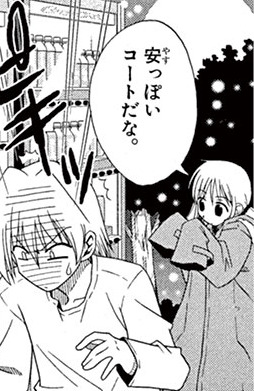
Hayate’s parents have left him with a 150-million-yen debt, and the yakuza are after him. Desperate, he decides to kidnap a girl he finds alone in a park on Christmas Eve. She tells him she ran out of a party and forgot her coat, and she’s shivering. Hayate drapes his own coat over her, then scolds himself for going soft on the girl he means to kidnap.
Hayate has just given his own coat to a shivering girl he found in the park. She thanks him by calling it a 安っぽいコート, a “cheap-looking coat.” 安っぽい is about how the coat looks and feels, not its price. She has no idea what he paid for it.
Example 2 of 2: Wanting an alluring older woman with 〜っぽい
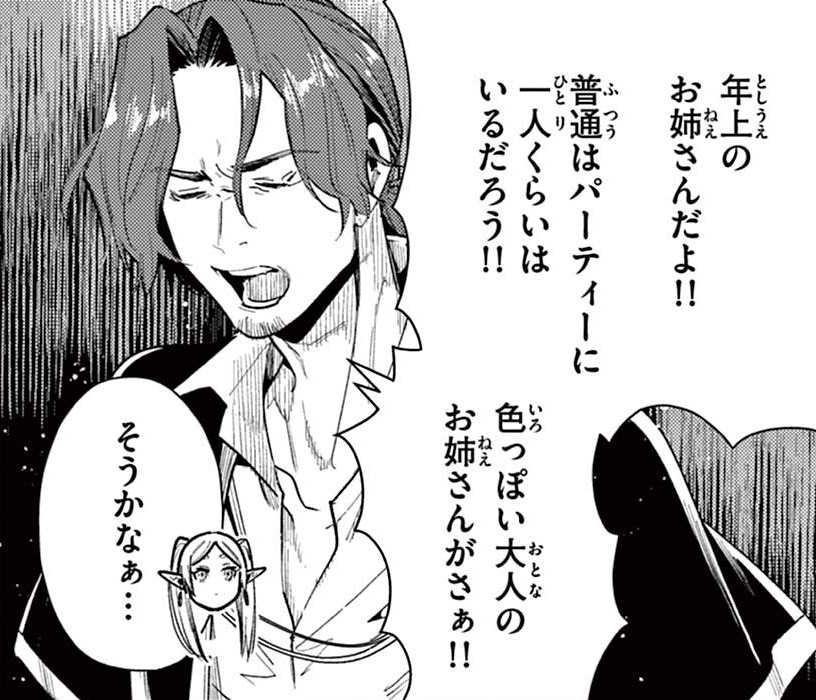
While the party walks through the hills of the northern lands, Sein says the party is missing something and asks the others what it is. Fern suggests a thief, since Frieren keeps falling for mimics, but Sein says what they lack is far more important.
Sein announces that their party is missing something important: an older woman. 色っぽい here has nothing to do with color. 色 means romance, and 色っぽい大人のお姉さん is “a sexy grown-up woman.”
Sounds True, Sounds Fake
Some っぽい words judge how real something seems. 嘘っぽい is “sounds like a lie” or “fishy”, and its opposite, 本当っぽい or ホントっぽい, is “sounds true”. マジっぽい is “seems serious”. それっぽい is “looks the part” or “plausible”: a clay animal can look それっぽい, and a made-up excuse can sound それっぽい.
These words are casual, and they judge an impression. 本当っぽい keeps a verdict tentative: calling a story 本当っぽい stops short of saying it’s true. ちょっと嘘っぽい softens a doubt, but 嘘っぽい on its own can be flat disbelief.
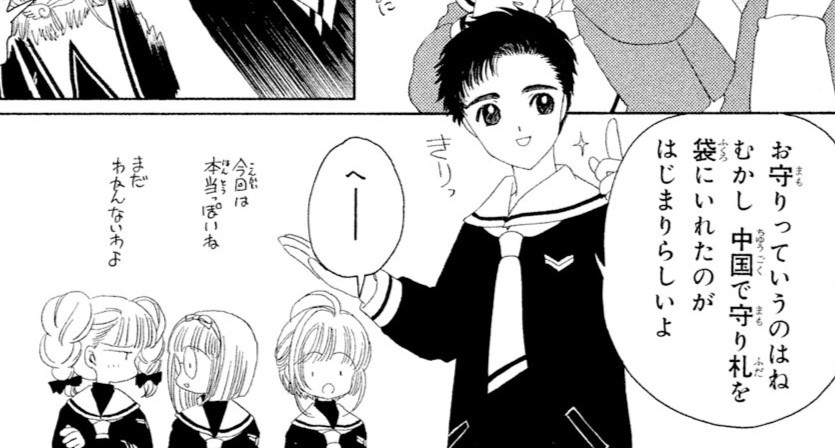
Sakura had to take a detour to get to class. She tells her friends at school about the shrine she saw along the way. Naoko says the talismans from there are popular, as they can grant wishes for things such as exams and romance.
山崎:
「お守りっていうのはね むかし 中国で守り札を袋にいれたのがはじまりらしいよ」
“You know, apparently good-luck charms began long ago in China, when people put protective talismans into bags.”
Yamazaki is known for making up stories, and this time he explains that good-luck charms began in ancient China. Naoko says 今回は本当っぽいね, “this time it sounds true, huh?” 今回は singles out this story from the made-up ones before it. っぽい keeps her verdict tentative, and Chiharu pushes back that they can’t tell yet.
Casual Guesses After a Whole Clause
In casual speech, っぽい can follow a whole clause in its plain form to make a guess: 明日雨降るっぽい, “looks like it’ll rain tomorrow”, or この薬、効かないっぽい, “this medicine doesn’t seem to work.” It means about the same as みたい, but it’s more casual, and it’s a common way to hedge.
Tense can help tell the two kinds of っぽい apart. A っぽい word always takes its tense after っぽい: 子供っぽかった, “was childish.” A guess can put the tense inside the clause, before っぽい: 子供だったっぽい, “seems it was a kid.” In the same way, 忘れっぽい is “forgetful”, but 忘れたっぽい is “seems someone forgot.”
This use is newer than the others and very informal. It turns up in casual talk and online posts, sometimes with です: 壊れたっぽいです. In formal speech or writing, use ようです instead.
Example 1 of 2: Not seeing the fabric shop with 〜っぽい
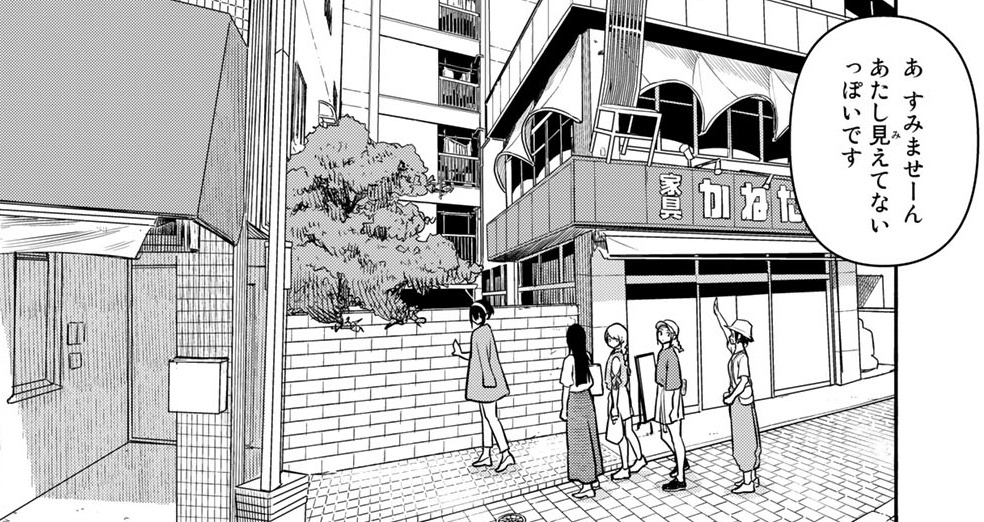
Tomoe Nibe, a witch who works with clothes, has brought Makoto and her friends to the fabric shop she runs in Sugamo. She tells them they’ve arrived and that the shop carries fabric from all over the world.
Nibe has brought Makoto and her friends to her fabric shop, but Yayoi sees only a wall. 見えてないっぽいです is “looks like I can’t see it”. The negative ない stays inside the clause, before っぽい, and です keeps the guess polite.
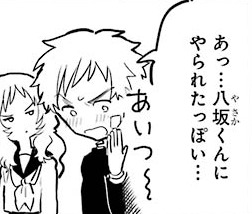
Mie has forgotten her glasses again, and at lunch she squints at the tiny print on a sticker from her bread bag. When Komura comes over to see what’s wrong, she notices something on his face and asks whether there’s something stuck to his cheek.
Mie spots something stuck to Komura’s cheek, and he works out who put it there. 八坂くんにやられたっぽい is “looks like Yasaka got me”. The past tense た comes before っぽい because he’s guessing about something that already happened.
っぽい, らしい, and みたい
Noun + らしい, as in 男らしい or 春らしい, says something lives up to what an X should be. It’s usually praise, and it’s said of a real X: a man is 男らしい, and a spring day is 春らしい. Noun + っぽい only says something gives the impression of X. 男っぽい can describe a man or a woman, and it’s not automatically praise.
In comparisons, noun + みたい means “like X”: 子供みたい is “like a child”. The guessing uses of みたい and らしい overlap with a clause + っぽい guess. Of the three, っぽい is the most casual.