Leaving as is with 〜まま
Grammar: Condition » 〜まま
〜まま holds a state unchanged: doing something while still in a prior state, or leaving things as they are.
靴を履いたまま means “with shoes still on”. Indoors in Japan, shoes normally come off, so the phrase points out that they stayed on during the next action.
Usage Notes
まま follows the た-form of a verb (the state resulting from the action), the ない-form (something not done), a noun plus の, an い-adjective, or a な-adjective plus な.
The た-form verb is usually one of instant action or change, such as つける “switch on”, 着る “put on”, or 忘れる “leave behind”. Its result is what stays in place. For two ongoing actions at once, use ながら: 歩きながら, not 歩いたまま.
まま is often used about a state that would normally have changed, with a hint of criticism. It can also be neutral: このままでいい, “it’s fine as is”. このまま and そのまま are everywhere in dialogue: “like this / as it is”. そのまま can also mean “straight on”, moving to the next action without a break. 〜ままにする means leaving something as it is on purpose.
Formation
View formation details
- Verb (た-form) + まま
- 電気をつけたまま寝てしまった
- "I fell asleep with the lights still on."
- Verb (ない-form) + まま
- 何も言わないまま、彼は行ってしまった
- "He left without saying anything."
- Noun + の + まま
- 昔のままの町
- "A town unchanged from the old days."
- い-adjective + まま
- 若いままでいたい
- "I want to stay young as I am."
- な-adjective + な + まま
- 祖母は今も元気なままだ
- "My grandmother is still as healthy as ever."
- このまま・そのまま
- そのままで待っていて
- "Wait just as you are."
- このままでは・このままじゃ
- このままじゃ間に合わない
- "At this rate, we won't make it."
With a State Left in Place
The た-form plus まま names a state left in place when the main action happens. Often the two hold at the same time: in 服を着たまま泳いだ, “I swam with my clothes on”, the clothes stay on during the swim. The state can also be left behind as someone moves on: in ドアを開けたまま出て行った, “I went out leaving the door open”, the door stays open after the speaker is gone.

Rize wonders what became of the missing piece from Chiya’s puzzle. Syaro suggets it’ll turn up once it’s no longer being looked for. This reminds Chiya of something else that was forgotten.
- 千夜:
- 「シャロちゃんは学校にランドセルを忘れたまま帰ってきた事があったわ」
- “Syaro-chan once came home having left her backpack at school.”
- シャロ:
- 「明日学校行けない…」
- “I can't go to school tomorrow...”
Here 忘れる means “leave behind”. This is the second kind: the backpack stays at school, and Syaro comes home without it.
Without Doing Something
With the ない-form, まま says something stayed undone while something else happened. ひげをそらないまま大学へ行った means “he went to college without shaving”.
Keeping Things as They Are
このまま means “as things are now”. With でもいい or でいい, it can express a wish for the present to last.

As they decorate their Christmas tree, Chii learns from her mother that kids need to be good because Santa is always watching. Chii wants Christmas to arrive soon so she doesn’t have to keep being good, until she takes a look at the decorated tree.
- ちー:
- 「ずっとこのままでもいいなー。」
- “It'd be fine if things stayed like this forever.”
- 「でもクリスマスもはやくきてほしいなー。」
- “But I want Christmas to also hurry and come.”
Chii looks at the decorated tree. このままでもいい is “it would be fine even like this”: she’d be happy for this moment to last forever. The next line adds a second wish, for Christmas to come soon.
At This Rate with このままじゃ
このままでは, or casual このままじゃ, warns about what will happen if nothing changes: “at this rate”. あのままじゃ means “if things stay like that”, about a state both speakers know of.
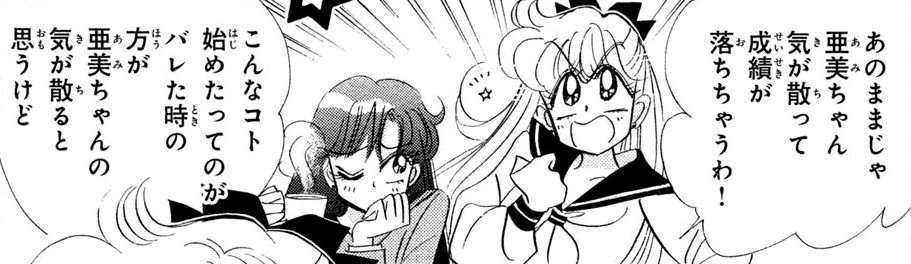
Ami is used to getting the top grade on mock exams, but when another name starts tying her scores, she begins to get flustered. Her friend Minako suggests they investigate the person behind the name, but Rei isn’t so sure.
- 美奈子:
- 「あのままじゃ 亜美ちゃん気が散って成績が落ちちゃうわ!」
- “The way things are, Ami-chan'll be distracted, and her grades will drop!”
- レイ:
- 「こんなコト 始めたってのがバレた時の方が亜美ちゃんの気が散ると思うけど」
- “I think Ami-chan will be more distracted when she finds out we've started something like this.”
Minako has watched Ami fret about a rival on the mock exams. あのまま points back to that state: if Ami stays like that, she’ll get distracted and her grades will drop.
Related Grammar
- Leaving something as-is with 〜っぱなし
- っぱなし stresses that something was left unattended, usually as a complaint. まま can be neutral.
- Doing in advance with 〜ておく
- ておく does something on purpose for later, including leaving a thing as it is. まま describes the unchanged state itself.