Limiting with 〜だけ
Grammar: Degree » だけ
だけ limits a statement to the word it follows, with meanings such as “only” or “as much as”. Its position relative to a particle shows which part of the sentence receives that limit.
Usage with Particles
When だけ marks the subject, が may be omitted. The same applies to an object and を. When が or を remains, だけ comes before it.
If the word marked by だけ has the particle で, だけ may appear before or after で. This also applies to に and と.
English
だけ often translates as “only” or “just”, but its position in the Japanese sentence shows exactly what it limits.
Related Grammar
- Not only this but also that with 〜だけではなく〜も
Examples
Because it's only this road with 〜だけ
Grammar Explanation: Limiting with 〜だけ
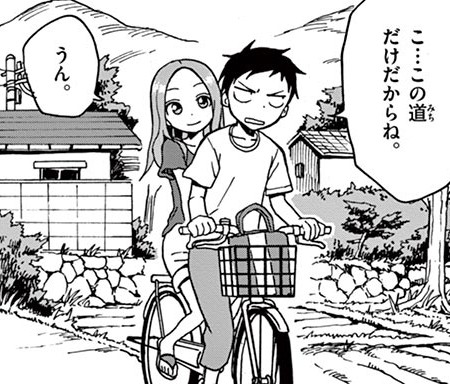
Takagi convinces Nishikata to spend his summer practicing riding his bike with her on the back. One day, she asks Nishikata if he’s progressed on his summer homework, saying they should go to his house to work on it. Since the road back is wide and without cars, Takagi convinces Nishikata to ride doubles to his house.
- 西片:
- 「こ…この道だけだからね。」
- “Because it's only this road, okay?”
Don't suspect only me with 〜だけ
Grammar Explanation: Limiting with 〜だけ
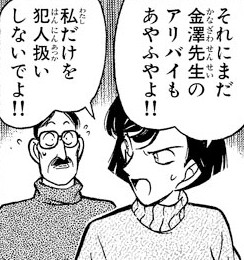
In a snow-covered mountain villa, a room full of suspects listen as Detective Mouri explains how their host was murdered. The accused notes she has a receipt showing she was at the convenience store at the bottom of the mountain when the murder took place.
- 中原:
- 「それにまだ金澤先生のアリバイもあやふやよ!!」
- “Moreover, Mr. Kanazawa's alibi is also vague!”
- 「私だけを犯人扱いしないでよ!!」
- “Don't treat only me as the suspect!”
Only for a little bit with 〜だけ
Grammar Explanation: Limiting with 〜だけ
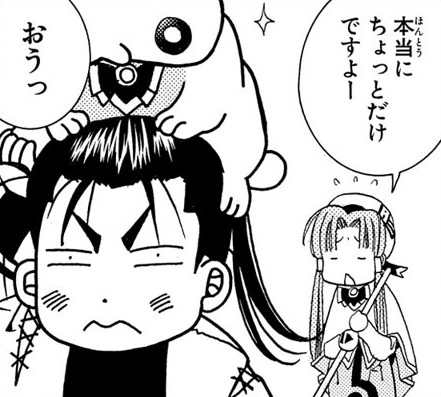
While waiting for his brother, Akatsuki finds Akari. He decides to pass the time by having Akari give him a tour of the area, but she explains that as a trainee she can’t take on customers by herself. Akatsuki hops into Akari’s gondola, saying it’s okay as long as he’s not a customer; he’s a friend.
- 灯里:
- 「本当にちょっとだけですよー」
- “It's really just a little bit!”
Supplemental Examples