Metaphor with 〜ようだ
Grammar: Appearance
〜ようだ likens one thing to another: “like” or “as if”. The comparison is figurative. The speaker knows the two things aren’t the same. A person is not actually an angel, and a day is not actually a dream.
Before a noun it takes the form ような, and before a verb or adjective, ように.
Usage Notes
A noun takes の before ようだ: 夢のようだ. A verb takes its plain form, and then the comparison covers a whole situation: 夢を見ているようだ, “it’s as if I’m dreaming”. The adverb まるで (“just like”) often comes first and signals that a comparison is coming.
The same forms have two other uses, and context decides which one you’re reading:
- Comparison (this page): the speaker knows it isn’t literally true. 夢のような一日, “a day like a dream”.
- Inference: the speaker thinks it may well be true. 誰もいないようだ, “it seems nobody’s here”.
- Example: the model really belongs to the group. 君のような人, “someone like you”.
みたい is the casual equivalent: 夢のようだ and 夢みたいだ both mean “it’s like a dream”. みたい is the conversational choice. ようだ is more formal, though ような and ように are common in speech too.
Formation
View formation details
- Noun + の + ようだ
- この景色は絵のようだ
- "This scenery is like a painting."
- Noun + の + ような + noun
- 天使のような笑顔
- "A smile like an angel's."
- Noun + の + ように + verb / adjective
- 子供のように泣いた
- "He cried like a child."
- Verb (plain form) + ようだ / ような / ように
- 死んだように眠る
- "Sleep like the dead."
- まるで 〜 ようだ
- まるで夢のようだ
- "It's just like a dream."
- Plain form + かのようだ
- 時間が止まったかのようだ
- "It's as if time had stopped."
- Note: かのようだ marks explicitly that it isn't really so. In the non-past, nouns and な-adjectives drop だ before かのようだ, or use である instead.
Likening One Thing to Another
The speaker describes one thing in terms of something it resembles. Noun + のような describes a noun that follows, and Noun + のようだ ends the sentence.
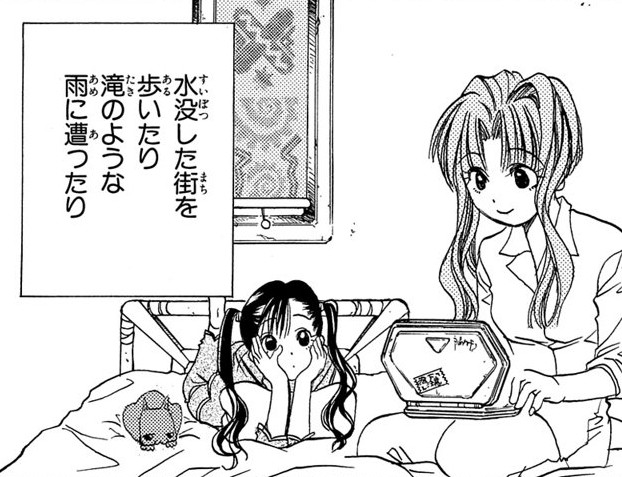
While out buying cat food during acqua alta, when tides have risen onto the streets, Akari is caught in a heavy downpour. She finds herself near Himeya Company, where her friend Aika lives, and she’s invited in to stay the night. As the two watch the falling rain through a window, Akari types an e-mail about her adventure that day.
- 灯里:
- 「水没した街を歩いたり滝のような雨に遭ったり」
- “Walking through a flooded town, getting caught in a downpour...”
Akari’s email describes her day out during acqua alta. Rain isn’t a waterfall, so 滝のような雨 is a comparison: the rain came down so hard it was like a waterfall. ような comes before the noun it describes, 雨. The English translation turns the comparison into “a downpour”.
Likening a Whole Situation
A verb in the plain form lets the speaker compare a whole situation, not just one thing. まるで夢を見ているようだ, “it’s as if I’m dreaming”, says the moment feels unreal. It does not suggest the speaker might actually be asleep.
This section covers ようだ and ような after a verb. Verb + ように, as in 死んだように眠る, is in the ように section below.
Emphasizing a Comparison with まるで
まるで means “just like”, so close you can hardly tell the difference. It strengthens the comparison and signals that ようだ is a comparison here. For a guess, ようだ often pairs with どうやら instead. あたかも also means “just like”.
The image can be exaggerated even without まるで, as in 滝のような雨.
Describing Actions and Qualities with ように
ように turns the comparison into an adverb. It describes how an action is done, as in 子供のように泣く, “cry like a child”, or a quality, as in 雪のように白い, “white as snow”.
Some of these are set phrases. 飛ぶように売れる, literally “sell as if flying”, means that something sells fast and in large numbers.
As If with かのようだ
Adding かの before ようだ marks explicitly that the comparison isn’t true: things only look that way. かのような describes a noun, and かのように describes a verb or adjective. 何もなかったかのように話す means “talk as if nothing had happened”, when something did.
Verbs and い-adjectives use the plain form. Nouns and な-adjectives can take かのようだ directly or add である first: 女王であるかのようだ, “as if she were the queen”.
Related Grammar
- Likening things with 〜みたい
- The casual equivalent for the same comparisons.
- Evidence-based guessing with 〜ようだ
- The same forms can make a guess that might be literally true, rather than a comparison.
- Giving an example with 〜ようだ
- ような can also point to a real example rather than a figurative one.
- As if with 〜んばかり
- んばかり describes something that looks just about to happen.