Must do with 〜なければならない
Grammar: Necessity » 〜なければならない
〜なければならない says that someone must do something. It is built from the negative conditional form, literally meaning “if not done”, followed by a judgment such as ならない or いけない .
In casual speech, the ending is often contracted to forms like 〜なきゃ , 〜なくちゃ , or 〜なけりゃ . The final ならない , いけない , or だめ is also often left unsaid when the obligation is clear.
Usage Notes
These are used when the speaker treats an action as necessary because of rules or personal responsibility. The full forms sound more complete and formal, while the contracted forms are common in casual dialogue.
Formation
View formation details
Verb negative stem + なければならない
Verb negative stem + なければいけない
止( と ) めなければいけない "have to stop it"
Verb negative stem + なきゃ
Verb negative stem + なくちゃ
帰( かえ ) らなくちゃ "have to go home"
Verb negative stem + なけりゃ
急( いそ ) がなけりゃ "have to hurry"
Note: The contracted forms usually come from dropping ない from the plain negative form and adding なきゃ, なくちゃ, or なけりゃ. They may be followed by ならない, いけない, だめ, or nothing at all.
Why a Negative Conditional Means “Must”
The core shape is a negative condition plus a bad result:
行( い ) かなければならない行( い ) かなければいけない行( い ) かなくてはだめ
English usually turns this around into “I have to go” or “I must go”.
Omitted Endings
In casual dialogue, the second half is often omitted:
行( い ) かなきゃ止( と ) めなきゃ探( さが ) さなければ!
This works because the listener understands the missing ending from context. A line like 「早( はや ) く止( と ) めなきゃ」 literally trails off as “If I don’t stop it quickly…”, but the practical meaning is “I have to stop it quickly”.
Examples
Grammar Explanation:
Must do with 〜なければならない
キラキラとギラギラ »
Volume 3 » Page 32
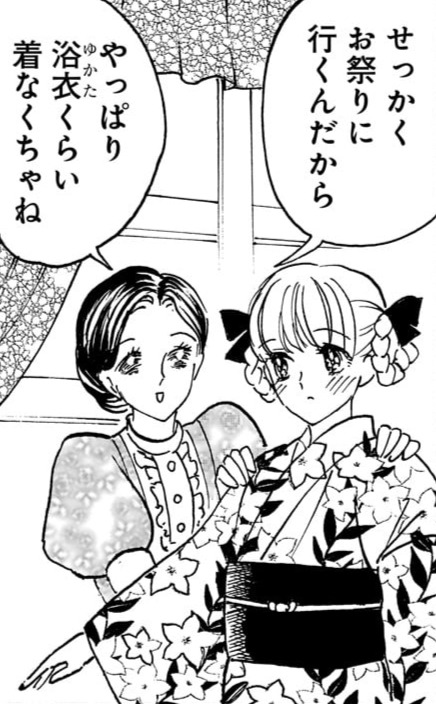
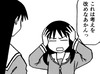
Lulu has plans to visit a local festival with her friends from class. Her mother helps her dress for the occasion.
ママ:
「せっかくお祭( まつ ) りに行( い ) くんだから」
“Since you're going to the festival and all...”
「やっぱり浴衣( ゆかた ) くらい着( き ) なくちゃ ね」
“You really should wear a yukata at least.”
Challenge Yourself
Show translation
Challenge
What does Lulu's mother say Lulu should do?
Clues
せっかくお祭( まつ ) りに行( い ) くんだから
since she has the special occasion of going to the festival
浴衣( ゆかた ) くらい着( き ) なくちゃねshe should wear at least a yukata, stated as a friendly expectation
What does the speaker mean?
Wear a yukata for the festival.
浴衣( ゆかた ) is the item before 着( き ) なくちゃ, and the first line gives the festival as the reason.
Buy a yukata while she is at the festival.
The verb is 着( き ) る, to wear, not buying. Her mother is already helping her dress.
Attend the festival only if her friends wear yukata.
Lulu's clothing is the topic of the expectation. The line sets no condition involving her friends.
Wear something other than a yukata this time.
やっぱり presents a yukata as the expected choice, not something to avoid.
Change clothes after returning from the festival.
The reason is that Lulu is about to go to the festival. The line does not concern changing afterward.
Ask whether a yukata is required at the festival.
Her mother states her own expectation with 着( き ) なくちゃね. She is not asking about a festival rule.
Lulu’s mother says that going to the festival calls for wearing at least a yukata. 着( き ) なくちゃ expresses the expectation casually, and ね keeps it friendly rather than strict.
Grammar Explanation:
Must do with 〜なければならない
怪盗セイント・テール »
Volume 2 » Page 89
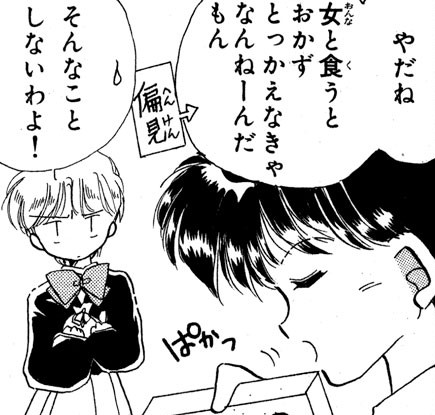
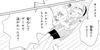
Rina asks Asuka Jr. if she can eat lunch with him.
アスカ Jr.:
「やだね」
“No way.”
「女( おんな ) と食( く ) うとおかずとっかえ なきゃなんねー んだもん」
“If I eat with a girl, I'd have to swap side dishes.”
リナ:
「そんなことしないわよ!」
“I wouldn't do that!”
Challenge Yourself
Show translation
Challenge
Why does Asuka Jr. refuse to eat lunch with Rina?
Clues
女( おんな ) と食( く ) うとhe is talking about what happens if he eats with a girl
おかずとっかえなきゃなんねー
he believes he would have to swap side dishes
What does the speaker mean?
He thinks eating with a girl means he would have to swap side dishes.
女と食うと sets the condition, and おかずとっかえなきゃなんねー gives the obligation he objects to.
He thinks Rina has already taken one of his side dishes.
The line describes what he believes would happen if they ate together, not something Rina has already done.
He has to finish lunch before Rina is allowed to eat.
〜なきゃなんねー applies to swapping side dishes, not finishing lunch first.
He refuses to eat any food prepared by a girl.
His excuse concerns exchanging side dishes while eating together, not who prepared the food.
He wants Rina to trade seats with someone else.
とっかえ refers to the おかず, side dishes, rather than their seats.
He thinks girls are not allowed to eat lunch with him.
He presents a supposed custom about swapping food, not a rule forbidding girls from joining him.
Asuka Jr. claims that if he eats with a girl, he will have to exchange side dishes with her. The rough contraction とっかえなきゃなんねー presents that imagined obligation as his reason for saying no.
Grammar Explanation:
Must do with 〜なければならない
カードキャプターさくら »
Volume 8 » Page 93
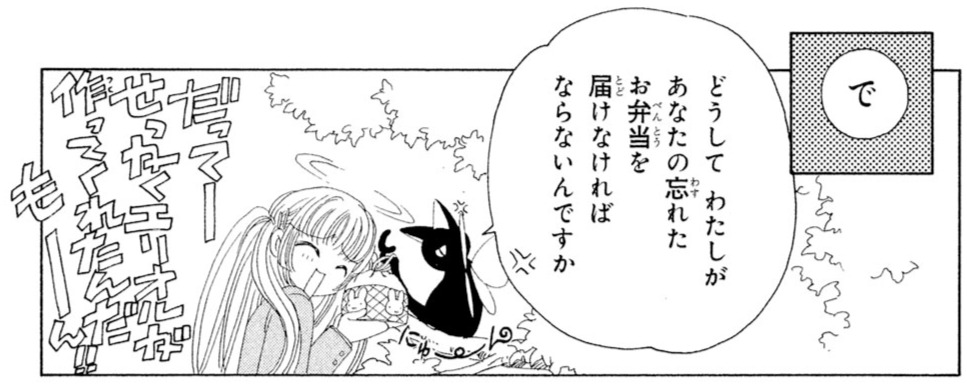
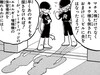
Spinel Sun calls out to Ruby Moon at school. After a brief discussion, Spinel Sun gets to the reason for his appearance there.
スピネル・サン:
「で」
“So.”
「どうして わたしがあなたの忘( わす ) れたお弁当( べんとう ) を届( とど ) けなければならない んですか」
“Why do I have to deliver the lunch you forgot?”
ルビー・ムーン:
「だってー せっかくエリオルが作( つく ) ってくれたんだもーーん!!」
“Well, because Eriol went to all that trouble to make it for me!!”
Challenge Yourself
Show translation
Challenge
What is Spinel Sun questioning?
Clues
どうして
why
あなたの忘( わす ) れたお弁当( べんとう )
the lunch that Ruby Moon forgot
届( とど ) けなければならないんですかwhy must I deliver it, phrased as a pointed request for an explanation
What does the speaker mean?
Why he must deliver the lunch that Ruby Moon forgot.
どうして asks for the reason, while 届( とど ) けなければならない says Spinel is required to deliver Ruby Moon's forgotten lunch.
Why Ruby Moon made a lunch for Eriol.
Ruby Moon forgot the lunch, and Eriol made it. Spinel is questioning his own delivery duty.
Whether Ruby Moon has already eaten her lunch.
The lunch was forgotten and still needs to be delivered. The line does not ask whether it was eaten.
Where he should buy a replacement lunch.
届( とど ) ける means to deliver the existing lunch. No purchase or replacement appears in the exchange.
Why Eriol asked Ruby Moon to bring him lunch.
The forgotten lunch belongs to Ruby Moon, and Spinel is bringing it to her.
Whether he is allowed to leave the lunch at home.
〜なければならない expresses an obligation to deliver it, not a request for permission to leave it behind.
Spinel objects to being made responsible for Ruby Moon’s mistake. He asks why he has to deliver the lunch she forgot, and んですか gives the complaint the form of a polite request for a reason.
Supplemental Examples
Try finding this grammar in the following examples: