Negative conjecture with 〜まい
Grammar: Conjecture » 〜まい
〜まい is an old-fashioned negative with two main uses. It can make a negative guess, “probably won’t” or “probably isn’t”, like 〜ないだろう. It can also state a decision not to do something, “I won’t” or “I shall not”, like 〜ないつもりだ.
At the end of a sentence, it’s a decision only when speakers talk about their own deliberate action. With any other subject, or with something the speaker can’t control, it’s a guess. When 〜まいと leads into an action, or in 〜まいとする, it can report anyone’s resolve.
Usage Notes
まい follows the dictionary form of godan verbs: 行くまい. Other verbs traditionally take the ない-stem, but other forms are accepted too. In writing, ichidan verbs much more often take the stem form, and すまい is the most common form of する:
- Ichidan verbs: 食べまい or 食べるまい
- する: しまい, すまい, or するまい
- 来る: 来まい, 来るまい, or 来まい
Nouns and adjectives go through ある: 冗談ではあるまい, 寒くはあるまい. A rare polite form is 〜ますまい: そんなことはありますまい.
まい is old-fashioned and mostly written, though the paired “whether or not” patterns sound less literary. Everyday speech uses ないだろう for the guess, and ないことにする or のはよそう for the decision. In manga, まい turns up in narration, in the speech of older, formal, or dramatic characters, and in set phrases like 仕方あるまい.
Two fixed patterns are worth knowing. 〜てくれまいか and 〜くださいますまいか make an old-fashioned request, “won’t you…?” 〜ではあるまいし, “it’s not as if…”, has its own page.
Formation
View formation details
- Verb (dictionary form) + まい (guess)
- 彼はもう戻るまい
- "He probably won't come back now."
- Noun + ではあるまい (guess)
- 冗談ではあるまい
- "This probably isn't a joke."
- Verb (dictionary form) + まい (decision)
- 二度とここへは来るまい
- "I shall never come here again."
- 〜まいと思う (decision)
- もう泣くまいと思った
- "I resolved not to cry anymore."
- 〜まいとする
- 彼女は泣くまいとした
- "She tried not to cry."
- 〜ようが〜まいが
- 信じようが信じまいが、本当の話だ
- "Whether you believe it or not, it's a true story."
Making a Negative Guess
With a subject other than the speaker, まい guesses that something won’t happen or isn’t so. It means the same as ないだろう but sounds more literary and old-fashioned. Potential forms and verbs of ability or understanding are common, saying what someone probably can’t do: 逃げられまい “you probably can’t escape”, わかるまい “you wouldn’t understand”.
The speaker can be the subject too, when the verb is something they don’t control: 私は気がつくまい “I probably won’t notice”. Nouns and adjectives take ではあるまい and くはあるまい: 彼の字ではあるまい “it probably isn’t his handwriting”.
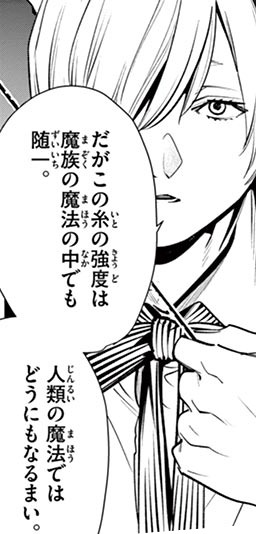
The demon Draht has slipped into the town jail where Frieren is held, intending to kill her. He wrapped invisible threads of mana around her neck and pulled to behead her, but she blocked the cut by concentrating her mana in her neck. Draht admits she kept her cool and warns that an ordinary mage would have lost their head before realizing what was happening.
- ドラート:
- 「だがこの糸の強度は魔族の魔法の中でも随一。」
- “But this thread is stronger than anything else in demon magic.”
- 「人類の魔法ではどうにもなるまい。」
- “Human magic won't be able to do a thing against it.”
The demon Draht tried to behead Frieren with threads of mana, and she blocked the cut. He isn’t worried, since the thread is the strongest in all of demon magic. 人類の魔法ではどうにもなるまい turns どうにもならない, “nothing can be done”, into a confident guess: human magic surely can’t touch it.
Swearing Off an Action
When speakers talk about their own deliberate action, まい states a decision not to do it. Adverbs like 二度と “never again”, もう “no more”, and 決して “never” often come with it.
〜まいと思う, 決める, or 誓う reports the decision: もう泣くまいと思った “I resolved not to cry anymore”. When the thinker is guessing about someone else’s action, まいと思う is a guess instead: 彼は来るまいと思う “I don’t think he’ll come”.
Acting on a Resolve with 〜まいと
〜まいと or 〜まいとして, followed by an action, says someone acts so that something unwanted won’t happen: “determined not to…” or “trying not to…”. 〜まいとする means “try not to”. Unlike a sentence-final まい, these forms can describe anyone’s resolve, which makes them handy in narration.
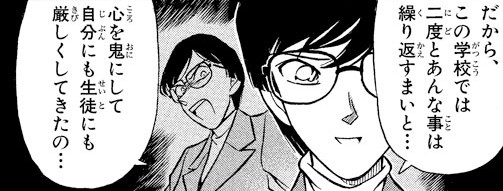
Conan’s classmates aren’t fond of their new teacher’s strict attitude. Ms. Kobayashi explains how at her last school, she couldn’t bring herself to be strict, and it allowed her students to get so out of control that students were injured in a fight.
- 小林:
- 「だから、この学校では二度とあんな事は繰り返すまいと…」
- “Therefore, to keep from repeating that kind of situation at this school...”
- 「心を鬼にして自分にも生徒にも厳しくしてきたの…」
- “I hardened my heart and became strict, with myself and with my students...”
Ms. Kobayashi explains why she has been so strict. Her students at her last school got out of control and some were hurt in a fight. 二度とあんな事は繰り返すまいと is her resolve never to let that happen again at this school. The action it drove comes next: 心を鬼にして自分にも生徒にも厳しくしてきた. 繰り返す is a godan verb, so まい follows its dictionary form.
Whether or Not with 〜ようが〜まいが and 〜ようか〜まいか
Paired with the volitional form of the same verb, まい sets out both choices. 〜ようが〜まいが and 〜ようと〜まいと mean “whether or not”, and say that either way, nothing changes: 信じようが信じまいが “whether you believe it or not”.
〜ようか〜まいか means “whether to … or not”. Verbs of hesitating, like 迷う, usually follow: 言おうか言うまいか迷った “I couldn’t decide whether to say it or not”.
Set Phrases with あるまい and なるまい
Longer expressions ending in ない can turn into guesses with まい. Where the ない stands for ある, it becomes あるまい, and ならない becomes なるまい:
- 〜しかない “there’s no choice but…” becomes 〜しかあるまい.
- 仕方がない “it can’t be helped” becomes 仕方あるまい.
- 〜ねばならない “must” becomes 〜ねばなるまい, “I suppose I’ll have to…”.
- 〜にちがいない “must be” becomes 〜にちがいあるまい.
- 〜のではないか “isn’t it that…?” becomes 〜のではあるまいか.
まさか〜(の)じゃあるまいな asks with suspicion, “surely you’re not…, are you?”: まさかのぞく気じゃあるまいな? “You’re not planning to peek, are you?”
Related Grammar
- Presuming with 〜だろう and 〜でしょう
- ないだろう is the everyday equivalent of guessing まい.
- Volitional with 〜う・〜よう
- まい works as the negative of the volitional, and pairs with it in 〜ようが〜まいが.
- Thinking of doing with 〜ようと思う
- The affirmative counterpart of まいと思う when it states a decision.
- It's not the case with 〜ではあるまいし
- A set pattern built on まい, meaning "it's not as if…".
- Must do with 〜なければならない
- 〜ねばなるまい turns this obligation into "I suppose I'll have to…".