Not as much as with 〜ほど〜ない
Grammar: Comparison and Contrast » 〜ほど〜ない
〜ほど〜ない means “not as ~ as”. In ⒶはⒷほど〜ない, Ⓑ is the yardstick and Ⓐ falls short of it: 今日は昨日ほど寒くない, “today isn’t as cold as yesterday”.
In this comparison, ほど needs a negative after it. For a positive “as ~ as”, Japanese uses くらい, and for “more than”, it uses より.
Usage Notes
The yardstick before ほど has to be a clear case of the quality. 昨日ほど寒くない only makes sense if yesterday was cold. The sentence usually grants that today is cold too, just less so. It isn’t used for a tiny, barely noticeable difference.
In conversation, the quality often goes unsaid when the context supplies it. 君ほどじゃないよ is “not as much as you”, and the listener knows what “much” refers to.
The same frame gives a few set patterns. Ⓑほど〜はない says nothing reaches Ⓑ. それほど〜ない is “not all that ~”. A verb before ほど can also set a threshold, the degree something would need to reach, so 心配するほどじゃない is “not bad enough to worry about”.
ほど has other uses that aren’t covered here: approximate amounts, as in 一週間ほど, “about a week”, extreme degree, as in 驚くほど似ている, “they look amazingly alike”, and 〜ば〜ほど, “the more ~, the more ~”.
Formation
View formation details
- Noun + ほど + negative predicate
- 兄ほど背が高くない
- "not as tall as my older brother"
- Plain-form verb + ほど + negative predicate
- 思ったほど難しくなかった
- "it wasn't as hard as I thought"
- Noun + ほど + modifier + noun + はない/はいない
- 彼ほど優しい人はいない
- "no one is as kind as he is"
- それほど + negative predicate
- それほど高くない
- "it isn't all that expensive"
- Plain non-past verb + ほど(のこと) + ではない
- 心配するほどのことではない
- "it's nothing to worry about"
A Person or Thing as the Yardstick
In ⒶはⒷほど〜ない, Ⓑ is the yardstick. Ⓐ is the topic, and the negative predicate says it doesn’t measure up. この町は東京ほど物価が高くない is “prices in this town aren’t as high as in Tokyo”.
Ⓑ has to have plenty of the quality, and Ⓐ usually has some of it too, just less. Think of this pattern as “Ⓐ and Ⓑ are both ~, but Ⓑ is more so”. With a noun or な-adjective predicate, the negative is じゃない or ではない.
In conversation, the predicate often shrinks to ほどじゃない. 兄貴ほどじゃない is “not as much as my brother”, and what “much” means comes from what was just said.
Not as Much as Before or as Expected
The yardstick can be an earlier time. 昔ほど and 前ほど compare the present with the past, as in 〜なくなった, “it’s no longer as ~”.
It can also be an expectation. 思ったほど, 思っていたほど, and 期待したほど measure the result against what the speaker had pictured. Depending on the quality, that’s a relief, as in 思ったほど悪くない, “not as bad as I thought”, or a letdown, as in 期待したほど面白くなかった, “not as fun as I’d hoped”. 言うほど works the same way with what someone said: “not as ~ as people say” or “not as ~ as you make it sound”.
Example 1 of 2: Not hanging out as much as before with 〜ほど〜ない
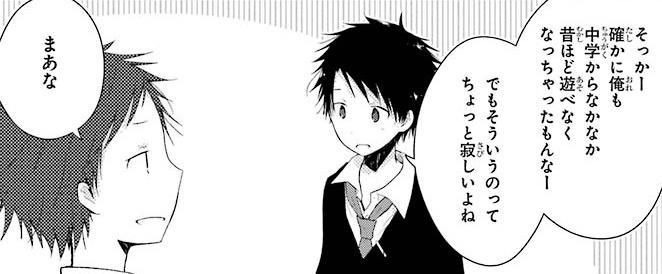
Kohei points out that this is the first time in a while he and Sana have talked this much. Ayumu asks why. Kohei says that between club activities, cram school, and entrance exams, everyone got busy, and they just got together less often.
- 歩:
- 「そっかー 確かに俺も中学からなかなか昔ほど遊べなくなっちゃったもんなー」
- “I see. Come to think of it, since middle school I haven't really been able to hang out as much as I used to, either.”
- 「でもそういうのってちょっと寂しいよね」
- “But that kind of thing is a little lonely, isn't it?”
- 康平:
- 「まあな」
- “I guess.”
Kohei has just explained why he and his old friends see each other less: once club activities, cram school, and entrance exams started, they got together less. Ayumu says he’s been through the same thing since middle school. 昔ほど makes the old days, when he hung out a lot, the yardstick, and 遊べなくなっちゃった says he no longer reaches it. He doesn’t say he stopped hanging out, only that he can’t do it as much as he used to.
Example 2 of 2: Not as good as you say with 口でいうほど〜ない
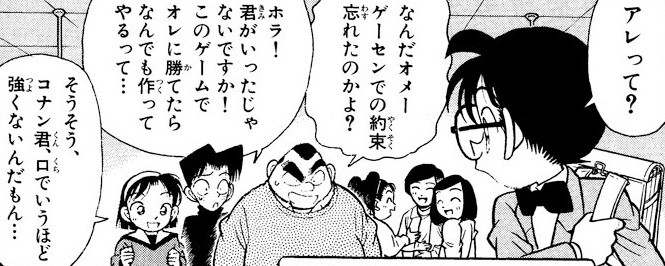
At Teitan Elementary, Genta asks Conan whether the thing he promised them should be ready by now.
- コナン:
- 「アレって?」
- “What thing?”
- 元太:
- 「なんだオメー ゲーセンでの約束忘れたのかよ?」
- “What, you forgot the promise you made at the arcade?”
- 光彦:
- 「ホラ! 君がいったじゃないですか! このゲームでオレに勝てたらなんでも作ってやるって…」
- “Come on! You said it yourself! 'If you can beat me at this game, I'll make you anything you want...'”
- 歩美:
- 「そうそう、コナン君、口でいうほど強くないんだもん…」
- “That's right. Because you're not as good as you said you were, Conan...”
Conan once promised his classmates he’d make them anything they wanted if they could beat him at an arcade game. They won, and now they want their prize. Ayumi explains how: コナン君、口でいうほど強くないんだもん. 口でいう, “what you say”, makes Conan’s boast the yardstick, and 強くない says his real play fell short of it. 強い, “strong”, here means good at the game.
Nothing Else Comes Close
Ⓑほど〜はない turns the comparison around. Instead of Ⓐ falling short of Ⓑ, nothing reaches Ⓑ. 夏のレモネードほどうまいものはない is “nothing tastes better than lemonade in summer”.
For people, use いない: 彼ほど優しい人はいない, “no one is as kind as he is”. When the yardstick is an action or situation, こと turns it into a noun first: 待たされることほど嫌なことはない, “nothing is worse than being kept waiting”.
This is the speaker’s own judgment, not a measured fact. くらい or ぐらい can replace ほど in this pattern, which is a softer way of putting it.
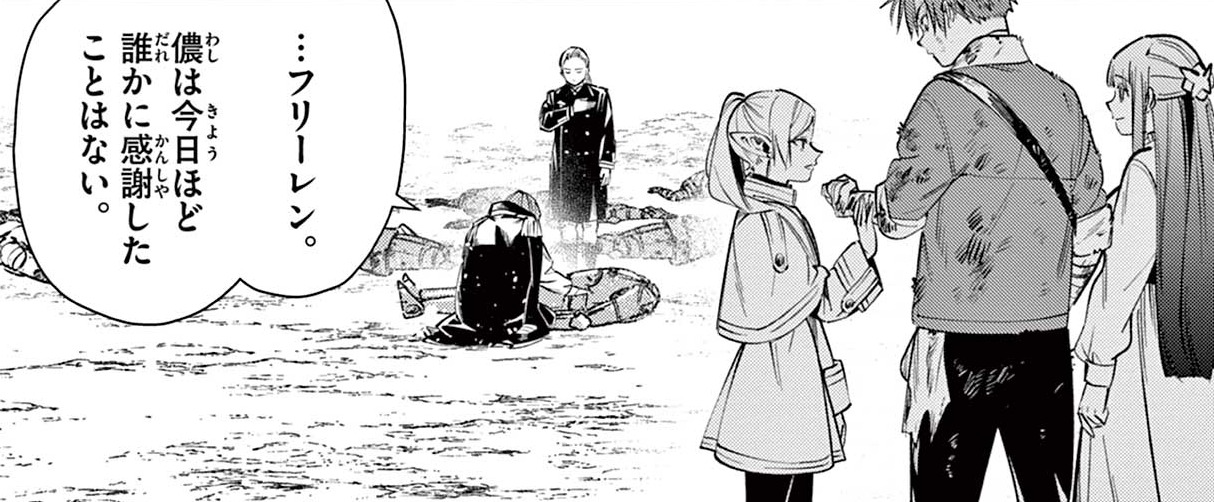
Frieren has defeated Aura the Guillotine, whose undead army was made of fallen northern warriors. Count Granat thanks the party for bringing the warriors down with so little damage to their bodies, and orders his soldiers to give them a proper burial. Among the bodies, he finds a suit of armor with the Granat family crest hanging from its neck. It belonged to his son, who died in battle.
- グラナト伯爵:
- 「…フリーレン。」
- 「儂は今日ほど誰かに感謝したことはない。」
- “...Frieren.”
- “I have never been as grateful to anyone as I am today.”
Frieren has just freed the fallen warriors of Aura’s undead army, and Count Granat has found his late son’s armor among them. 今日ほど makes today the yardstick, and 感謝したことはない says no past occasion ever reached it. He has never been more grateful to anyone.
Not All That with それほど
When それ, “that”, is the yardstick, the comparison is with whatever degree is under discussion or implied. それほど〜ない is “not all that ~” or “not especially ~”. それほど好きじゃない is “I don’t like it all that much”. そんなに works much the same way.
With the predicate dropped, それほどでもない is a common way to answer praise: “oh, I’m not that good”. It can also play down a worry: “it’s not that big a deal”.
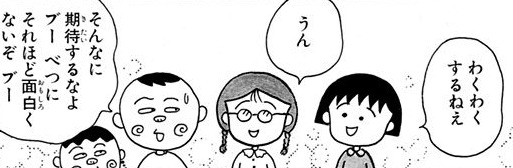
Bootaro has started going to church with a relative. He told Maruko and Tama-chan it was pretty fun, with hymns, picture-story shows of Bible stories, and snacks. Maruko, mostly interested in the snacks, decided to go too, and Tama-chan came along. On Sunday the two meet Bootaro outside the church.
- まる子:
- 「わくわくするねえ」
- “This is so exciting!”
- たまちゃん:
- 「うん」
- “Yeah.”
- ブー太郎:
- 「そんなに期待するなよブー べつにそれほど面白くないぞブー」
- “Don't get your hopes up that much, boo. It's not all that fun, boo.”
Bootaro once told Maruko that church was pretty fun, with snacks, and now she and Tama-chan have come along. When Maruko says she’s excited, Bootaro tries to lower their hopes. それほど makes the fun they’re expecting the yardstick, and 面白くない says church doesn’t reach it. He isn’t calling it boring, only less fun than they imagine.
Not Enough to Do Something
Here, a verb before ほど names what it would take to reach a certain degree. With a negative after it, the speaker says that degree isn’t reached. 冷房を入れるほど暑くない is “it isn’t hot enough to turn on the AC”, or literally “it isn’t hot to the point of turning on the AC”.
This is the “so ~ that” ほど, which also works without a negative, as in 驚くほど似ている, “they look surprisingly alike”. Unlike the comparison in the first section, it doesn’t imply that the topic has much of the quality. It may not be hot at all.
The adjective often drops out, leaving Verb + ほどじゃない. 心配するほどじゃない is “it’s not bad enough to worry about”. Adding のこと gives 〜ほどのことではない, “it’s not worth ~ing”, and 言うほどのことじゃない is “it’s not worth mentioning”.

On a warm morning, Chii has taken over the electric fan, chasing it as it swings so the breeze only reaches her. Nishikata complains that none of the air is getting to him, and Takagi laughs.
- 西片:
- 「朝だし、冷房入れるほど暑くはないんだよなー。」
- “It's still morning, and it's not really hot enough to turn on the AC.”
- 高木:
- 「あ。」
- “Oh.”
On a warm morning, Chii has taken over the electric fan, and Nishikata is left without a breeze. He considers the air conditioner and decides against it. 冷房入れるほど sets turning on the AC as the bar, and 暑くはない says the heat hasn’t reached it. It’s warm, but it isn’t AC weather yet.
One stock phrase is 〜ほど甘くない, “isn’t lenient enough to ~”. 世の中はそんなことが許されるほど甘くない is “the world isn’t so forgiving that it’ll let that slide”.
Not Quite What You’d Call It with ってほど
〜というほどではない, and casual 〜ってほどじゃない, say a label or description is too strong for the situation. 得意ってほどじゃない is “I wouldn’t say I’m good at it”. Here, the speaker rejects 得意 as too strong a description. How much ability they’re admitting depends on the context.
It often works as a hedge before けど: 得意ってほどじゃないけど… is “I wouldn’t say I’m good at it, but…”. 〜ってほどでもない works the same way.
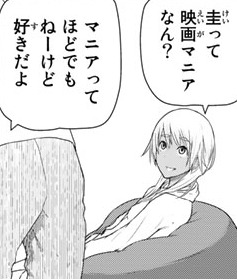
Kei’s cousin Akane is at his house, and the two of them have been watching a movie together. The film has just ended.
- 茜:
- 「圭って映画マニアなん?」
- “Kei, are you a movie buff?”
- 圭:
- 「マニアってほどでもねーけど好きだよ」
- “I wouldn't go as far as "buff", but I like them.”
Akane and her cousin Kei have just finished watching a movie at Kei’s house, and Akane asks whether he’s a movie buff. マニアってほどでもねー rejects マニア as too strong a word, and けど好きだよ admits what he will claim: he likes movies. でもねー is a rough でもない.
Further Reading
- 〜ほど〜ない, 日本語文型バンク (NINJAL) (ninjal.ac.jp)
- 〜ほど〜はない, 日本語文型バンク (NINJAL) (ninjal.ac.jp)
- 程, デジタル大辞泉 and 精選版 日本国語大辞典 (Kotobank) (kotobank.jp)
Related Grammar
- Than, more, and from with より
- より marks the baseline and works with positive and negative predicates. ほど marks a yardstick the topic doesn't reach, so it needs a negative.
- More than with 〜方が and 〜より
- This pattern says which side has more of a quality. 〜ほど〜ない says one side has less.
- Proportional to with 〜ば〜ほど
- This is ほど with a different job. One degree rises along with another.