Not necessarily with 〜わけではない
Grammar: Assertion and Declaration » 〜わけではない
〜わけではない rejects a conclusion someone might draw: “it’s not that…” or “that doesn’t mean…”
The conclusion can be one the listener has drawn, or one the speaker expects the listener or people in general to draw. The context or a following sentence often explains what is true instead. With みんな, いつも, or 必ずしも, it says something doesn’t hold in every case. It also makes a denial sound softer than a flat ない.
Usage Notes
わけではない follows the plain form of a verb or い-adjective. In the non-past, な-adjectives and nouns take な, or である in formal writing: 嫌いなわけではない, 学生なわけではない. Past and negative forms attach directly: 嫌いだったわけではない. Casual speech uses わけじゃない, and the polite form is わけではありません, わけじゃありません, or わけじゃないです. わけではなかった puts the denial in the past.
という, or casual って, can wrap any clause before わけ: 全員が学生というわけではない, 冗談ってわけじゃない. On its own, そういうわけじゃない means “that’s not it” or “that’s not what I mean”.
The real explanation often follows: 〜わけじゃないけど… “it’s not that…, but…”, or 〜わけじゃなくて… “it’s not that…, it’s…”. わけでもない adds も: “nor is it that…”, or just a softer “it’s not really that…”. When a speaker breaks off, only わけじゃ… or わけでは… may be left, and the context has to finish the denial.
Formation
View formation details
- Verb (plain form) + わけではない
- 全部覚えているわけではない
- "It's not like I remember all of it."
- い-adjective + わけではない
- 特に高いわけではない
- "It's not that it's especially expensive."
- な-adjective + な + わけではない
- 嫌いなわけではない
- "It's not that I dislike it."
- Noun + な + わけではない
- 全員が学生なわけではない
- "Not everyone is a student."
- Noun or clause + って + わけじゃない
- 冗談ってわけじゃない
- "It's not that I'm joking."
- Negative + わけじゃない
- 欲しくないわけじゃないけど…
- "It's not that I don't want it, but…"
- Polite 〜わけではありません
- 反対しているわけではありません
- "It's not that I'm against it."
- 別に 〜 わけじゃない
- 別に怒っているわけじゃない
- "It's not like I'm angry or anything."
Heading Off a Misunderstanding
The speaker rejects a conclusion the listener has drawn, or might draw, from what was said or what happened. The real reason often follows, after 〜わけじゃないけど or in a 〜だけだ sentence.
- 怒ってるわけじゃないよ。ちょっと疲れてるだけ。
- It's not that I’m angry. I’m just a little tired.
わけじゃなくて, or written わけではなく, sets the wrong reading and the right one side by side: “it’s not X, it’s Y”.
Example 1 of 2: Receiving praise with 〜れる

Cocoa prepares to teach Chiya, Chino, and Rize how to bake bread.
- リゼ:
- 「それにしてもココアがパン作れるって意外だったな」
- “Still, I didn't expect you to know how to bake bread, Cocoa.”
- ココア:
- 「えへへー」
- “Hee hee!”
- チノ:
- 「褒められてるわけじゃないと…」
- “It's not like you're being praised...”
Rize says she didn’t expect Cocoa to know how to bake bread, and Cocoa giggles as if she’s been complimented. Chino thought heads off that reading: 褒められてるわけじゃないと…, “it’s not like you’re being praised…”. She doesn’t include what Rize did mean. わけじゃない only rules out the conclusion Cocoa drew.
Example 2 of 2: Not doing it on purpose with 〜わけじゃない
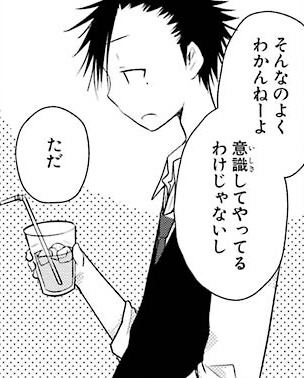
Hase suspects Kujou knows something about Fujimiya’s past, so he decides to get closer to him and takes him to a family restaurant after school. Over dinner, Kujou mentions he moved to Hokkaido for his father’s job and later came back. Hase asks whether moving bothered him, and Kujou says not really. Hase tells him he seems somehow detached, and Kujou answers, “…I wonder.” Hase asks if he’s always been like that.
- 九条:
- 「そんなのよくわかんねーよ」
- “I don't really know about that stuff.”
- 「意識してやってるわけじゃないし」
- “It's not like I'm doing it on purpose.”
- 「ただ」
- “It's just…”
Over dinner, Hase tells Kujou he seems detached and asks if he’s always been that way. Kujou says he doesn’t really know, since it isn’t something he does consciously: 意識してやってるわけじゃないし. He doesn’t deny being detached. わけじゃない only rules out the idea that he does it on purpose.
Qualifying a Generalization
With words like みんな “everyone”, 全部 “all”, いつも “always”, or 必ずしも “necessarily”, わけではない denies that something holds in every case. It may still hold in some.
- 日本人がみんな寿司が好きなわけではない。
- Not all Japanese people like sushi.
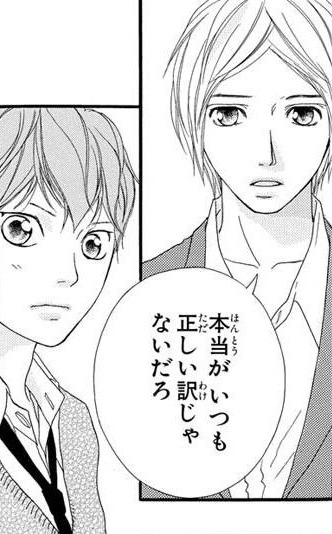
Ninako confessed to Ren and was turned down, since he already has a girlfriend. Manabu has been pushing Ren to admit he has feelings for Ninako. After Ren leaves, Manabu insists to Yuu that Ren really does like her. Yuu answers, “So what?”
- 裕:
- 「本当がいつも正しい訳じゃないだろ」
- “What's true isn't always what's right.”
Manabu insists that Ren has feelings for Ninako, even though Ren already has a girlfriend. Yuu answers that the truth isn’t always right. With いつも, 訳じゃない denies only “always”: being true doesn’t make something right in every case. Yuu isn’t saying the truth is never right.
Double Negatives with 〜ないわけではない
When the word before わけではない is already negative, the two negatives make a qualified yes. 〜ないわけじゃない means “it’s not that I don’t…”: the speaker admits something, often followed by a reservation or the real reason.
- 行きたくないわけじゃないんだ。時間がないだけだ。
- It's not that I don’t want to go. I just don’t have time.
With 全然 or 全く, わけではない denies only the extreme. 全然眠れないわけではない, “it’s not that I can’t sleep at all”, leaves room for some sleep, just not easily.
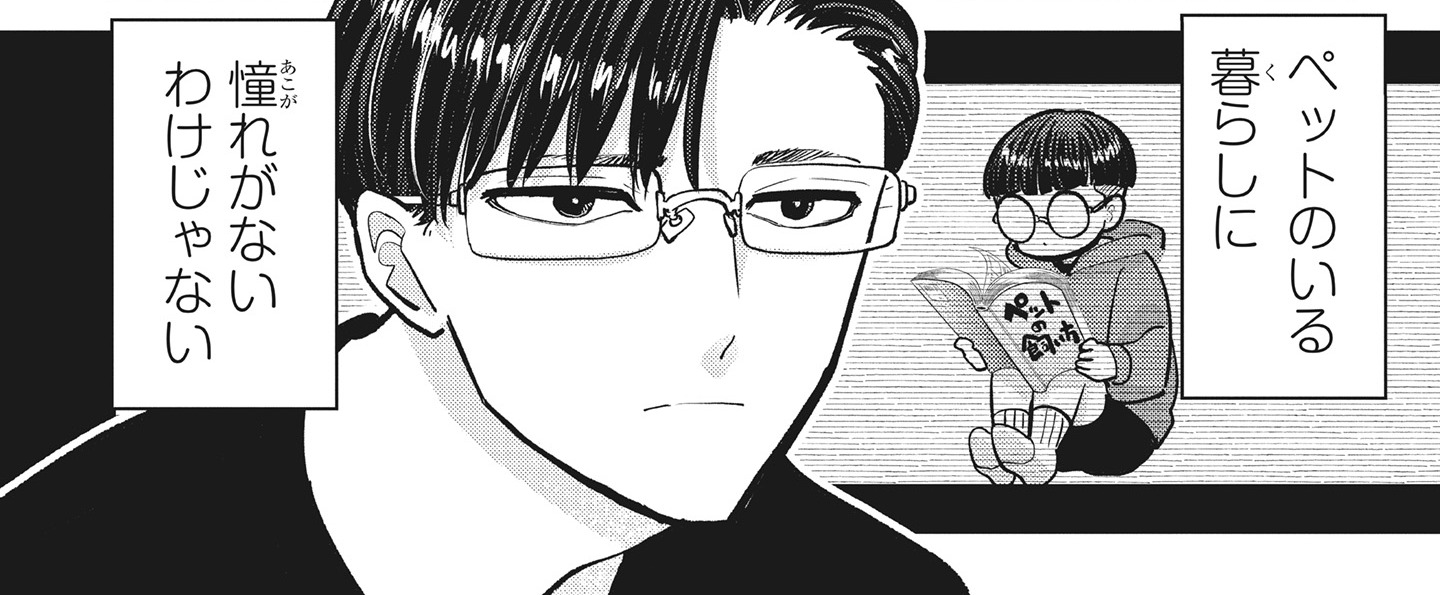
Kumada wishes the bear that lives with him were as cute as the neighborhood cat that visits. Later, he watches a TV segment in which a woman gushes about her dog. It’s part of the family, it sleeps with her at night, and life with a pet is the best.
- (熊田):
- 「ペットのいる暮らしに憧れがないわけじゃない」
- “It's not that I've never longed for a life with a pet.”
Kumada has just watched a TV segment about a woman and her beloved dog, while his own roommate is a bear. 憧れがない, “I have no longing”, is already negative, and わけじゃない rejects it. The two negatives add up to a reluctant yes: he has wanted a pet since he was a boy.
Just Because X Doesn’t Mean Y
だからといって refers back to something already said: “but that doesn’t mean…”. 〜からといって, casually 〜からって, attaches to the premise itself: “just because…”. わけではない then rejects the conclusion that seems to follow.
- 高いからって美味しいわけじゃない。
- Just because it’s expensive doesn't mean it tastes good.
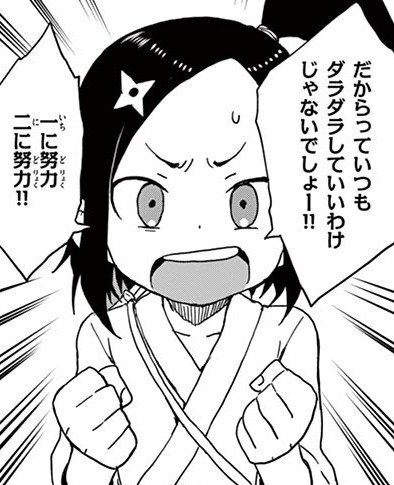
The teacher has declared a day of team-against-team battles. Benisumomo, a senior on Touwata’s team, challenges Tsubaki’s team, and Tsubaki accepts. Sazanka whispers that they should pick another team, since Touwata never gives up, Mizubashou is too good at setting traps, and Benisumomo is extremely strong. Benisumomo overhears and agrees: “Well, I am a genius.”
- トウワタ:
- 「だからっていつもダラダラしていいわけじゃないでしょー!!」
- “That doesn't mean you get to laze around all the time!!”
- 「一に努力二に努力!!」
- “Effort first, effort second!!”
Benisumomo, Touwata’s senior, has just called herself a genius. Touwata doesn’t argue with that. だからって points back to it, and いいわけじゃない rejects what Benisumomo thinks it allows: talent doesn’t make it okay to laze around all the time.
Not Really with 別に
別に often comes with the denial. English renders 別に〜わけじゃない as “not really…” or “it’s not like … or anything”. 特に means “particularly”: 特に高いわけじゃない, “it isn’t particularly expensive”. 別に〜わけじゃない can be a plain, sincere denial: 別に反対する訳ではない, “it’s not that I object”.
In manga, the same words often come from a character who obviously does care, and the scene makes the denial ring false. That’s the tsundere line:
- 別にあんたのために作ったわけじゃないからね。
- It’s not like I made it for you or anything.
Related Grammar
- No way with 〜わけがない
- わけがない rules out a possibility as unthinkable. わけではない rejects one reading of the facts.
- Logical conclusion with 〜わけだ
- The affirmative pattern draws a conclusion. わけではない blocks one.
- Not at all with 全然〜ない
- 全然〜ない means "not at all". It can sit inside わけではない, as in 全然眠れないわけではない, "it's not that I can't sleep at all".