Not only this but also that with 〜だけではなく〜も
Grammar: Addition » 〜だけではなく〜も
〜だけで(は)なく〜も adds a second item, quality, or action by first saying that the first one is not the full limit. It means “not only Ⓐ but also Ⓑ”, “Ⓑ as well as Ⓐ”, or “besides Ⓐ, Ⓑ too”.
The pattern is built from だけ (“only”), the negative connector ではなく (“not being”), and usually も (“also”) on the added item.
Usage Notes
This is used when the listener might think the statement applies only to Ⓐ, but the speaker wants to widen the scope to include Ⓑ. The two parts should be parallel: two nouns, two qualities, two actions, two places, two reasons, and so on.
だけでなく and だけではなく are both common. The は in では makes the contrast a little more explicit, and the shorter だけでなく often feels smoother in ordinary writing. In casual speech, だけじゃなく or だけじゃなくて may appear instead.
Formation
View formation details
- Noun + だけで(は)なく + Noun + も
- 顔だけでなく体も
- "not only the face but also the body"
- Particle phrase + だけで(は)なく + matching phrase + も
- 日本からだけでなく海外からも
- "not only from Japan but also from overseas"
- Verb plain form + だけで(は)なく + Verb/こと phrase + も
- 読むだけでなく書くことも
- "not only reading but writing too"
- い-adjective + だけで(は)なく + adjective/phrase + も
- 安いだけでなく使いやすくもある
- "not only cheap but also easy to use"
- な-adjective + なだけで(は)なく + adjective/phrase + も
- 便利なだけでなく安全でもある
- "not only convenient but also safe"
Reading Manga Examples
When reading the provided manga examples, first find the item before だけでなく. That is the thing being rejected as the only limit. Then scan forward for the item marked by も. That is the added item.
Example 1 of 3: Not just Machisu, but also Kyou with 〜だけでなく〜も
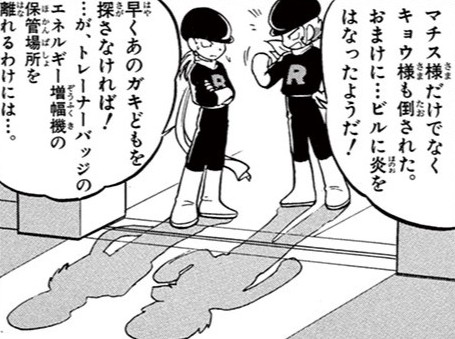
After infiltrating a Team Rocket hideout, Red, Green, and Blue take on the various Gym Leaders inside, including Machisu, Natsume, and Kyou. A couple of Team Rocket grunts discuss the fallout.
- したっぱ 1:
- 「マチス様だけでなくキョウ様も倒された。 おまけに…ビルに炎をはなったようだ!」
- “Not only Master Machisu, but Master Kyou was defeated too. On top of that... it looks like they set fire to the building!”
- したっぱ 2:
- 「早くあのガキどもを探さなければ! …が、トレーナーバッジのエネルギー増幅器の保管場所を離れるわけには…。」
- “We have to find those brats quickly! ...But we cannot leave the place where the Trainer Badge energy amplifier is being stored...”
Red, Green, and Blue have broken into a Team Rocket hideout and are taking on the Gym Leaders inside. A grunt reports the result. マチス様 is Ⓐ, and キョウ様も adds Ⓑ, so the defeat isn’t limited to Machisu. Both share one predicate, 倒された, “were defeated”. おまけに then starts a new sentence with more bad news: it looks like the building has been set on fire.
Example 2 of 3: Care for not only Lou's face but also her body with 〜だけでなく〜も
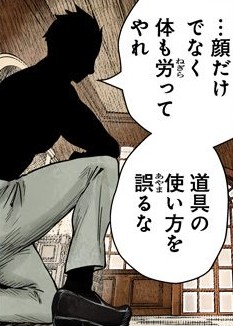
Benjamin suggests Louise do push-ups alongside Lou, her “Living Doll”. When Louise tires quickly, Benjamin tells her to care for Lou’s body as well as her face.
- ベンジャミン:
- 「顔だけでなく体も労ってやれ。」
- “Take care of not only her face but also her body.”
- 「道具の使い方を誤るな」
- “Don't misuse your tools.”
Benjamin has Louise do push-ups alongside Lou, her Living Doll, and Louise tires quickly. 顔 is Ⓐ, Lou’s face. 体も adds Ⓑ, her body. Both are what Louise should care for in 労ってやれ, a rough command. The next line, 道具の使い方を誤るな, warns her not to misuse her “tool”.
Example 3 of 3: They'll target not just me with 〜だけじゃなく〜も
In casual speech, では becomes じゃ, so the pattern appears as だけじゃなく.
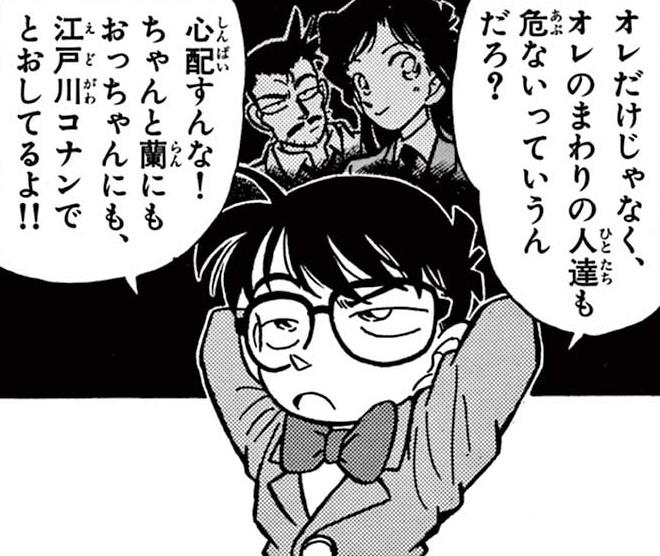
After Shin’ichi was forced to take a deadly drug that instead shrank him back to a child, he took on the undercover name Conan and went to stay with his childhood friend Ran and her detective father in the hope of a lead to the black-clad men who drugged him. He later discusses with Professor Agasa about how useless Detective Mouri is. The professor reminds Conan that the poison was supposed to have killed him, so he can’t rush and let others know his true identity.
- コナン:
- 「オレだけじゃなく、オレのまわりの人達も危ないっていうんだろ?」
- “You're saying it won't be just me, but the people around me will be in danger too, right?”
- 「心配すんな!ちゃんと蘭にもおっちゃんにも、江戸川コナンでとおしてるよ!!」
- “Don't worry! I'm keeping up the Conan Edogawa act with Ran and the old man, too!!”
Professor Agasa has reminded Conan that the poison was supposed to kill him, so he can’t let anyone learn who he really is. オレ is Ⓐ, and オレのまわりの人達も adds Ⓑ: if his identity gets out, the danger won’t stop with him. っていうんだろ? checks that this is what Agasa means.
Particle Placement
が and を usually drop out of this pattern, as in 顔だけでなく体も. Other particles, such as から, に, and と, can stay with the noun before だけでなく, and the matching particle then appears again with も. The first one is often left off, though, as in 子どもだけでなく大人にも.
- ⒶからだけでなくⒷからも: not only from Ⓐ, but from Ⓑ too
- ⒶにだけでなくⒷにも: not only to/at Ⓐ, but to/at Ⓑ too
- ⒶとだけでなくⒷとも: not only with Ⓐ, but with Ⓑ too
This pattern can be easier to parse if you look for a matching pair rather than translating word by word.
Similar Expressions
〜ばかりで(は)なく〜も is very close in meaning and is often used for the same “not only Ⓐ but also Ⓑ” idea. It can sound a little more emphatic or formal than plain だけでなく.
Do not confuse だけじゃなくて〜も with だけじゃなくても. だけじゃなくて〜も adds a specific Ⓑ item. だけじゃなくても often means that “only Ⓐ” is not required, as in “it does not have to be just Ⓐ.”
Sentence-level adders such as それに, さらに, and しかも also add information, but they usually connect whole statements. 〜だけで(は)なく〜も works inside a sentence by pairing Ⓐ and Ⓑ directly.
Further Reading
- だけでなく (JLPT N4) (bunpro.jp)
- だけ for "Only" (tofugu.com)
- N3文法 ~だけでなくて/だけじゃなくて (mainichi-nonbiri.com)
Related Grammar
- Limiting with 〜だけ
- 〜だけ marks a limit; 〜だけで(は)なく removes that limit and adds another thing.
- Not limited to just this with 〜だけじゃなくても
- 〜だけじゃなくても often means that something does not have to be limited to only Ⓐ, rather than adding one specific Ⓑ.
- Completely opposite to with 〜どころか
- 〜どころか is not simple addition; it often rejects Ⓐ and says the reality is much stronger or opposite.