Ongoing actions and resulting states with 〜ている
Grammar: Time and Sequence » 〜ている
〜ている combines a verb’s て-form with いる. It can describe an action in progress , a state left by a change , or a habit or repeated action .
English “be doing” covers only the first meaning. The verb and context determine the translation: 「読( よ ) んでいる」 means “is reading”, 「窓( まど ) が開( あ ) いている」 means “the window is open”, and 「東京( とうきょう ) に住( す ) んでいる」 means “lives in Tokyo”.
Usage Notes
Add いる to the て-form of a verb. If the て-form ends in で, the result is 〜でいる: 読( よ ) む → 読( よ ) んでいる.
With an activity such as 読( よ ) む or 走( はし ) る, 〜ている says that the activity is underway. With a change such as 開( あ ) く, 結婚( けっこん ) する, or 死( し ) ぬ, it may describe the state after the change. Time expressions such as 今( いま ) , 毎日( まいにち ) , and もう often make the intended meaning clear.
Speakers drop the い in casual conversation: 〜ている → 〜てる and 〜でいる → 〜でる.
Always write this use of いる in kana.
Formation
View formation details
Verb (て-form) + いる
妹( いもうと ) はマンガを読( よ ) んでいる "My sister is reading manga."
〜ています (polite)
父( ちち ) は銀行( ぎんこう ) で働( はたら ) いています "My father work s at a bank."
〜ていた (past)
電話( でんわ ) が来( き ) たとき、寝( ね ) ていた "I was sleep ing when the call came."
〜ていない・〜ていません (negative)
まだ昼( ひる ) ご飯( はん ) を食( た ) べていない
"I haven't eaten lunch yet."
Note: With まだ, the negative often means that an expected action has not happened yet.
〜ている → 〜てる (casual contraction)
何( なに ) 見( み ) てる の?"What are you look ing at?"
〜でいる → 〜でる (casual contraction)
今( いま ) 、マンガを読( よ ) んでる "I'm read ing manga now."
Choosing the Meaning
The kind of verb is usually the best clue.
Verb type
Example
Usual reading
Activity
走( はし ) っているis running
Change
窓( まど ) が開( あ ) いているthe window is open
Repeated action
毎日( まいにち ) 走( はし ) っているruns every day
Continuing situation
東京( とうきょう ) に住( す ) んでいるlives in Tokyo
Context can change the reading. 「パンを焼( や ) いている」 describes someone in the middle of baking bread. 「パンが焼( や ) けている」 says that the bread is baked.
An Action in Progress
Activity verbs use 〜ている for something happening at the time being discussed.
にじいろフォトグラフ »
Volume 1 » Page 80
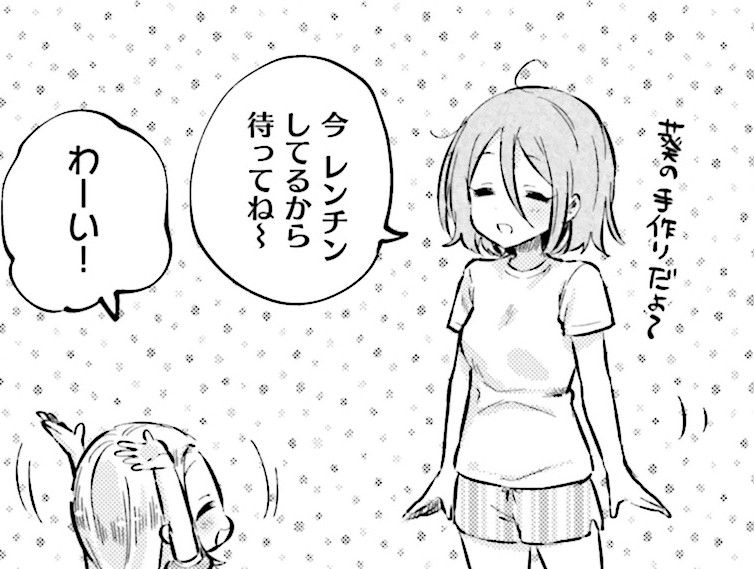
Satsuki is left to watch Sara for the day. As the afternoon arrives, Satsuki discovers their lunch had already been prepared and placed the refrigerator, with a note saying to heat it and eat it.
皐( さつき ) :「今( いま ) レンチンしてる から待( ま ) ってね〜」
“The food's heating up right now, so wait a bit, okay?”
サラ:
「わーい!」
“Yay!”
Challenge Yourself
Show translation
Challenge
Why does Satsuki ask Sara to wait?
Clues
今( いま ) レンチンしてるshe is microwaving the food right now
から
marks the first clause as the reason for her request
What does the speaker mean?
Because she is microwaving lunch right now.
今( いま ) and レンチンしてる show that the food is currently heating in the microwave.
Because lunch still needs to be prepared from scratch.
レンチンしてる says the food is already being heated. It does not say Satsuki still needs to cook the meal from the beginning.
Because the food needs to cool down before she heats it.
The food is heating now, so Satsuki is asking Sara to wait for that process to finish.
Because Sara needs to put the lunch in the microwave.
Satsuki describes the microwaving as already in progress. She is not asking Sara to start it.
Because the microwave has stopped working.
レンチンしてる describes normal microwave heating. The line gives no sign that the appliance has failed.
Because Satsuki is waiting for instructions about the lunch.
The reason marked by から is that the food is heating, not that Satsuki needs more instructions.
Satsuki says the lunch is in the microwave now, so Sara needs to wait for it to finish heating. The casual してる marks the action in progress, and から connects it to the gentle request 待( ま ) ってね.
View Full Example
Satsuki says レンチンしてる while the food is heating. The contracted してる expands to している.
美少女戦士セーラームーン »
Volume 8 » Page 58
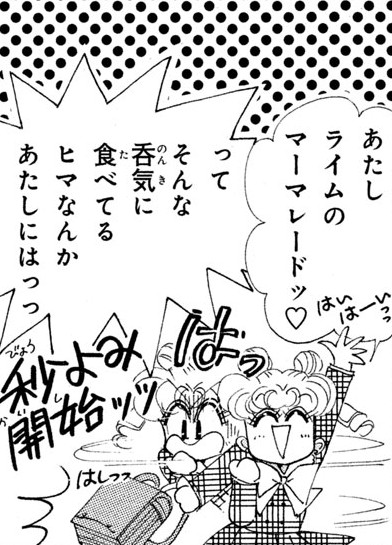
After an enemy attack changes Usagi and Mamoru into kids, Usagi wakes to find the two of them living together as a couple.
As Usagi wanders into the dining room, Mamoru is placing a plate of french toast on the table. He greets her and asks Usagi what type of jam she wants on her toast.
Usagi responds, then realizes she needs to get to school.
うさぎ:
「あたし ライムのマーマレードッ」
“I'll have lime marmalade!”
「ってそんな呑気( のんき ) に食( た ) べてる ヒマなんかあたしにはっっ」
“Ah, I don't have any time to be leisurely eating!”
Challenge Yourself
Show translation
Challenge
Why does Usagi reject the idea of sitting down to eat?
Clues
ってそんな呑気( のんき ) に食( た ) べてる
she interrupts her own order and pictures herself eating without concern
ヒマなんかあたしには
she realizes that she has no time to spare
What does the speaker mean?
She realizes she has no time to eat leisurely before school.
呑気に食べてる describes relaxed eating, while ヒマなんかあたしには emphatically rejects having time for it.
She decides that she no longer likes lime marmalade.
Usagi first chooses lime marmalade, then objects to spending time eating. She does not change her preference.
She thinks Mamoru has made breakfast too quickly.
Her concern is her own lack of time, not the speed at which Mamoru prepared the food.
She wants to eat slowly because school has been canceled.
The urgency comes from needing to get to school, so she says she cannot eat in a carefree way.
She is waiting for Mamoru to choose a different jam.
Usagi has already answered the jam question. Her interruption comes from remembering the time.
She refuses because children are not allowed to eat french toast.
Nothing in the line forbids the food. She rejects the time it would take to sit and eat leisurely.
Usagi answers the jam question, then abruptly remembers that she needs to get to school. 呑気に食べてる describes the relaxed meal she cannot afford, and ヒマなんかあたしには rejects the idea that she has spare time.
View Full Example
食( た ) べてる is the casual form of 食( た ) べている. Eating would take time, and Usagi says she has none to spare.
ご注文はうさぎですか? »
Volume 1 » Page 13
After Chino shows Cocoa to the changing room, Chino goes to get Cocoa’s uniform. Left alone, Cocoa gets a feeling otherwise.
ココア:
「あれ… 誰( だれ ) もいないはずなのに誰( だれ ) かに見( み ) られている ような」
“Huh? Even though nobody should be here, it feels like I'm being watched by someone.”
Challenge Yourself
Show translation
Challenge
What does ココア mean in the highlighted line?
Clues
見( み ) られている見( み ) られている means Cocoa is being watched
What does the speaker mean?
Huh? Even though nobody should be here, it feels like I'm being watched by someone.
見( み ) る becomes 見( み ) られる in the receptive, so Cocoa is not doing the watching. She is receiving someone else's gaze.
Cocoa says she is secretly watching someone else.
The highlighted form is 見( み ) られている. Here 見( み ) られている means Cocoa is being watched, so this choice does not match the Japanese.
Cocoa identifies the person watching her with certainty.
The highlighted form is 見( み ) られている. Here 見( み ) られている means Cocoa is being watched, so this choice does not match the Japanese.
Cocoa says she feels no gaze because the room is empty.
The highlighted form is 見( み ) られている. Here 見( み ) られている means Cocoa is being watched, so this choice does not match the Japanese.
見( み ) られている means Cocoa is being watched. 見( み ) る becomes 見( み ) られる in the receptive, so Cocoa is not doing the watching. She is receiving someone else’s gaze.
View Full Example
見( み ) られている combines the receptive form 見( み ) られる with 〜ている. Cocoa feels that is being watched by someone at that moment.
A Resulting State
Some verbs describe a change with a clear endpoint. With these verbs, 〜ている often describes the state afterward:
結婚( けっこん ) している: is marriedドアが閉( し ) まっている: the door is closed
その人( ひと ) を知( し ) っている: knows that person
知( し ) る means to learn or come to know. 知( し ) っている describes the state after gaining that knowledge, so it translates as “know”.
好きな子がめがねを忘れた »
Volume 5 » Page 56
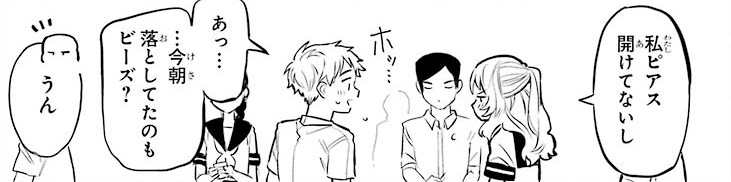
Komura sees Mie pick up an item she dropped and he wonders if it’s an earring. During class later, Mie shows Komura the item held up to her ear calling it a 「ピアス」. She then reveals it’s just a bead.
三重( みえ ) :「私( わたし ) ピアス開( あ ) けてない し」
“Since I don't have my ears pierced.”
小村( こむら ) :「あっ… …今朝( けさ ) 落( お ) としてたのもビーズ?」
“Ah, the item you dropped this morning was a bead?”
三重( みえ ) :「うん」
“Mmhm.”
Challenge Yourself
Show translation
Challenge
What does Mie reveal about the item Komura thought was an earring?
Clues
私( わたし ) ピアス開( あ ) けてないしI do not have my ears pierced
今朝( けさ ) 落( お ) としてたのもビーズ? うんthe item dropped this morning was also a bead, yes
What does the speaker mean?
It was a bead, and she does not have pierced ears.
Mie confirms ビーズ and explains that she has not opened piercing holes.
It was a pierced earring that she wears every day.
開( あ ) けてない says that she does not have pierced ears.
It was an earring that belonged to Komura.
Mie identifies the dropped object as her bead, not Komura's jewelry.
It was a bead she planned to use for a piercing that morning.
She uses the bead to imitate an earring, but confirms that she has no piercing.
It was an earplug she lost during class.
The item is explicitly identified as ビーズ, a bead.
It was a clip-on earring rather than a pierced one.
Komura's assumption is overturned when Mie reveals that the object is only a bead.
Mie confirms that the object was a bead, not an earring. She had only held it by her ear and explains that she does not have pierced ears.
View Full Example
ピアス開( あ ) けてない is casual ピアスを開( あ ) けていない. Mie is saying that her ears are not pierced.
あしたは土曜日 »
Volume 春・夏 » Page 36
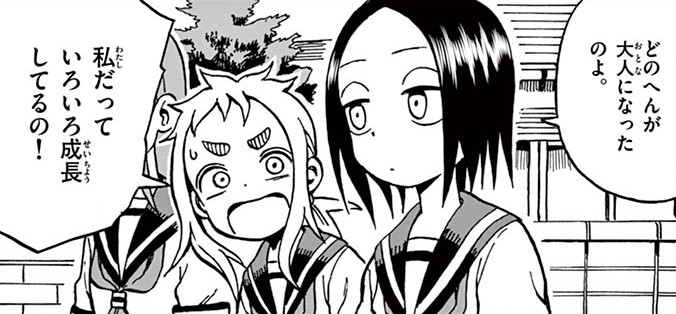
Mina buys a can of coffee, even though she’s bad at bitter drinks. When her friends question her, she says she’s grown up a bit and should be able to drink it.
サナエ:
「どのへんが大人( おとな ) になったのよ。」
“What part of you has grown up?”
ミナ:
「私( わたし ) だっていろいろ成長( せいちょう ) してる の!」
“I've grown in lots of ways!”
Challenge Yourself
Show translation
Challenge
How does Mina answer Sanae's challenge?
Clues
私( わたし ) だってeven I or me too
いろいろ
in various ways
成長( せいちょう ) してるhas grown or developed
〜の!
an emphatic, insistent ending
What does the speaker mean?
She insists that she has grown in many different ways.
私( わたし ) だって pushes back against Sanae, while いろいろ成長( せいちょう ) してる makes a broad claim about Mina's growth.
She says she has only grown taller.
いろいろ broadens the claim to various kinds of growth. Mina does not limit it to height.
She agrees that she has not grown up at all.
成長( せいちょう ) してる is a positive claim that her growth is already evident.
She claims that Sanae has become an adult.
私( わたし ) だって makes Mina herself the person whose growth is at issue.
She asks Sanae which part of her should change.
Sanae asks the question. Mina answers with an emphatic statement rather than another question.
She says drinking coffee is what made her grow.
The scene links coffee with Mina's attempt to act grown-up, but her line does not say coffee caused her 成長( せいちょう ) .
Mina defensively insists that even she has grown in various ways. The contracted してる presents that growth as a current result, and the final の adds force.
View Full Example
Here, 成長してる means “I’ve grown” or “I’ve developed”, not “I’m growing right now”.
とんがり帽子のアトリエ »
Volume 2 » Page 50
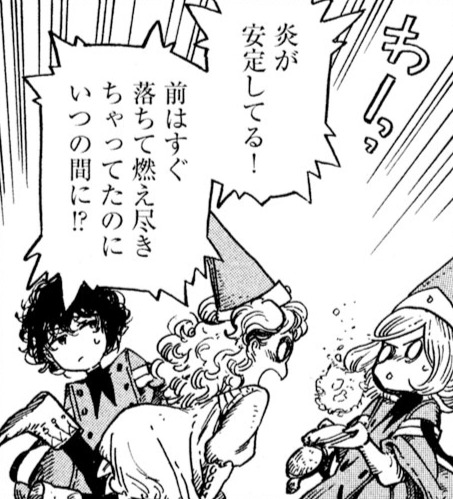
Coco and her friends are trapped in a maze and trying to find a way past a dragon. Seeing the others working out magic to use, Coco tries her hand at a spell, creating a flame. Agott isn’t impressed, but Tetia feels otherwise.
テティア:
「炎( ほのお ) が安定( あんてい ) してる !」
“The flame is stable!”
「前( まえ ) はすぐ落( お ) ちて燃( も ) え尽( つ ) きちゃってたのにいつの間( ま ) に!?」
“It used to go out and burn out right away, so when did this happen!?”
Challenge Yourself
Show translation
Challenge
Why is Tetia surprised by Coco's flame?
Clues
炎( ほのお ) が安定( あんてい ) してる!the flame is burning steadily now
前( まえ ) はすぐ落( お ) ちて燃( も ) え尽( つ ) きちゃってたのにcontrasts the current flame with earlier attempts that quickly fell and burned out
What does the speaker mean?
The flame is stable now, although Coco's earlier flames quickly burned out.
安定( あんてい ) してる describes the flame now, while 前( まえ ) は and のに contrast it with Coco's failed attempts before.
The flame used to be stable, but it has suddenly started burning out.
This reverses the timeline. 前( まえ ) は introduces the flames that burned out, and the current flame is stable.
The flame fell before Coco could make it burn steadily.
Falling and burning out describe Coco's earlier attempts. Tetia says the flame she sees now is stable.
Coco made the flame disappear as soon as Tetia noticed it.
すぐ belongs to the description of earlier flames. The current flame remains steady.
Tetia realizes that Agott created the stable flame instead of Coco.
The lines compare the current flame with Coco's previous results. They do not identify Agott as its creator.
Tetia wonders when the group moved away from the dragon.
いつの間( ま ) に asks when Coco's improvement happened, not when the group changed location.
Tetia sees that Coco’s flame is stable. That is a clear improvement because Coco’s earlier flames would fall and burn themselves out right away, so Tetia blurts out いつの間( ま ) に to ask when Coco became able to do this.
View Full Example
安定( あんてい ) してる describes the flame when Tetia sees it. It is burning steadily.
Habits and Repeated Actions
A frequency phrase such as 毎朝( まいあさ ) “every morning” can make 〜ている describe a habit. English usually uses the simple present for this meaning.
ご注文はうさぎですか? »
Volume 1 » Page 93
Rize and Cocoa watch as Chino seems to be telling a customer a fortune. Cocoa asks Rize what it was about.
リゼ:
「コーヒー占( うらな ) いだよ」
“It's coffee fortune-telling.”
「頼( たの ) まれたらやってる けどチノの占( うらな ) いよく当( あ ) たるんだ」
“I do it when I receive a request to, but Chino's fortunes are usually accurate.”
Challenge Yourself
Show translation
Challenge
Which interpretation best matches the highlighted line?
Clues
頼( たの ) まれたら頼( たの ) まれたら means when someone asks her
What does the speaker mean?
I perform coffee fortune-telling when someone asks, and Chino's fortunes are usually accurate.
Rize is the omitted recipient of a request. The person making each request remains unspecified.
Rize says she refuses every request for coffee fortune-telling.
The highlighted form is 頼( たの ) まれたら. Here 頼( たの ) まれたら means when someone asks her, so this choice does not match the Japanese.
Rize says Chino performs fortunes only when Rize asks her.
The highlighted form is 頼( たの ) まれたら. Here 頼( たの ) まれたら means when someone asks her, so this choice does not match the Japanese.
Rize says the requested fortunes are usually inaccurate.
The highlighted form is 頼( たの ) まれたら. Here 頼( たの ) まれたら means when someone asks her, so this choice does not match the Japanese.
頼( たの ) まれたら means when someone asks her. Rize is the omitted recipient of a request. The person making each request remains unspecified.
View Full Example
頼( たの ) まれたらやってる says that Rize does fortune-telling whenever someone asks. The conditional 頼( たの ) まれたら makes the repeated occasion clear.
三ツ星カラーズ »
Volume 1 » Page 11
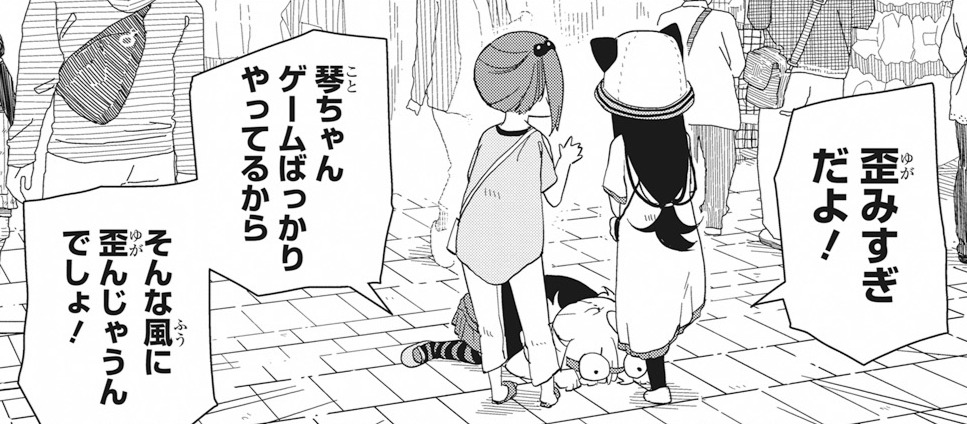
Sacchan tries crawling on the ground to help find the cat that’s been stealing from the area lately. Kotoha takes this opportunity to step on Sacchan’s head.
さっちゃん:
「歪( ゆが ) みすぎだよ!」
“You're way too twisted!”
「琴( こと ) ちゃんゲームばっかりやってる からそんな風( ふう ) に歪( ゆが ) んじゃうんでしょ!」
“It's 'cause you only ever play video games, Koto-chan, that's why you've gotten all warped like that!”
Challenge Yourself
Show translation
Challenge
Why does Sacchan say Kotoha has become so twisted?
Clues
ゲームばっかりやってるから
because she does nothing but play video games
そんな風( ふう ) に歪( ゆが ) んじゃうんでしょ
that is why she ends up warped like that, right
What does the speaker mean?
She spends all her time playing video games.
ゲームばっかり means nothing but games, and から marks that habit as Sacchan's blamed cause.
She stopped playing games before she learned the rules.
やってる describes an ongoing habit, not something Kotoha stopped doing.
She lets Sacchan win every game they play.
The line says only that Kotoha plays games constantly. It says nothing about letting Sacchan win.
She has been crawling on the ground like Sacchan.
Sacchan blames games for Kotoha's attitude after Kotoha steps on her.
Her games have physically bent out of shape.
歪( ゆが ) んじゃう describes how Kotoha has supposedly turned out, not the condition of the games.
She is upset because her game is too difficult.
Sacchan criticizes Kotoha's general behavior. The line does not mention difficulty or frustration with a game.
Sacchan blames Kotoha’s twisted behavior on playing nothing but video games. 歪( ゆが ) んじゃう is the casual contraction of 歪( ゆが ) んでしまう and presents that state as an unfortunate result.
View Full Example
ゲームばっかりやってる describes Kotoha’s habit of playing video games. ばっかり suggests that she spends her time doing little else.
ふだつきのキョーコちゃん »
Volume 1 » Page 11
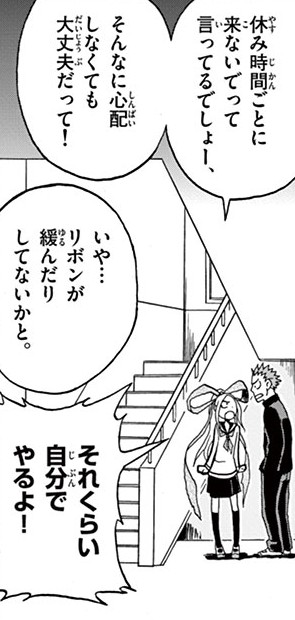
Due to concern about his sister’s ribbon, which seals away her need to attack people for their blood, Kenji takes every opportunity he can to check up on her in at school.
キョーコ:
「休( やす ) み時間( じかん ) ごとに来( こ ) ないでって言( い ) ってる でしょー、そんなに心配( しんぱい ) しなくても大丈夫( だいじょうぶ ) だって!」
“I'm telling you, you don't need to check up on me every break period. I'll be fine even without you worrying about me!”
ケンジ:
「いや… リボンが緩( ゆる ) んだりしてないかと。」
“No, I'm just checking whether your ribbon's come loose.”
キョーコ:
「それくらい自分( じぶん ) でやるよ!」
“I can handle that much on my own!”
Challenge Yourself
Show translation
Challenge
What does Kyouko want Kenji to stop doing?
Clues
休( やす ) み時間( じかん ) ごとに来( こ ) ないでdo not come to see her at every break
そんなに心配( しんぱい ) しなくても大丈夫( だいじょうぶ )
she will be fine without him worrying so much
What does the speaker mean?
Visiting her at every break to check the ribbon.
休( やす ) み時間( じかん ) ごとに means at every break, and 来( こ ) ないで tells Kenji not to keep coming.
Coming to school whenever the ribbon is loose.
Kenji worries that the ribbon might loosen, but Kyouko objects to his visits at every break, not emergency help.
Telling other students why she wears the ribbon.
The complaint concerns how often Kenji checks on her. She does not mention him revealing her secret.
Asking her to tighten the ribbon by herself.
Kyouko says she can handle that herself. Kenji is the one repeatedly coming to check it.
Worrying about her only after the school day ends.
Kyouko wants less constant worry. She does not ask him to move the same checks to after school.
Waiting until each break before returning to class.
ごとに marks repeated visits during every break, not a request to wait before going back to class.
Kyouko wants Kenji to stop checking on her during every break. He is worried that her ribbon might come loose, but she insists that she can manage it herself and will be fine without so much attention.
View Full Example
言ってる means “I keep telling you” here. Kenji visits every break, so Kyoko has to repeat the warning.
Continuing Situations
Verbs such as 住( す ) む “live”, 勤( つと ) める “work for”, and 通( かよ ) う “attend” use 〜ている for a situation that continues over time.
ぼくの魔なむすめ »
Volume 1 » Page 138
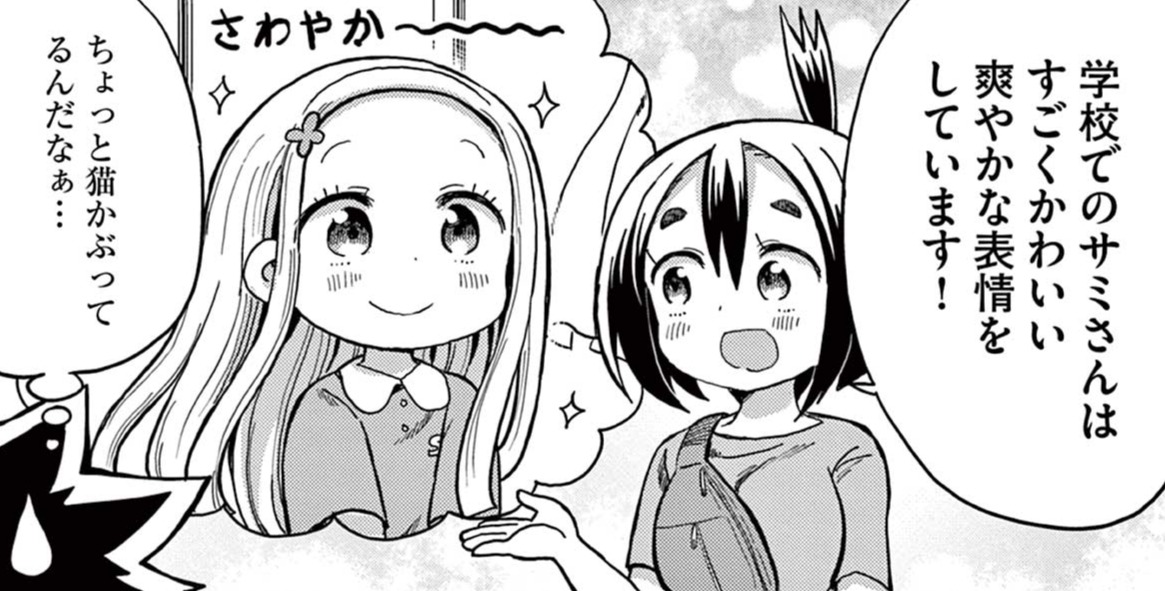
Sami and her father go to the park to play. There, they see Sami’s teacher. The teacher is surprised to see Sami’s rambunctious behavior, as it’s different from the Sami she sees at school.
先生( せんせい ) :「学校( がっこう ) でのサミさんはすごくかわいい爽( さわ ) やかな表情( ひょうじょう ) をしています!」
“At school, Sami has such a cute and delightful expression!”
パパ:
「ちょっと猫( ねこ ) かぶってる んだなぁ…」
“She's just putting on a front, isn't she...”
Challenge Yourself
Show translation
Challenge
How does Sami's father think of her different behavior at school?
Clues
学校( がっこう ) でのサミさんはすごくかわいい爽( さわ ) やかな表情( ひょうじょう ) her teacher sees a sweet, pleasant version of Sami at school
ちょっと猫( ねこ ) かぶってる
she is hiding her usual nature behind an innocent front
What does the speaker mean?
She puts on a sweet, well-behaved front at school.
猫( ねこ ) を被( かぶ ) る means to conceal one's usual nature by acting innocent or reserved.
Her teacher has confused her with another student.
The father accepts that the teacher is describing Sami. He thinks of the contrast as an act Sami maintains at school.
She becomes quiet because school makes her tired.
猫( ねこ ) かぶってる describes deliberate self-presentation, not fatigue.
She behaves more wildly at school than at the park.
The teacher sees Sami as sweet and pleasant at school. Her lively park behavior is the surprising side.
She is pretending to dislike her teacher.
The front concerns Sami's overall innocent demeanor, not a claim that she dislikes the teacher.
Her pleasant expression comes from playing with a cat.
猫( ねこ ) かぶってる is an idiom here. It does not refer to a real cat or explain her expression literally.
Sami’s father says that the calm, sweet child her teacher sees at school is only part of her usual personality. 猫( ねこ ) かぶってる means she acts innocent and well-behaved there, hiding her more rambunctious side.
View Full Example
猫( ねこ ) かぶってる says that Sami keeps up an innocent act at school. Her father is talking about her usual behavior there.
名探偵コナン »
Volume 26 » Page 131
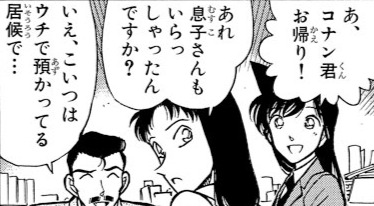
Conan returns home from school to the sound of a music box. When he opens the door, he finds Kogoro and Ran with a client.
欄( らん ) :「あ、コナン君( くん ) お帰( かえ ) り!」
“Ah, Conan, welcome back!”
春菜( はるな ) :「あれ 息子( むすこ ) さんもいらっしゃったんですか?」
“Oh? You have a son, too?”
小五郎( こごろ ) :「いえ、こいつはウチで預( あず ) かってる 居候( いそうろう ) で…」
“No, this kid's just a freeloader we're looking after...”
Challenge Yourself
Show translation
Challenge
How does Kogoro explain Conan's place in the household?
Clues
ウチで預( あず ) かってる
we are looking after him in our home
居候( いそうろう ) でhe is a freeloader or live-in dependent
What does the speaker mean?
He is a child they are looking after, not Kogoro's son.
Kogoro rejects the son assumption and calls Conan a 居候( いそうろう ) staying in their care.
He is Kogoro's biological son.
Kogoro begins with いえ to deny that assumption.
He owns the detective agency.
The line describes where Conan lives, not ownership of the business.
He is a client staying for one night.
預( あず ) かってる describes an ongoing arrangement in the household.
He works for the family as a servant.
居候( いそうろう ) describes a dependent resident, not an employee.
He is Haruna's missing child.
Haruna mistakes him for Kogoro's son, and Kogoro corrects her.
Kogoro says Conan is a child the family has taken in and bluntly calls him a 居候( いそうろう ) , not his son.
View Full Example
預( あず ) かってる says that the Mouri household is looking after Conan. They are still caring for him when Kogoro explains who he is.
それでも歩は寄せてくる »
Volume 6 » Page 4
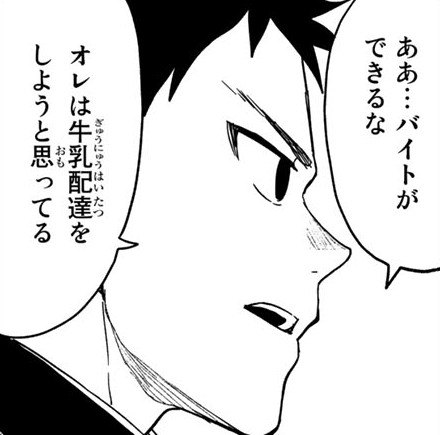
Takeru and Ayumu talk about now being in high school.
歩( あゆむ ) :「ああ…バイトができるな」
“Yeah, I can get a part-time job.”
「オレは牛乳( ぎゅうにゅう ) 配達( はいたつ ) をしようと思ってる 」
“I'm thinking of doing milk delivery.”
Challenge Yourself
Show translation
Challenge
What part-time job is Ayumu considering?
Clues
バイトができるな
"Now I can get a part-time job."
オレは牛乳( ぎゅうにゅう ) 配達( はいたつ ) をしようと思( おも ) ってる
"I am thinking of doing milk delivery."
What does the speaker mean?
Delivering milk.
牛乳( ぎゅうにゅう ) 配達( はいたつ ) names milk delivery, and しようと思( おも ) ってる marks it as Ayumu's current plan.
Working at a shogi shop.
Ayumu discusses part-time work, but the job he names is milk delivery.
Studying instead of taking a job.
バイトができるな shows that he is pleased he can now work part time.
Delivering newspapers with Takeru.
The item being delivered is 牛乳( ぎゅうにゅう ) , milk, and Ayumu frames it as his own plan.
Helping at the school cafeteria.
No cafeteria appears in the line. The stated work is 牛乳( ぎゅうにゅう ) 配達( はいたつ ) .
Starting the job immediately that day.
しようと思( おも ) ってる describes an intention under consideration, not an immediate start.
Ayumu says he can now take a part-time job and follows with 牛乳( ぎゅうにゅう ) 配達( はいたつ ) をしようと思( おも ) ってる. He is thinking of delivering milk.
View Full Example
しようと思( おも ) ってる uses casual 思( おも ) っている for a current intention. Ayumu still plans to deliver milk.
The plain nonpast form presents an action as a whole and can refer to a future or recurring event. 〜ている describes an action already underway or a state that already holds.
Japanese
Reading
今( いま ) から本( ほん ) を読( よ ) む。I’ll read the book now.
今( いま ) 、本( ほん ) を読( よ ) んでいる。I’m reading the book now.
毎週( まいしゅう ) この雑誌( ざっし ) を読( よ ) む。I read this magazine every week.
最近( さいきん ) 、この雑誌( ざっし ) を読( よ ) んでいる。I’ve been reading this magazine these days.
Supplemental Examples
Try finding this grammar in the following examples:


高木さん/thumbnail/からかい上手の(元)高木さん-volume-15-page-36-panel-2.jpg)