Past tense with 〜た・〜だ
Grammar: Time and Sequence » 〜た・〜だ
〜た commonly reports a past event: 読んだ “read”, 行った “went”. Depending on the verb and context, it can also present an action as already completed.
The name “past tense” does not cover every use. 疲れた can mean “I’m tired”, and あった! can mean “there it is!” Other patterns use the た-form for future or hypothetical situations.
Usage Notes
た attaches with exactly the same sound changes as the て-form: wherever a verb takes て, swap in た; wherever で, swap だ. Master one and you have the other.
い-adjectives have their own past, かった (楽しかった “was fun”), and the copula becomes だった. Some common た-forms announce a result: やった! “we did it!”, 分かった “got it”, 決まった “it’s settled”.
Formation
View formation details
- Godan (replace final う・つ・る with った)
- 昨日、友達に会った
- "I met a friend yesterday."
- Godan (replace final む・ぶ・ぬ with んだ)
- この本はもう読んだ
- "I already read this book."
- Godan (く → いた/ぐ → いだ)
- 手紙を書いた
- "I wrote a letter."
- Note: 行く is the exception again, becoming 行った.
- Godan (す → した)
- 鍵を無くした
- "I lost my keys."
- Ichidan (drop る) + た
- 全部食べた
- "I ate it all."
- する → した、来る → 来た
- 電車が来たよ
- "The train has come."
- い-adjective (drop い) + かった
- 映画は面白かった
- "The movie was interesting."
- Noun / な-adjective + だった
- 昔はここが海だった
- "Long ago, this was the sea."
Something That Happened
The plain past reports an event from before the moment of speaking. It’s the default for telling what happened, in conversation and in narration alike.
- 昨日、駅で先生に会った。
- I ran into my teacher at the station yesterday.
In 休むと言った, “she said she’d rest”, 言った places the speaking in the past. The quoted 休む stays non-past: resting was still ahead when she said it.
Example 1 of 26: Scheduled to stay the night with 〜ことになっている
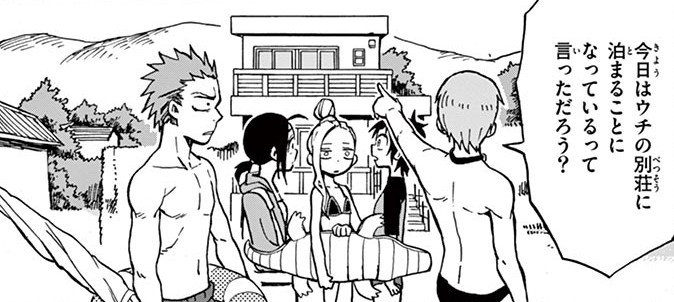
After a day playing at the beach, Hikari asks Shindou when someone is coming to pick everyone up. Shindou says it will be “tomorrow evening”.
- 神藤:
- 「今日はウチの別荘に泊まることになっているって言っただろう?」
- “Didn't I say we're scheduled to stay the night at my villa?”
After a day at the beach, Hikari asks when someone is coming to pick everyone up, and Shindou says tomorrow evening. 言っただろう? is “didn’t I tell you?” It checks something he already said. The plan inside the quote, 泊まることになっている, keeps its own non-past.
Example 2 of 26: Heating leftover pancakes with チンする

During Jumbo’s visit, Yotsuba tells him she made pancakes earlier.
- よつば:
- 「まだちょっとのこってる!チンしてたべるか!?」
- “There's some left over! Shall I heat it up to up to eat?”
- ジャンボ:
- 「おう。よつばが作ったんなら食べなきゃな」
- “Sure. If you made them, I have to eat some.”
Yotsuba made pancakes earlier and offers to heat up what’s left. Jumbo can’t say no. よつばが作ったんなら is “if Yotsuba made them”, with んなら as a casual のなら. The making is already done, so it takes た.
Example 3 of 26: Merely by shaking hands with 握手
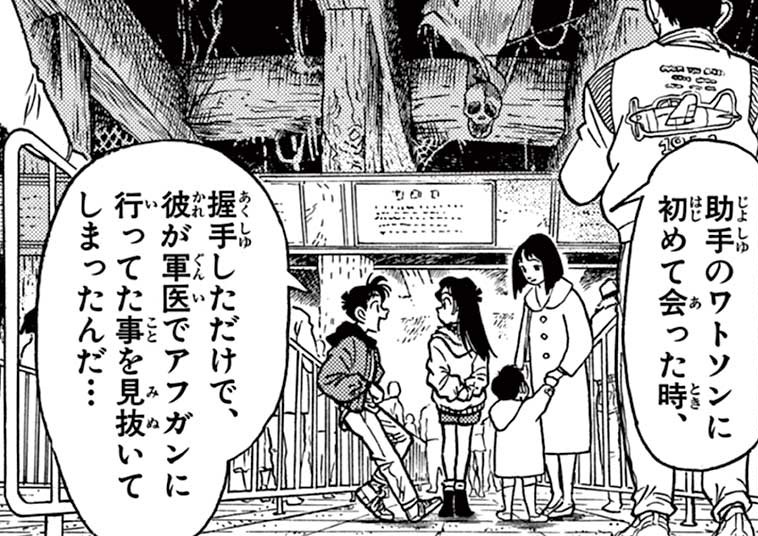
Shin’ichi treats Ran to a day at Tropical Land as a reward for winning the city karate tournament. As they wait in line for a ride on the roller coaster, Shin’ichi explains all the reasons why Sherlock Holmes was the greatest detective.
- 新一:
- 「助手のワトソンに初めて会った時、握手しただけで、彼が軍医でアフガンに行ってた事を見抜いてしまったんだ…」
- “The first time he met his assistant Watson, Holmes could tell just from a handshake that he was a military doctor who had been stationed in Afghanistan...”
Shin’ichi is telling Ran why Sherlock Holmes was the greatest detective. 初めて会った時 means “when he first met Watson” and frames their first encounter. The handshake is part of that meeting, so the line does not require the encounter to be over first. 握手しただけで says a handshake alone was enough for Holmes to work out Watson’s background.
Example 4 of 26: Expecting the residence to be around here with はず

Cocoa gets lost looking for the residence she’ll be staying at. She stops by at a café and speaks to the barista inside.
- ココア:
- 「道を聞くついでに休憩しようと思ったんだけど」
- “I was thinking of taking a break while I asked for directions.”
- 「香風さんちってこの近くのはずなんだけど知ってる?」
- “The Kafuu residence should be around here, but do you know of it?”
Cocoa got lost looking for the house where she’ll be living, and she has stepped into a café. 思う, “think”, becomes 思った. 〜ようと思った is “I thought I’d…”, a plan she made before walking in. んだけど leads into her real question: where is the Kafuu house?
Example 5 of 26: Lunch duty today of all days with 〜に限って
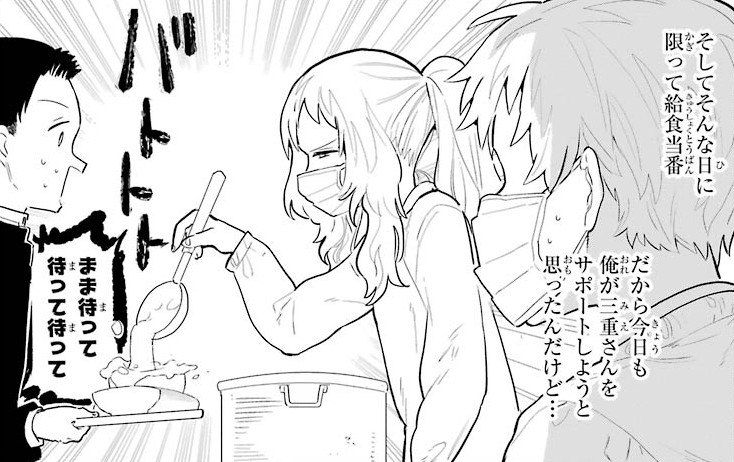
Komura and Mie have serving duty in the cafeteria. Normally this wouldn’t be an issue, except today Mie accidentally stepped on her glasses and broke them, and can barely see without them.
- 小村:
- 「そしてそんな日に限って給食当番」
- “Thus, on a day such as that (of all days), she has lunch duty.”
- 「だから今日も俺が三重さんをサポートしようと思ったんだけど…」
- “Therefore, I thought I'd support Mie today as well, but...”
- 男の子:
- 「まま待って待って待って」
- “W-w-wait, wait, wait!”
Mie stepped on her glasses this morning and can barely see, and today she’s on lunch duty. Komura had planned to help her again. 思ったんだけど, “I thought I would…, but”, reports the plan, and けど leaves it hanging, as if it’s about to go wrong.
Example 6 of 26: Corresponding letters of the alphabet with 相当
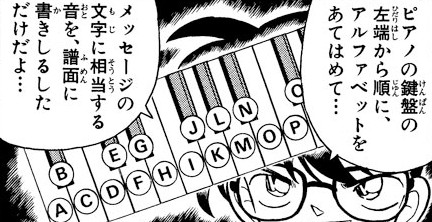
Following a series of murders, Conan discovers a message hidden in sheet music. He explains it to Ran.
- コナン:
- 「ピアノの鍵盤の左端から順に、アルファベットをあてはめて…」
- “Starting from the leftmost key on the piano keyboard, I assigned each key a letter...”
- 「メッセージの文字に相当する音を、譜面に書きしるしただけだよ…」
- “I simply wrote down the notes corresponding to the letters of the message on the sheet music...”
Conan has found a message hidden in a piece of sheet music, and he explains the code to Ran. Each piano key, counting from the far left, stands for a letter of the alphabet. 書きしるす means “write down”, and 書きしるした reports how the notes for the message got into the score. ただけ, “only did”, makes the trick sound simple.
Example 7 of 26: Hesitant to wear contacts with 抵抗
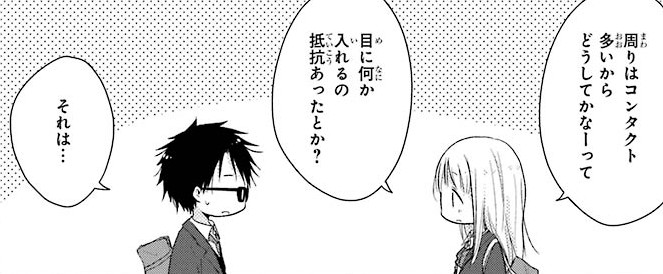
Seeing Shun again for the first time in seven years, Sana notices he’s now wearing glasses. She asks him why he doesn’t wear contacts.
- 紗奈:
- 「周りはコンタクト多いからどうしてかなーって」
- “Most people wear contacts, so I was kind of wondering why.”
- 「目に何か入れるの抵抗あったとか?」
- “Is it because you're hesitant with putting something in your eye?”
- 駿:
- 「それは…」
- “Well...”
Sana hasn’t seen Shun in seven years, and now he wears glasses. Most people their age wear contacts, so she asks why. 抵抗がある means “be reluctant”, with が dropped. あった is the past of ある. Sana tentatively asks whether he had reservations about putting something in his eye. とか makes this a suggested explanation, and the line does not specify when he felt that way.
Example 8 of 26: Craftman's efforts making glassware with 職人
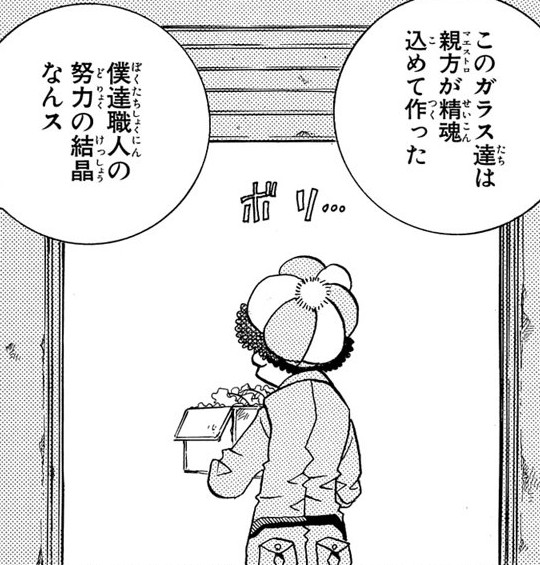
Akari picks up a box containing glassware items for her to transport. One of the employees from the shop making the glassware takes the box from her to place in her gondola. After he does this a second time, Akari says she can help carry the boxes, but he refuses.
- 職人:
- 「このガラス達は親方が精魂込めて作った」
- “These pieces of glass were made with the maestro's heart and soul poured into them.”
- 「僕達職人の努力の結晶なんス」
- “They're the crystallization of our craftsmen's efforts.”
Akari’s first job as an undine is carrying glassware for a workshop, and one of the craftsmen won’t let her carry the boxes. 精魂込めて means “pouring heart and soul into it”, and 作った says the maestro made these pieces. The next line calls them the fruit of all the craftsmen’s work, which is why he handles them himself.
Example 9 of 26: Skilled mirror maker with 職人
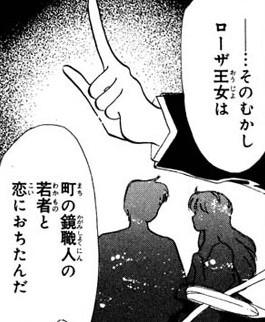
Following the theft of the Mirror of Queen Rosa, Sawatari writes an article for the school paper accusing Saint Tail. As Asuka Jr. demands proof from Sawatari, a notification appears from Saint Tail, announcing her intent to steal the stolen mirror. Later, Asuka Jr. goes to Sawatari to learn about the mirror’s backstory.
- 佐渡:
- 「そのむかしローザ王女は街の鏡職人の若者と恋におちたんだ」
- “Long ago, Princess Rosa fell in love with a young mirror maker from the town.”
Asuka Jr. asks Sawatari about the history of the stolen mirror. Sawatari tells it like a story: そのむかし, “long ago”, then the past 恋におちた, “fell in love”. んだ presents it as the explanation of where the mirror comes from.
Example 10 of 26: Koto lessons with 稽古
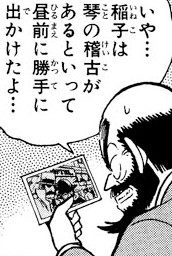
Hired to confirm whether a client’s wife is having an affair, Kogoro reveals a candid photo he took of the wife with another man. The client mentions he let his staff take a break so they wouldn’t know about Kogoro’s visit. Kogoro asks if that includes the client’s wife.
- 伝次郎:
- 「いや… 稲子は琴の稽古があるといって昼前に勝手に出かけたよ」
- “No... Ineko said she had a koto lesson and went out on her own before noon.”
Kogoro is checking whether a client’s wife is having an affair. The client sent his staff away for the day, and Kogoro asks about the wife. 出かけた, “went out”, reports what she did before noon. Her excuse, 琴の稽古がある, “I have a koto lesson”, stays in the non-past even though she said it earlier.
Example 11 of 26: Diving into the river with 飛びこむ
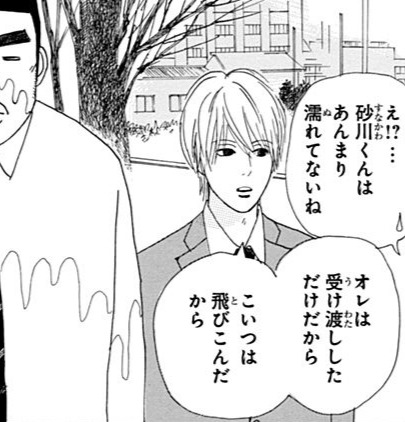
Takeo and Sunakawa meet Yamato at the park. Yamato sees that Takeo is soaked. Sunakawa explains that they saved a child from drowning.
- 大和:
- 「え!?… 砂川くんはあんまり濡れてないね」
- “Huh?!... You're not that wet, Sunakawa.”
- 砂川:
- 「オレは受け渡ししただけだから」
- “I just did the handoff, is all.”
- 「こいつは飛びこんだから」
- “This guy dived right in.”
Takeo and Sunakawa saved a drowning child, and Yamato notices that only Takeo is soaked. 飛びこむ ends in む, so its past is 飛びこんだ. In Sunakawa’s first line, した is the past of する: all he did was take the child from Takeo.
Example 12 of 26: Correcting a case of mistaken identity with 訂正
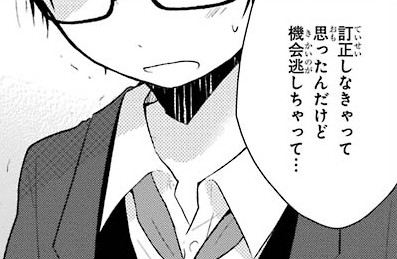
While Sana is away with her other friends for a moment, Ayumu leaves to use the restroom. Shun takes off his glasses to rub something from his eye, only for Sana to return and mistake him for Ayumu. He doesn’t correct her, but when Sana asks where Shun is, Shun says the restroom, and goes that way himself to wash his eye. In the restroom, Shun finds Ayumu and is about to explain what happened, but stops himself. Ayumu says it’s better not to hold back, and that Shun can say anything to him. Shun finally explains that Sana mistook him for Ayumu.
- 駿:
- 「訂正しなきゃって思ったんだけど機会逃しちゃって…」
- “I thought I should correct it, but I missed the chance…”
Sana mistook Shun for Ayumu, and he never set her straight. 〜なきゃって思った, “I thought I had to…”, is what went through his head at the time. けど turns to what actually happened: he missed his chance.
Example 13 of 26: Losing all that built-up friendship with 水の泡になる
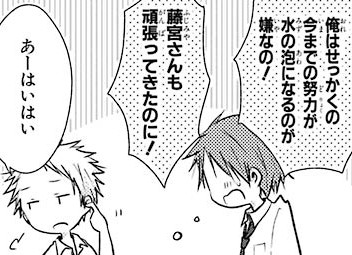
Although Fujimiya loses her memory of friends every Monday morning, she and Hase have become close enough that she feels comfortable around him when meeting him “for the first time” at school each Monday. Hase fears that progress will be lost during summer break.
- 長谷:
- 「俺はせっかくの今までの努力が水の泡になるのが嫌なの!」
- “I hate seeing all my hard work up to now go down the drain!”
- 「藤宮さんも頑張ってきたのに!」
- “Fujimiya-san has worked so hard, too!”
- 桐生:
- 「あーはいはい」
- “Yeah, got it.”
Fujimiya forgets her friends every Monday, and Hase is afraid summer break will undo all their progress. 〜てくる describes something carried on up to now, so 頑張ってきた is “has kept working hard”. The past marks the effort as already made, and のに protests that it could all go to waste.
Example 14 of 26: Being strict with oneself and one's student with 心を鬼にする
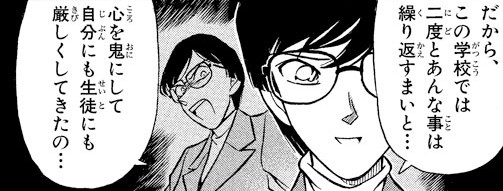
Conan’s classmates aren’t fond of their new teacher’s strict attitude. Ms. Kobayashi explains how at her last school, she couldn’t bring herself to be strict, and it allowed her students to get so out of control that students were injured in a fight.
- 小林:
- 「だから、この学校では二度とあんな事は繰り返すまいと…」
- “Therefore, to keep from repeating that kind of situation at this school...”
- 「心を鬼にして自分にも生徒にも厳しくしてきたの…」
- “I hardened my heart and became strict, with myself and with my students...”
Ms. Kobayashi’s new students think she’s too strict. At her last school, she was too soft, and her students got so out of hand that some were hurt in a fight. 厳しくしてきた, “have been strict”, covers her whole time at this school, up to now. The の at the end explains.
Example 15 of 26: Dazed by a wristwatch with 気が遠くなる
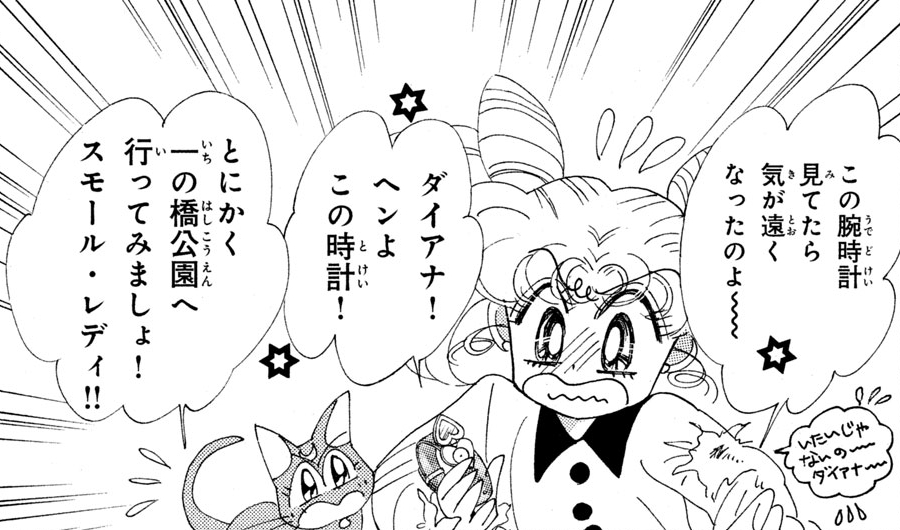
At the stroke of midnight, Chibiusa wakes to a mysterious glow from her new wristwatch. She gets out of bed in a daze, and begins to leave the room. Her cat, Diana, bites her on the arm, returning Chibiusa from her trance.
- ちびうさ:
- 「この腕時計見てたら気が遠くなったのよ〰〰」
- “While I was looking at this wristwatch, I became lightheaded〰”
- 「ダイアナ! ヘンよ この時計!」
- “Diana! Something is strange about this watch!”
- ダイアナ:
- 「とにかく 一の橋公園へ行ってみましょ! スモール・レディ!!」
- “Anyway, let's try going to Ichinohashi Park! Small Lady!!”
Chibiusa woke at midnight to her new watch glowing, wandered out of bed in a daze, and only snapped out of it when Diana bit her. 気が遠くなる means “feel faint”. 見てたら, “when I was looking”, sets up the moment, and 遠くなった reports what happened. のよ insists it’s true.
Example 16 of 26: A kidnapped daughter with 誘拐

At Professor Agasa’s request, Ran takes Conan home to see if her father will let him stay over for a while. When they reach Ran’s place, her detective father bursts out of the front door, saying he’s heading out on a job.
- 小五郎:
- 「さっき電話があったんだよ!!」
- “I just got a call!!”
- 「娘が黒ずくめの男に誘拐されたと、親から依頼が来た!!」
- “A request came from the parent, saying his daughter was kidnapped by a man dressed in all black!!”
- 「オレの力を借りたいってな!!」
- “He wants my help!!”
Ran brings Conan home, and her father, Kogoro, bursts out the door on his way to a job. さっき電話があった, “I got a call just now”, reports what happened, and the next line has more past forms: 誘拐された, “was kidnapped”, and 依頼が来た, “a request came”. 借りたい, “wants to borrow”, isn’t past. Its た belongs to たい.
Example 17 of 26: An accomplice in sharing lunch with 共犯
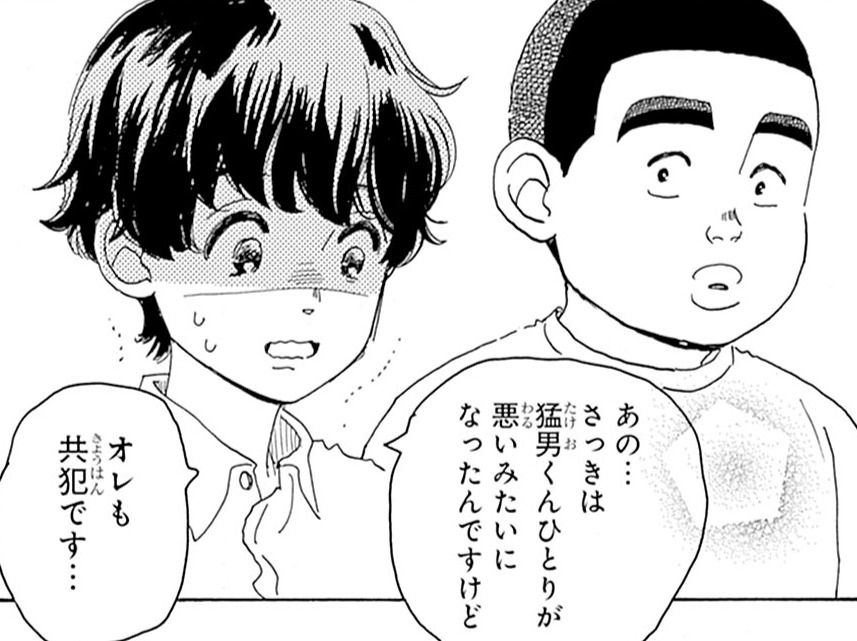
Yacchin eats little and dislikes many foods, so his friend Takeo helps by eating the parts of his lunch he doesn’t like. A teacher catches sight of this and yells at them not to give or take food from one another. When the coast is clear, Takeo continues, only to be sighted and punished by the teacher. Yacchin goes up to the teacher afterward.
- やっちん:
- 「あの… さっきは猛男くんひとりが悪いみたいになったんですけどオレも共犯です…」
- “Um... It seemed like Takeo was the only one at fault just now, but I was in on it too...”
Takeo was eating the parts of Yacchin’s lunch that Yacchin doesn’t like, and a teacher caught and punished Takeo alone. Yacchin goes to the teacher afterward. 悪いみたいになった is “it ended up looking like (Takeo) was to blame”. さっき, “just now”, places it, and the present 共犯です owns up now.
Example 18 of 26: Ate snacks with 食うた
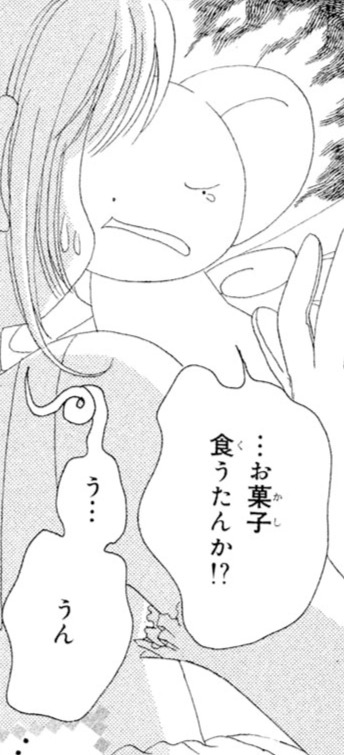
Kero joins Sakura at the spot where she sensed a Clow Card. Seeing Tomoyo and Li, Kero asks why Sakura called them first. Sakura explains she and Tomoyo had stopped by Li’s place, with Tomoyo adding that Sakura tried on a new outfit and they all had snacks.
- ケロ:
- 「…お菓子食うたんか!?」
- “…You ate snacks?!”
- 桜:
- 「う… うん」
- “Y... yeah.”
Kero finds out that Sakura and Tomoyo went to Li’s place first and had snacks there. 食うた is Kansai for 食った, the past of 食う, a rough word for “eat”. Kansai uses う where the standard past of verbs like this has っ. んか is the Kansai form of のか.
Example 19 of 26: Cause of incidents in the pool with 原因
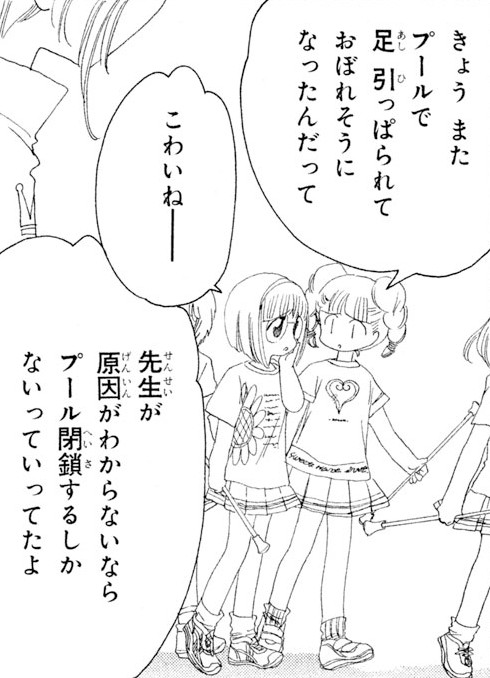
After cheerleading practice, Sakura overhears her friends talking about incidents at the school pool, where Sakura and Chiharu were among those mysteriously pulled underwater.
- 千春:
- 「きょう また プールで足 引っぱられておぼれそうになったんだって」
- “I heard that today, someone got dragged under the water at the pool and almost drowned again.”
- 奈緒子:
- 「こわいねーーー」
- “That's scary!”
- 千春:
- 「先生が原因がわからないならプール閉鎖するしかないっていってたよ」
- “The teacher said that if they can't figure out the cause, they'll have no choice but to close the pool.”
Something keeps pulling students under at the school pool, and Sakura overhears her friends talking about it. おぼれそうになった is “almost drowned”, and んだって marks it as something Chiharu heard. Her second line ends in いってた, from 言っていた, “the teacher was saying”.
Example 20 of 26: Had a bad experience in Nara with 〜目に遭う
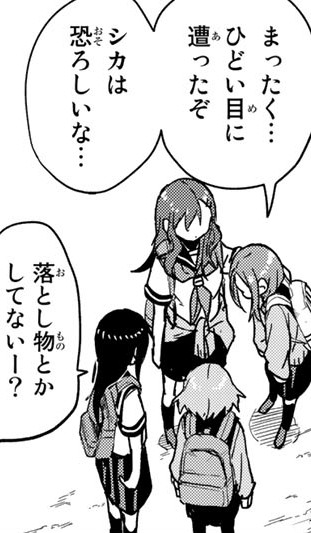
While in Nara on a class trip, Urushi and her friends stop to feed to deer. As the hungry animals completely surround Urushi, her friends discuss their schedule, ignoring Urushi’s plight. When Urushi finally returns to her group, she demands to know why no one came to her rescue.
- うるし:
- 「まったく… ひどい目に遭ったぞ」
- “Seriously… I had a terrible experience.”
- 「シカは恐ろしいな…」
- “Deer are scary…”
- ミク:
- 「落とし物とかしてないー?」
- “Did you drop anything?”
On a class trip to Nara, Urushi stopped to feed the deer, and they mobbed her while her friends calmly discussed the schedule. ひどい目に遭う is “have a terrible time”, and 遭った looks back on it now that she’s free. ぞ makes it a complaint.
Example 21 of 26: In another world with 異世界
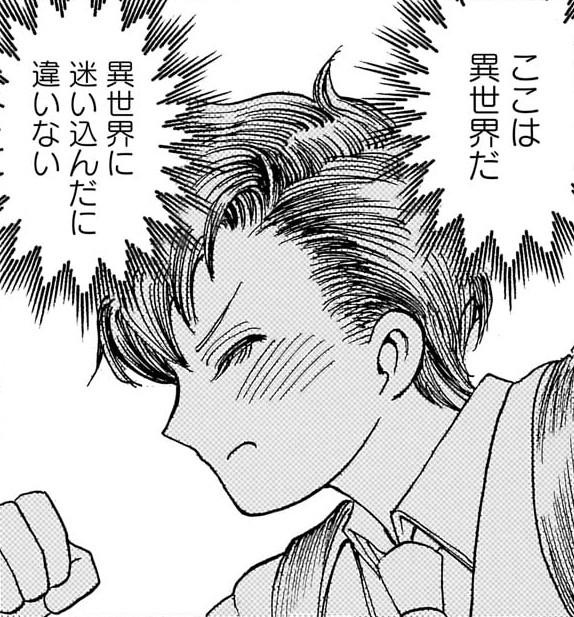
Zen lived in a glittering, idyllic town until his family moved. During his first day of school, he found everyone to be glaring and rugged. Rather than being gentle and playful, his classmates sought a brawl and chased after him.
- 禅:
- 「ここは異世界だ」
- “This is another world.”
- 「異世界に迷い込んだに違いない」
- “I must have wandered into another world.”
Zen’s family moved away from a peaceful, sparkling town, and on his first day at the new school, his classmates chased him, looking for a fight. 迷い込んだ is “wandered into”, and に違いない, “must have”, is his guess about how it happened. The wandering is past. The certainty is now.
Example 22 of 26: Not just Machisu, but also Kyou with 〜だけでなく〜も
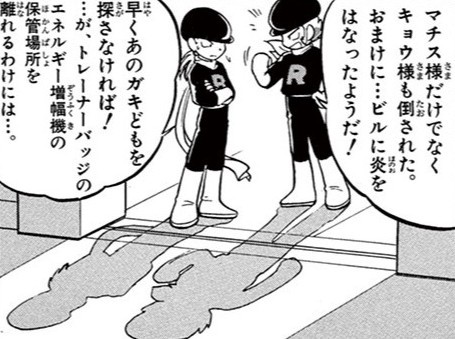
After infiltrating a Team Rocket hideout, Red, Green, and Blue take on the various Gym Leaders inside, including Machisu, Natsume, and Kyou. A couple of Team Rocket grunts discuss the fallout.
- したっぱ 1:
- 「マチス様だけでなくキョウ様も倒された。 おまけに…ビルに炎をはなったようだ!」
- “Not only Master Machisu, but Master Kyou was defeated too. On top of that... it looks like they set fire to the building!”
- したっぱ 2:
- 「早くあのガキどもを探さなければ! …が、トレーナーバッジのエネルギー増幅器の保管場所を離れるわけには…。」
- “We have to find those brats quickly! ...But we cannot leave the place where the Trainer Badge energy amplifier is being stored...”
Red, Green, and Blue have broken into a Team Rocket hideout and beaten the Gym Leaders there. Two grunts take stock. 倒された, “was defeated”, is a past passive, and はなったようだ, “it seems they set (fire)”, adds an inference to a past.
Example 23 of 26: Receiving a treating as with 〜れる

Cocoa wonders why it is that she didn’t like coffee before, but she’s crazy about the coffee Chino makes.
- チノ:
- 「でもココアさんは味の違いわからないじゃないですか」
- “But you don't know the difference in taste, right?”
- 「ただのカフェイン中毒ですよ」
- “That makes it just a caffeine addiction.”
- ココア:
- 「中毒扱いされた…」
- “I got treated like an addict...”
Cocoa loves the coffee Chino makes, though she never liked coffee before. Chino says she can’t tell the difference and is just hooked on caffeine. 中毒扱いされた, “I got treated like an addict”, reacts to what Chino has just said.
Example 24 of 26: Receiving saying with 〜れる

Cocoa takes a brief break from work to tell Chino something good that just happened.
- ココア:
- 「この前お客さんにココアちゃんはシスター・コンプレックスだねって言われちゃった」
- “Earlier, it was said by a customer that I have a sister complex.”
- チノ:
- 「え…」
- “Ah...”
- ココア:
- 「響きがかっこいいよね」
- “It sounds cool, doesn't it?”
Cocoa takes a break from work to tell Chino some news. この前, “the other day”, sets the time, and 言われちゃった is “I got told”: a customer said she has a sister complex. Cocoa is pleased, since it sounds cool to her.
Example 25 of 26: Sneaking sleeping pills in with 目を盗む

As Ran sleeps, she’s carried to a sink filled with water and almost drowned. After, Conan considers the coffee Ran drank earlier must have been drugged, or else Ran would have fought back. Since Mrs. Yone, who prepared the coffee with Ran’s help, was with Kogoro at the time of the attack, Kogoro narrows the list of suspects to four who were out of sight while the coffee was being prepared.
- 小五郎:
- 「という事は、あなた方の中の誰かが米さんと蘭の目を盗んで睡眠薬を入れたとも考えられますな?」
- “Considering that, isn't it possible one of you slipped past Mrs. Yone and Ran and put sleeping pills in?”
Someone nearly drowned Ran in her sleep, so the coffee she drank earlier must have been drugged. Kogoro narrows it down to four people who were out of sight while it was made. 睡眠薬を入れた is “put sleeping pills in”, and とも考えられます, “it could also be”, turns the past event into a theory.
Example 26 of 26: Told me not to come with と言う
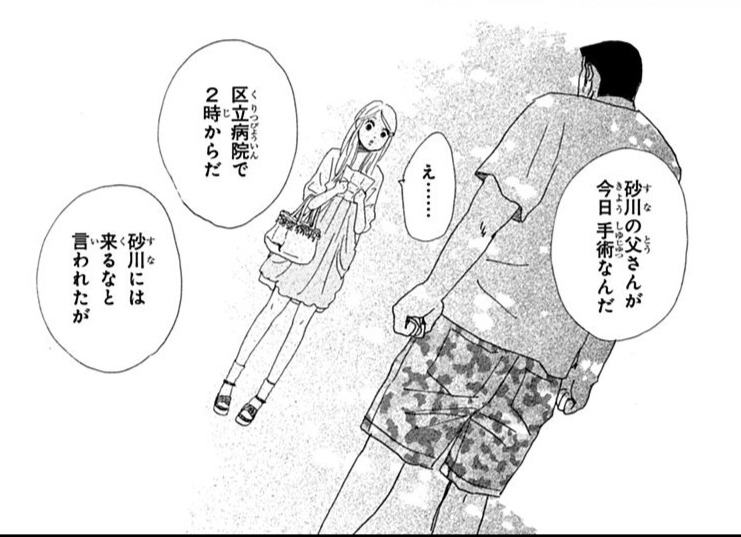
Takeo and Yamato go out on a date for Yamato’s birthday. They have a great time spending the day together, but when Yamato asks Takeo what his friend Sunakawa is doing, Takeo becomes silent. He says Suna helped him plan the date’s events, and Takeo gives her the tickets to the date’s finale. He tells Yamato to take a friend, because he needs to go be with Suna.
- 猛男:
- 「砂川の父さんが今日手術なんだ」
- “Suna's dad is having surgery today.”
- 大和:
- 「え……」
- “Eh......”
- 猛男:
- 「区立病院で2時からだ」
- “It's at the municipal hospital at 2 o'clock.”
- 猛男:
- 「砂川には来るなと言われたが」
- “Suna told me not to come, but...”
Takeo and Yamato are on a birthday date, but Sunakawa’s father is having surgery today, and Takeo gives Yamato the tickets for the finale so he can go to the hospital. 来るなと言われた is “I was told not to come”. The quote, 来るな, keeps its own form, and が, “but”, says he’s going anyway.
Ongoing Actions and States with 〜ていた
〜ていた is the past of 〜ている. It describes something that was going on, or a state that held, at some point in the past. Casual speech shortens it to 〜てた.
- 電話が鳴った時、寝ていた。
- I was asleep when the phone rang.
It also covers habits, the way English uses “used to”.
Example 1 of 11: Getting good grades in school with 成績

Yukari stops by the preschool where Mina works, just as Takagi is there picking up her daughter. Yukari compares her life with theirs.
- ユカリ:
- 「高木ちゃんは成績よくて しっかりしてたし、」
- “Takagi-chan got good grades and had it together.”
- 「ミナは料理が得意だったりするじゃない。」
- “And Mina's good at cooking and such, right?”
Grown-up Yukari runs into Mina and Takagi and compares her life with theirs. Looking back on school, she remembers Takagi as someone with good grades who had her act together. しっかりしてた is しっかりしていた: that’s how Takagi was all through those years. Mina’s 得意だったり is the たり form, which lists one thing among others. It looks past, but it’s about Mina now.
Example 2 of 11: A pretty clean room with 相当
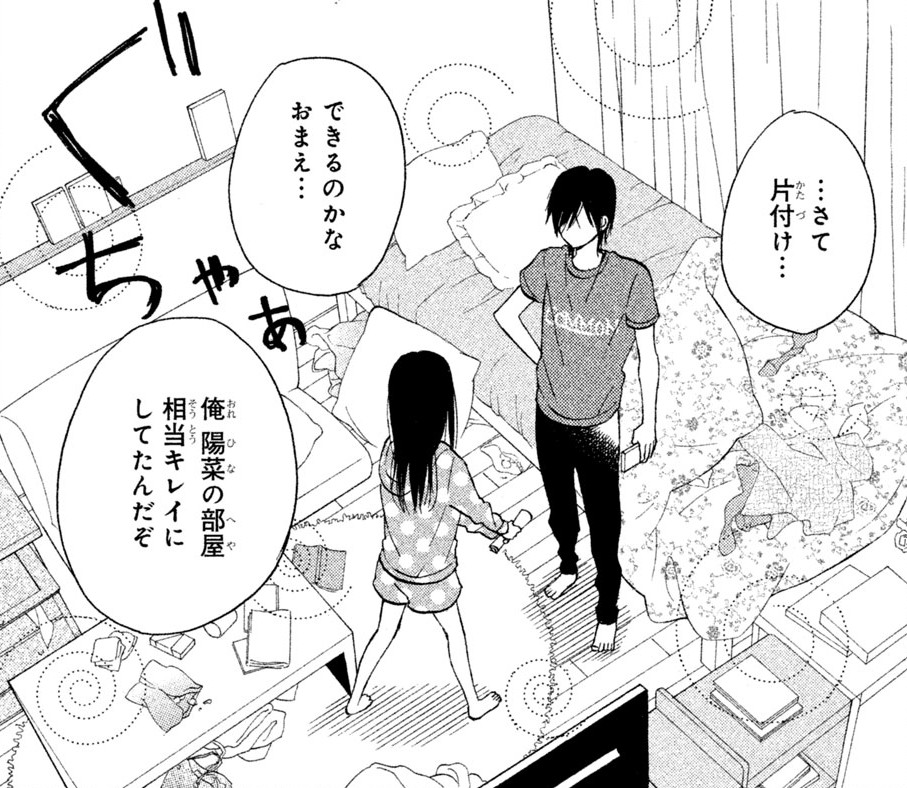
Hiro lets Mao move into his sister’s bedroom, as Hina is living with relatives. After, he comes up with a list of rules that Mao needs to follow if she’s to keep living there.
- 基:
- 「…さて 片付け…」
- “Now then, cleaning...”
- 「できるのかな おまえ…」
- “I wonder if you can do it.”
- 「俺 陽菜の部屋相当キレイにしてたんだぞ」
- “I kept Hina's room pretty clean, you know.”
Hiro has given Mao the room that belonged to his little sister, Hina, who lives with relatives now. キレイにする is “keep clean”, and キレイにしてた, from していた, says that’s how he kept the room the whole time. んだぞ warns Mao she has a standard to live up to.
Example 3 of 11: A stable flame with 安定
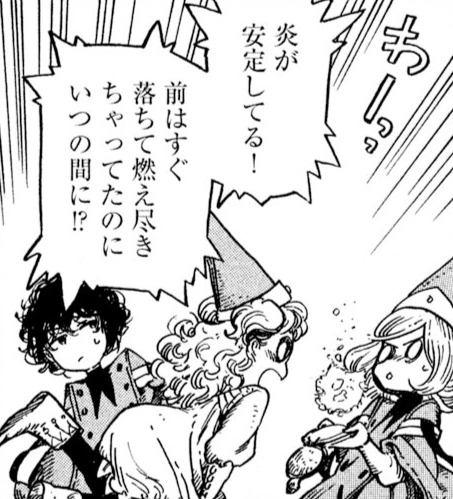
Coco and her friends are trapped in a maze and trying to find a way past a dragon. Seeing the others working out magic to use, Coco tries her hand at a spell, creating a flame. Agott isn’t impressed, but Tetia feels otherwise.
- テティア:
- 「炎が安定してる!」
- “The flame is stable!”
- 「前はすぐ落ちて燃え尽きちゃってたのにいつの間に!?」
- “It used to go out and burn out right away, so when did this happen!?”
Coco’s flame is holding steady, and Tetia remembers how it used to go. 燃え尽きちゃってた is 燃え尽きてしまっていた, shortened twice. 前は, “before”, and the contrast with her present flame make this a repeated past problem: “it used to burn out right away”. ていた describes that earlier situation.
Example 4 of 11: Interpretating dancing flower petals with 解釈
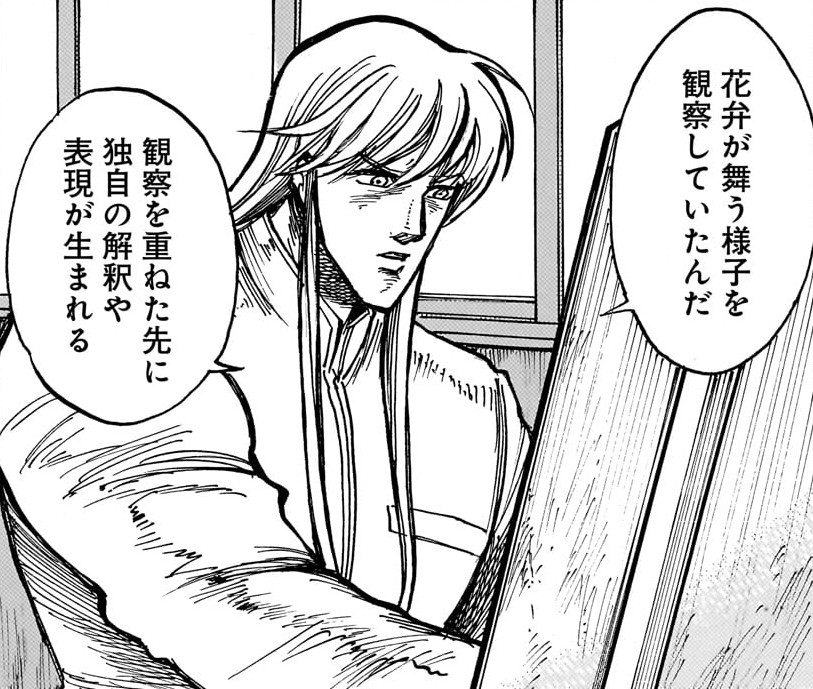
As she models for a sketch, Lulu recalls seeing Hideki blowing flower petals into the air. She brings it up to him.
- 秀樹:
- 「花弁が舞う様子を賢察していたんだ」
- “I was observing the petals as they danced.”
- 「観察を重ねた先に独自の解釈や表現が生まれる」
- “Through repeated observation, unique interpretations and expressions emerge.”
Lulu remembers seeing Hideki blow flower petals into the air, and she asks him about it. していた says what he was doing at that moment: watching how the petals dance. んだ explains. In the next line, 重ねた先に, “at the end of repeated (observation)”, puts た before a noun.
Example 5 of 11: Gotten completely lost in an abandoned building with 〜ちゃう
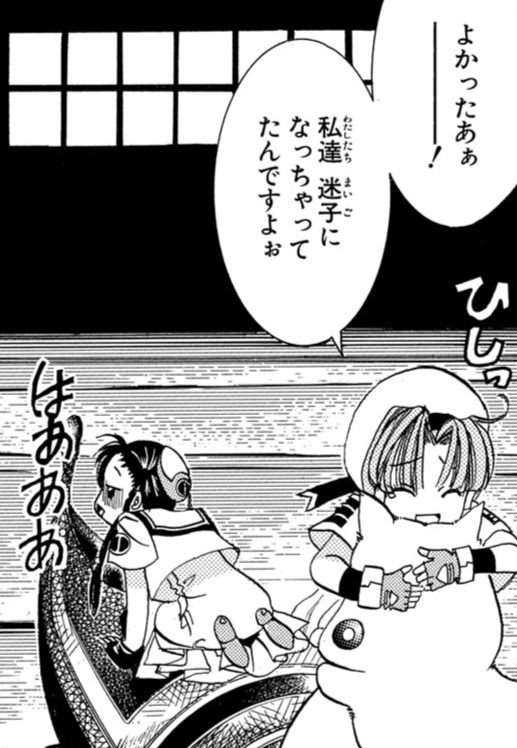
During training, Akari spots her company’s feline president, President Aria, sailing by in a small gondola. She instructs Aika to row the training gondola in the same direction, and the two follow him down an alley that’s normally gated from entry. The two lose sight of Aria and find themselves going in circles through flooded abandoned buildings. After some time, Aria’s gondola floats by.
- 灯里:
- 「よかったあぁーーーーー! 私達 迷子になっちゃってたんですよぉ」
- “Oh, thank goooodness! We had gotten completely lost, you know!”
Akari and Aika followed President Aria into a closed-off canal and lost him among flooded, abandoned buildings. When his gondola floats by again, Akari is overjoyed. 迷子になっちゃってた is 迷子になってしまっていた: they had gotten lost and had stayed lost. んです explains why she’s so relieved.
Example 6 of 11: Besides, it's just practice with それに〜
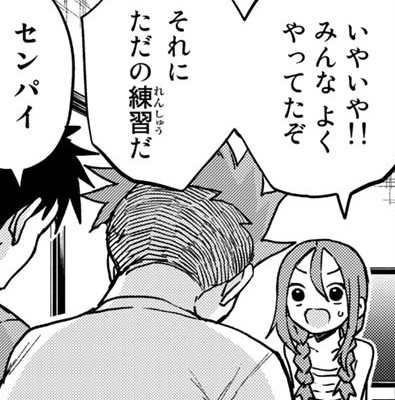
Urushi plays three shogi games at once against the other members of the shogi club. After she wins all three, she worries she has hurt their confidence right before the upcoming tournament.
- うるし:
- 「いやいや!!みんなよくやってたぞ」
- “No, no! You guys did great!”
- 「それにただの練習だ」
- “Besides, it's just practice.”
Urushi just played three club members at once and beat them all, and now she’s worried she crushed their confidence before the tournament. よくやってた is “you were doing well”, from やっていた, about the games just finished. それに, “besides”, adds a second comfort.
Example 7 of 11: Exploring the neighborhood with 探索
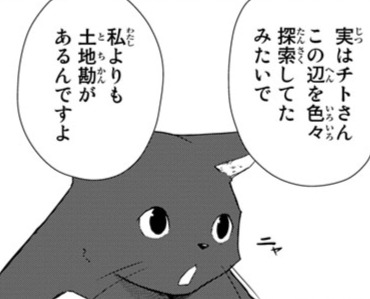
Not long after moving to a new town to stay with relatives, Makoto decides to head out for a walk. Her cousin is worried she’ll get lost. Makoto says not to worry, because she’ll have her witch familiar cat, Chito, with her.
- 真琴:
- 「実はチトさん この辺を色々探索してたみたいで私よりも土地勘があるんですよ」
- “Actually, Chito seems to have explored this area quite a bit, so she knows her way around better than I do.”
Makoto has just moved in with relatives and wants to go for a walk. Her cousin worries she’ll get lost, but she’ll have her cat, Chito, with her. 探索してた is 探索していた, “had been exploring”, something Chito did before today. みたい marks it as Makoto’s impression.
Example 8 of 11: Proportional to the degree of time passed with 〜ば〜ほど
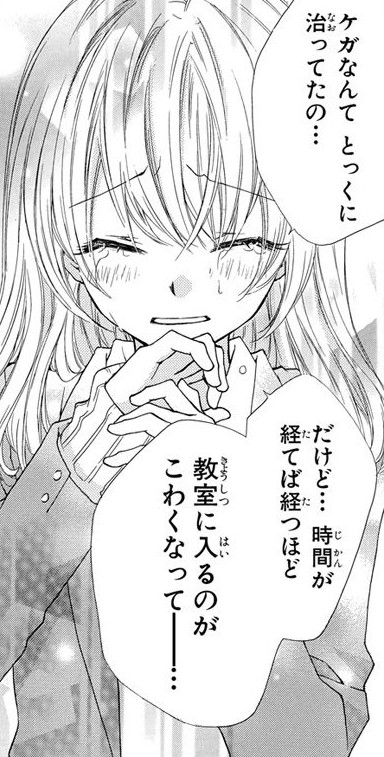
After a traffic accident sends Hiyori to the hospital, she misses the first few months of the school year. Once she’s finally able to attend, an embarrassing situation occurs, and she runs out of the classroom and hides. Yuushin tracks her down, and Hiyori tells him she should never have come to school.
- ひより:
- 「ケガなんて とっくに治ってたの…」
- “I'd already healed from my injuries.”
- 「だけど… 時間が経てば経つほど教室に入るのがこわくなってーー…」
- “But, the more time passed, the more scary it became to return to class.”
A traffic accident kept Hiyori out of school for the first months of the year. On her first day back, something embarrassing happens, and she runs off to hide. 治ってた is 治っていた, “had healed”, and とっくに, “long ago”, says her injuries were fine well before now. The next line explains why she stayed away.
Example 9 of 11: Strange behavior with 異様
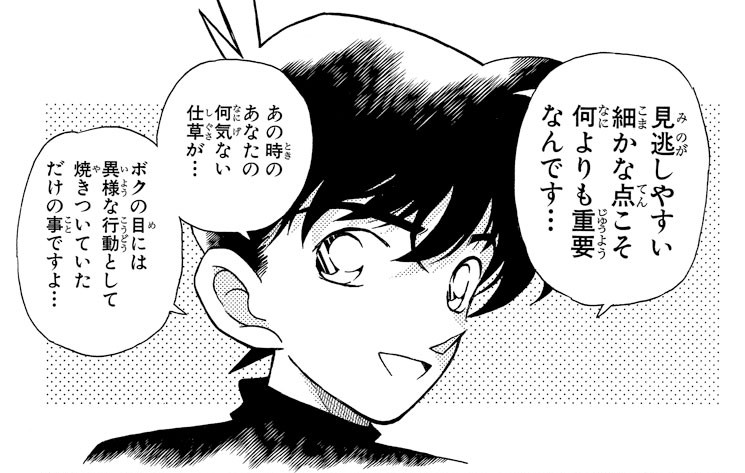
Shin’ichi reveals the details of a murder. The culprit asks how Shin’ichi discovered the hidden weapon, and he explains it was due to a specific movement the culprit made.
- 新一:
- 「見逃しやすい細かな点こそ何よりも重要なんです…」
- “It's precisely those subtle details that are easy to overlook that matter most of all...”
- 「あの時のあなたの何気ない仕草が…」
- “That casual gesture of yours back then...”
- 「僕の目には異様な行動として焼きついてただけの事ですよ…」
- “It's just that it was etched in my mind as strange behavior...”
Shin’ichi has laid out the murder, and the culprit wants to know how he found the hidden weapon. It was a small gesture. 焼きつく is “be burned in”, and 焼きついてた, from 焼きついていた, says the image stayed with him from that moment on. あの時, “back then”, in the line before, sets the time.
Example 10 of 11: Too much to handle on top of class representative duties with 荷が重い
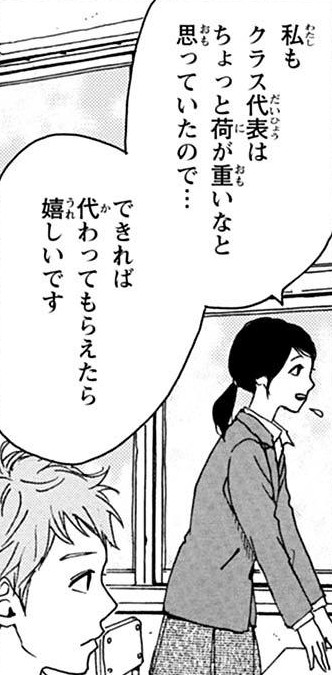
Takako and Azu tell their teacher they want to participate in the sports day relay race. The teacher points out that participants have already been decided, then one of the decided participants chimes in.
- 生徒:
- 「私もクラス代表はちょっと荷が重いなと思っていたので…」
- “I was also thinking I have too much on my plate as class representative.”
- 「できれば代わってもらえたら嬉しいです」
- “If possible, I'd be happy if someone could take my place.”
Takako and Azu ask to run in the sports day relay, but the runners have already been chosen. Then one of them speaks up. 思っていた is “I had been thinking”: she felt this way before they asked. ので gives it as her reason for wanting to switch.
Example 11 of 11: Why is it you're here with いんの
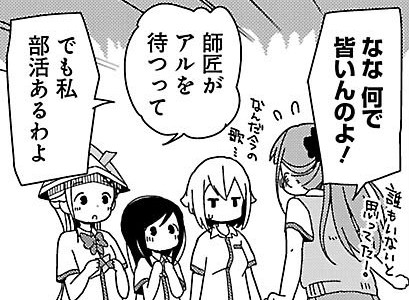
Aru returns to her classroom after club. Expecting the classroom to be empty, she’s singing a song about herself as she enters the room. There, she finds her friends idling away the time.
- アル:
- 「なな 何で皆いんのよ!(誰もいないと思ってた!)」
- “Wh- why is it that you all are here?! (I was thinking no one was here!)”
- なこ:
- 「(なんだ今の歌…)」
- “(What was with that song just now...)”
- ソトカ:
- 「師匠がアルを待つって」
- “Master said she'd wait for you.”
- アル:
- 「でも私部活あるわよ」
- “But I'm in a club!”
Aru walks back into her classroom after club, singing a song about herself, and finds her friends there. 誰もいないと思ってた is “I thought no one was here”. The past ていた marks a belief she held until a moment ago, the same way English uses “thought”.
Polite Forms with ました and でした
In polite speech, ます becomes ました, and です becomes でした. The polite negative is ませんでした.
- 昨日、映画を見ました。
- I saw a movie yesterday.
い-adjectives carry the past themselves and keep です: 楽しかったです, “it was fun”, not 楽しいでした.
Example 1 of 10: Forgotten homework with 宿題
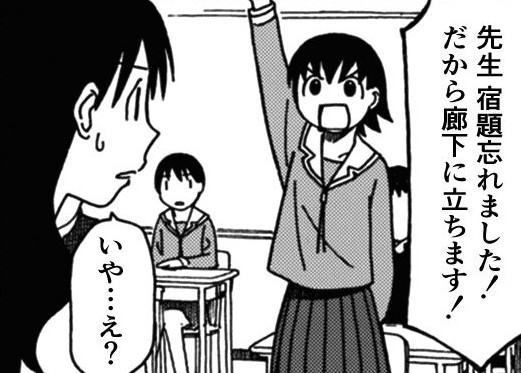
Tomo stands from her desk and raises her hand.
- とも:
- 「先生 宿題忘れました!だから廊下に立ちます!」
- “Teacher, I forgot my homework! So I'll stand in the hall!”
Tomo stands up in class and raises her hand. 忘れました is the polite past of 忘れる, “forget”, since she’s talking to her teacher. Then she announces her own punishment, standing in the hall, before anyone asks.
Example 2 of 10: Even though it's still chilly with 〜が〜
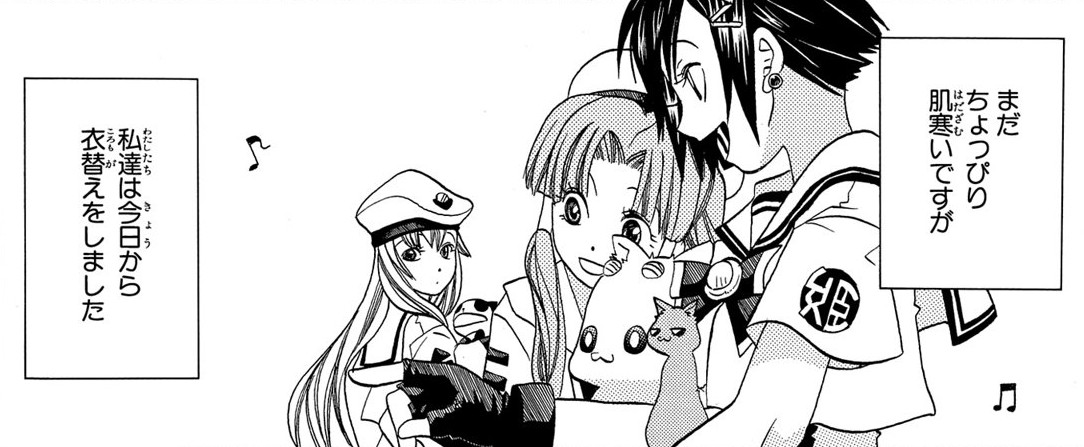
Akari narrates about her group’s change from winter uniforms to summer uniforms.
- 灯里:
- 「まだちょっぴり肌寒いですが私達は今日から衣替えをしました」
- “It is still a little chilly, but we changed our uniforms today.”
Akari narrates the day her group switches to summer uniforms. 衣替え is the seasonal change of clothes, and しました reports that they made it today. Her narration stays polite throughout, with です in the first half and ました in the second.
Example 3 of 10: Costume for catching a Clow Card with 衣装
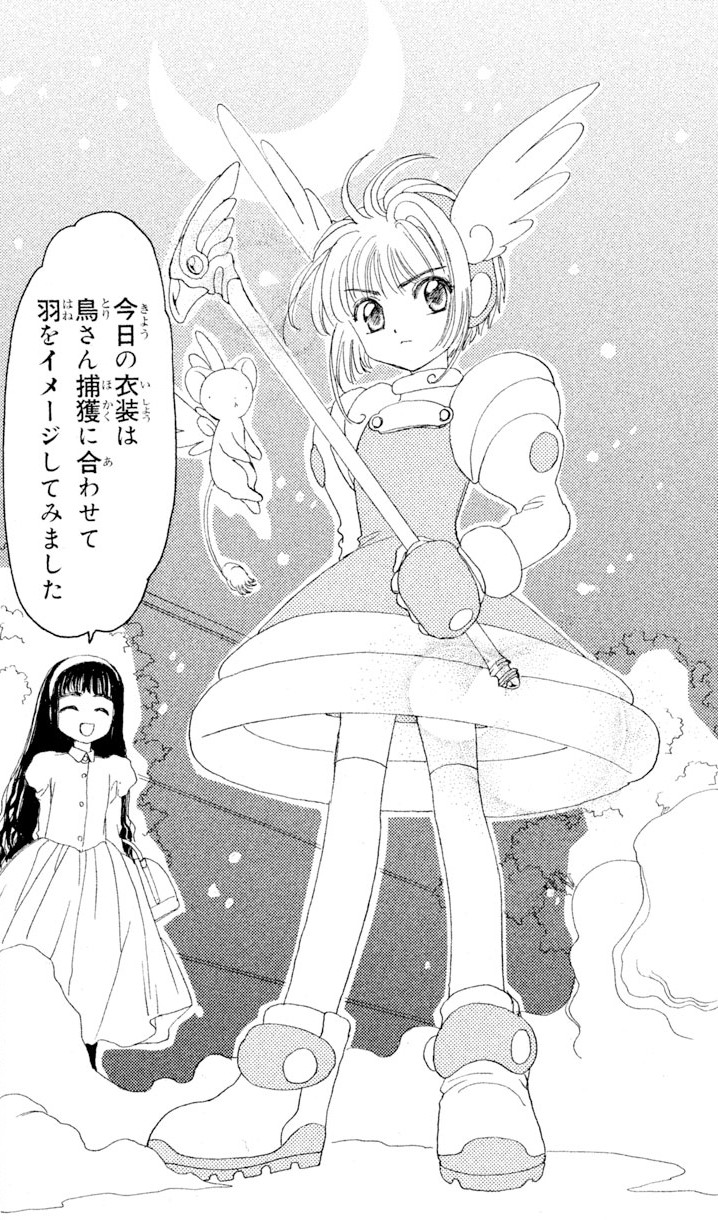
A magical bird appears at Sakura’s school and causes trouble with strong winds. Recognizing it as a Clow Card, Sakura returns at night to try to capture it. After she fails, she returns the next night to try again, sporting a new Cardcaptor outfit designed by her friend Tomoyo.
- 知世:
- 「今日の衣装は鳥さん捕獲に合わせて羽をイメージしてみました」
- “For today's outfit, I went with a feather-inspired look to match the bird-catching theme.”
Sakura failed to catch the bird card last night, and tonight she’s back in a new costume Tomoyo designed. Tomoyo explains her idea: wings, to match a bird hunt. 〜てみる is “try doing”, and its polite past is 〜てみました. Tomoyo speaks politely even to her best friend.
Example 4 of 10: Did you sleep properly with ちゃんと
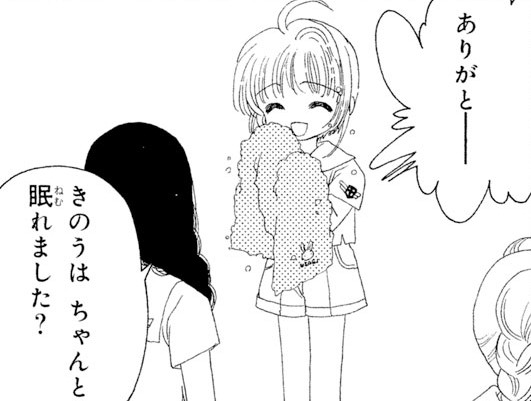
During an overnight school trip, a classmate tells a ghost story right before bedtime. While everyone else easily falls asleep, Sakura is too scared to close her eyes. The next morning, when Sakura washes her face, Tomoyo hands her a towel.
- さくら:
- 「ありがとーーー」
- “Thank you!”
- 知世:
- 「きのうは ちゃんと眠れました?」
- “Were you able to properly sleep last night?”
A ghost story kept Sakura awake on the school trip while everyone else slept. In the morning, Tomoyo hands her a towel. 眠れる is “be able to sleep”, so 眠れました? is “were you able to sleep?” きのうは sets the time.
Example 5 of 10: A discreet investigation with 極秘
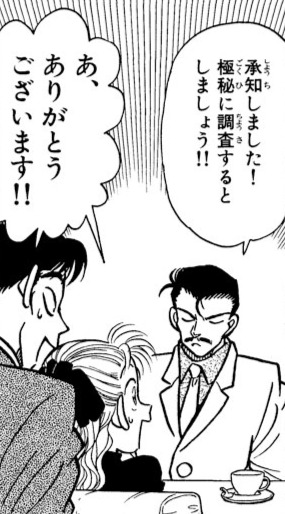
Detective Mouri’s favorite idol, Yoko, comes to his agency after receiving threatening calls and candid photos. Her manager hopes to keep the matter quiet to protect her image.
- 毛利:
- 「承知しました!極秘に調査するとしましょう!!」
- “Got it! Let's investigate this discreetly!!”
- ヨーコ:
- 「あ、ありがとうございます!!」
- “Thank you very much!!”
Yoko, Kogoro’s favorite idol, has been getting threatening calls, and her manager wants it handled quietly. 承知する means “understand” or “agree to”. 承知しました, “understood”, accepts the request the moment it’s made, as if the understanding were already complete.
Example 6 of 10: The correct ingredient with 正解
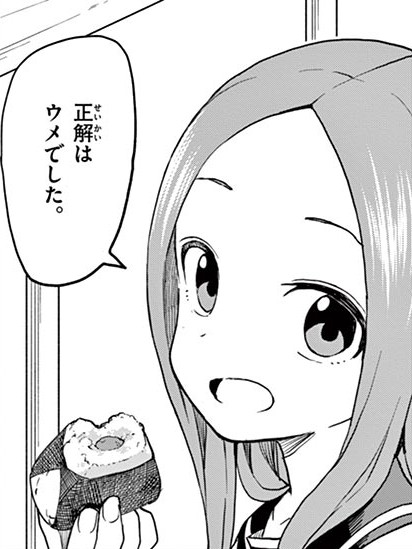
Takagi challenges Nishikata to guess what ingredient is inside a riceball in her lunch box. Seeing a bit of salmon from the other riceball, Nishika goes with salmon as his guess.
- 高木:
- 「正解はウメでした。」
- “The correct answer was apricot.”
Takagi had Nishikata guess the filling of one of her rice balls. He spotted salmon in the other one and guessed salmon. 正解はウメでした, “the right answer was plum”, uses でした, the past of です. Quiz shows announce answers the same way, as a settled result.
Example 7 of 10: Keeping my dad company with 相手
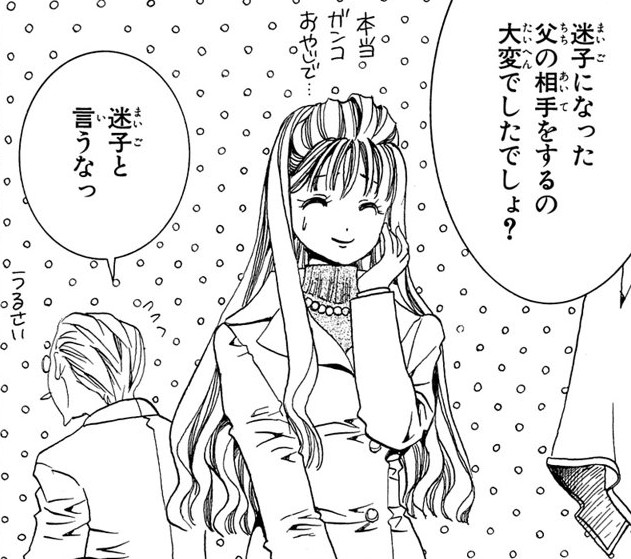
Akari encounters an older gentleman looking for a police box, so he can report his missing daughter and son-in-law. Akari offers to take him around and see if they can find the couple. Once they are reunited, the daughter thanks Akari for finding her father.
- 娘:
- 「迷子になった父の相手をするの大変でしたでしょ?」
- “It must have been tough dealing with my dad when he got lost, right?”
- 「本当ガンコおやじで…」
- “He really is a stubborn old man...”
- 父さん:
- 「迷子と言うなっ」
- “Don't say lost!”
- 「うるさい」
- “Annoying...”
An old man got separated from his daughter and son-in-law, and Akari helped him look for them. Now the daughter thanks her. 大変でした is the polite past of 大変だ, “hard”, and でしょ? makes it a guess, “it must have been tough”. In 迷子になった父, the past なった describes her father, which he objects to.
Example 8 of 10: Thank you for the water with ありがとうございました
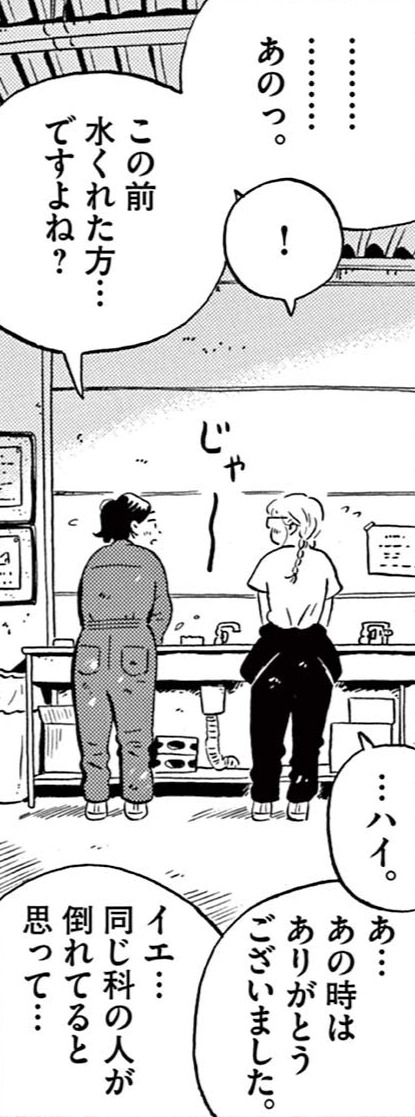
Natsumi tried making new friends from college only to end up drunk and abandoned. At class one day, she finds herself face to face with the helpful person who had found her and briefly helped her afterward.
- なつみ:
- 「……… ……… あのっ。」
- “Um...”
- 「この前水くれた方…ですよね?」
- “You're the one who gave me water before...right?”
- 女:
- 「…はい。」
- “...yes.”
- なつみ:
- 「あ…あの時はありがとうございました。」
- “Ah... Thank you for what you did back then.”
- 女:
- 「イエ…同じ科の人が倒れてると思って…」
- “Not at all... I thought it was someone from the same department who had collapsed...”
Natsumi got drunk and was left behind by people she’d hoped to befriend, and a stranger gave her water. Now she recognizes that woman in class. ありがとうございました thanks someone for something that’s over, here あの時, “that time”. For a kindness still going on, the non-past ありがとうございます fits. Natsumi’s 水くれた方, “the person who gave me water”, puts a past verb before a noun.
Example 9 of 10: Because strong players gather here with 〜ので

Cocoa inquires about the board and pieces sitting in front of Chino. Chino says it’s chess and gives a further explanation.
- チノ:
- 「この温泉は強者が集まるのでおじいちゃんは白熱してました」
- “Grandpa would get excited because strong players gather at this hot spring spa.”
- ココア:
- 「温泉に浸かりながらチェス出来るのっていいねー」
- “It's nice being able to play chess while soaking in the hot spring.”
Cocoa asks about the chessboard at the hot spring, and Chino explains. Her grandfather used to come here, and 白熱してました, from 白熱していました, is “he would get really fired up”. The polite past of ている describes something that kept happening back then.
Example 10 of 10: Receiving an overtaking with 〜れる

Chino watches her “grandpa” bread bake alongside Cocoa’s and Chiya’s breads.
- チノ:
- 「おじいちゃんがココアさんと千夜さんに抜かされました!」
- “Grandpa got passed by Cocoa-san and Chiya-san!”
- 千夜:
- 「おじいちゃんもガンバレー!」
- “You can do it too, Grandpa!”
Chino is watching the bread bake, including the loaf shaped like her “grandpa”. 抜かす is “overtake”, and 抜かされました, a polite passive past, is “got passed”. Grandpa’s bread is rising slower than Cocoa’s and Chiya’s, and Chino reports it like a race.
Past Negatives
Negative forms end in ない, which works like an い-adjective, so its past is なかった.
- 昨日は雨が降らなかった。
- It didn’t rain yesterday.
After a noun or な-adjective, the past negative is じゃなかった, or ではなかった in careful speech. The polite forms are 〜ませんでした and 〜じゃありませんでした.
Example 1 of 6: Might have similar tastes with 〜かもしれない

At the library, Cocoa thinks she’s realized which book Chino is trying to find but forgot the title of.
- ココア:
- 「今まで気付かなかったけど」
- “I didn't notice until now, but...”
- 「私本の趣味合うのかもしれないねっ」
- “...maybe we have similar taste in books.”
At the library, Cocoa thinks she’s figured out which book Chino is looking for. 気付く, “notice”, becomes 気付かない, then 気付かなかった. 今まで, “until now”, marks a stretch of time that has just ended, and what she’s noticed is that they might like the same books.
Example 2 of 6: Enthusiasm about a trip with 乗り気

Al shows Akari and Aika around his workplace. Afterwards, Akari thanks Al for showing them around and she prompts Aika to do the same.
- 藍華:
- 「まあ あんまり乗り気じゃなかったケド思ったより悪くない小旅行だったわよ」
- “Well, I wasn't that enthusiastic, but the excursion wasn't as bad as I thought it would be.”
- 「あんたのおやじっぷりはどうかと思うケド」
- “I still have a problem with your old man style, though.”
Al has shown Akari and Aika around his workplace, and Akari prompts Aika to thank him. 乗り気, “enthusiasm”, is a noun, so its past negative is 乗り気じゃなかった, “wasn’t keen”. The line ends on 小旅行だった, “it was a trip”. 悪くない stays non-past inside the description, because the final だった already sets the time.
Example 3 of 6: It's not like you're a foreigner with 〜じゃあるまいし
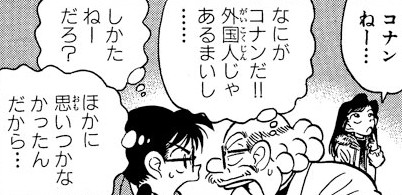
Shin’ichi’s teenage friend Ran enters Professor Agasa’s house looking for him, unaware that he was forced to take a poison that inadvertently turned the teenager into a young child. When Ran sees the boy and asks his name, Shin’ichi recalls Agasa’s suggestion to not reveal who he is. Panicking, he gives the name “Conan”, explaining the oddness of it by saying his father is a fan of author Arthur Conan Doyle.
- 蘭:
- 「コナンねー…」
- “Conan, huh?”
- 阿笠:
- 「なにがコナンだ!! 外国人じゃあるまいし」
- “What's with 'Conan'!? It's not like you're a foreigner...”
- コナン:
- 「しかたねーだろ? ほかに思いつかなかったんだから…」
- “It couldn't be helped, all right? I couldn't think up anything else...”
Shin’ichi, shrunk into a child, had to make up a name on the spot when Ran asked, and he said “Conan”. Professor Agasa can’t believe it. 思いつく means “think of”, and 思いつかなかった says nothing else came to mind. んだから offers that as his excuse.
Example 4 of 6: Suddenly remembering with 思い出す
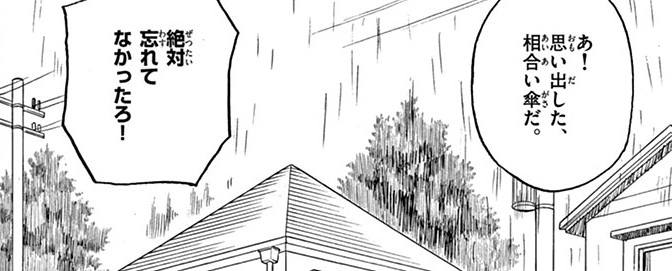
Takagi and Nishikata share an umbrella to walk home after school. Takagi says she completely forgot the term for two people sharing an umbrella. Nishika, with embarrassment, mutters that it’s あいあいがさ. When Takagi asks him to repeat it louder, he keeps quiet in his embarrassment.
- 高木:
- 「あ! 思い出した、相合い傘だ。」
- “Ah, I just remembered, it's 相合い傘.”
- 西片:
- 「絶対忘れてなかったろ!」
- “You totally didn't forget it!”
Takagi claimed she’d forgotten the word for two people sharing an umbrella, and Nishikata muttered it, embarrassed. Now she suddenly “remembers” it: 思い出した. Nishikata isn’t fooled. 忘れてなかった is the past negative of 忘れている: she never forgot it at all. The ろ at the end is a short だろ, “right?”
Example 5 of 6: All that murder planning for nothing with 水の泡になる
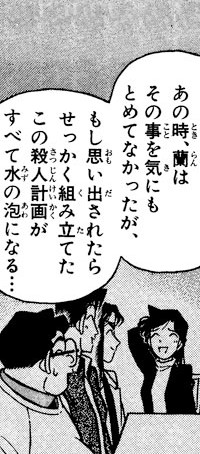
After discovering who the murderer is, Conan explains why the murderer went after Ran. He pinpoints when Ran unknowingly discovered a vital clue.
- コナン:
- 「あの時、蘭はその事を気にもとめてなかったが、もし思い出されたらせっかく組み立てたこの殺人計画がすべて水の泡になる…」
- “Ran didn't think anything of it at the time, but if she remembered it, all the murderous plans he worked so hard on putting together would go up in smoke.”
Conan explains why the murderer went after Ran: she saw a vital clue without realizing it. 気にとめる is “pay attention to”, and 気にもとめてなかった, ていた turned negative, is “didn’t give it a thought”. せっかく組み立てたこの殺人計画, “this murder plan he took such trouble to put together”, puts a past verb before a noun.
Example 6 of 6: Enthusiasm for shogi club with 乗り気
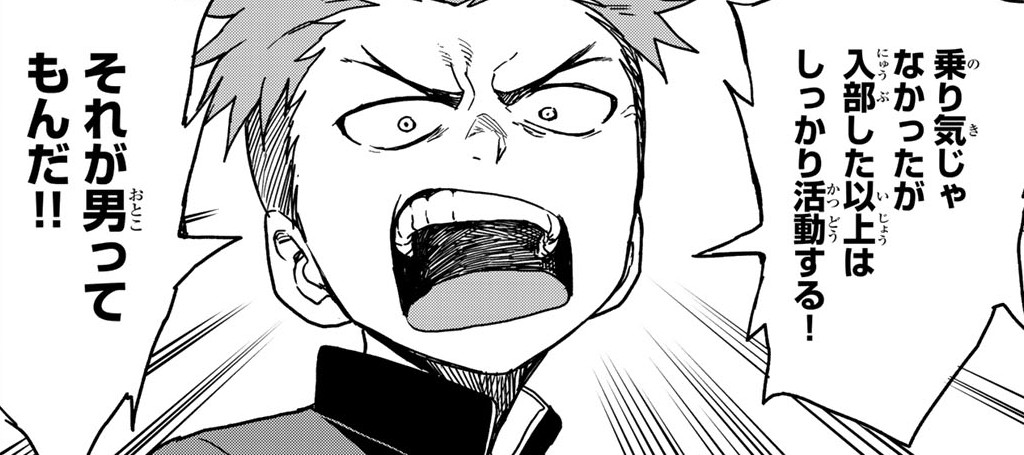
Sakurako forces Takeru to join the shogi club. When he suggests she join as well, she refuses and tells him not to go either, or else he’ll be in the way there.
- タケル:
- 「乗り気じゃなかったが入部した以上はしっかり活動する!」
- “I wasn't enthusiastic, but now that I'm in the club, I'll work hard!”
- 「それが男ってもんだ!!」
- “That's what it means to be a man!!”
Sakurako forced Takeru to join the shogi club. 乗り気じゃなかった, “I wasn’t keen”, describes how he felt. 入部した以上は, “now that I’ve joined”, puts the joining first, and his resolution follows: he’ll work hard.
Adjectives and Nouns in the Past
い-adjectives take the past themselves: い becomes かった. 楽しい becomes 楽しかった, “was fun”. いい is irregular and becomes よかった.
Nouns and な-adjectives use だった, the past of だ: 雨だった, “it was rainy”, and 静かだった, “it was quiet”.
Some of these past forms are set phrases about right now. よかった is “I’m glad” or “thank goodness”, and 悪かった is a casual “sorry”.
Example 1 of 20: Thinking your clothes were baggier with 〜気がする
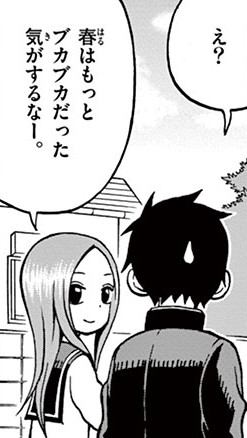
Takagi joins Nishikata as they head to school. They talk about having switched to their winter uniforms as the days are getting colder. Takagi asks Nishikata if he’s gotten taller.
- 西片:
- 「え?」
- “Huh?”
- 高木:
- 「春はもっとブカブカだった気がするなー。」
- “I think your clothes were more baggy back in spring.”
The class has just switched to winter uniforms, and Takagi thinks Nishikata has gotten taller. ブカブカ, “baggy”, works like a な-adjective, so its past is ブカブカだった. 春は, “in spring”, sets the time she’s comparing with, and 気がする softens it to “I think”.
Example 2 of 20: A loss of public order at school with 治安
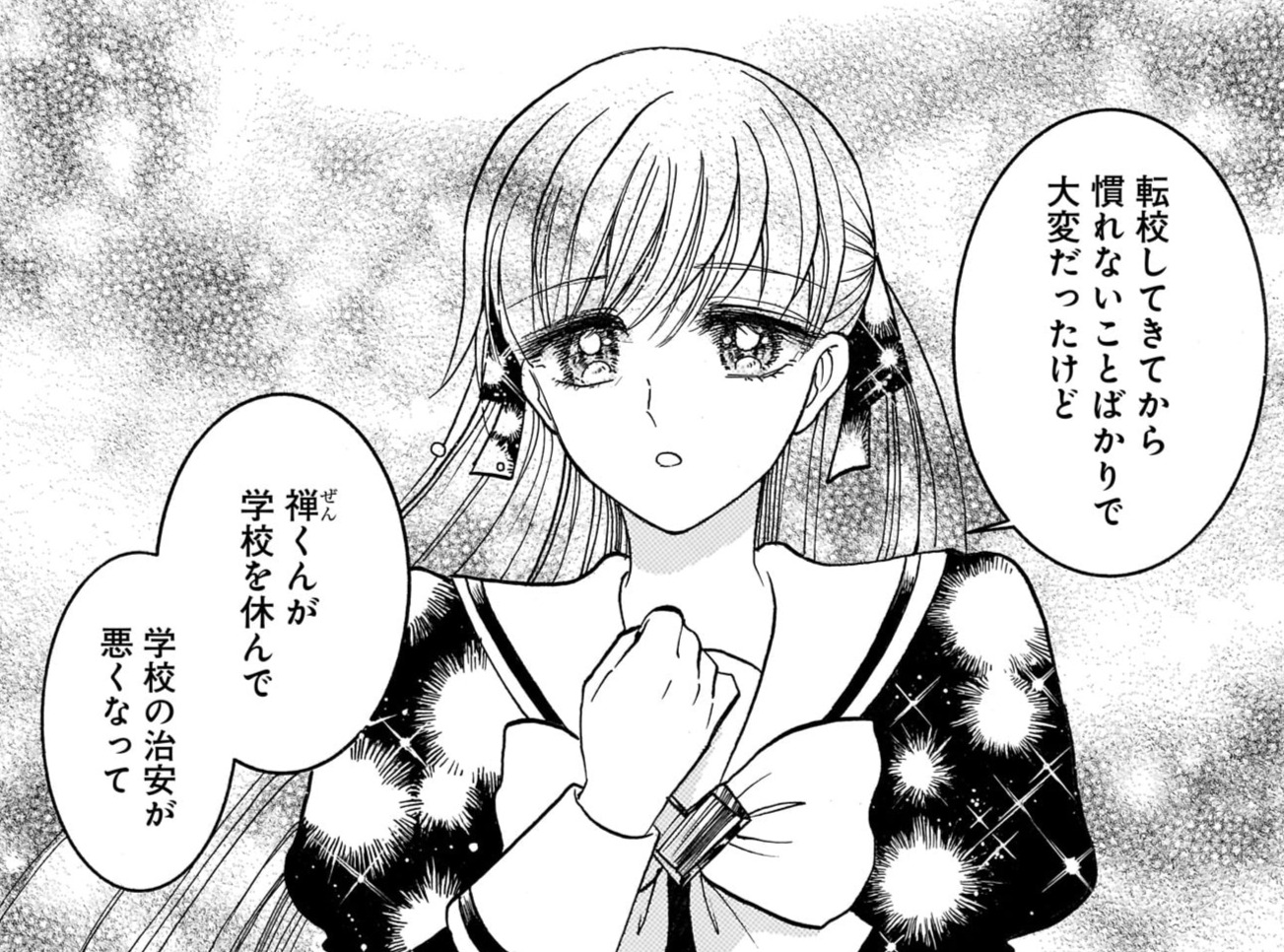
Following Zen’s absence from school for a while, fights and disobedience have taken over the school grounds. When Lulu learns Zen hasn’t been at home either during this time, she travels to the mountains in search of him. After finding him, she explains the situation at school.
- ルル:
- 「転校してきてから慣れないことばかりで大変だったけど禅くんが学校を休んで学校の治安が悪くなって」
- “Since I transferred to this school, everything has been unfamiliar and difficult, but ever since you've started missing school, the school's security has gotten worse...”
Zen has been away from school, and fights have broken out without him. Lulu finds him in the mountains to tell him. 大変, “hard”, is a な-adjective, so its past is 大変だった. It covers the stretch since she transferred, which 転校してきてから marks. けど turns to what’s worse now.
Example 3 of 20: Because of too much sorrow with 〜あまり

An image of Queen Serenity tells Sailormoon and her friends about the day the Moon Kingdom was attacked, and how Prince Endymion of Earth came to its defense.
- クイン・セレニティ:
- 「ーーー遅かった」
- “...it was too late.”
- 「彼はあなたを守り倒れ」
- “To protect you, he fell.”
- 「悲しみのあまりあなたも自害を……」
- “Because your sorrow was too much, you took your own life.”
An image of Queen Serenity tells Sailor Moon how the Moon Kingdom fell. Prince Endymion came to defend it, but it was too late. 遅い, “late”, becomes 遅かった. Here, 遅い means “too late” because timing matters in the story. かった puts the adjective in the past.
Example 4 of 20: Wanted you to eat the cookies I baked with 〜てほしかった

During cooking class, Komura has trouble concentrating as the girl he likes, Mie, and another boy who seems to like her, Azuma, are teamed up and seem to be getting along well together. After class, Komura sulks away. On his way home, Mie catches up with him. She gives him a bag with the cookies she baked in class.
- 三重:
- 「小村くんに食べてほしかったのはね」
- “I wanted you to eat them.”
Komura sulked off after cooking class, where Mie was paired with Azuma. Mie catches up and gives him the cookies she baked. ほしい, “want”, is an い-adjective, so 〜てほしかった is “wanted you to…”. The past points back to when she baked them: she was making them for him all along.
Example 5 of 20: Hired to work for the summer with 〜ことになる
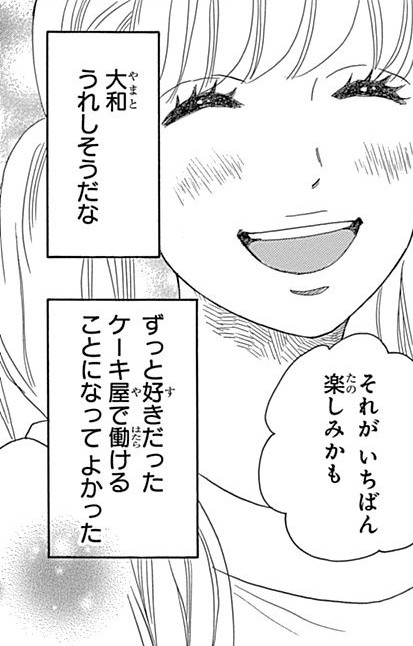
Rinko (Yamato) interviews for a summer job at her favorite cake shop. Following the interview, she is hired and is set to start work the next day. She’s excited at all the new techniques she’ll learn that she’ll use to make various sweets for her boyfriend, Takeo.
- 凛子:
- 「それがいちばん楽しみかも」
- “I think that's what I'm most looking forward to.”
- 猛男:
- 「大和うれしそうだな」
- “Yamato looks happy.”
- 「ずっと好きだったケーキ屋で働けることになってよかった」
- “I'm glad it worked out that she can work at the cake shop she's always loved.”
Rinko got a summer job at her favorite cake shop and starts tomorrow. Takeo thinks about how happy she looks. ずっと好きだった, “had always loved”, is a past な-adjective describing the shop. よかった, the past of いい, is “I’m glad”. The good news is settled, and he’s happy about it now.
Example 6 of 20: Decision made during the day yesterday with 〜うちに
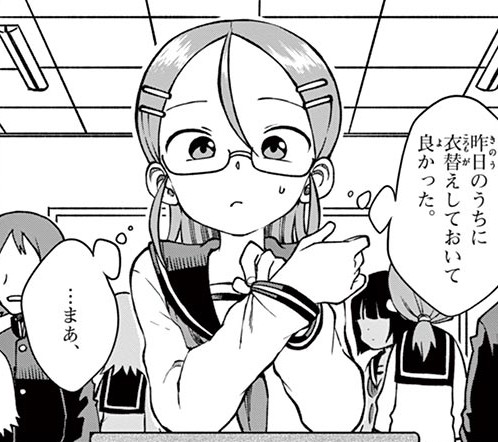
Yukari and her friends have a miscommunication on whether they’ll change from their summer uniforms to their winter uniforms yet. The decision is finalized just in time, as the following day is even colder.
- ユカリ:
- 「昨日のうちに衣替えしておいて良かった。」
- “I'm glad we (took the opportunity and) settled our uniform change (during) yesterday.”
Yukari and her friends couldn’t agree on when to switch to winter uniforms, but they settled it yesterday, and today is even colder. 〜ておいて良かった is “I’m glad we did it ahead of time”. The form is past, but the gladness is now.
Example 7 of 20: Giving up catching a cat with 匙を投げる
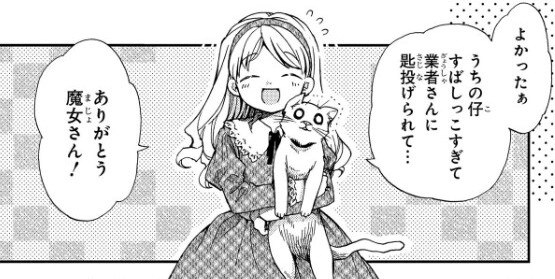
Eve takes the job of catching a cat that ran away from its owner. Following a successful mid-air catch off the roof and into a tree, Eve returns the cat to its owner.
- お城ちゃん:
- 「よかったぁ うちの仔すばしっこすぎて業者さんに匙投げられて…」
- “Thank goodness! Our little one was so quick that the hired help gave up on us...”
- 「ありがとう 魔女さん」
- “Thank you, Miss Mage.”
Eve caught a runaway cat in midair as it jumped from a roof, and she brings it back to its owner. よかったぁ is “thank goodness”. The owner explains that the cat was so quick the professionals gave up. 匙投げられて is the passive, “had them give up on us”.
Example 8 of 20: Interested in a defector with 入れ込む
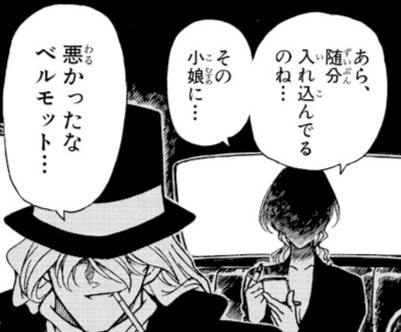
Gin and Vodka finally find Sherry, but after multiple gunshots are fired, she escapes. Vodka thinks they should continue to search for her, but Gin says there’s no way she’ll stay in town after their encounter.
- ベルモット:
- 「あら、随分入れ込んでるのね…」
- “Oh my... You're rather interested in her, aren't you...”
- 「その小娘に…」
- “That little girl...”
- ジン:
- 「悪かったなベルモット…」
- “Sorry, Vermouth...”
Gin and Vodka found Sherry, but she escaped, and Gin is sure she’s left town. Vermouth teases him about how fixated he is on the girl. 悪かった, the past of 悪い, “bad”, is a curt “sorry”. Coming from Gin, it’s more of a brush-off than an apology.
Example 9 of 20: A junior or something with 〜か何か
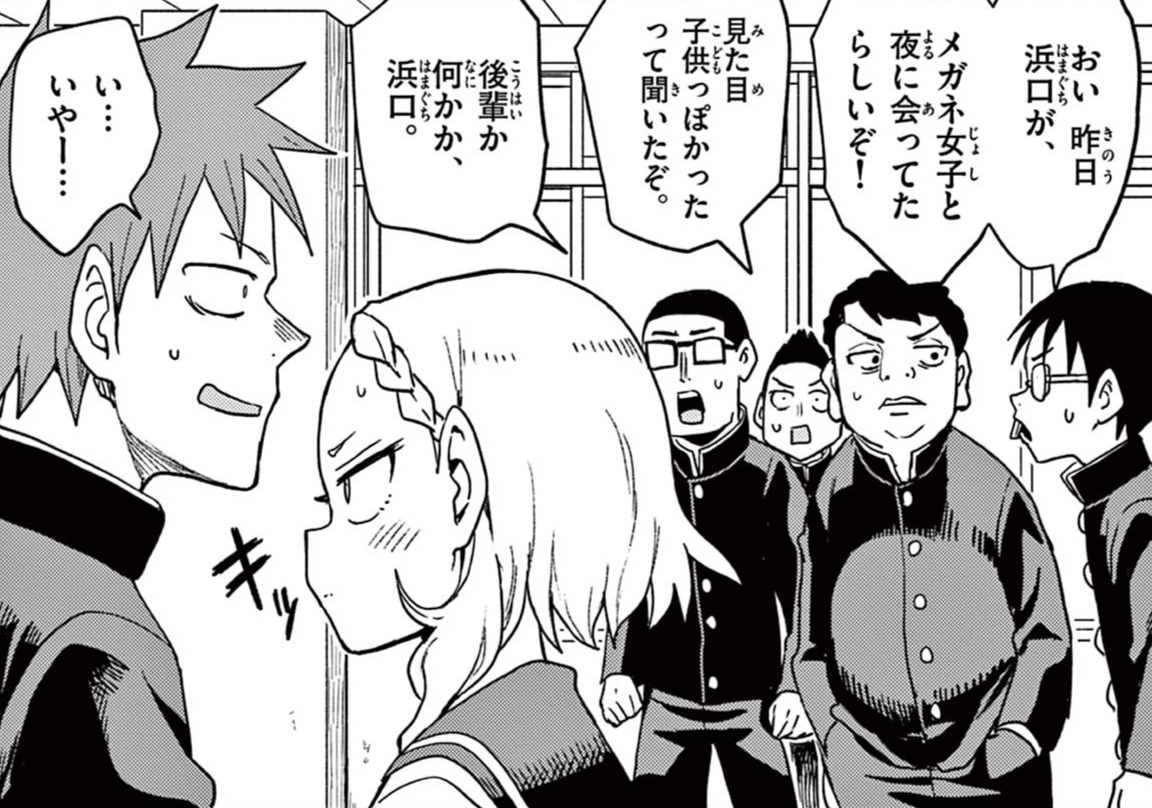
On a nighttime walk, Hamaguchi sees Hokujou casually dressed and wearing glasses. She’s fine with Hamaguchi seeing her like this, as they’ve known each other for a long time, but she tells him not to tell their classmates. At school the next morning…
- 高尾:
- 「おい 昨日浜口が、メガネ女子と夜に会ってたらしいぞ!」
- “Hey, I heard Hamaguchi was hanging out with a girl in glasses last night!”
- 生徒A:
- 「見た目子供っぽかったって聞いたぞ。」
- “I heard she looked kind of childish.”
- 生徒B:
- 「後輩か何かか、浜口。」
- “Is she a junior or something, Hamaguchi?”
- 浜口:
- 「い… いやー…」
- “Uh... well...”
Hamaguchi was seen out at night with Hokujou, who was in casual clothes and glasses, and the next morning the class is buzzing. 〜っぽい, “-ish”, works like an い-adjective, so 子供っぽかった is “looked childish”. The first line has 会ってた, “was meeting”, with らしい, “apparently”. Nobody has worked out who she was.
Example 10 of 20: A long-desired kaleidoscope with 万華鏡
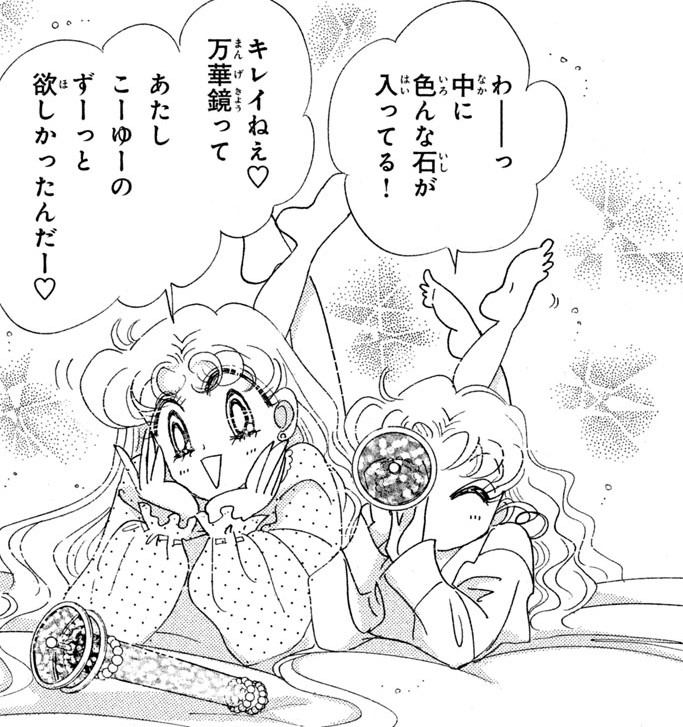
Usagi and Chibiusa look at the kaleidoscopes Mamoru bought them at the carnival.
- ちびうさ:
- 「わーーーっ 中に色んな石が入ってる」
- “Wow! There are all kinds of stones inside!”
- うさぎ:
- 「キレイねえ♡ 万華鏡って」
- “It's so pretty♡ A kaleidoscope...”
- 「あたし こーゆーの ずーっと 欲しかったんだー♡」
- “I've wanted one of these for so long♡”
Mamoru bought Usagi and Chibiusa kaleidoscopes at the carnival. 欲しい, “want”, becomes 欲しかった, and ずーっと, “all this time”, says she’s wanted one for ages. The wanting is over now that she has one. んだ shares the feeling.
Example 11 of 20: A meal provided by the school with 給食
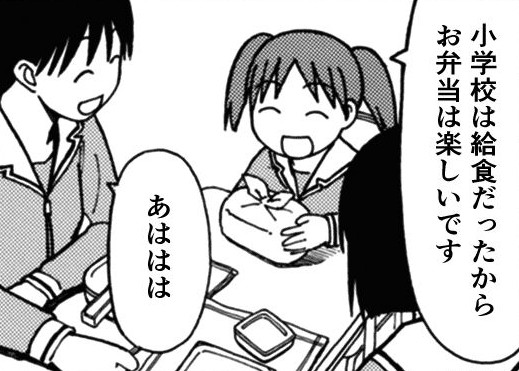
Chiyo is a child prodigy who’s skipped from elementary school to high school.
During her first day of class, Chiyo is invited by a couple of classmates to join them for lunch.
- ちよ:
- 「小学校は給食だったからお弁当は楽しいです」
- “Since we were provided lunches in elementary school, a boxed lunch is fun.”
It’s Chiyo’s first day of high school, and two classmates invite her to eat lunch with them. 給食, “school lunch”, is a noun, so its past is 給食だった: in elementary school, lunch was provided. 楽しいです stays in the present, since boxed lunches are fun for her now.
Example 12 of 20: Receiving exam results by mail with 郵送
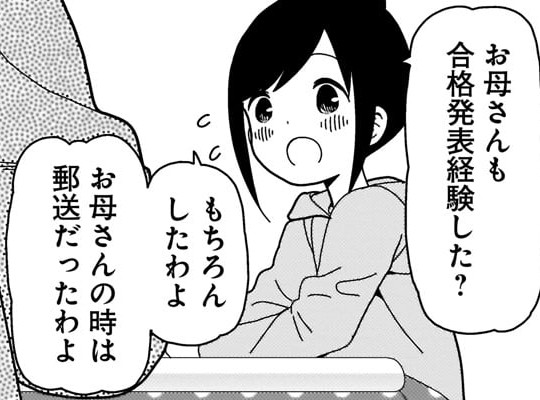
Bocchi’s mother confirms with Bocchi that her exam results will be available online.
- ぼっち:
- 「お母さん合格発表経験した?」
- “Mom, have you ever been through the experience of waiting for exam results?”
- お母さん:
- 「もちろん したわよ」
- “Of course!”
- 「お母さんの時は郵送だったわよ」
- “Back in my day, it was sent by mail.”
Bocchi’s mother checks that the exam results will be posted online. Bocchi asks if her mother ever waited for results like this: 経験した?, “did you go through it?” お母さんの時は郵送だった is “in my day, they came by mail”. 郵送 is a noun, so it takes だった.
Example 13 of 20: Receiving praise with 〜れる

Cocoa prepares to teach Chiya, Chino, and Rize how to bake bread.
- リゼ:
- 「それにしてもココアがパン作れるって意外だったな」
- “Still, I didn't expect you to know how to bake bread, Cocoa.”
- ココア:
- 「えへへー」
- “Hee hee!”
- チノ:
- 「褒められてるわけじゃないと…」
- “It's not like you're being praised...”
Cocoa is about to teach the others to bake bread. 意外, “unexpected”, is a な-adjective, so Rize’s 意外だった is “I didn’t expect it”. The surprise came when she found out, so it’s past. Chino points out that it isn’t exactly praise.
Example 14 of 20: Sensation of a bit cooled down with 〜気味

While visiting her friend Hiromi, Yukiko is the last one to use the heated bath. That is, except for Hiromi’s mother-in-law who will take a bath after returning from a late party.
- 広美:
- 「あ、どうだった湯加減?」
- “Ah, how was the water temperature?”
- 有希子:
- 「ちょっと冷めぎみ…だったかな…」
- “Maybe it's slightly cooled down a bit...”
Yukiko was the last to use the bath, apart from Hiromi’s mother-in-law, who will take one when she gets home from a party. Hiromi asks どうだった?, “how was it?”, and Yukiko answers 冷めぎみだった, “it was a little cool”. 〜ぎみ, “a bit”, makes a noun-like word, so it takes だった, and かな softens the answer.
Example 15 of 20: Skilled clock maker with 職人
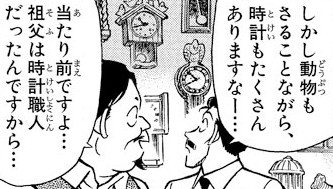
Having received a letter requesting help solving a mystery, Kogoro finds himself in a house filled with animal designs everywhere, including the doors, the chairs, and the plates. His attention turns to the clocks covering the walls.
- 小五郎:
- 「しかし動物もさることながら、時計もたくさんありますなー...」
- “But aside from the animals, there are also a lot of clocks, huh...”
- 男:
- 「当たり前ですよ... 祖父は時計職人だったんですから...」
- “Of course there are... Grandfather was a clock maker, after all...”
Kogoro has come to a house full of animal designs, and the walls are covered with clocks. 職人だった, “was a craftsman”, describes the man’s grandfather. んですから gives it as the obvious reason for all the clocks.
Example 16 of 20: Thanks for the mochi with どうも
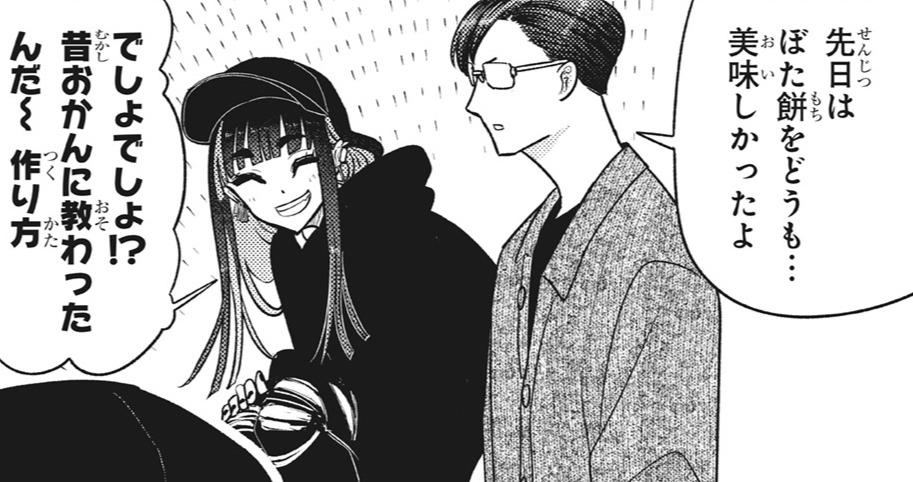
Kumada’s neighbor gave him extra mochi when she made too much. A few days later, he sees her in the park.
- 熊田:
- 「先日はぼた餅をどうも… 美味しかったよ」
- “Thanks for the botamochi the other day... They were really delicious.”
- 隣さん:
- 「でしょでしょ!? 昔おかんに教わったんだ〜 作り方」
- “Right?! I learned how to make them from my mom a long time ago~”
Kumada’s neighbor made too much botamochi and gave him some. A few days later, he runs into her in the park. 美味しい becomes 美味しかった, “they were delicious”, since he ate them days ago. She answers with a past of her own: she learned the recipe from her mother long ago.
Example 17 of 20: Wanting to burn fliers with 〜たい

Cocoa sees Syaro handing out advertisement fliers. When Syaro says she can’t go home until she’s done with them, Cocoa likens her to the fabled little match girl.
- ココア:
- 「そんなにチラシ燃やしたかった?」
- “Did you really want to burn the fliers that badly?”
- 「マッチならあるよ」
- “I've got some matches.”
- シャロ:
- 「そういう意味じゃない」
- “That's not what I meant.”
Syaro is handing out flyers and can’t go home until they’re gone, so Cocoa compares her to the little match girl. 〜たい, “want to”, works like an い-adjective, so its past is 〜たかった. 燃やしたかった? is “did you want to burn them that badly?” Cocoa even offers matches.
Example 18 of 20: Wanting to meet up with 〜たい

After worrying about being short, Chino sees Megu and Maya after summer break. Finding their heights comparable to her own brings Chino relief.
- メグ:
- 「そんなに休み中私たちに会いたかった?」
- “Did you really want to see us that badly during break?”
- マヤ:
- 「照れるじゃん」
- “You're making me blush.”
Chino was worried about being short, and when she sees Megu and Maya after summer break, she’s relieved to find they’re about her height. Megu misreads the relief: 会いたかった? is “did you want to see us that badly?” 休み中, “during break”, is the time the wanting covered.
Example 19 of 20: Wanting to try eating bread with 〜たい

After an unfortunate event ruins Cocoa’s boxed lunch, she buys bread from the school store.
- ココア:
- 「この学校のパン食べてみたかったんだー」
- “I wanted to try eating the bread at this school.”
- 「千夜ちゃんのおかげ」
- “It's thanks to you, Chiya.”
Cocoa’s boxed lunch got ruined, so she buys bread from the school store. 〜てみたい is “want to try”, and 食べてみたかった says she’d wanted to try this school’s bread for a while. Now she’s getting her wish, and she thanks Chiya for it.
Example 20 of 20: What score did you get with 〜の
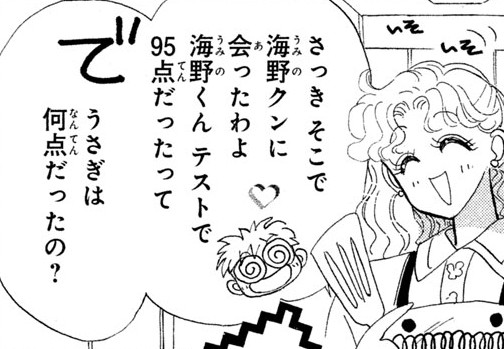
After failing a test at school, Usagi drowns her sorrows at the arcade. She returns home late and finds her mother expecting her.
- お母さん:
- 「さっき そこで海野クンに会ったわよ。海野くんテストで95点だったって」
- “I saw Umino a while ago. He said he scored 95 points on a test.”
- 「で、うさぎは何点だったの? 」
- “So, what was your score, Usagi?”
Usagi failed a test, spent the afternoon at the arcade, and came home late to find her mother waiting. Her mother ran into Umino, who scored 95. 95点だったって reports his score, and 何点だったの? asks for Usagi’s. A score is a noun, so it takes だった.
Before a Noun
A plain past verb can describe a noun with nothing in between. 昨日買った本 is “the book I bought yesterday”. English may use “that” or “who”; Japanese puts the describing clause before the noun.
Some verbs describe a state when they come before a noun, not a past event. 眼鏡をかけた人 is “a person wearing glasses”, and 曲がった道 is “a winding road”.
Example 1 of 19: Photographs of deceased parents with 写真
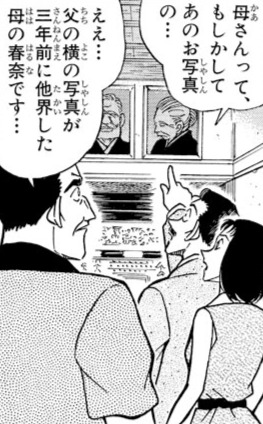
Kogoro takes a client to the home of someone she’d be communicating with via pagers. They show the household family a music box that was left to the client by her correspondence partner. The music it plays reminds the homeowner of the koto his mother used to play.
- 小五郎:
- 「母さんってもしかしてあのお写真の…」
- “By 'Mom', could that be the one in that photo…?”
- 常雄:
- 「ええ… 父の横の写真が三年前に他界した母の春菜です…」
- “Yes... The photo beside my father's is my mother, Haruna, who passed away three years ago...”
A music box reminds the head of the house of the koto his mother used to play, and Kogoro asks about her. 他界する is a gentle way to say “pass away”. 三年前に他界した母 is “my mother, who passed away three years ago”. Everything before 母 describes her.
Example 2 of 19: Leaving the room while Yukiko was out with 〜間
A murder victim was last heard from via phone call at 9PM. Her body was found outside later that night. Yukiko was in the main room with everyone except when she was bathing.
- 有希子:
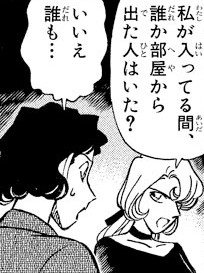
- 「私が入ってる間、誰か部屋から出た人はいた?」
- “While I was in the bath, was there anyone who left the room?”
- 広美:
- 「いいえ誰も…」
- “No, no one...”
A woman was killed after a 9 p.m. phone call, and Yukiko was with everyone except while she was in the bath. 部屋から出た人 is “someone who left the room”. The question ends on いた, the past of いる: “was there anyone…?”
Example 3 of 19: Getting onto a subway car with 飲み込む
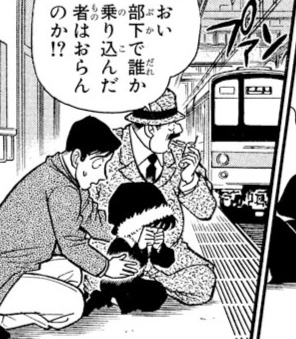
Following the kidnapping of a pop music duo, the police are forced to rely on Conan and his friends to deliver the ransom. The kids speak to one of the kidnappers by phone at the subway station, with the police force watching from a distance. When a subway car is about to close its doors, the kids suddenly bolt onto the nearest car, three of the four making it on before the doors close.
- 目暮:
- 「おい部下で誰か乗り込んだ者はおらんのか!?」
- “Hey! Did any of you get on?!”
The kids jumped onto a subway car just as the doors closed, leaving the police on the platform. Megure demands to know if any of his men made it on. 乗り込んだ者 is “anyone who got on”, with the past verb right before 者, “person”. おらん is a gruff いない.
Example 4 of 19: Dorky shirt my mom bought me with ダサイ
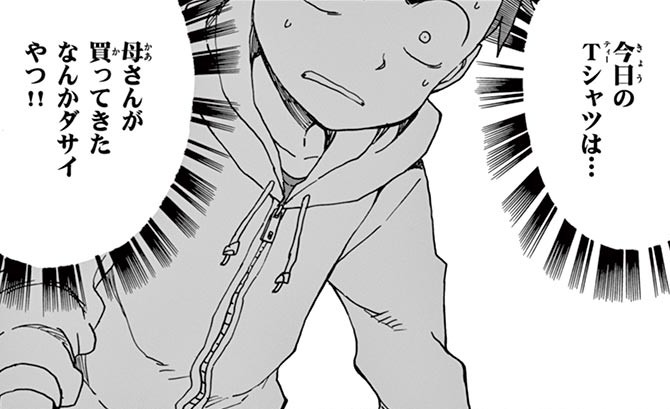
Nishikata and Takagi meet up at the library to study. Although it’s hot out, and Nishikata ran to make it to the library on time, he refuses to remove his sweater.
- 西片:
- 「今日のTシャツは… 母さんが買ってきたなんかダサイやつ!!」
- “Today's T-shirt is...some dorky thing my mom bought me!!”
Nishikata ran to the library in the heat but won’t take off his sweater, and here’s why. 母さんが買ってきた, “that my mom bought”, describes the T-shirt. なんかダサイ, “kind of dorky”, is a second description, and both come before やつ, “thing”.
Example 5 of 19: Don't make such a thing with な
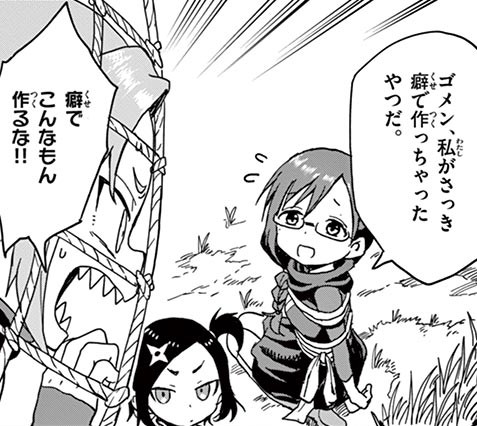
During a competition, Touwata and Mizubashou confront Tsubaki’s group to ask for help. While Touwata lays out her request, Sazanka and Asagao tie the two with ropes, believing their plea to be a trick. Figuring they’ve won, Sazanka and Asagao let down their guard and fall into a trap.
- ミズバショウ:
- 「ゴメン、私がさっき癖で作っちゃったやつだ。」
- “Sorry, I made that out of habit earlier.”
- サザンカ:
- 「癖でこんなもん作るな!!」
- “Don't make these things out of habit!”
Sazanka and Asagao tied up Touwata and Mizubashou, then let down their guard and walked into a trap. Mizubashou recognizes it as one of hers. 作っちゃったやつ is “the one I made”, with ちゃった, short for てしまった, adding that it wasn’t on purpose. さっき, “a little while ago”, places it.
Example 6 of 19: Transporting delicate glassware with 輸送
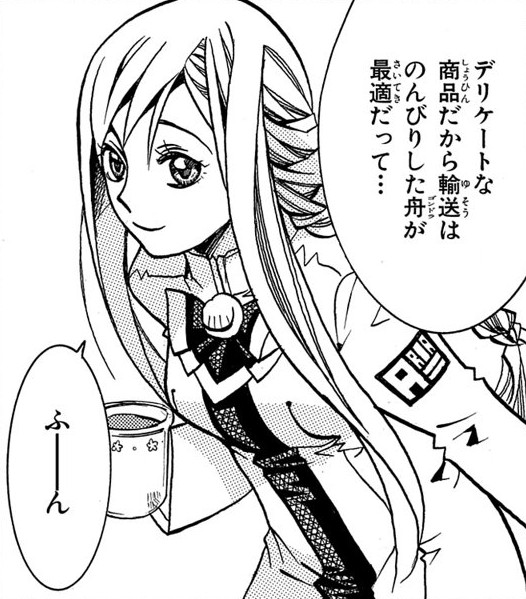
Akari receives her first commission as an Undine gondolier, but rather than taking someone sightseeing, it’s for transporting glassware.
- 灯里:
- 「デリケートな商品だから輸送はのんびりした船が最適だって…」
- “Since it's a delicate item, a slow-moving gondola is the best for transport...”
Akari’s first job as an undine is carrying glassware, not passengers. のんびりする means “be relaxed”, and のんびりした船 is “a leisurely gondola”. It describes what the boat is like, not something it did. A slow boat suits fragile cargo.
Example 7 of 19: Breaking down grease with 分解
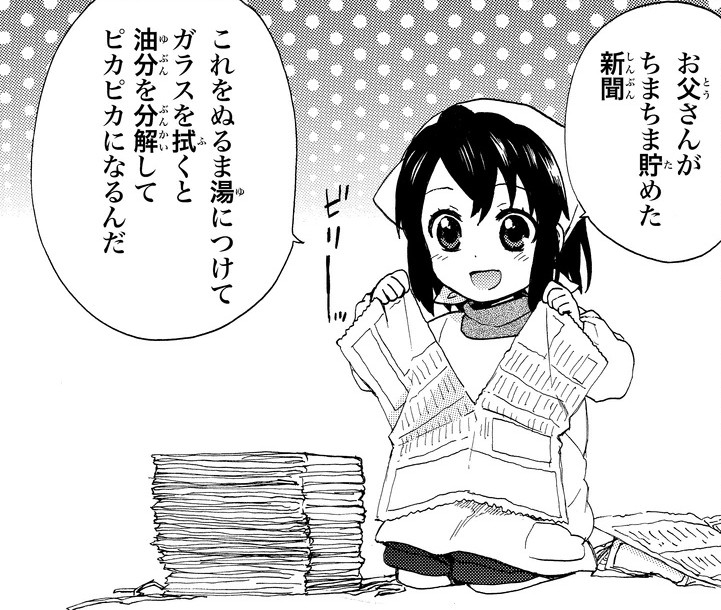
Hinata dedicates the month of December to giving her home a complete cleaning.
- ひなた:
- 「お父さんがちまちま貯めた新聞…」
- “The old newspapers Dad's been saving forever...”
- 「これをぬるま湯につけてガラスを拭くと油分を分解してピカピカになるんだ」
- “Soak them in warm water and wipe the glass, and they cut through the grease and get it sparkling clean.”
Hinata is giving her home a top-to-bottom cleaning for December. 貯める is “save up”, and お父さんがちまちま貯めた新聞 is “the newspapers Dad has been saving bit by bit”. She’s found a use for them: soaked in warm water, they clean glass.
Example 8 of 19: Bead as an earring with ピアス
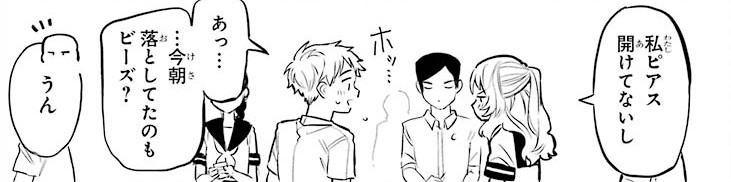
Komura sees Mie pick up an item she dropped and he wonders if it’s an earring. During class later, Mie shows Komura the item held up to her ear calling it a 「ピアス」. She then reveals it’s just a bead.
- 三重:
- 「私ピアス開けてないし」
- “Since I don't have my ears pierced.”
- 小村:
- 「あっ… …今朝落としてたのもビーズ?」
- “Ah, the item you dropped this morning was a bead?”
- 三重:
- 「うん」
- “Mmhm.”
Komura saw Mie drop something this morning and wondered if it was an earring. She tells him it’s a bead, since her ears aren’t pierced. 落としてたの is “the thing you dropped”, with の standing in for the noun. 今朝, “this morning”, places it.
Example 9 of 19: I say that because I thought it up with だって
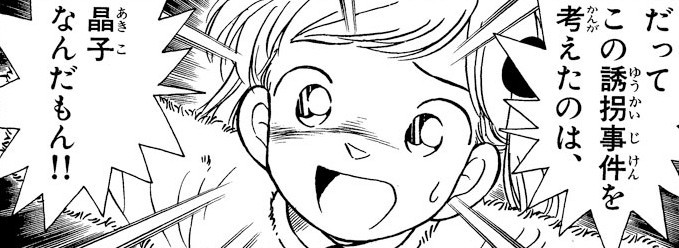
A fake kidnapping ploy turns into an actual kidnapping. After the kidnapped child is safe, her father goes after their butler for concocting the scheme. The daughter, Akiko, protects the butler, saying she’s the bad one.
- 晶子:
- 「だってこの誘拐事件を考えたのは、晶子なんだもん!!」
- “I say that because I'm the one who thought up the kidnapping plot!”
A fake kidnapping turned into a real one. Now that Akiko is safe, her father turns on the butler who planned the fake. Akiko takes the blame. この誘拐事件を考えたの is “the one who came up with this kidnapping”, with の standing in for “person”. Then she names herself.
Example 10 of 19: Testing one's detective ability with 能力
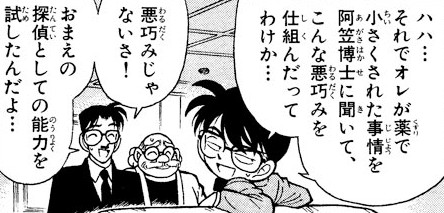
Conan finds himself in the clutches of a dangerous pair, only to discover it’s his parents in disguise.
- コナン:
- 「ハハ… それでオレが薬で小さくされた事情を阿笠博士に聞いて、こんな悪巧みを仕組んだってわけか…」
- “So you heard from Dr. Agasa about how I was shrunk by a drug and cooked up this evil scheme, huh...”
- 父さん:
- 「悪巧みじゃないさ! おまえの探偵としての能力を試してんだよ…」
- “It's not an evil scheme! I'm just testing your abilities as a detective...”
Conan was grabbed by a dangerous-looking pair who turned out to be his parents in disguise. 薬で小さくされた事情 is “the circumstances of how I was shrunk by a drug”. The past passive された describes 事情. His father says it isn’t a scheme: he’s testing Conan.
Example 11 of 19: Being strict about eating sweets with 心を鬼にする
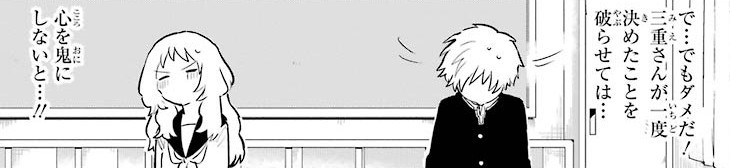
Having gained weight recently, Mie asks Komura to stop her from eating sweets at school, a difficult task as it’s White Day. Komura repeatedly stops Mie from eating the cookies and chocolate she’s received as gifts. His resolve weakens as he finds it adorable how Mie tries to sneak a bite whenever he’s not looking.
- 小村:
- 「で…でもダメだ! 三重さんが一度決めたことを破らせては… 心を鬼にしないと…!!」
- “But, that's no good! If I let Mie break her decision... I have to be strict for her sake!”
Mie gained weight and asked Komura to stop her from eating sweets at school, on White Day of all days. She keeps trying to sneak a bite, and it’s hard for him to stay firm. 一度決めたこと is “something she decided once”. He can’t let her break it, so he has to be strict.
Example 12 of 19: Indiscriminate murder would be one thing if with 〜ならともかく
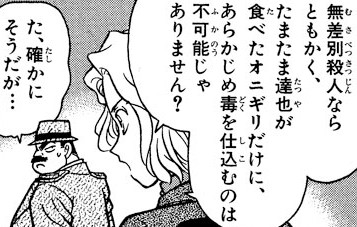
Sonoko is invited to a band’s after party. During the get-together, the band’s singer Tatsuya eats a rice ball only to collapse and die. The police are called in, and Inspector Megure discovers the victim was poisoned. He accuses the man who prepared the food, but Conan bites into a rice ball to show it’s safe. The victim’s manager, Mari, agrees.
- 麻理:
- 「無差別殺人ならともかく、たまたま達也が食べたオニギリだけに、あらかじめ毒を仕込むのは不可能じゃありません?」
- “If it were indiscriminate murder, that's one thing but since it was just the rice ball Tatsuya happened to eat, wouldn't it be impossible to poison it beforehand?”
- 目暮:
- 「た、確かにそうだが…」
- “Th-that's true, but...”
The band’s singer collapsed after eating a rice ball, and Megure suspects the man who made the food. Conan bites into a rice ball to show it’s safe, and the manager, Mari, agrees. たまたま達也が食べたオニギリ is “the rice ball Tatsuya happened to eat”. Nobody could have known in advance which one he’d pick.
Example 13 of 19: Only the ace of spades with 〜だけ
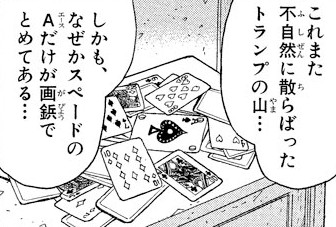
The Detective Boys group visits a cabin where Professor Agasa has secretly set out clues leading to a treasure. Conan draws the group’s attention to an arrow pointing to a table, on top of which there is…
- コナン:
- 「これまた不自然に散らばったトランプの山…」
- “A pile of cards, rather unnaturally scattered about.”
- 「しかも、なぜかスペードのAだけが画鋲でとめてある…」
- “Further, for some reason, only the ace of spades is pinned down with thumbtacks...”
Professor Agasa has hidden clues around a cabin for the Detective Boys’ treasure hunt, and Conan points to a table. 散らばる is “be scattered”, and 散らばったトランプ is “scattered cards”. It describes how the cards look now, not an event. The next line notes that only the ace of spades is pinned down.
Example 14 of 19: Reading a book to distract from waiting for a text message with 気を紛らす
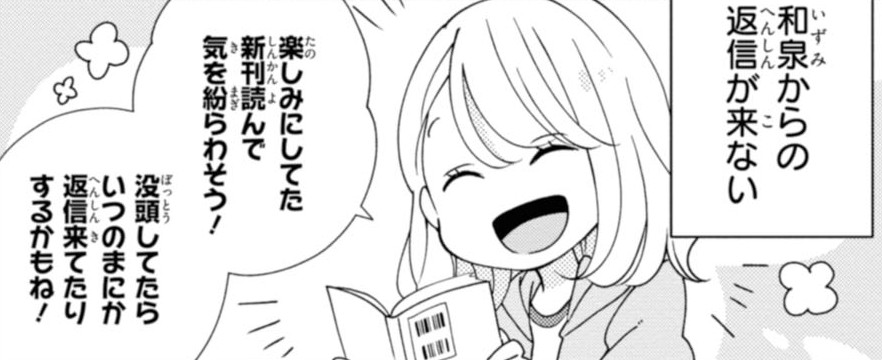
Akari is expecting a text message from Izumi. Unknown to her, Izumi’s response was getting too long, so he switched to his computer to write up an e-mail instead.
- Narration:
- 「和泉からの返信が来ない」
- “I haven't received a reply from Izumi.”
- あかり:
- 「楽しみにしてた新刊読んで気を紛らわそう!」
- “I'll distract myself by reading the new book I've been looking forward to!”
- 「没頭してたらいつのまにか返信来てたりするかもね!」
- “Maybe if I get really absorbed in it, the reply will show up before I know it!”
Akari is waiting for a text from Izumi, and it isn’t coming. 楽しみにしてた新刊 is “the new book I’d been looking forward to”, with ていた before the noun. Her next line has two more てた forms: 没頭してたら, “if I get absorbed”, and 来てたり, “(the reply) might have come”.
Example 15 of 19: Disbanding a music group with 解散
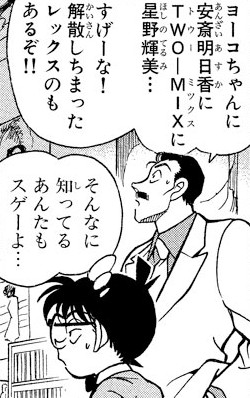
Detective Kogoro gives a young woman a ride home in exchange for concert tickets. While waiting for her to get the tickets, Kogoro notices the livingroom is filled with pop star posters.
- 小五郎:
- 「ヨーコちゃんに安斎明日香にTWO―MIXに星野輝美…」
- “There's Yoko, and Asuka Anzai, and Two-Mix, and Terumi Hoshino...”
- 「すげーな!解散しちまったレックスのもあるぞ!!」
- “Amazing! There's even the disbanded group Lex!”
- コナン:
- 「そんなに知ってるあんたもスゲーよ…」
- “It's also amazing that you know that much about them...”
Kogoro is waiting in a young woman’s living room, which is covered in pop star posters. 解散しちまったレックス is “Lex, which has broken up”. ちまった is a rough てしまった, and the whole phrase describes the group.
Example 16 of 19: Helpful invention for an investigation with 捜査
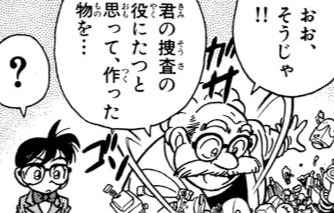
Conan is now staying with Detective Mouri in hopes of finding a case related to the men responsible for his becoming a child. He stops by Professor Agasa’s place to discuss the situation.
- 阿笠:
- 「おお、そうじゃ!!」
- “Oh, that's right!!”
- 「君の捜査の役にたつと思って、作った物を…」
- “I made this thinking it might help with your investigation...”
Conan is staying with the Mouris, hoping to find the men who shrank him, and he stops by Professor Agasa’s. 作った物 is “something I made”. Agasa made it thinking it would help Conan’s investigation, and he’s about to show it off.
Example 17 of 19: Stewed greenbeans with 煮込む
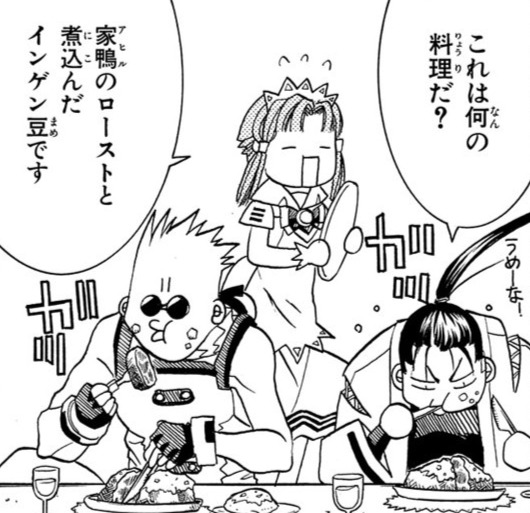
As part of their training, Akari, Aika, and Alice prepare a meal and host a large dinner.
- 暁:
- 「これは何の料理だ?」
- “What dish is this?”
- 灯里:
- 「家鴨のローストと煮込んだインゲン豆です」
- “It's roast duck and stewed green beans.”
As part of their training, Akari, Aika, and Alice host a large dinner, and Akatsuki asks what’s on his plate. 煮込む is “stew”, and 煮込んだインゲン豆 is “stewed green beans”. Like English “stewed”, it describes the beans by what was done to them.
Example 18 of 19: Too cute pajamas with 〜すぎる

Chiya and Syaro unexpectedly have to stay the night at Chino’s home.
- シャロ:
- 「チノちゃんにパジャマ借りたのはいいけどちょっとかわいすぎない?」
- “Borrowing pajamas from Chino-chan is fine, but aren't they a little too cute?”
- 「いつもはジャージなのに」
- “Even though I usually wear a tracksuit.”
- 千夜:
- 「本物のお嬢様みたい♪」
- “You look like a real young lady♪”
Chiya and Syaro have ended up staying the night at Chino’s house. パジャマ借りたの is “borrowing pajamas”, with の turning the past verb into a noun. That part is fine, Syaro says, but they’re a little too cute for someone who usually sleeps in a tracksuit.
Example 19 of 19: Why must I bring you your lunch with 〜なければならない
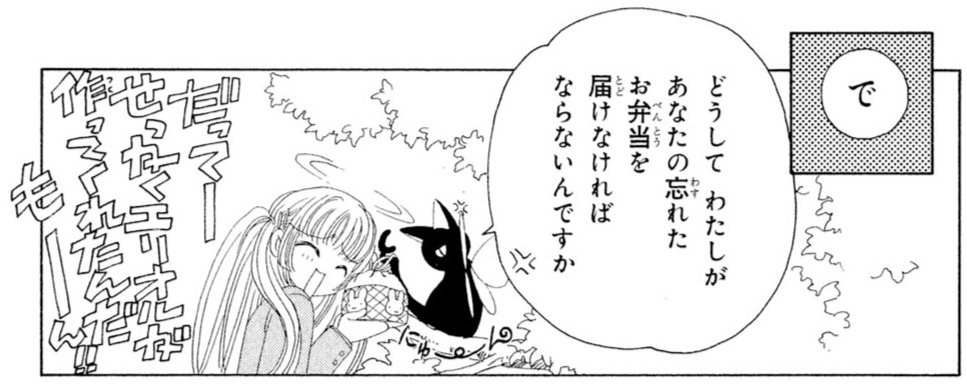
Spinel Sun calls out to Ruby Moon at school. After a brief discussion, Spinel Sun gets to the reason for his appearance there.
- スピネル・サン:
- 「で」
- “So.”
- 「どうして わたしがあなたの忘れたお弁当を届けなければならないんですか」
- “Why do I have to deliver the lunch you forgot?”
- ルビー・ムーン:
- 「だってー せっかくエリオルが作ってくれたんだもーーん!!」
- “Well, because Eriol went to all that trouble to make it for me!!”
Spinel Sun has come to school with the lunch Ruby Moon left behind, and he wants to know why that was his job. あなたの忘れたお弁当 is “the lunch you forgot”. In a description like this, the doer can take の in place of が. Ruby Moon’s answer: Eriol made it for her.
Finished Before Something Else
With an action verb before 時, “when”, the た-form can place the action’s completion before the main event. The dictionary form can place the main event before that action is complete.
- 日本に行った時、カメラを買った。
I bought a camera when I went to Japan, usually understood here as after arriving.
- 日本に行く時、カメラを買った。
- I bought a camera when I was going to Japan, before arriving.
Context can also make 行った時 refer to the trip as a whole, including the departure. This ordering does not apply to every た-form inside a sentence. For example, 部屋にいた時, “when I was in the room”, describes a state that overlapped with the main event.
The reference time can also be in the future: 日本に着いた時、電話します, “I’ll call when I arrive in Japan”. 〜た後で, “after doing”, and the conditional 〜たら can likewise refer to events that haven’t happened yet.
Example 1 of 5: Drinking completely with 〜終わる

Chino explains the steps to perform coffee fortune telling.
- チノ:
- 「おじいちゃんのカフェ・ド・マンシーは当たりすぎて怖いと有名でした」
- “Grandpa's Café de Mancy was famous for predictions so accurate they were scary.”
- 「飲み終わった後に残ったコーヒーの模様で占うんです」
- “After you've finished drinking it, we tell fortunes from the patterns left in the coffee.”
Chino explains how coffee fortune-telling works. 飲み終わった後 means “after you’ve finished drinking”, so finishing comes first. 残った, “left behind”, describes the pattern remaining in the cup. She’s describing the usual procedure. The first line, 有名でした, is a real past: her grandfather was famous for it.
Example 2 of 5: Determining the cause of death with 解剖
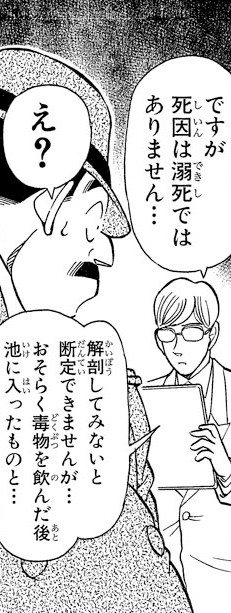
Inspector Megure suggests the murder suspect committed suicide by drowning himself. The medical examiner disagrees.
- 監察医:
- 「ですが死因は溺死ではありません…」
- “However, drowning wasn't the cause of death...”
- 目暮:
- 「え?」
- “What?”
- 監察医:
- 「解剖してみないと断定できませんが… おそらく毒物を飲んだ後池に入ったものと…」
- “I can't say for certain without an autopsy... but it's likely he took poison and then entered the pond...”
Megure thinks the suspect drowned himself, but the medical examiner disagrees. He can’t be sure without an autopsy, but he thinks the man took poison first and then went into the pond. 飲んだ後 is “after drinking”, and 入った finishes the picture. ものと leaves off something like “it seems”.
Example 3 of 5: When I took my eyes off her for just a minute with 目を離す

Satsuki leaves Sara, the young girl she’s watching, alone to go heat up lunch. When she returns with the food, Sara is nowhere to be found. Satsuki calls her sister to let her know what’s happened.
- 皐:
- 「それが… ちょっと目を離した隙に…」
- “The thing is, I took my eyes off her for a just a minute...”
- 「これから警察に連絡して探しに出るから…」
- “I'm going to call the police, then I'm heading out to look for her...”
Satsuki left Sara, the girl she’s looking after, alone to heat up lunch, and when she came back, Sara was gone. 目を離す is “take one’s eyes off”, and 目を離した隙に means “during the brief moment I wasn’t watching”. た presents the lapse in attention as an event, and 隙に identifies the opening during which Sara disappeared.
Example 4 of 5: Want to say something with 〜たい+ことがある
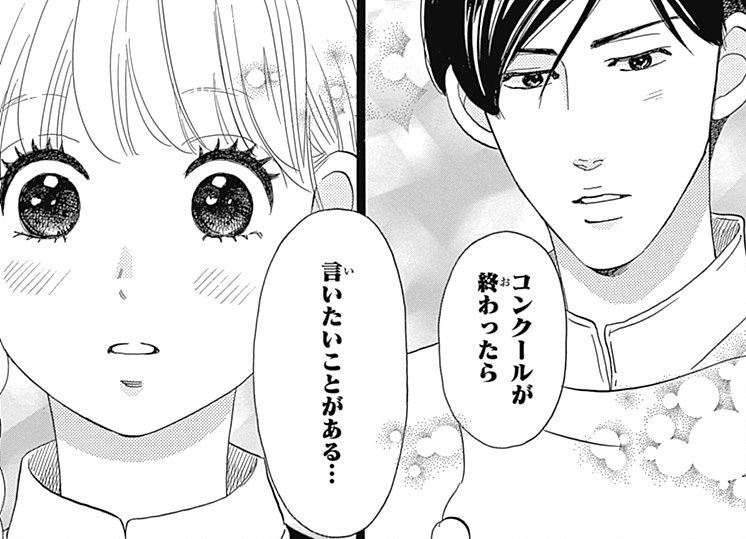
Ichinose normally shuns his inferior co-workers. When Rinko starts working at the confectionery, she unknowingly becomes Ichinose’s muse. Even after learning of her boyfriend, Ichinose still convinces Rinko to spend long hours helping him prepare for an upcoming competition. He plans to confess his feelings to Rinko after he wins the competition.
- 一之瀬:
- 「コンクールが終わったら言いたいことがある…」
- “When the competition is over, there's something I want to tell you.”
Ichinose has been keeping Rinko late to help him prepare for a pastry competition, and he plans to confess his feelings once he wins. コンクールが終わったら is “once the competition is over”. The competition is still ahead, but 終わった says it will be finished before he speaks.
Example 5 of 5: Distracted by test scores with 気が散る
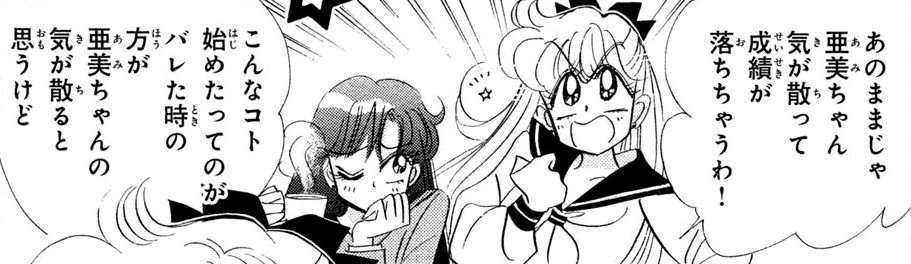
Ami is used to getting the top grade on mock exams, but when another name starts tying her scores, she begins to get flustered. Her friend Minako suggests they investigate the person behind the name, but Rei isn’t so sure.
- 美奈子:
- 「あのままじゃ 亜美ちゃん気が散って成績が落ちちゃうわ!」
- “The way things are, Ami-chan'll be distracted, and her grades will drop!”
- レイ:
- 「こんなコト 始めたってのがバレた時の方が亜美ちゃんの気が散ると思うけど」
- “I think Ami-chan will be more distracted when she finds out we've started something like this.”
Someone keeps tying Ami’s top scores, and Minako wants to investigate. Rei thinks Ami would be more distracted if she found out about that. バレた時 means “when it comes out”. The discovery is still hypothetical, but its た-form places it before the distraction. 始めた sits inside the report of what Ami would discover, so this line alone does not establish that the investigation has already started.
Already Done
The た-form can focus on an action being complete and its result mattering now. English often uses “have” for this. The action still happened before a reference time; the point is whether it has happened yet.
- 宿題、もう終わった?
- Have you finished your homework yet?
To answer “not yet”, the usual form is まだ終わっていない, “I haven’t finished yet”, or simply まだ, “not yet”. 終わらなかった instead reports that it didn’t finish on a past occasion.
Example 1 of 18: Went and brought the wrong textbook with 〜ちゃう
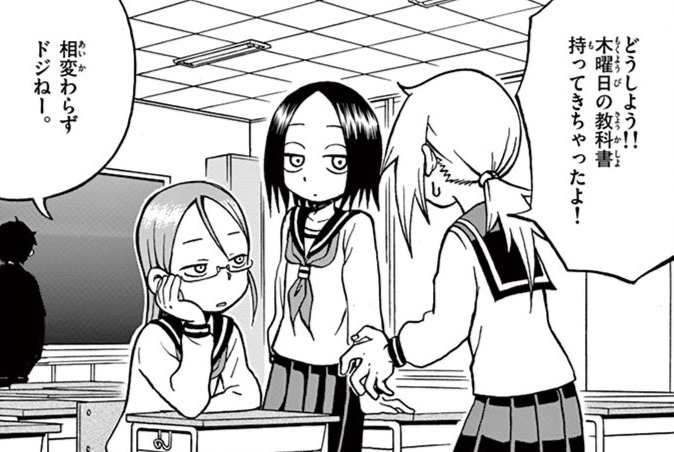
Mina is startled to learn that today is Friday.
- ミナ:
- 「どうしよう!!木曜日の教科書持ってきちゃったよ!」
- “What'll I do?! I ended up bringing my textbook for Thursday!”
- ユカリ:
- 「相変わらずドジねー。」
- “You're such a klutz, as usual.”
Mina has just found out that today is Friday, not Thursday. 持ってきちゃった, from 持ってきてしまった, is what she blurts out the moment she realizes she brought the wrong textbook. Yukari isn’t surprised.
Example 2 of 18: Congratulations after touching with 〜てから

Chino doesn’t have much luck with animals other than her rabbit Tippy. However, she’s able to successfully touch the always-still rabbit at Chiya’s family’s café.
- ココア:
- 「やったよチノちゃん!おめでとう!!」
- “At last, Chino-chan! Congrats!!”
- リゼ:
- 「ちゃんと触ってから祝ってやれよ」
- “After she properly touches the rabbit, congratulate her.”
Chino has no luck with animals other than her own rabbit, Tippy, and at Chiya’s family’s café she’s trying to touch a rabbit that never moves. Cocoa cheers: やった!, “you did it!” Cocoa announces success, but Rize says to wait until Chino has properly touched the rabbit. The dialogue presents the congratulations as premature.
Example 3 of 18: Trying on a uniform with 〜てみる

While staying in Chino’s room during a storm, Cocoa looks over at Chino’s middle school uniform.
- ココア:
- 「じゃーんチノちゃんの制服着てみたよ!」
- “Ta-da, I tried putting on Chino-chan's uniform!”
A storm has Cocoa staying in Chino’s room, and she spots Chino’s middle school uniform. じゃーん, “ta-da!”, shows it off. 〜てみる is “try doing”, and 着てみた announces that it’s done: she’s wearing it now.
Example 4 of 18: Coming to wake someone with 〜に来る

As the new butler, Hayate is tasked with waking Nagi for breakfast, but he’s quickly startled by the sight of a large white tiger sleeping alongside her. Nagi wakes and notices Hayate standing in her room.
- ナギ:
- 「あ…起こしに来てくれたのか、ありがとう…」
- “Ah... did you come to wake me up? Thanks...”
- 「ところで何を固まっているのだ?」
- “By the way, why are you frozen stiff?”
- ハヤテ:
- 「い…いえ… その…うしろ…」
- “N-no... it's just... behind you...”
Hayate, the new butler, came to wake Nagi and froze at the sight of a white tiger sleeping beside her. Nagi wakes and sees him. 起こしに来てくれた is “you came to wake me”. He’s already standing there, so the coming is complete. Nagi hasn’t noticed what he’s staring at.
Example 5 of 18: Did you come to get me with 〜んです
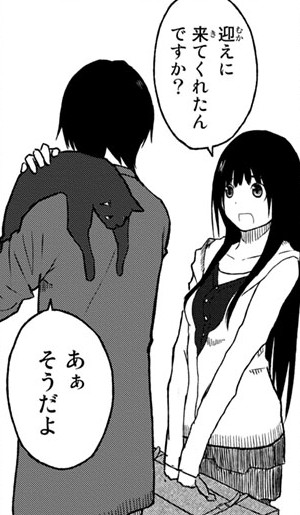
After getting off the intercity bus, Makoto is greeted by her cousin Kei.
- 真琴:
- 「迎えに来てくれたんですか?」
- “Did you come to get me?”
- 圭:
- 「あぁ そうだよ」
- “Yeah, that's right.”
Makoto gets off the long-distance bus, and her cousin Kei is waiting. 迎えに来てくれた is “you came to pick me up”. Kei is right in front of her, so the past is about the result: he’s here. んですか asks politely for confirmation.
Example 6 of 18: Came to be studying with us with 〜ことになる
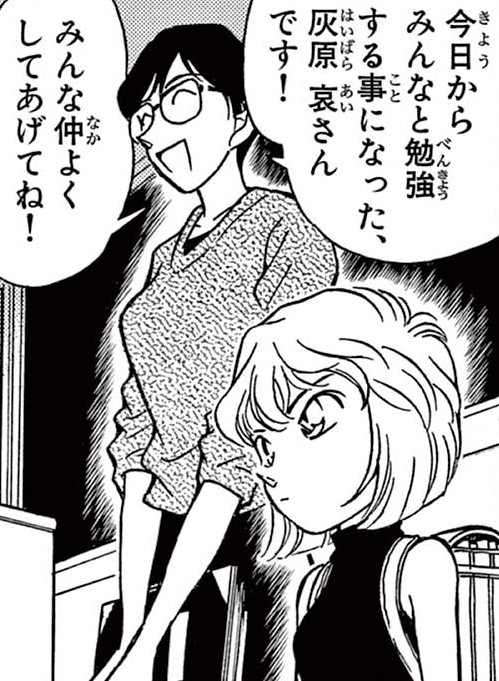
A new student joins Conan’s elementary school classroom. The teacher introduces her.
- 先生:
- 「今日からみんなと勉強する事になった、灰原 哀さんです!」
- “This is Ai Haibara. It came to be that she'll be studying with us starting today.”
- 「みんな仲良くしてあげてね!」
- “Everyone be friendly with her!”
A new student joins Conan’s class, and the teacher introduces her. 〜ことになる is “it’s been arranged that…”, and なった says the arrangement is settled. The studying starts today, but the decision is already made.
Example 7 of 18: Safer when lit up with 安全
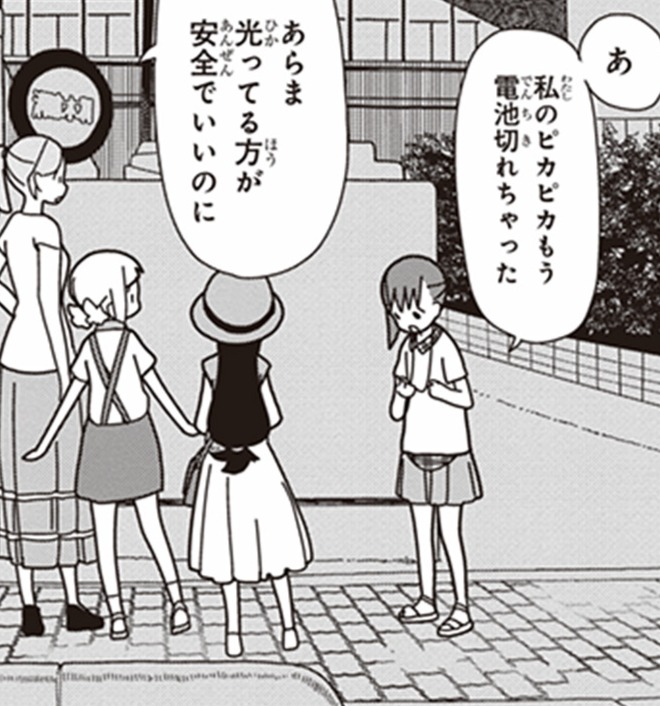
At a nighttime festival, Sacchan, Yui, and Kotoha receive glowing star necklaces to wear. After some time, Sacchan’s mother arrives to pick them up.
- 結衣:
- 「あ 私のピカピカもう電池切れちゃった」
- “Ah, my light-up necklace's battery has already run out.”
- 母さん:
- 「あらま 光ってる方が安全でいいのに」
- “Oh dear, it's safer and better when it's lit up.”
At a night festival, the girls got glowing star necklaces, and Yui’s has gone dark. 電池が切れる is “the battery runs out”, and 切れちゃった, from 切れてしまった, says it’s dead now. もう, “already”, goes naturally with completion.
Example 8 of 18: Enthusiasm in giving a bribe with ノリ気

Hinagiku wants to see behind Rindou’s mask. Since Sazanka was scolded for trying the same, Hinagiku suggests they team up to take Rindou’s mask away. Asagao opposes the proposition, but Sazanka immediately quiets her by offering a bribe for her support.
- ヒナギク:
- 「ふーん。そっちでアサガオ買収してくれるなんて、ノリ気じゃない。」
- “Hmm. If you're willing to bribe Asagao on your side, you're pretty into this, aren't you?”
- 「私の術で言うこときかせる手間が省けたわ。」
- “Saves me the trouble using my technique to make her do as I say.”
Hinagiku wants to see behind Rindou’s mask, and she teams up with Sazanka, who promptly bribes Asagao into helping. 手間が省ける is “be spared the trouble”. 省けた says that’s settled: thanks to the bribe, Hinagiku won’t need her own technique to bring Asagao around.
Example 9 of 18: Coming to buy coffee mugs with 〜に来る

Rize explains to Syaro why she and her friends are at the store.
- リゼ:
- 「喫茶店で使うカップ買いに来たんだよ」
- “We came to buy cups to use at the café.”
- シャロ:
- 「そうだったんですか」
- “Oh, I see.”
Syaro runs into Rize and the others at a shop. 買いに来た is “came to buy”. They’re in the shop now, so the past is about the result. Syaro’s そうだったんですか, “oh, I see”, is a past of realization.
Example 10 of 18: Coming to meet someone with 〜に来る

Syaro tries to find out who’s responsible for Chiya and the others visiting her workplace.
- シャロ:
- 「大体こんなチラシで勘違いしたの誰」
- “Who misunderstood this flyer in the first place?”
- ココア:
- 「私たちシャロちゃんに会いに来ただけだよ?」
- “We just came to see you, Syaro-chan.”
- チノ:
- 「いかがわしいってどういう意味です?」
- “What does “shady” mean?”
- リゼ:
- 「こんなことだろうと思った」
- “I figured it was something like this.”
A flyer made Cocoa and the others think Syaro’s workplace was something shady, so they came to check. Syaro wants to know who misread it: 勘違いしたの誰, “who got the wrong idea?” Cocoa says they only came to see her, with 来ただけ. Rize’s 思った, “I figured”, says she suspected as much all along.
Example 11 of 18: Ended up relying on your help with 〜てしまう
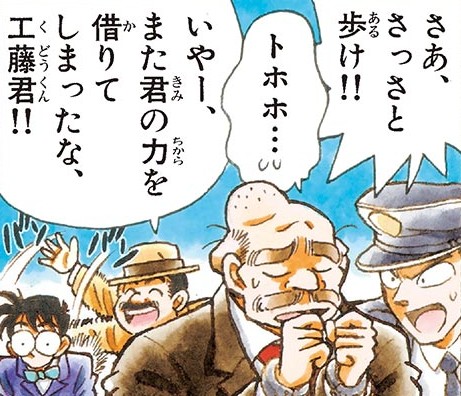
After Kudo helps Inspector Megure solve a murder case, he also catches the fleeing culprit.
- 警察官:
- 「さあ、さっさと歩け!!」
- “Come on, hurry up and walk!!”
- 目暮:
- 「いやー、また君の力を借りてしまったな、工藤君!!」
- “Man, I ended up relying on your help again, Kudo!!”
Kudo has solved another murder for Inspector Megure and caught the fleeing culprit too. 力を借りる, “borrow someone’s strength”, is “rely on someone’s help”, and 〜てしまった says it’s happened again, done and settled. Megure says it cheerfully, as thanks.
Example 12 of 18: Forgotten Japanese language textbook with 国語
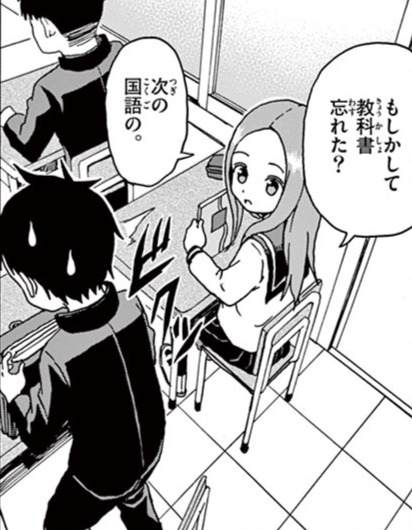
As class is about to begin, Takagi notices Nishikata frantically looking through his book bag.
- 高木:
- 「もしかして教科書忘れた?」
- “Did you forget your textbook, by any chance?”
- 「次の国語の。」
- “The one for Japanese class next.”
Class is about to start, and Nishikata is digging frantically through his bag. Takagi guesses: 教科書忘れた?, “did you forget your textbook?” The forgetting happened at home, but what matters is the result: he doesn’t have it now.
Example 13 of 18: Misunderstanding an incriminating situation with 誤解
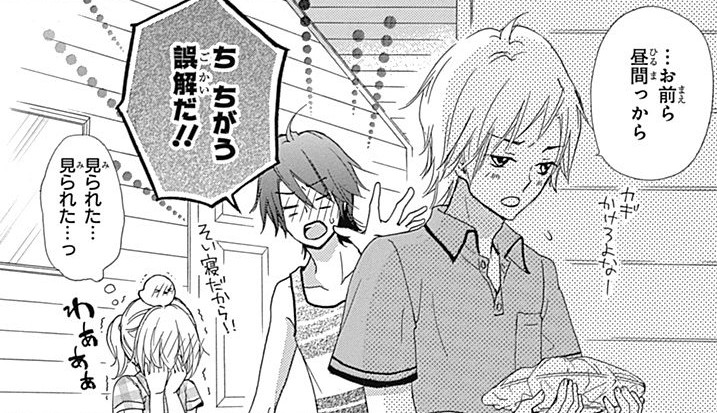
Since Hiyori is resting on a bed inside, Junpei takes a plate from the barbecue to her room. As he walks in, he finds Hiyori and Yuushin in what looks like a compromising position.
- 淳平:
- 「…お前ら昼間っから (カギかけろよなー)」
- “You guys, in the middle of the day… (At least lock the door!)”
- 結心:
- 「ち ちがう 誤解だ!!(そい寝だから!!)」
- “N—No! You've got it wrong!! (We were just lying down together!)”
- ひより:
- 「見られた… 見られた…っ」
- “We were seen… We were seen…!”
Junpei walks into Hiyori’s room with a plate from the barbecue and finds her and Yuushin in what looks like a compromising position. 見られた, “we were seen”, is the past passive of 見る. It’s done and can’t be undone, which is why Hiyori keeps repeating it.
Example 14 of 18: Nearby stores with 近隣店舗
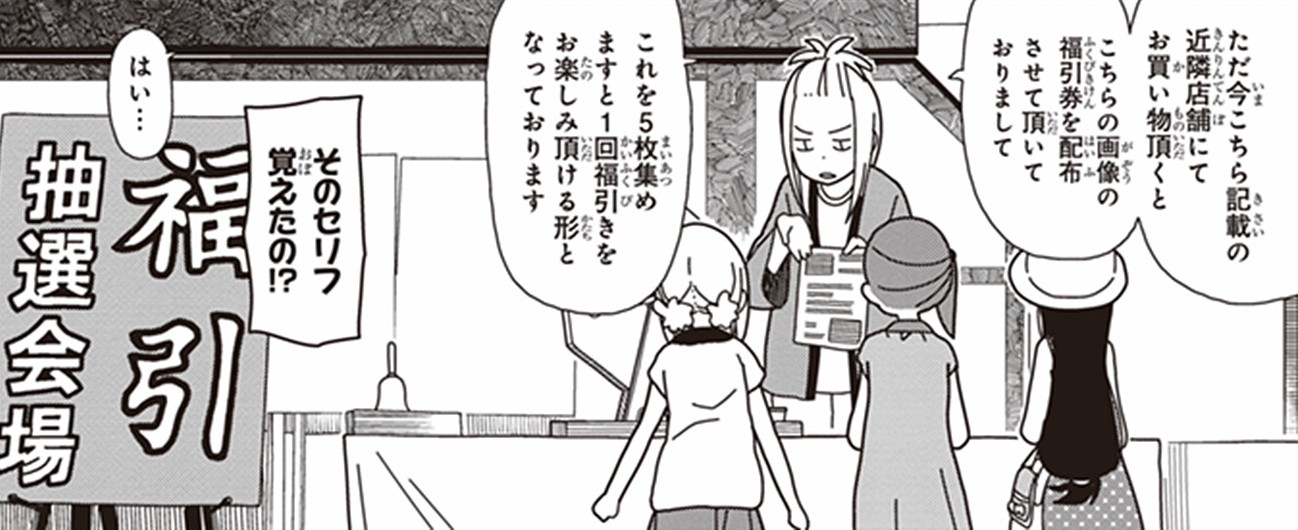
Upon entering the mall, Yui notices a lottery wheel. Sacchan and Kotoha join her, the two quickly pestering Subaru, the part-timer working the lottery, with random questions. Subaru pushes on with her script.
- すばる:
- 「ただ今こちら記載の近隣店舗にてお買い物頂くとこちらの画像の福引券を配布させて頂いておりまして」
- “Currently, when you make a purchase at a neighborhood store, we are distributing the raffle tickets shown in this image.”
- 「これを5枚集めますと1回福引きをお楽しみ頂ける形となっております」
- “If you collect five tickets, you'll be able to enjoy one lottery draw.”
- さっちゃん:
- 「そのセリフ覚えたの!?」
- “You memorized that line!?”
- すばる:
- 「はい…」
- “Yes...”
Subaru is working the lottery booth at the mall and reciting her script while Sacchan and Kotoha pester her. 覚える is “memorize”, and 覚えたの? is “you memorized that?” The memorizing is done, and the result is the speech she just gave.
Example 15 of 18: Receiving a held image with 〜れる

Syaro returns home after seeing Rize at the store.
- シャロ:
- 「リゼ先輩に余計なイメージもたれた…」
- “A wrong impression of me has become held by Rize-senpai...”
- 「あと頭にへんな生物が…」
- “And there was a strange creature on her head...”
- 千夜:
- 「ココアちゃん達に会ったのね!」
- “So you met Cocoa and the others!”
Syaro comes home after running into Rize at the store. イメージをもつ is “form an impression”, and もたれた, the passive past, is “Rize got an impression of me”. Syaro worries about the impression Rize has formed. Chiya figures out the rest: 会ったのね, “so you met Cocoa and the others”.
Example 16 of 18: Trying to make bread with 〜てみる

Cocoa shows off the bread she made.
- ココア:
- 「じゃーんティッピーパン作ってみたんだ」
- “Ta-da, I tried making Tippy bread.”
- リゼ:
- 「看板メニューはこれで決定だな」
- “That settles our signature menu item, then.”
Cocoa shows off the bread she made. 〜てみる is “try doing”, and 作ってみた announces the result: here’s Tippy bread. Rize decides on the spot that it’s their signature menu item.
Example 17 of 18: Re-imagining oneself with 〜直す

Cocoa imagines her future self, but the image isn’t quite right.
- ココア:
- 「あ ちょっと間違えた。やり直し」
- “Ah, I made a little mistake. I'll do it over.”
Cocoa is picturing her future self, and it isn’t coming out right. 間違えた, “I got it wrong”, reports a mistake she has just made. Then she starts over: やり直し, “do-over”.
Example 18 of 18: Finished helping somehow with なんとか
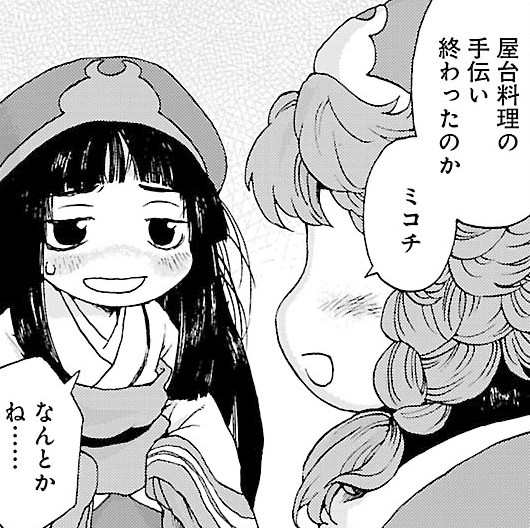
Hakumei is waiting in town. Mikochi joins her and apologizes for being late.
- ハクメイ:
- 「屋台料理の手伝い終わったのか ミコチ」
- “So you're done helping with the stall food, Mikochi?”
- ミコチ:
- 「なんとかね…」
- “Somehow, yeah...”
Hakumei has been waiting in town, and Mikochi finally shows up. 手伝い終わったのか is “so you’re done helping?” What matters is that Mikochi is free now, not when she finished.
A Present State
With some verbs, a た-form naturally describes how someone feels now. お腹がすいた means “I’m hungry”, 疲れた means “I’m tired”, and 困った means “I’m in a bind”. These expressions can present a change or the speaker’s recognition of a state.
- あー、疲れた。
- Ugh, I’m tired.
This use depends on the verb and context. A bare た-form does not always replace ている for a continuing state. The same words can describe the past when a past time is given.
どうしたの? often asks “what’s wrong?” or “what happened?” The speaker may be asking what caused the problem they see now.
Example 1 of 11: A cat's natural instinct with 本能
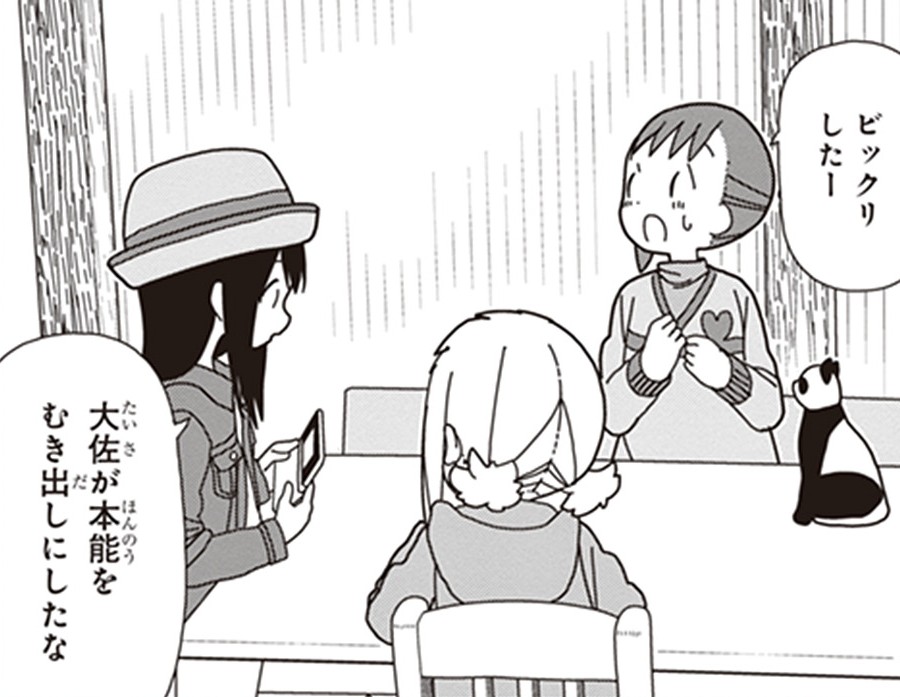
Yui and her friends are in their secret base when a pigeon flies in and lands on the table between them. The group’s cat, Colonel Monochrome, leaps after it, but the pigeon escapes.
- 結衣:
- 「ビックリしたー」
- “That surprised me!”
- 琴葉:
- 「大佐が本能をむき出しにしたな」
- “The Colonel laid bare his instincts.”
A pigeon flew into the girls’ secret base, and their cat, the Colonel, leapt after it. ビックリした, “that surprised me”, is past, though the surprise is still fresh. Kotoha’s むき出しにした, “laid bare”, describes what the Colonel just did.
Example 2 of 11: I'll fix you dinner with 〜てあげる

After a case wraps up, Conan parts ways with Kogoro and Ran to do something. When Conan returns home, Ran gets ready to prepare dinner.
- 蘭:
- 「おなかすいたでしょーー?」
- “You're hungry, right?”
- 「今、何か作ってあげるからね!」
- “I'll make you something right now!”
- コナン:
- 「うん!」
- “'kay!”
Conan comes home after a case, and Ran gets ready to make dinner. おなかすいた means “you’re hungry” right now: 空く is “become empty”, and the た is the result. でしょ makes it a guess, “right?”
Example 3 of 11: Feeling you've gained weight with 〜気がする
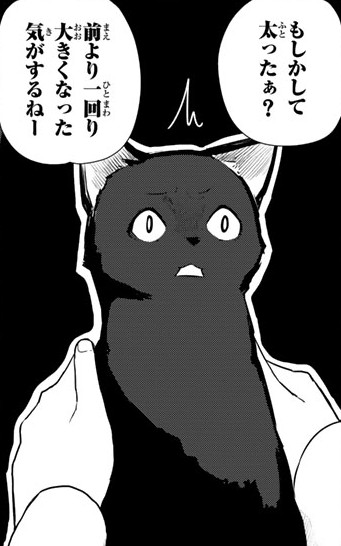
Nao sees Makoto’s cat, Chito. She stops to pet the cat when she notices something.
- なお:
- 「もしかして太ったぁ?前より一回り大きくなった気がするねー」
- “Could it be you've gotten fatter? I feel you've grown a size bigger than before.”
Nao stops to pet Makoto’s cat, Chito, and notices something. 太る means “put on weight”, so 太った is “has gotten fat”, a state Chito is in now. 大きくなった, “has gotten bigger”, works the same way, and 前より, “than before”, makes the comparison.
Example 4 of 11: While I didn't see you with 〜うちに

Jumbo arrives to help Yotsuba and her father move into their new home.
- よつば:
- 「しばらく見ないうちにまた大きくなった!」
- “You've grown bigger since I last saw you!”
- ジャンボ:
- 「お?どこでおぼえたそのセリフ」
- “Oh? Where'd you pick up that line?”
Jumbo has come to help Yotsuba and her father move into their new house. Yotsuba greets him with a line grown-ups say to children: しばらく見ないうちにまた大きくなった, “you’ve grown since I last saw you”. The た is the result, how big he is now. Jumbo wants to know where she picked that up.
Example 5 of 11: Growing in many ways with 成長
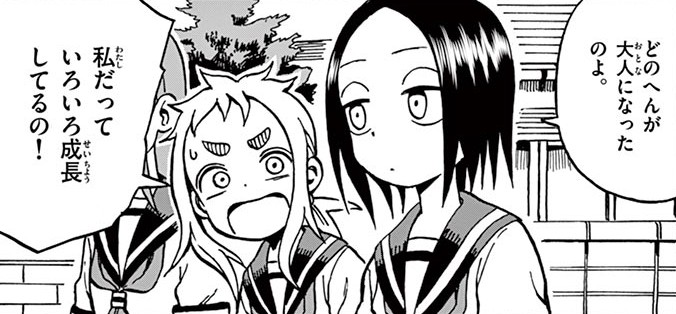
Mina buys a can of coffee, even though she’s bad at bitter drinks. When her friends question her, she says she’s grown up a bit and should be able to drink it.
- サナエ:
- 「どのへんが大人になったのよ。」
- “What part of you has grown up?”
- ミナ:
- 「私だっていろいろ成長してるの!」
- “I've grown in lots of ways!”
Mina bought canned coffee even though she can’t stand bitter drinks, and she claims she’s grown up enough to drink it now. Sanae asks どのへんが大人になったのよ, “what part of you has grown up?” なった asks about Mina as she is now. Mina’s answer, 成長してる, uses ている for the same idea.
Example 6 of 11: Feeling a bit better with 気が晴れる
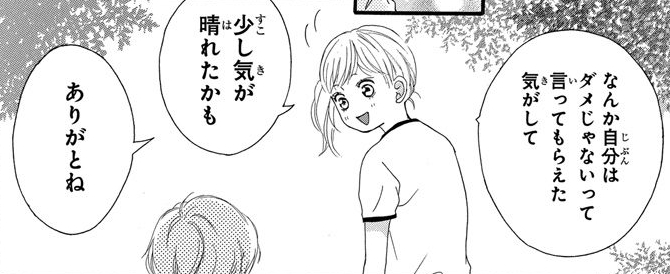
Futaba had been feeling the weight of uncertainty of her standing with Kou. A general discussion about boys and relationships with her friend Kikuchi clears up her feelings.
- 双葉:
- 「なんか自分はダメじゃないって言ってもらえた気がして」
- “It kind of felt like you were telling me I'm not hopeless.”
- 「少し気が晴れたかも」
- “I may be feeling a bit better.”
- 「ありがとね」
- “Thanks.”
Futaba has been anxious about where she stands with Kou, and a talk with her friend Kikuchi helps. 気が晴れる is “feel better”, like clouds clearing. 晴れた describes how she feels now, and かも, “maybe”, keeps it modest.
Example 7 of 11: Depressed over a snatched dumpling with 落ち込む
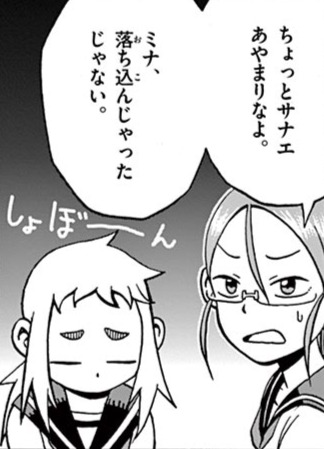
Yukari doesn’t like carrots, so she offers the ones from her lunch to Mina, who gladly accepts. Mina offers one of her dumplings in return, but Yukari is hesitant to accept because Mina did her a favor by taking the carrots. Sanae takes the opportunity to snatch the dumpling and eat it herself, claiming that neither of the other two seemed to want it. Mina mutters that she never said that.
- ユカリ:
- 「ちょっとサナエ あやまりなよ。」
- “Hey, Sanae, apologize.”
- 「ミナ、落ち込んじゃったじゃない。」
- “Mina's gotten all depressed.”
Sanae snatched the dumpling Mina offered Yukari and ate it herself, and Yukari tells her to apologize. 落ち込む is “get depressed”, and 落ち込んじゃった, short for 落ち込んでしまった, describes the state Mina is in now. The じゃない at the end means “look what you did”.
Example 8 of 11: Feeling better after a scolding with 気が済む
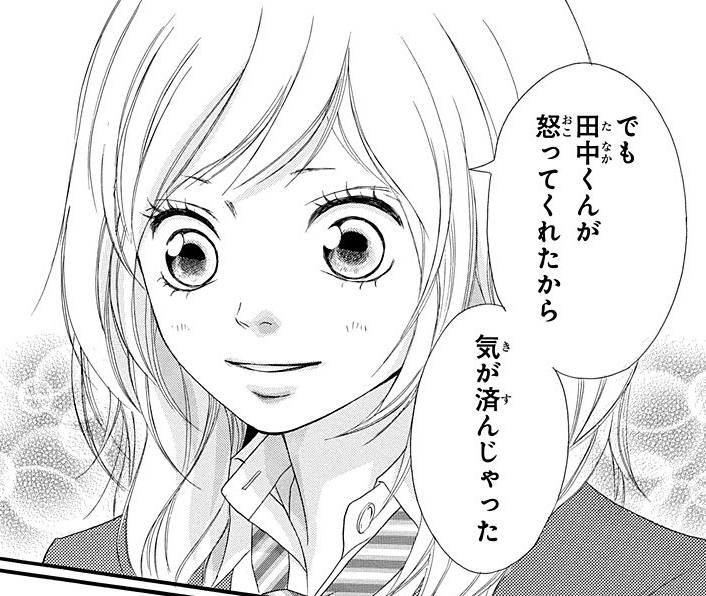
Futaba is falsely accused of stealing by a lunch lady, but Tanaka steps in and vindicates her. Soon after, Futaba thanks Tanaka, saying that when she was accused, she was so angry she didn’t know what to do.
- 双葉:
- 「でも田中くんが怒ってくれたから気が済んじゃった」
- “But since you scolded her for me, I felt better.”
A lunch lady accused Futaba of stealing, and Tanaka stepped in to clear her name. 気が済む is “feel satisfied”, and 済んじゃった says that’s how she feels now, so her anger is gone. 怒ってくれた, “you got angry for me”, gives the reason.
Example 9 of 11: Creating a report with 作成
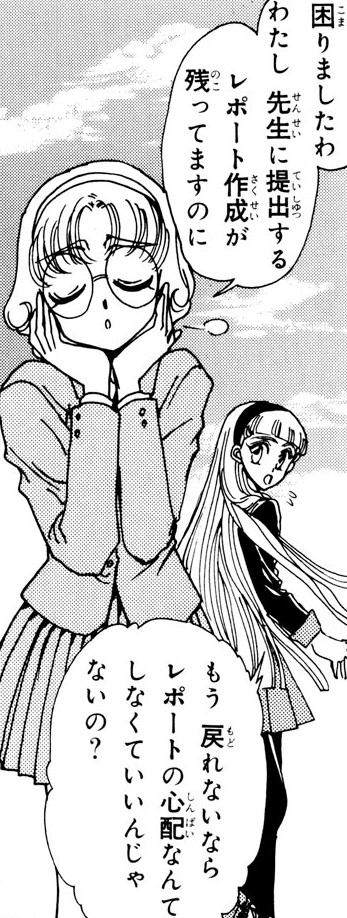
Fuu finds herself spirited away to another world, along with two other girls. A wizard appears before them, saying they cannot return home until they accomplish a specific goal.
- 風:
- 「困りましたわ。 わたし 先生に提出するレポート作成が残ってますのに」
- “Oh dear. I've still got to write that report to hand in to the teacher...”
- 海:
- 「もう 戻れないならレポートの心配なんてしなくていいんじゃないの?」
- “If we can't go back anyway, isn't there no point worrying about the report?”
Fuu has been pulled into another world with two other girls, and they can’t go home until they finish a mission. 困る is “be troubled”, so 困りました is a polite “oh dear, I’m in trouble”, about how things stand now. Her worry is an unfinished report, which makes Umi wonder why she still cares.
Example 10 of 11: Difficult to see the text with 〜づらい
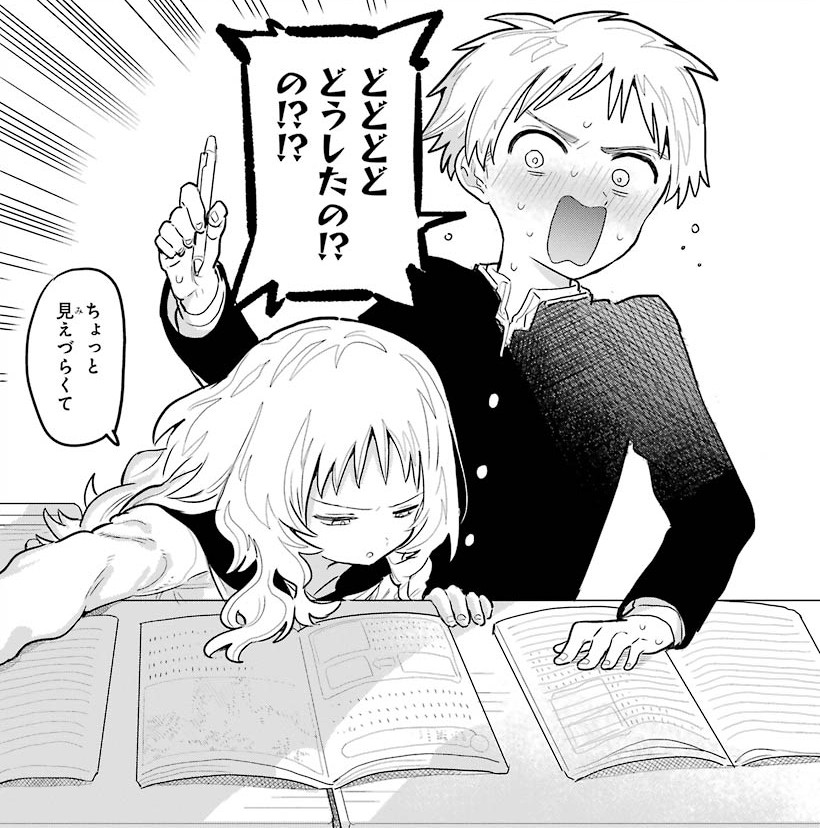
Komura shares his history book with Mie. Since Mie forgot her glasses, she leans in as she strains to see the material written in the book.
- 小村:
- 「どどどど どうしたの!? の!?!?」
- “Wh-wh-what's wrong?!”
- 三重:
- 「ちょっと見えづらくて」
- “It's a bit difficult to see...”
Mie forgot her glasses and is sharing Komura’s textbook. She leans in close to read, and Komura panics. どうしたの? is “what’s wrong?”, about how she is right now. Mie explains that the text is hard to see.
Example 11 of 11: Every successive try with 〜ごとに

The prime suspect in a murder has a rock-solid reason for his innocence: between the time he was on live television and the time of the murder, there’s no way he could have traveled the flights of stairs to reach the victim and return to the camera. To test this, Inspector Megure has Detective Mouri repeatedly run the course from the television stage to the murder scene and back.
- 目暮:
- 「6分47秒か…」
- “6 minutes and 47 seconds, huh...”
- 「どーしたんだ?回を増すごとに遅くなってきとるじゃないか…」
- “What's wrong? You're getting slower with each succession...”
To test a suspect’s alibi, Megure has Mouri run from the TV studio to the murder scene and back, again and again. どーしたんだ? is “what’s the matter?” The た is about how Mouri is doing now: he keeps getting slower.
関口美緒’s study analyzes 疲れた as recognition of fatigue that is present now. This is one analysis of the expression, rather than a rule that all uses of た have the same underlying meaning.
The Moment of Realization
A た-form can mark finding or recognizing something that is true now. あった! means “there it is!”, even though the object is still there. 来た!, “here it comes!”, can announce an arrival as the speaker notices it.
そうだったのか, “so that’s how it was”, can mark learning or remembering something. But のか and んだ can also accompany an ordinary past event. Finding out now that someone baked cookies earlier does not make the baking present. The examples below include both discovery uses of た and past events that someone is only now reacting to.
Example 1 of 14: Seasonal exclusive product with 限定
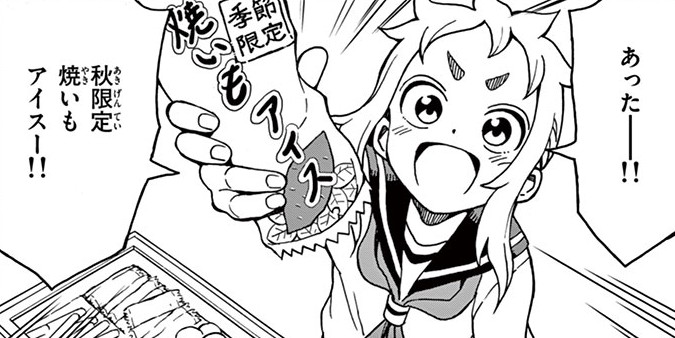
Mina stops by a local convenience store to buy a seasonal ice cream.
- ミナ:
- 「あった!秋限定焼きいもアイスー!!」
- “They have it! The autumn-exclusive baked sweet potato ice cream!”
Mina has stopped at a convenience store for a seasonal ice cream. あった! is “found it!” The ice cream was on the shelf all along, but た marks the moment she spots it.
Example 2 of 14: Is your dad still a detective with 〜の
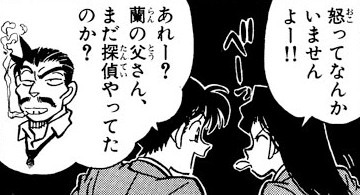
Ran seems angry as Shin’ichi basks in the media attention he’s getting for solving a difficult case. When Shin’ichi asks Ran why she’s angry, she points out that it’s because of Shin’ichi that her father’s been getting fewer case requests.
- 蘭:
- 「怒ってなんかいませんよー!!」
- “I'm not at all angry!”
- 新一:
- 「あれー?蘭の父さん、まだ探偵やってたのか?」
- “Huh? Your dad was still working as a detective?”
Shin’ichi is enjoying the press coverage for solving a hard case, and Ran points out that her father has been getting fewer cases because of him. まだ探偵やってたのか is “so he was still working as a detective?” The past with のか acts as if Shin’ichi is only now finding out something that was true all along, which makes it a jab at Kogoro.
Example 3 of 14: A picked-up earring with イヤリング
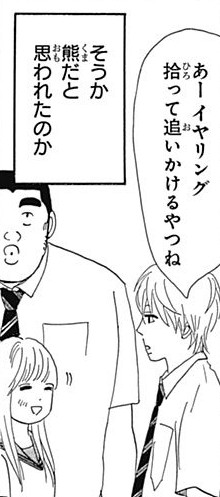
Takeo runs after a mother and her child to give them a shoe they dropped. Due to Takeo’s large size and loud steps, the mother and child get frightened and run from him. After he manages to return the dropped item, Takeo returns to his friends. Rinko remarks that the scene was like “A Bear in the Forest”. Sunakawa recalls the song.
- 砂川:
- 「あーイヤリング拾って追いかけるやつね」
- “Ah, the one who picked up an earring and chased after.”
- 猛男:
- 「そうか 熊だと思われたのか」
- “I see. It's that I was thought of as a bear?”
Takeo chased a mother and child to return a dropped shoe, and they ran from him in fright. Rinko compares it to the song “A Bear in the Forest”. Takeo puts it together: 熊だと思われたのか, “so they thought I was a bear”. The passive past with のか marks the moment he realizes it.
Example 4 of 14: Liberated from a life of paying rent with 解放
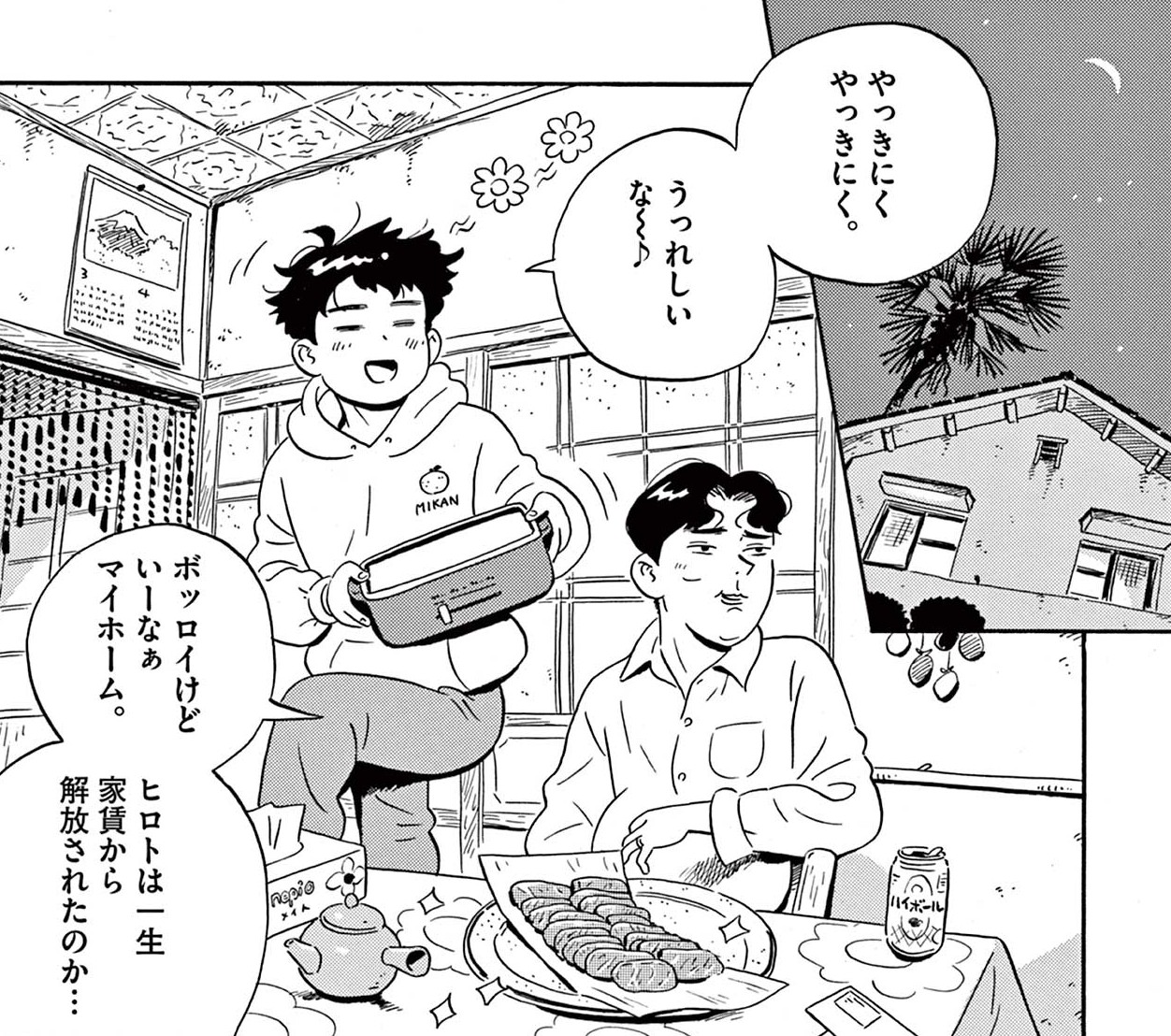
Hiroto’s friend Hideki stops by Hiroto’s workplace looking for a place to stay for the night. He has with him a shopping bag with beef.
- ヒロト:
- 「やっきにく やっきにく。うっれしいな〜♪」
- “Grilllled meat, grilllled. So happy~~♪”
- ヒデキ:
- 「ボッロイけどいーなぁマイホーム。」
- “It's a bit run down, but how nice, having your own home.”
- 「ヒロトは一生家賃から解放されたのか…」
- “Have you been freed from rent forever...?”
Hiroto’s friend Hideki has come to stay the night, and he’s impressed that Hiroto has a house of his own, even a run-down one. 家賃から解放された is “has been freed from rent”. With のか, Hideki is taking in the news as he says it.
Example 5 of 14: Understanding my resolve as a man with 理解
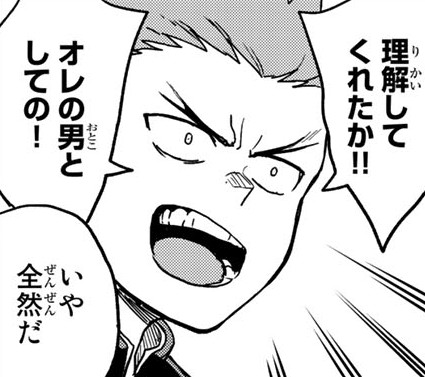
Sakurako tells Takeru not to go to the shogi club as he’ll get in the way of Ayumu being with Urushi. However, as a new member of shogi club, and as a man, Takeru feels it’s his duty to show up. On his way to the shogi club room, he encounters Ayumu who implores him to come to the shogi club room.
- タケル:
- 「理解してくれたか!!」
- “You understood me, huh?”
- 「オレの男としての!」
- “As a man, my (duty)!”
- 歩:
- 「いや全然だ」
- “No, not at all.”
Sakurako told Takeru to stay away from the shogi club so he won’t get between Ayumu and Urushi. Takeru thinks showing up is his duty as a man, and when Ayumu asks him to come along, he takes it as support. 理解してくれたか!! is “you understood!”, said the moment he thinks it’s true. Ayumu’s いや全然だ says it isn’t.
Example 6 of 14: Never mind that, what about the exam with いいから
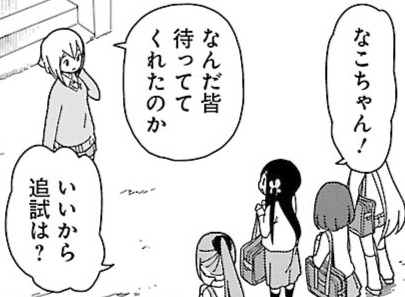
After failing an exam, Nako has to take a make-up exam. Bocchi provides her notes to help Nako learn the material better. After the test, Nako finds Bocchi and their friends waiting for her.
- ぼっち:
- 「なこちゃん!」
- “Nako-chan!”
- なこ:
- 「なんだ皆 待っててくれたのか」
- “Hey everyone. You've been waiting for me?”
- アル:
- 「いいから追試は?」
- “Never mind that, how'd the make-up exam go?”
Nako failed a test and had to take a make-up. When she comes out, Bocchi and the others are there. 待っててくれた is 待っていてくれた, “you waited for me”. なんだ and のか show she’s only just realizing it. Al cuts straight to the question: how did the test go?
Example 7 of 14: A freeloading child with 居候
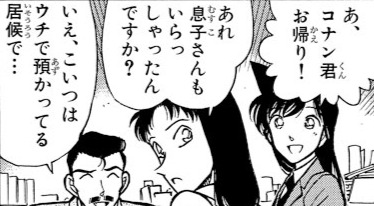
Conan returns home from school to the sound of a music box. When he opens the door, he finds Kogoro and Ran with a client.
- 蘭:
- 「あ、コナン君 お帰り!」
- “Ah, Conan, welcome back!”
- 春菜:
- 「あれ 息子さんもいらっしゃったんですか?」
- “Oh? You have a son, too?”
- 小五郎:
- 「いえ、こいつはウチで預かってる居候で…」
- “No, this kid's just a freeloader we're looking after...”
Conan comes home to find Kogoro and Ran with a client. いらっしゃる is an honorific いる, so 息子さんもいらっしゃったんですか is “oh, you have a son too?” Conan has lived there all along, but the past marks the moment Haruna learns about him. Kogoro calls him a freeloader.
Example 8 of 14: A festival takoyaki food stall with 屋台
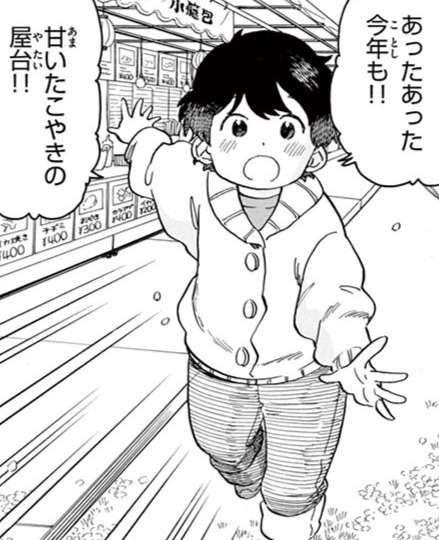
At a local festival, Kiyo hurries over to Sumire and Kenta.
- キヨ:
- 「あったあった 今年も!!」
- “It's here, it's here, again this year!”
- 「甘いたこやきの屋台!!」
- “The sweet takoyaki booth!”
At a local festival, Kiyo hurries over to Sumire and Kenta. あったあった is “there it is!”, and saying it twice makes her sound thrilled. 今年も, “this year too”, says the sweet takoyaki stall is back.
Example 9 of 14: Demolishing the movie theater with 解体
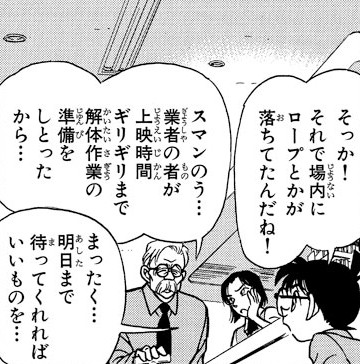
Conan and his friends go to the theater to see a movie. There, they discover this is the last day before the theater closes.
- コナン:
- 「そっか!それで場内にロープとかが落ちてたんだね!」
- “Oh, I see! That's why there were ropes and stuff lying around the venue!”
- オーナー:
- 「スマンのう… 業者の者が上映時間ギリギリまで解体作業の準備をしとったから…」
- “Sorry about that... The contractor's crew was rushing to get the dismantling ready right up until showtime...”
- スタッフ:
- 「まったく… 明日まで待ってくれればいいものを…」
- “Honestly... They could've at least waited until tomorrow...”
Conan and his friends have come to a movie theater on its last day before closing. そっか! is “oh, I get it!”, and 落ちてたんだ, “that’s why (ropes) were lying around”, connects what he saw earlier with what he has just learned. The owner’s しとった is a western Japanese version of していた.
Example 10 of 14: How about some cookies with 〜でしょう

After serving tea to her friends, Syaro brings out a plate of cookies.
- シャロ:
- 「ハーブを使ったクッキーはいかがでしょう?私が焼いたんですが…」
- “How about some cookies made with herbs? Although I'm the one who baked them...”
- ◯:
- 「シャロが作ったのか」
- “You made these, Syaro?”
Syaro has served tea, and now she brings out cookies made with herbs. ハーブを使ったクッキー puts a past verb before a noun, “cookies made with herbs”, and 私が焼いた says she baked them. The reply, シャロが作ったのか, “you made these?”, takes in the news.
Example 11 of 14: Keeping a museum from shutting down with 事件
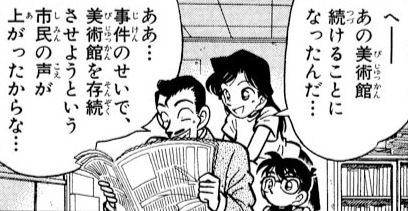
Following the solving of a murder case, Detective Mouri reads an article about the museum where the murder took place.
- 蘭:
- 「へーーー あの美術館続けることになったんだ…」
- “Wow... So they decided to keep the art museum open after all...”
- 毛利:
- 「ああ… 事件のせいで美術館を存続させようという市民の声が上がったからな…」
- “Yeah... Because of the incident, there was a public outcry to keep the art museum open...”
After the murder case at the art museum, Kogoro is reading an article about it. Ran’s へーーー shows she’s just learning the news: 続けることになったんだ, “so they decided to keep it open”. Kogoro explains why with another past, 声が上がった, “people spoke up”.
Example 12 of 14: Littering a soft drink can with ポイ捨て

As Kenji Fudazuki ponders ways to increase his image as a delinquent, he hears a teacher asking who littered an empty soft drink can. Seeing an opportunity, Kenji takes credit for the misdeed. With this revelation, the teacher backs off and leaves quietly.
- Students:
- 「札月だったのか。」
- “So it was Fudazuki, huh?”
- 「しかしポイ捨てしといて全く悪びれてないぜ…」
- “But to litter, he really has no shame...”
- 「むしろ怒ってた先生ニラんでたぜ。」
- “Instead, he glared at the scolding teacher.”
- 「ホント…怖いなぁ。」
- “He truly is scary.”
A teacher asked who littered an empty can, and Kenji Fudazuki, who wants to look like a delinquent, claimed it. 札月だったのか is “so it was Fudazuki”. The past with のか marks the moment the students think they’ve found out. 怒ってた先生, “the teacher who was angry”, puts ていた before a noun.
Example 13 of 14: When you're small with 〜うちは
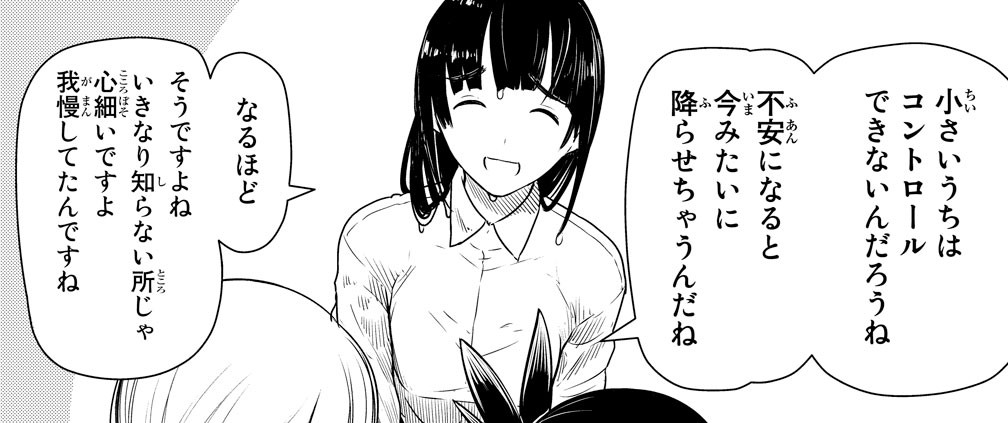
During a visit with Anzu’s family, Makoto receives a request to babysit for another witch. Things are fine at first, but after a while, rain begins to pour inside. Anzu’s mother realizes that the child they’re watching over has rain magic.
- 杏子の母:
- 「小さいうちはコントロールできないんだろうね。不安になると今みたいに降らせちゃうんだね」
- “You don't have control while you're small, right? When he gets uneasy, he makes it rain like just now.”
- 真琴:
- 「なるほど。そうですよね。いきなり知らない所じゃ心細いですよ。我慢してたんですね」
- “I see. So that's it. It's a little scary suddenly being in a place you don't know. You've been patient, haven't you?”
Makoto is babysitting a young witch at Anzu’s house when rain starts pouring indoors. Anzu’s mother realizes the child has rain magic and makes it rain when he’s anxious. Makoto works out what that means: 我慢してたんですね, “so he’s been holding it in”. ていた with んです marks something that was true all along, which she’s only now seeing.
Example 14 of 14: You're already awake with 起きてもた
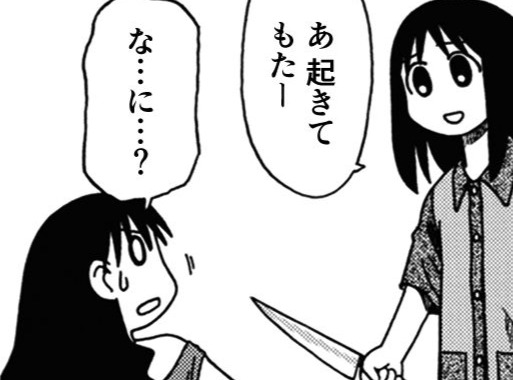
During a vacation trip with her teacher and friends from class, Ayumu plans to wake the teacher by banging a ladle against a frying pan. Since Ayumu is still half asleep herself, she doesn’t realize all she’s grabbed is a kitchen knife. She enters the teacher’s room only to find her sitting up already.
- 歩:
- 「あ 起きてもたー」
- “Oh, you're already awake!”
- ゆかり:
- 「な…に…?」
- “What...?”
On a trip, a half-asleep Ayumu sets out to wake their teacher, Yukari, by banging a ladle on a frying pan, though what she’s holding is a kitchen knife. Yukari is already sitting up. 起きてもた is Kansai for 起きてしまった, and it’s what Ayumu says the moment she sees.
Remembering and Checking with 〜っけ
〜っけ checks a memory or introduces a recollection. With a past verb, as in 泳いだっけ, it follows the た-form. In 何曜日だっけ, the だ is the copula, not a verb’s voiced past ending. This is casual speech. Copular 〜だっけ can ask about the present, as in 何曜日だっけ?, “what day is it again?”
- 名前、何だっけ?
- What was your name again?
Without a question, 〜たっけ can recall an experience with some feeling: “I remember doing…” The past alone can also mark something just remembered, such as a plan: 今日テストがあった!, “we have a test today!”
Example 1 of 4: Relax about what day it is with 安心

After returning home from work, Nishikata is ready to sit back and relax for a bit. Takagi leans over and asks Nishikata if he knows what day it is.
- 西片:
- 「あれ?何の日だっけ?」
- “Huh? What day is it again?”
- 高木:
- 「2人の記念日とかではないから安心して。」
- “Relax, it's not an anniversary or anything like that.”
Nishikata has just gotten home from work, and Takagi asks if he knows what day it is. 何の日だっけ? is “what day is it again?” It’s about today, but だっけ treats it as something he ought to know already. Takagi lets him off: it isn’t their anniversary.
Example 2 of 4: Receiving a scolding with 〜れる

Cocoa and her friends visit an indoor hot spring.
- ココア:
- 「小さい頃銭湯で泳いだっけ」
- “Come to think of it, I used to swim at the public bath when I was little.”
- シャロ:
- 「それでよく怒られたわよね」
- “You used to get scolded for that a lot, right?”
Cocoa and her friends are at an indoor hot spring. 泳ぐ ends in ぐ, so its past is 泳いだ. 泳いだっけ looks back on a childhood memory: “I remember swimming at the public bath when I was little.” Syaro guesses the rest: she must have gotten scolded for it a lot.
Example 3 of 4: Replacing the bathroom lock with 交換

The bathroom door lock broke, leaving the door unable to open. With a bit of effort, Yousuke is finally able to unlock it.
- 葉介:
- 「こりゃさっさと交換した方がいいな」
- “Looks like I'd better replace it right away.”
- 「近くで売ってるトコあったっけなぁ…(あちィ…)」
- “Was there somewhere nearby that sells them...? (Man, it's hot...)”
The bathroom lock broke, and Yousuke has finally gotten the door open. It needs replacing right away. 近くで売ってるトコあったっけ is “was there a place nearby that sells them?” He’s trying to remember the neighborhood. His first line, 交換した方がいい, uses た differently, as part of a set pattern for advice.
Example 4 of 4: Classroom bag inspection with 検査
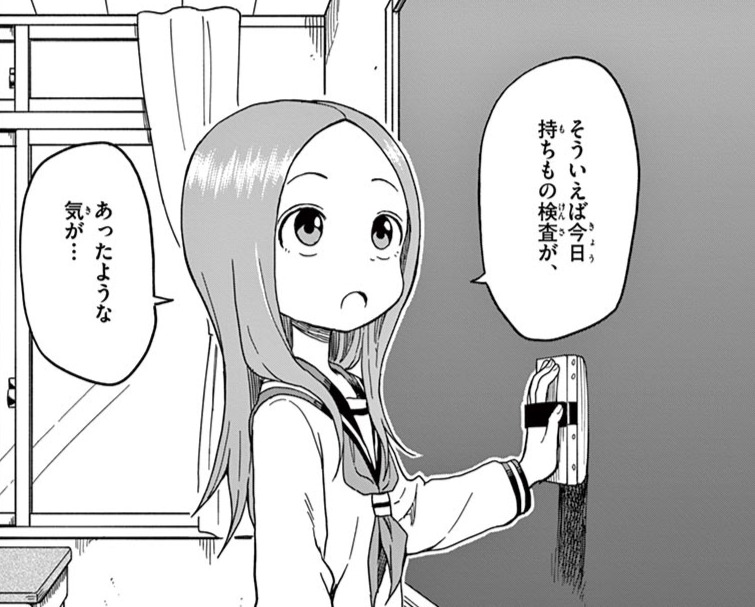
Nishikata and Takagi are on duty preparing the classroom before class.
- 高木:
- 「そういえば今日持ちもの検査があったような気が…」
- “Come to think of it, I think we have a bag inspection today…”
Nishikata and Takagi are getting the classroom ready before school, and Takagi remembers something: 持ちもの検査があった, “there’s a bag inspection”. The inspection is today, but the past marks it as something she has just recalled. ような気が, “I have a feeling”, keeps it vague.
Regrets and Missed Chances
Some past forms appear in regrets and unrealized possibilities. 〜べきだった often means “should have”. 〜たかった means “wanted to”; it does not by itself tell us whether the wish came true. のに can express disappointment when an expectation fails.
- もっと早く言ってくれればよかったのに。
- I wish you’d told me sooner.
With a condition stated or understood, a past verb can say what would have happened. のに adds regret: 言ってくれたら手伝ったのに, “if you’d told me, I would have helped”.
Example 1 of 7: Should have brought an umbrella with 〜べきだった

On the way home from shopping, it starts raining.
- お母さん:
- 「傘持つべきだったねー。」
- “We should have brought an umbrella, huh?”
- お父さん:
- 「そうだなー。」
- “You're right.”
The family is on the way home from shopping when it starts to rain. べきだ is “should”, and its past べきだった is “should have”: they should have brought an umbrella. ね invites agreement, and the father gives it.
Example 2 of 7: Wanted to you taste-test with 〜てほしかった
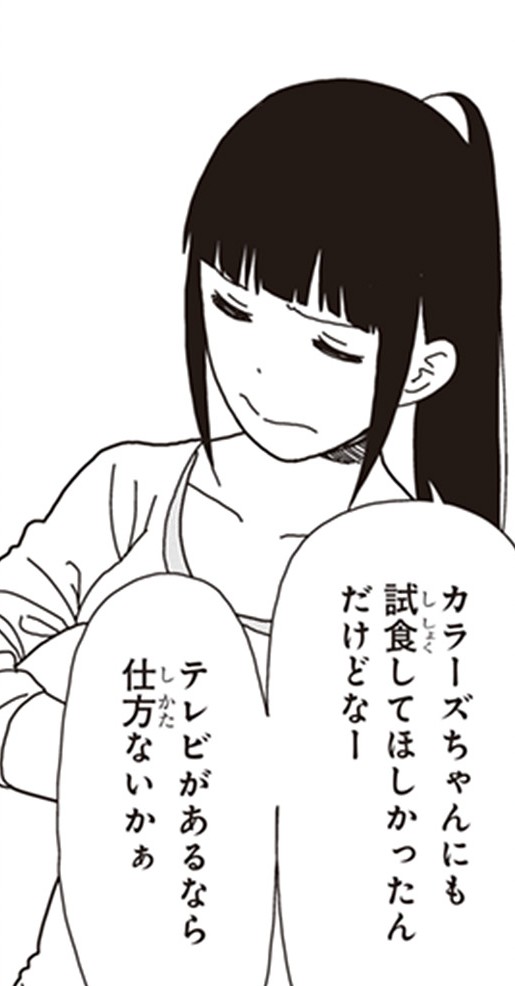
Momoka notices the trio Colors pestering a television cameraman. She intervenes to help him, telling the girls that she is heading to her family’s bakery to have taste-testing of her new type of rice ball.
- ももか:
- 「カラーズちゃんにも試食してほしかったんだけどなー」
- “I wanted you all to do some taste-testing as well, but...”
- 「テレビがあるなら仕方ないかぁ」
- “If it's television, it can't be helped, huh?”
Momoka rescues a TV cameraman from the Colors and mentions she’s on her way to have people try her new rice balls. 〜てほしかった is “I wanted you to…”: she’d hoped they would come too. んだけどなー trails off in disappointment, and the next line lets them go, since they’re busy with TV.
Example 3 of 7: Quoting a reward with って
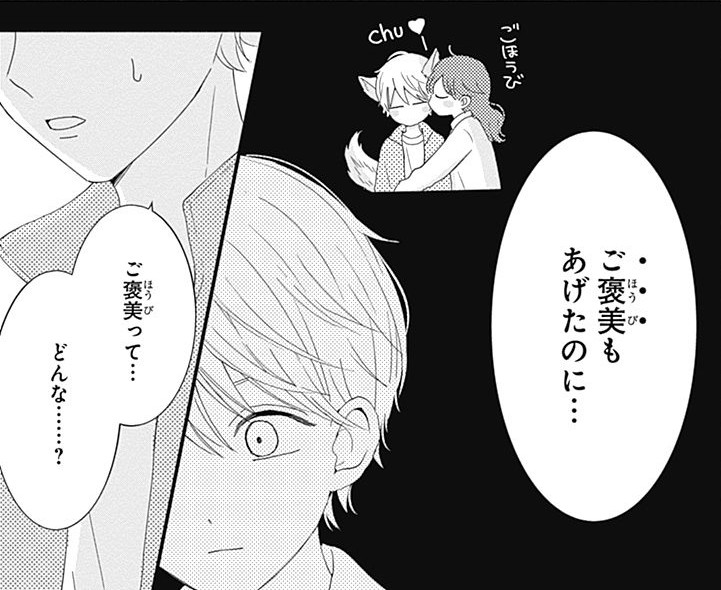
Ayumu tries to throw a basketball into the basket, only to have it bounce back and hit her in the face. After waking in the infirmary, she learns from her friend that Luna carried her there. When Luna denies it, Ayumu says she would have been happy if he did.
- 歩:
- 「ご褒美もあげたのに…」
- “I would have even given you a reward...”
- 月:
- 「ご褒美って… どんな……?」
- “A reward... What kind?”
Ayumu got hit in the face with a basketball, and her friend says Luna carried her to the infirmary. Luna denies it, and Ayumu says she’d have been happy if he had. ご褒美もあげたのに is “I would even have given you a reward”. The understood condition is “if you had carried me”. あげた gives the unrealized result, and のに adds regret that it didn’t happen. Luna wants to know what kind of reward.
Example 4 of 7: Place of part-time job with 〜先

Syaro explains the qualities of a shop’s tea cup, but Rize points out that her workplace primarily sells coffee.
- シャロ:
- 「リゼ先輩のバイト先行ってみたかったのに…」
- “I wanted to try going to Rize-senpai's part-time workplace...”
- ココア:
- 「もしかしてコーヒー苦手?」
- “Do you not like coffee?”
Syaro has been explaining what makes a good teacup, and Rize reminds her that her café mostly serves coffee. 〜てみたい is “want to try”, and 〜てみたかった is its past. With のに, it becomes a complaint: Syaro had hoped to visit Rize’s workplace. Cocoa guesses that Syaro doesn’t like coffee.
Example 5 of 7: Wanting to lie down with 〜たい

Cocoa asks Chino where her rabbit, Tippy, is. Chino explains that Tippy is watching over the bar with her father.
- ココア:
- 「そっかー」
- “I see.”
- 「ぎゅーってして寝たかったのになー」
- “I wanted to sleep while hugging her tight, though.”
- チノ:
- 「ティッピーは抱き枕じゃないですよ」
- “Tippy isn't a body pillow.”
Cocoa wants to know where Tippy is, and Chino says Tippy is helping her father at the bar. 寝たかった, the past of 寝たい, is “wanted to sleep”, and のになー sighs over a plan that won’t happen: she wanted to sleep hugging Tippy. Chino points out that Tippy isn’t a body pillow.
Example 6 of 7: Seasonal uniform change contest with 勝負
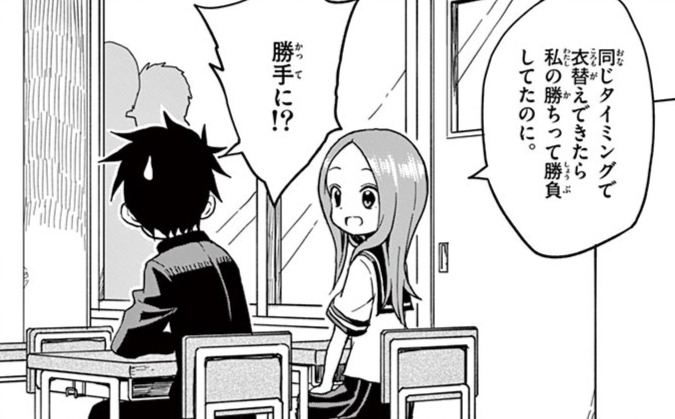
Nishikata arrives at school wearing his winter school uniform. He finds Takagi still wearing her summer uniform. Nishikata’s reason for the switch is that he heard the weather forecast for cooler temperatures. Takagi laments her carelessness.
- 高木:
- 「同じタイミングで衣替えできたら私の勝ちって勝負してたのに。」
- “We had a contest going where if we switched uniforms at exactly the same time, it would count as my win.”
- 西片:
- 「勝手に!?」
- “You just decided that on your own!?”
Nishikata switched to his winter uniform because of the forecast, and Takagi is still in summer clothes. 勝負してたのに is “and I had a contest going”. ていた plus のに sighs over a contest she has just lost. Nishikata had no idea there was one.
Example 7 of 7: The trouble of forgetting about today with せっかく〜のに

After Cocoa has a string of bad luck throughout the day, Chiya takes her to the tea shop where Syaro works to get her mind off everything that happened.
Just as Cocoa’s finally cheered up, Syaro comments to herself about her own bad luck, returning Cocoa to gloom.
- 千夜:
- 「せっかく今日の出来事忘れてたのについてないなんて言っちゃだめ!」
- “We went through the trouble to forget about today, so don't say bad luck!”
- シャロ:
- 「よくわからないけどめんどくさい…」
- “I don't really understand, but this is a pain...”
Cocoa had bad luck all day, and Chiya brought her to Syaro’s tea shop to cheer her up. Just as it’s working, Syaro grumbles about her own bad luck. 忘れてたのに is “she had finally forgotten”, and せっかく, “after all that”, says the effort is now wasted.
Brisk Commands
A repeated た-form can be an impatient order, as in 帰った帰った, “go on, go home”, or どいたどいた, “out of the way”. This use urges someone to act right away, often with repetition or さあ. It is not a general substitute for an imperative. 待った! is a set phrase for “hold it!”
Patterns Built on the た-Form
Several patterns start from the た-form. In these, the た is part of the pattern and may not point to the past at all. Follow the links for each pattern’s meaning and use.
- 〜たことがある: have done before
- 〜た方がいい: had better do
- 〜たら: if, when
- 〜たばかり: just did
- 〜たり〜たりする: do things like … and …
- 〜たつもり: thought one had done
- 〜たまま: with something left as it is
Example 1 of 14: Have met with 〜た+ことがある
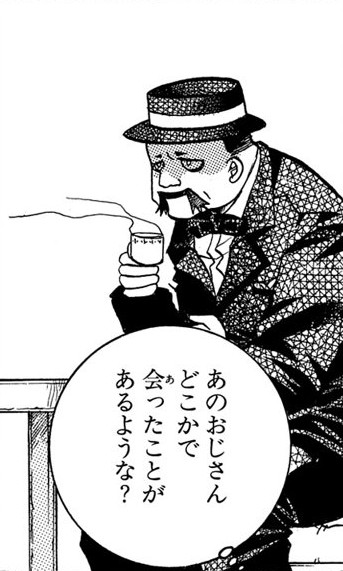
Akari and President Aria walk with Alicia to her meeting location. Rather than head back home, Akari and President Aria decide to sit at the café across the street until the meeting is over. There, Akari notices a gentleman sitting at another table.
- 灯里:
- 「あのおじさんどこかで会ったことがあるような?」
- “It feels like I have met that man somewhere before.”
Akari is waiting at a café while Alicia is in a meeting, and she notices a man at another table. 〜たことがある, “have done before”, is built on the past 会った. ような, “it seems”, makes it a vague feeling: she thinks she’s met him somewhere.
Example 2 of 14: Have seen with 〜た+ことがある
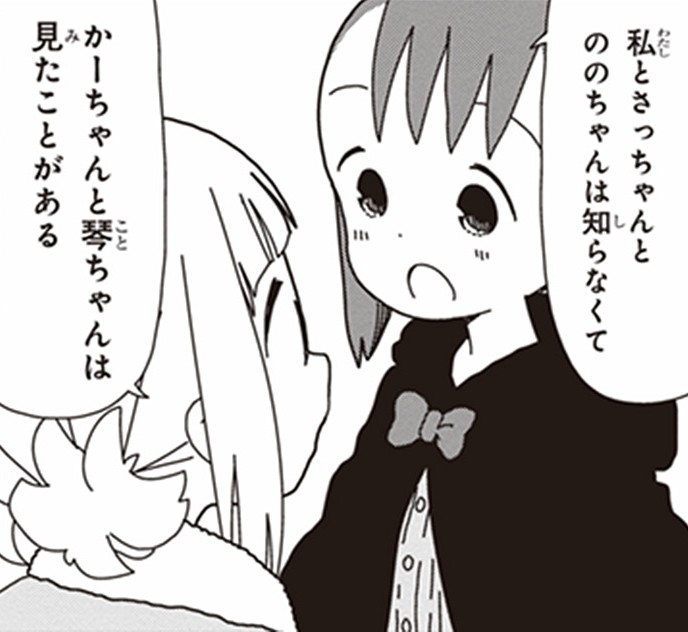
Sacchan and her friends come across a torn piece of paper with 「あたり100」 written on it. Thinking it may be for a 100,000 yen prize, the girls head to the shopping district to redeem it. Along the way, their friend Nonoko says she doesn’t recognize where the ticket is from, but Sacchan’s mother says it looks familiar somehow. Kotoha admits it seemed familiar to her as well, but she thought it was just her imagination until now.
- 結衣:
- 「私とさっちゃんとののちゃんは知らなくて」
- “Even though Sacchan, Nono-chan, and I don't know it...”
- さっちゃん:
- 「かーちゃんと琴ちゃんは見たことがある」
- “My mom and Koto-chan have seen it before.”
The girls found a torn ticket and are trying to work out where it’s from. Yui, Sacchan, and Nono don’t recognize it, but Sacchan’s mom and Kotoha do. 見たことがある is “have seen it before”.
Example 3 of 14: Feeling running is better after all with 〜気がする
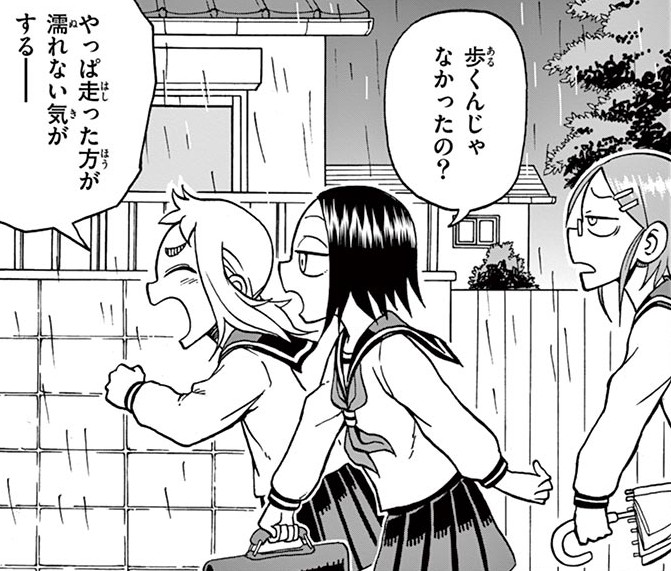
Mina proclaims she knows a shocking fact about being caught in the rain: it doesn’t matter whether you walk or run because you’ll get wet the same amount either way. Sanae says she heard running is better to avoid getting as wet. Mina says if it starts raining, she’ll walk, and Sanae has to run.
- サナエ:
- 「歩くんじゃなかったの?」
- “Weren't you going to walk?”
- ミナ:
- 「やっぱ走った方が濡れない気がするーーー」
- “I feel like I'll get less wet if I run after all!”
Mina claimed it doesn’t matter whether you walk or run in the rain, and she said she’d walk. Now it’s raining, and she’s running. 〜た方が is the advice pattern, “it’s better to…”, so 走った方が濡れない is “running keeps you drier”. Sanae’s 歩くんじゃなかったの?, “weren’t you going to walk?”, recalls Mina’s earlier plan, rather than saying she actually walked.
Example 4 of 14: Better to give up fortune telling with 〜た+方がいい

Cocoa did fortune telling for her friends, only for all their fortunes to happen to her in a bad way.
- チノ:
- 「ココアさんは人の不幸の身代わりになる才能があるんですか?」
- “Cocoa, do you have a talent for taking on other people's misfortune?”
- リゼ:
- 「今後占いやめた方がいいぞ自分のために」
- “For your own sake, you had better stop fortune telling from now on.”
- ココア:
- 「なんで!?」
- “Why!?”
Cocoa told her friends’ fortunes, and every one came true for her instead, all of it bad. Rize gives her advice: 占いやめた方がいい, “you’d better quit fortune-telling”. The た in やめた doesn’t mean she has quit. It’s part of the advice pattern.
Example 5 of 14: If you feel up to kendo with 気が向く
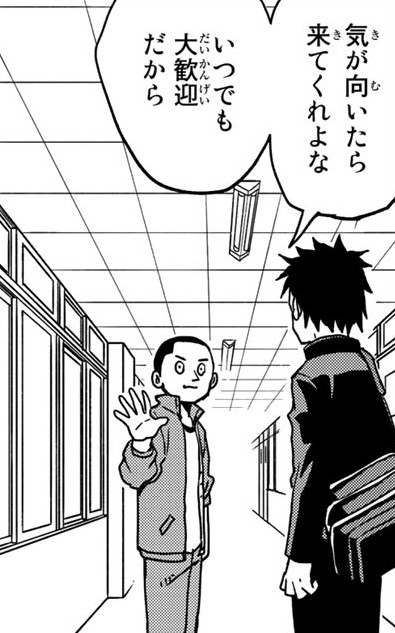
A member of the kendo club asks Ayumu to join the club, so they can win the next tournament. Although Ayumu is well known for his kendo prowess in middle school, he’s in the shogi club now, and rejects the request.
- 生徒:
- 「気が向いたら来てくれよな」
- “Come by whenever you feel like it.”
- 「いつでも大歓迎だから」
- “You're always welcome.”
A kendo club member wants Ayumu to join, since he was a well-known kendo player in middle school. Ayumu is in the shogi club now and says no. 気が向く is “feel like it”, and 〜たら makes it “if you ever feel like it”. The た is part of たら, not a past.
Example 6 of 14: Experience returning home for a backpack with 〜た+ことがある

Rize wonders what became of the missing piece from Chiya’s puzzle. Syaro suggets it’ll turn up once it’s no longer being looked for. This reminds Chiya of something else that was forgotten.
- 千夜:
- 「シャロちゃんは学校にランドセルを忘れたまま帰ってきた事があったわ」
- “Syaro-chan once came home having left her backpack at school.”
- シャロ:
- 「明日学校行けない…」
- “I can't go to school tomorrow...”
The group is wondering where the missing piece of Chiya’s puzzle went, and Syaro says it’ll turn up once they stop looking. That reminds Chiya of something Syaro once forgot: 帰ってきた事があった, “there was a time she came home (without her backpack)”. ことがあった is the past of ことがある, and 忘れたまま, “with it left behind”, is another pattern built on た.
Example 7 of 14: Experience with sleepovers with 〜た+ことがある

Cocoa thinks Rize is nervous about staying overnight with her and Chino.
- リゼ:
- 「いや… 親父の部下に誘われたワイルドなキャンプしか経験した事ないから…」
- “Well... I've only had the experience of those wild camping trips my dad's subordinates invited me on...”
- 「こんなの初めてで…」
- “I've never done anything like this before...”
- ココア:
- 「ワイルド?」
- “Wild?”
Cocoa thinks Rize is nervous about staying the night with her and Chino. Rize admits she’s only been on rough camping trips with her father’s men. キャンプしか経験した事ない combines しか with a negative: “I’ve experienced nothing except those camping trips”. Rize has been camping, but this kind of sleepover is new to her. 誘われたワイルドなキャンプ, “wild camping trips I was invited on”, puts a past passive before a noun.
Example 8 of 14: Experienced a situation in a comic with 〜た+ことがある

Rize and Chino watch as Cocoa and another girl reach for the same teacup in a shop.
- チノ:
- 「こんなシチュエーション漫画でみたことあります」
- “I've seen this kind of situation in manga before.”
- リゼ:
- 「よく恋愛に発展するよな」
- “This kind of thing often leads to romance.”
At a shop, Cocoa and another girl reach for the same teacup at the same moment. Chino has seen this before, in manga: みたことあります, with the が of ことがあります dropped. Rize knows how those scenes usually end: in romance.
Example 9 of 14: Experienced drinking tea with 〜た+ことがある

After a misunderstanding brings Cocoa and her friends to the teahouse where Syaro works, the group stays to have some tea.
- ココア:
- 「やっぱダンディー・ライオンだよね!」
- “Dandy Lion is definitely the one!”
- チノ:
- 「飲んだことあるんですか?」
- “Have you drunk it before?”
After a mix-up brings the group to the tea shop where Syaro works, Cocoa announces her favorite tea. 飲む ends in む, so its past is 飲んだ, and 飲んだことある is “have drunk it before”. Chino wants to know if Cocoa really has.
Example 10 of 14: Experienced receiving a gold prize with 〜た+ことがある

Talking about drawing, Cocoa is boastful of her own ability.
- ココア:
- 「これでも金賞もらったことあるんだ」
- “Believe it or not, I've actually won a gold medal before.”
- リゼ:
- 「町内会の小学生低学年の部とかいうのはナシな」
- “And don't tell me it was in the neighborhood association's lower-elementary division.”
Cocoa is bragging about her drawing. これでも, “believe it or not”, and もらったことある, “have received”, claim a gold prize in her past. Rize heads off the obvious catch: it had better not be the neighborhood association’s division for young children.
Example 11 of 14: Never seen a panda with 見たことない
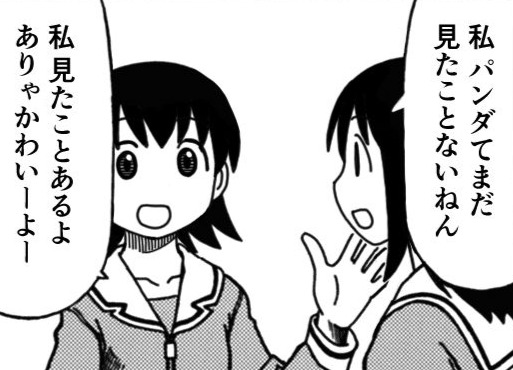
Chiyo shows her friends in class the panda picture book she bought.
- 歩:
- 「私 パンダてまだ見たことないねん」
- “I haven't seen a panda yet.”
- とも:
- 「私 見たことあるよ ありゃかわいーよー」
- “I've seen one. They're cute!”
Chiyo has brought a panda picture book to class. Ayumu has never seen a real one, 見たことない, and まだ, “yet”, says she hasn’t had that experience up to now. Tomo has: 見たことある. Both build on the past 見た. Ayumu’s ねん is Kansai for んだ.
Example 12 of 14: A submerged town with 水没
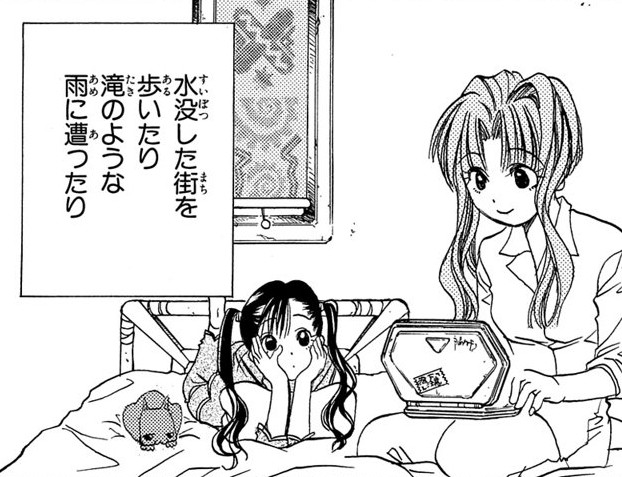
While out buying cat food during acqua alta, when tides have risen onto the streets, Akari is caught in a heavy downpour. She finds herself near Himeya Company, where her friend Aika lives, and she’s invited in to stay the night. As the two watch the falling rain through a window, Akari types an e-mail about her adventure that day.
- 灯里:
- 「水没した街を歩いたり滝のような雨に遭ったり」
- “Walking through a flooded town, getting caught in a downpour...”
During acqua alta, Akari got caught in a downpour and is spending the night at Aika’s. She types an email about her day. 〜たり〜たり lists a few of the things she did: 歩いたり, “walking”, and 遭ったり, “getting caught”. 水没した街, “the flooded town”, puts a past verb before a noun.
Example 13 of 14: Receiving a throwing with 〜れる

After learning the fortunes she told didn’t come true for Chino and Rize, Cocoa lists the bad fortune she ran into.
- ココア:
- 「そっかー」
- “I see.”
- 「私あんこが落下してきたりスカートめくれちゃってたりシャロちゃんにお金投げられたり色々あって大変だったよー」
- “All sorts of things happened to me, like Anko falling on me, my skirt flipping up, and having Syaro-chan throw money at me, so it was rough.”
- 「占い勝負はティッピーの勝ちだね」
- “Then Tippy wins the fortune-telling contest.”
Cocoa’s fortunes for Chino and Rize didn’t come true, so she lists the bad luck she ran into herself. Three たり forms list the mishaps: Anko fell on her, her skirt flipped up, and Syaro threw money at her. The たり forms take no tense of their own. The final 大変だった, “it was rough”, sets it all in the past.
Example 14 of 14: Suppressed presence with 〜た+つもり

While changing into her uniform, Rize hid in the closet when she sensed someone unfamiliar nearby. Cocoa, feeling as though she was being watched, opened the closet door.
- ココア:
- 「下着姿の…ドロボーさん?」
- “A burglar… in their underwear?”
- リゼ:
- 「完全に気配を殺してたつもりなのに」
- “I thought I completely suppressed my presence, and yet...”
Rize hid in the closet while changing into her uniform, sensing a stranger nearby. Cocoa felt watched and opened the door. 殺してた is casual 殺していた, describing her attempt to keep her presence hidden. With つもり, 気配を殺してたつもり means “I thought I was keeping my presence completely hidden”. のに says it didn’t work.
Related Grammar
- Connecting actions with 〜て・〜で
- The て-form uses identical sound changes; learn one set, get both.
- Previous experience with 〜た+ことがある
- たことがある builds "have done before" on the た-form.
- If and when with 〜たら
- The たら conditional is the た-form plus ら.
- Just happened with 〜た+ばかり
- たばかり builds "just did" on the た-form.
- Giving advice with 〜た+方がいい
- Advice grammar that attaches to the た-form.
