Polite style with です and ます
Grammar: Colloquial and Casual Speech
です and ます mark the polite style: です is the polite “is”, and ます rides on the verb stem (行きます “go (polite)”).
In manga, politeness can be a form of characterization: who uses ます to whom, and when they stop, signals relationships.
Usage Notes
ます attaches to the ます-stem and conjugates as ました (past), ません (negative), ましょう (volitional). です follows nouns and adjectives, with でした and じゃありません as its past and negative.
い-adjectives take です directly (高いです).
Formation
View formation details
-
Verb (ます-stem) + ます
- 毎日学校に行きます
- "I go to school every day."
-
〜ました (past)
- 昨日、映画を見ました
- "I watched a movie yesterday."
-
〜ません (negative)
- 肉は食べません
- "I don't eat meat."
-
Noun / な-adjective + です
- 私は学生です
- "I'm a student."
-
い-adjective + です
- この店は安いですよ
- "This shop is cheap, you know."
- Note: い-adjectives keep their own conjugation and simply add です.
Talking to Superiors and Strangers
The default register for students to teachers, juniors to seniors, and anyone to a customer.
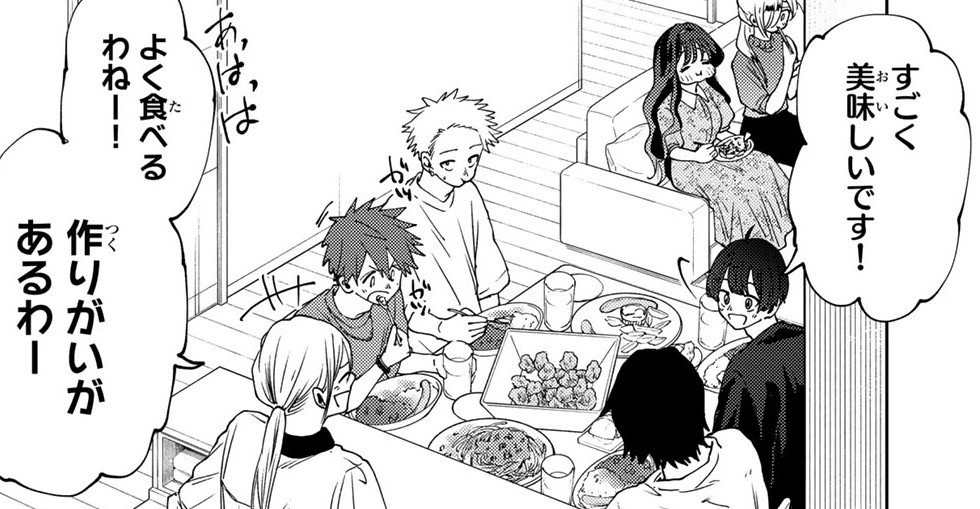
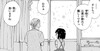
Rintaro’s mother is overjoyed when her son has friends over for the first time in his life. She prepares a large meal for them to eat.
- 絢斗:
- 「すごく美味しいです!」
- “This is incredibly delicious!”
- 杏子:
- 「よく食べるわね! 作りがいがあるわー」
- “You sure do eat a lot! It makes cooking worthwhile!”
For Rintaro’s friends, it would be improper to not speak politely to his mother.
The Permanently Polite Character
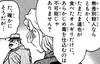
Some characters never leave です・ます, which itself is the joke or the charm.
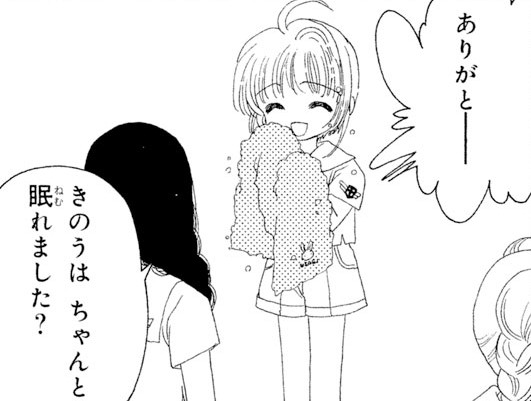
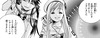
During an overnight school trip, a classmate tells a ghost story right before bedtime. While everyone else easily falls asleep, Sakura is too scared to close her eyes. The next morning, when Sakura washes her face, Tomoyo hands her a towel.
- さくら:
- 「ありがとーーー」
- “Thank you!”
- 知世:
- 「きのうは ちゃんと眠れました?」
- “Were you able to properly sleep last night?”
Although Sakura and Tomoyo are classmates and close friends, Tomoyo uses polite speech.
The Register Shift
Dropping (or adopting) ます mid-scene signals a changed relationship.
Icy Politeness
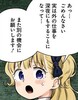
Excessive politeness from an angry character reads as threat.
Further Reading
- Register (sociolinguistics) (en.wikipedia.org)
Related Grammar
-
The copula だ
- The plain counterpart of です.
-
Volitional with 〜う・〜よう
- ましょう is the polite volitional.
-
Negation with 〜ない
- The plain negative that ません replaces in polite style.
Supplemental Examples