Previous experience with 〜た+ことがある
Grammar: Experience » 〜た+ことがある
〜たことがある says that someone has done or experienced something at least once before. It looks back over someone’s experience up to the present instead of placing one event at a stated past time.
The negative 〜たことがない means that someone has never had that experience.
With a past reference point, ある and ない can become あった and なかった .
Usage Notes
Put the verb in its plain past form before こと . The final ある says that such an experience exists. Change ある to ない to say that it does not.
The word after こと carries the tense and politeness of the full pattern: ことがある, ことがあります, ことがない, and ことがあった. The verb before こと stays in the past form.
In conversation, speakers often omit が and say 〜たことある, 〜たことない, or 〜たことあります.
Formation
View formation details
こと turns the past-form clause before it into a noun phrase. がある then presents that past action as an experience someone has had.
Verb (plain past) + ことがある
富士山( ふじさん ) に登( のぼ ) ったことがある "I have climbed Mount Fuji before."
Verb (plain past) + ことがない
納豆( なっとう ) を食( た ) べたことがない "I have never eaten natto."
Verb (plain past) + ことがありますか
日本( にほん ) へ行( い ) ったことがありますか "Have you ever been to Japan?"
Verb (plain past) + ことがあった
子供( こども ) のころ、一人( ひとり ) で留守番( るすばん ) をしたことがあった "There was a time when I stayed home alone as a child."
ことある・ことない (casual omission of が)
見( み ) たことある ?/見( み ) たことない "Have you seen it before? / I have never seen it."
Saying that an experience exists
The affirmative 〜たことがある treats a past action as part of someone’s experience. It does not identify when the action happened.
ご注文はうさぎですか? »
Volume 1 » Page 19
Talking about drawing, Cocoa is boastful of her own ability.
ココア:
「これでも金賞( きんしょう ) もらっ たことある んだ」
“Believe it or not, I've actually won a gold medal before.”
リゼ:
「町内会( ちょうないかい ) の小学生( しょうがくせい ) 低学年( ていがくねん ) の部( ぶ ) とかいうのはナシな」
“And don't tell me it was in the neighborhood association's lower-elementary division.”
Challenge Yourself
Show translation
Challenge
What does ココア mean in the highlighted line?
Clues
もらったことある
もらったことある presents the prize as past experience
What does the speaker mean?
Believe it or not, I've actually won a gold medal before.
Cocoa says that receiving a gold prize is part of her experience, without locating the award at a stated past time.
Cocoa says she expects to win a gold prize in the future.
The highlighted form is もらったことある. Here もらったことある presents the prize as past experience, so this choice does not match the Japanese.
Cocoa says she once borrowed someone else's gold prize.
The highlighted form is もらったことある. Here もらったことある presents the prize as past experience, so this choice does not match the Japanese.
Cocoa admits that she has never entered an art contest.
The highlighted form is もらったことある. Here もらったことある presents the prize as past experience, so this choice does not match the Japanese.
もらったことある presents the prize as past experience. Cocoa says that receiving a gold prize is part of her experience, without locating the award at a stated past time.
View Full Example
Cocoa presents winning a gold prize as evidence of her drawing ability. She does not say when she won it. Her casual もらったことある omits が.
ARIA The MASTERPIECE »
Volume 4 » Page 152
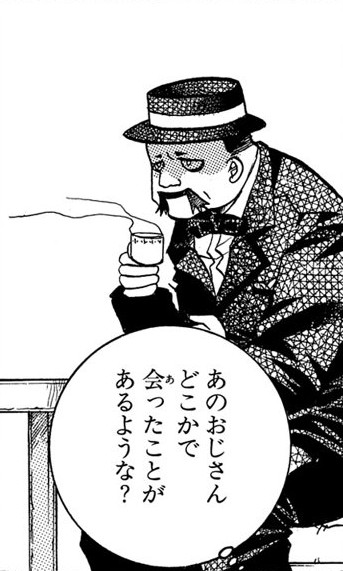
Akari and President Aria walk with Alicia to her meeting location. Rather than head back home, Akari and President Aria decide to sit at the café across the street until the meeting is over. There, Akari notices a gentleman sitting at another table.
灯里( あかり ) :「あのおじさんどこかで会( あ ) ったことがある ような?」
“It feels like I have met that man somewhere before.”
View Full Example
会( あ ) ったことがある
三ツ星カラーズ »
Volume 5 » Page 115
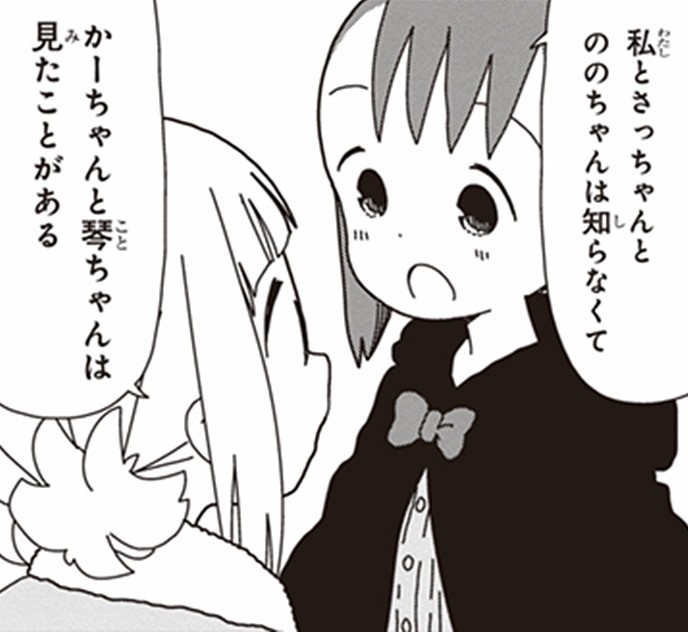
Sacchan and her friends come across a torn piece of paper with 「あたり100」 written on it. Thinking it may be for a 100,000 yen prize, the girls head to the shopping district to redeem it. Along the way, their friend Nonoko says she doesn’t recognize where the ticket is from, but Sacchan’s mother says it looks familiar somehow. Kotoha admits it seemed familiar to her as well, but she thought it was just her imagination until now.
結衣( ゆい ) :「私( わたし ) とさっちゃんとののちゃんは知( し ) らなくて」
“Even though Sacchan, Nono-chan, and I don't know it...”
さっちゃん:
「かーちゃんと琴( こと ) ちゃんは見( み ) たことがある 」
“My mom and Koto-chan have seen it before.”
Challenge Yourself
Show translation
Challenge
Who does Sacchan say has seen the mysterious ticket before?
Clues
私( わたし ) とさっちゃんとののちゃんは知( し ) らなくてYui, Sacchan, and Nono-chan do not recognize it
かーちゃんと琴( こと ) ちゃんは見( み ) たことがある
Mom and Koto-chan have seen it before
What does the speaker mean?
Sacchan's mother and Kotoha.
かーちゃんと琴( こと ) ちゃん are the people marked as having the experience 見( み ) たことがある.
Yui, Sacchan, and Nono-chan.
Those three are followed by 知( し ) らなくて, so they do not recognize it.
Only Sacchan's mother.
と joins かーちゃん and 琴( こと ) ちゃん as two people with the experience.
Only Kotoha.
Sacchan includes both Kotoha and her mother.
Yui and Kotoha.
Yui places herself among those who do not know it, while Kotoha is in the experienced group.
Sacchan and her mother.
Sacchan says she does not recognize it. Her mother and Kotoha do.
Sacchan divides the group in two. Yui, Sacchan, and Nono-chan do not recognize the ticket, but Sacchan’s mother and Kotoha have seen it before.
View Full Example
Here 見( み ) たことがある
Asking about experience
An affirmative question asks whether the listener has ever had the experience. Casual speech can use 〜たことある? . Polite speech commonly uses 〜たことがありますか .
ご注文はうさぎですか? »
Volume 1 » Page 63
After a misunderstanding brings Cocoa and her friends to the teahouse where Syaro works, the group stays to have some tea.
ココア:
「やっぱダンディー・ライオンだよね!」
“Dandy Lion is definitely the one!”
チノ:
「飲( の ) んだことある んですか?」
“Have you drunk it before?”
Challenge Yourself
Show translation
Challenge
What does チノ mean in the highlighted line?
Clues
飲( の ) んだことある飲( の ) んだことある asks about prior experience
What does the speaker mean?
Have you drunk it before?
Chino asks whether Cocoa has ever drunk dandelion tea, rather than whether she drank it at one known time.
Chino asks whether Cocoa is drinking dandelion tea right now.
The highlighted form is 飲( の ) んだことある. Here 飲( の ) んだことある asks about prior experience, so this choice does not match the Japanese.
Chino states that Cocoa has definitely drunk it before.
The highlighted form is 飲( の ) んだことある. Here 飲( の ) んだことある asks about prior experience, so this choice does not match the Japanese.
Chino asks whether Cocoa wants to try the tea for the first time.
The highlighted form is 飲( の ) んだことある. Here 飲( の ) んだことある asks about prior experience, so this choice does not match the Japanese.
飲( の ) んだことある asks about prior experience. Chino asks whether Cocoa has ever drunk dandelion tea, rather than whether she drank it at one known time.
View Full Example
Chino asks whether Cocoa has drunk dandelion tea before. The line is conversational, so が is absent. The explanatory んですか connects the question to Cocoa’s confident choice.
Polite あります
Replacing ある with あります makes the pattern polite. が can still disappear in conversation.
ご注文はうさぎですか? »
Volume 1 » Page 52
Rize and Chino watch as Cocoa and another girl reach for the same teacup in a shop.
チノ:
「こんなシチュエーション漫画( まんが ) でみ たことあります 」
“I've seen this kind of situation in manga before.”
リゼ:
「よく恋愛( れんあい ) に発展( はってん ) するよな」
“This kind of thing often leads to romance.”
Challenge Yourself
Show translation
Challenge
What does チノ mean in the highlighted line?
Clues
みたことあります
見( み ) たことあります reports prior experience
What does the speaker mean?
I've seen this kind of situation in manga before.
Chino says she has encountered this kind of scene in manga before.
Chino says the current encounter is taking place inside a manga.
The highlighted form is みたことあります. Here 見( み ) たことあります reports prior experience, so this choice does not match the Japanese.
Chino says she has never seen a scene like this before.
The highlighted form is みたことあります. Here 見( み ) たことあります reports prior experience, so this choice does not match the Japanese.
Chino says she has seen romance in manga, but not this situation.
The highlighted form is みたことあります. Here 見( み ) たことあります reports prior experience, so this choice does not match the Japanese.
見( み ) たことあります reports prior experience. Chino says she has encountered this kind of scene in manga before.
View Full Example
Chino’s みたことあります is polite because of あります, even though she omits が.
Saying that an experience does not exist
The negative 〜たことがない says that the person has never done something. In casual speech, が is often omitted: 〜たことない .
あずまんが大王 »
Volume 1年生 » Page 132
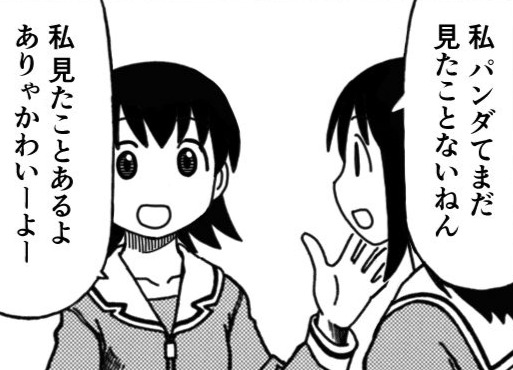
Chiyo shows her friends in class the panda picture book she bought.
歩( あゆむ ) :「私( わたし ) パンダてまだ見( み ) たことない ねん」
“I haven't seen a panda yet.”
とも:
「私( わたし ) 見( み )
“I've seen one. They're cute!”
Challenge Yourself
Show translation
Challenge
How do Ayumu's and Tomo's panda experiences differ?
Clues
まだ見( み ) たことない
has not seen one yet
見( み ) たことあるhas seen one before
ありゃかわいーよ
those are cute
What does the speaker mean?
Ayumu has never seen a panda, while Tomo has and says they are cute.
Ayumu uses 見( み ) たことない, while Tomo answers with the affirmative 見( み ) たことある and comments that pandas are cute.
Ayumu has seen a panda, while Tomo has not.
This swaps the two experiences. Ayumu uses ない, and Tomo uses ある.
Neither girl has ever seen a panda.
Tomo explicitly says 見( み ) たことある, so she has seen one.
Both girls have seen pandas and found them cute.
Ayumu's まだ見( み ) たことない says she has not seen one yet.
Ayumu saw a panda recently but Tomo saw one long ago.
Ayumu describes no past viewing at all. まだ with the negative means not yet.
Tomo has seen the picture book but not a real panda.
Tomo's 見( み ) たことある answers Ayumu's statement about seeing a panda, not about seeing the book.
Ayumu says she has never seen a panda yet. Tomo contrasts that with her own experience and adds that pandas are cute.
View Full Example
Recalling a past occasion with ことがあった
The past 〜たことがあった can recall an occasion that existed in an earlier period. English often translates it as “there was a time when” or simply “once.”
ご注文はうさぎですか? »
Volume 1 » Page 116
Rize wonders what became of the missing piece from Chiya’s puzzle. Syaro suggets it’ll turn up once it’s no longer being looked for. This reminds Chiya of something else that was forgotten.
千夜( ちや ) :「シャロちゃんは学校( がっこう ) にランドセルを忘( わす ) れたまま帰( かえ ) ってきた事( こと ) があったわ」
“Sharo-chan once came home having left her backpack at school.”
シャロ:
「明日( あした ) 学校( がっこう ) 行( い ) けない…」
“I can't go to school tomorrow...”
Challenge Yourself
Show translation
Challenge
What does 千夜( ちや ) mean in the highlighted line?
Clues
帰( かえ ) ってきた事( こと ) があった帰( かえ ) ってきた事( こと ) があった reports a past experience
What does the speaker mean?
Sharo-chan once came home having left her backpack at school.
Chiya says there was an occasion when Syaro came home after leaving her backpack at school.
Syaro once forgot her backpack at home and returned to school for it.
The highlighted form is 帰( かえ ) ってきた事( こと ) があった. Here 帰( かえ ) ってきた事( こと ) があった reports a past experience, so this choice does not match the Japanese.
Syaro came home without her backpack every day.
The highlighted form is 帰( かえ ) ってきた事( こと ) があった. Here 帰( かえ ) ってきた事( こと ) があった reports a past experience, so this choice does not match the Japanese.
Chiya says Syaro has never forgotten her backpack at school.
The highlighted form is 帰( かえ ) ってきた事( こと ) があった. Here 帰( かえ ) ってきた事( こと ) があった reports a past experience, so this choice does not match the Japanese.
帰( かえ ) ってきた事( こと ) があった reports a past experience. Chiya says there was an occasion when Syaro came home after leaving her backpack at school.
View Full Example
が, は, and no particle
が is the neutral particle in this pattern. Conversation often drops it, as several examples above do.
は adds contrast. 食( た ) べたことはある食( た ) べたことはない
The verb form before こと changes the meaning.
Pattern
Meaning
〜たことがある
have done before
〜ることがある
sometimes do
〜ないことがある
sometimes do not do
〜たいことがある
have something one wants to do
Examples
Grammar Explanation:
Previous experience with 〜た+ことがある
ご注文はうさぎですか? »
Volume 1 » Page 69
Cocoa thinks Rize is nervous about staying overnight with her and Chino.
リゼ:
「いや… 親父( おやじ ) の部下( ぶか ) に誘( さそ ) われたワイルドなキャンプしか経験( けいけん ) した事( こと ) ない から…」
“Well... I've only had the experience of those wild camping trips my dad's subordinates invited me on...”
「こんなの初( はじ ) めてで…」
“I've never done anything like this before...”
ココア:
「ワイルド?」
“Wild?”
Challenge Yourself
Show translation
Challenge
What does リゼ mean in the highlighted line?
Clues
経験( けいけん ) した事( こと ) ない〜た(事:こと)がある = have had the experience of...
What does the speaker mean?
Well... I've only had the experience of those wild camping trips my dad's subordinates invited me on...
The highlighted pattern expresses past experience at least once.
Rize says she often attends ordinary sleepovers with friends.
The highlighted form is 経験( けいけん ) した事( こと ) ない. Here 〜た事( こと ) がある = have had the experience of..., so this choice does not match the Japanese.
Rize says she has never gone camping before.
The highlighted form is 経験( けいけん ) した事( こと ) ない. Here 〜た事( こと ) がある = have had the experience of..., so this choice does not match the Japanese.
Rize says she invited her father's subordinates to stay at her home.
The highlighted form is 経験( けいけん ) した事( こと ) ない. Here 〜た事( こと ) がある = have had the experience of..., so this choice does not match the Japanese.
〜た事( こと ) がある = have had the experience of…. The highlighted pattern expresses past experience at least once.
Supplemental Examples
Try finding this grammar in the following examples: