Remembering with 〜っけ
Grammar: Particles
〜っけ goes at the end of a sentence when the speaker is checking a memory. As a question, it asks about something the speaker once knew but can’t quite recall: 何の日だっけ?, “what day is it again?”
Without a question, 〜たっけ looks back on the past: 小さい頃、よくここで遊んだっけ, “I used to play here a lot when I was little.”
Usage Notes
っけ usually follows a past form or だ: 言ったっけ, 高かったっけ, 学生だっけ, 学生だったっけ. The past form doesn’t always mean the question is about the past. 何曜日だったっけ asks about today, and 明日、テストあったっけ? asks about tomorrow. The past points back to when the speaker learned the answer. To ask about the present or future without a past form, use だっけ after a noun, or んだっけ after a verb: 何時に来るんだっけ?
It belongs to casual conversation. The polite でしたっけ and ましたっけ are still conversational, not formal.
っけ assumes the speaker knew the answer once. For a question about something new, use plain か or の instead.
Some lookalikes aren’t this っけ: オッケー, 見っけ (“found it”), そっけない, あっけない, いっけない (“oops”), でっけー (“huge”), and コロッケ.
っけ comes from the classical past auxiliary けり, by way of eastern Japanese and Edo speech.
Formation
View formation details
- Verb (た-form) + っけ
- エアコン、消したっけ?
- "did I turn off the AC?"
- い-adjective (past) + っけ
- こんなに辛かったっけ?
- "was it always this spicy?"
- Noun or な-adjective + だ/だった + っけ
- 何の日だっけ?
- "what day is it again?"
- Verb (plain form) + んだっけ
- 何時に来るんだっけ?
- "what time are they coming again?"
- でした/ました + っけ
- お名前、何でしたっけ?
- "what was your name again?"
Asking Someone to Remind You
As a question to someone, っけ asks about something the speaker knew once and has lost hold of. English often adds “again”: 君の年、いくつだっけ? is “how old are you again?” Said with a rising tone, it invites the listener to fill the gap.
It works with a question word, as a yes/no question, or with two choices: 君だっけ、田中だっけ?, “was it you or Tanaka?”

After returning home from work, Nishikata is ready to sit back and relax for a bit. Takagi leans over and asks Nishikata if he knows what day it is.
- 西片:
- 「あれ?何の日だっけ?」
- “Huh? What day is it again?”
- 高木:
- 「2人の記念日とかではないから安心して。」
- “Relax, it's not an anniversary or anything like that.”
Nishikata has just gotten home from work, and Takagi asks if he knows what day it is. He has the feeling it’s a day he should remember and can’t place it. 何の日だっけ? is “what day is it again?” He asks Takagi. She doesn’t say what day it is, only that it isn’t their anniversary, so he can relax. The だ is the copula, and the question is about today.
Asking Yourself
っけ also works with no one to answer. The speaker is searching their own memory out loud: 牛乳、まだあったっけ, “do we still have milk?”
When a particle follows, it’s most often な or なあ: 何だっけなあ, “what was it, now…” か is rougher: 何だっけか.
っけ also shows surprise when something doesn’t match the speaker’s memory. こんなに辛かったっけ? is “was it always this spicy?”
Example 1 of 2: Replacing the bathroom lock with 交換

The bathroom door lock broke, leaving the door unable to open. With a bit of effort, Yousuke is finally able to unlock it.
- 葉介:
- 「こりゃさっさと交換した方がいいな」
- “Looks like I'd better replace it right away.”
- 「近くで売ってるトコあったっけなぁ…(あちィ…)」
- “Was there somewhere nearby that sells them...? (Man, it's hot...)”
The bathroom door lock broke, and Yousuke has just gotten the door open. It needs replacing, and he tries to remember whether any shop nearby sells locks. He’s talking to himself as he searches his memory. なぁ and the trailing … show him turning it over in his head. A shop like that would exist now, if at all, but he says あった: he’s checking what he remembers about the neighborhood.
Example 2 of 2: Switching uniforms with 〜っけ
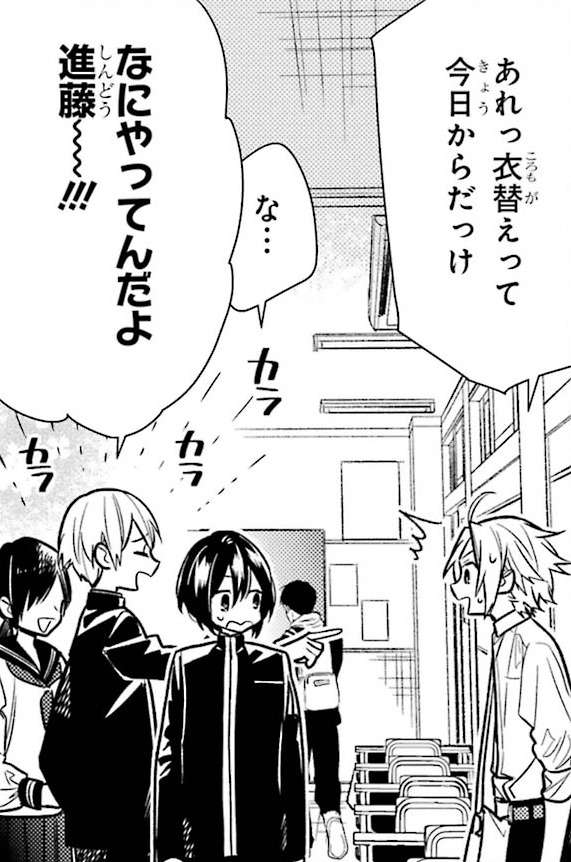
One morning, Miyamura and his classmates are wearing the black, high-collared jackets of the winter uniform. Shindou walks into the classroom in a white summer shirt.
- 進藤:
- 「あれっ 衣替えって今日からだっけ」
- “Huh? Was the uniform change supposed to start today?”
- 宮村:
- 「な…」
- “Wh...”
- 同級生:
- 「なにやってんだよ進藤〜〜!!!」
- “What are you doing, Shindou?!”
Shindou walks into class in his summer shirt and finds everyone else in black winter jackets. That doesn’t match what he thought he knew, and あれっ 衣替えって今日からだっけ is “huh? Was the uniform change supposed to start today?” He’s questioning his own memory out loud, and the question is about today, so だ takes っけ with no past form.
Something Just Remembered
っけ can also mark something the speaker has just called back to mind. あ、お湯を沸かしてたんだっけ is “oh, right, I had water on to boil.” This isn’t really a question, and it’s often said to oneself.
It works for plans too. Even when the event is still to come, the plan was made earlier, so んだっけ fits: 田中さんも今日来るんだっけ, “oh right, Tanaka’s coming today too.” Starters like あ, そうだ, and そういえば often come before it.
Looking Back with 〜たっけ
Without a question, 〜たっけ looks back on the past: 子どものころ、この川でよく遊んだっけ is “I used to play in this river a lot when I was a kid.” The speaker isn’t asking anyone anything.
This use normally takes past forms: たっけ, かったっけ, だったっけ. It’s usually warm, but it doesn’t have to be a happy memory. 先輩によく怒られたっけ is “my seniors were always scolding me.”
Example 1 of 2: Receiving a scolding with 〜れる

Cocoa and her friends visit an indoor hot spring.
- ココア:
- 「小さい頃銭湯で泳いだっけ」
- “Come to think of it, I used to swim at the public bath when I was little.”
- シャロ:
- 「それでよく怒られたわよね」
- “You used to get scolded for that a lot, right?”
Cocoa and her friends are at an indoor hot spring, and Cocoa remembers something from her childhood: 小さい頃銭湯で泳いだっけ, “I used to swim at the public bath when I was little.” There’s no question mark, and she isn’t asking anyone. Syaro picks up the memory and guesses how it ended: she must have gotten scolded for it a lot.
Example 2 of 2: Practicing to skip the dishes with 〜っけ
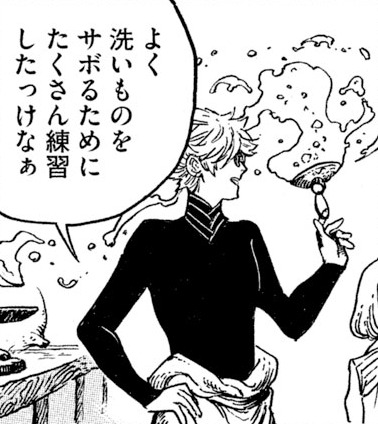
Coco has been worrying that she’s falling behind in her magic studies. While they cook in the kitchen, Qifrey tells her that water magic was the first kind he got good at, partly because he hated getting wet.
- キーフリー:
- 「よく洗いものをサボるためにたくさん練習したっけなぁ」
- “I used to practice like crazy so I could get out of doing the dishes.”
Qifrey is telling Coco how he learned water magic as a boy. He hated getting wet, so he practiced hard to get out of washing the dishes. With よく, 練習したっけ recalls a habit, “I used to practice,” and なぁ makes it a fond, half-to-himself memory. Coco has no way to answer, so it isn’t a question.
Polite でしたっけ and ましたっけ
In polite speech, っけ follows でした or ました: お名前、何でしたっけ?, “what was your name again?” 甘いもの、苦手でしたっけ? is “you don’t like sweets, do you?” Here でした asks about the present, the way だったっけ does.
ですっけ and ますっけ are rare. For a noun or な-adjective, use でしたっけ, not ですっけ. For an い-adjective, add です to the past: 高かったですっけ.
These forms are polite but still conversational. They suit a coworker or an acquaintance, not a formal letter.
Isn’t It…? with 〜じゃなかったっけ
A negative form before っけ checks something the speaker remembers but now doubts. 髪、長くなかったっけ? is “didn’t he have long hair?” The speaker remembers long hair, and the actor in front of them doesn’t fit. じゃなかったっけ does the same after nouns and な-adjectives: 彼女、猫嫌いじゃなかったっけ?, “doesn’t she hate cats?”
The non-past じゃないっけ shows up too, in casual speech. Apart from だ and んだ, non-past forms before っけ are rare, and most of the ones that turn up are negative questions like this.

It’s raining again. When her mother remarks on it, Chii scowls and says she hates rain. Her mother looks at her, surprised.
- お母さん:
- 「雨は好きじゃなかったっけ?」
- “I thought you liked rain?”
It’s raining again, and Chii grumbles that she hates rain. That doesn’t match what her mother remembers. 雨は好きじゃなかったっけ? is “I thought you liked rain?” 好き is a な-adjective, so its past negative is 好きじゃなかった. The question is about how Chii feels now.
Further Reading
- 〜っけ, 日本語文型バンク (NINJAL) (ninjal.ac.jp)
- 野田春美「っけ」, 日本語のモダリティのコーパス調査報告 (kobegakuin.ac.jp)
- け, デジタル大辞泉 and 精選版 日本国語大辞典 (Kotobank) (kotobank.jp)
- たっけ, デジタル大辞泉 (Kotobank) (kotobank.jp)
- だっけ, デジタル大辞泉 (Kotobank) (kotobank.jp)
Related Grammar
- Past tense with 〜た・〜だ
- The past form that っけ usually follows, and why it can point back to when the speaker learned something.
- Wondering with かな
- かな wonders about something the speaker may never have known. っけ checks something the speaker knew once.
- Reasoning with 〜のだ
- The の or ん in んだっけ, which lets っけ follow a non-past verb.
- The copula だ
- The だ in 何だっけ is the copula, not a past ending.