Japanese asks someone to do something by putting the verb in its て-form and adding a word for “give me”. 〜てください is the polite version: 待ってください, “please wait”. 〜てくれ is the blunt, mostly male version: 待ってくれ, “wait”. 〜てちょうだい is the familiar version, often from women and children: 待ってちょうだい, “wait for me”.
Among friends and family, the request word often drops off entirely, and the bare て-form does the job: 待って!
Usage Notes
ください is the command form of くださる, the honorific version of くれる, so 〜てください and 〜てくれ are the same request at two levels of respect. ちょうだい comes from 頂戴, “receive humbly”. All three work as “give me”, so the request is framed as something done for the speaker. That framing stays even when the request is for the listener’s sake, as in がんばってください, “good luck”.
The forms line up roughly like this, from casual to polite.
Form
Who uses it
待って
friends, family, people below the speaker
待ってくれ
mostly men, to close friends or people below them
待ってくれる? 待ってくれない?
friends, as a softer question
待ってちょうだい
mostly women and children, often a parent to a child
待ってください
the standard polite request, though it fits some requests and relationships better than others
待ってくれませんか
a polite question, one step below くださいませんか
待ってくださいませんか
strangers and superiors, when asking a real favor
お待ちください
staff to customers, announcements
The ladder isn’t strict. てちょうだい sounds friendlier than てください but isn’t more polite. 〜てください is polite in form, but it tells the listener what to do instead of asking. When the request is a real favor from a superior, a question form sounds better.
The same words also ask for things. Put a noun before them: 水をください, 水をくれ, 水をちょうだい all mean “give me some water”.
Formation
View formation details
Verb (て-form) + くれ
ちょっと手を貸してくれ
"Give me a hand."
Verb (て-form)
ちょっと待って!
"Wait a sec!"
Verb (て-form) + ちょうだい
静かにしてちょうだい
"Be quiet, please."
Verb (て-form) + ください
ここに名前を書いてください
"Please write your name here."
Verb (ない-form) + で + ください/くれ/ちょうだい
写真を撮らないでください
"Please don't take pictures."
Verb (て-form) + くださいませんか
もう一度説明してくださいませんか
"Could you explain it once more?"
お + Verb (ます-stem) + ください
お待ちください
"Please wait."
Noun + を + ください/くれ/ちょうだい
水をください
"Water, please."
Blunt Requests with 〜てくれ
くれ is the command form of くれる. 〜てくれ asks someone to do something for the speaker, and it’s blunt. It’s what men say to friends, family, and people below them, such as a father to his child or a boss to his staff. It sits close to an order, but it still frames the action as a favor: 待て is “wait!”, while 待ってくれ is “wait for me”.
Women use it less in conversation, but anyone uses it when reporting a request. 来てくれと言われた is just “I was asked to come”.
よ often follows to push the request harder, and よな can make it sound friendly, like “okay?” at the end, as in the kendo invitation below.
Yotsuba and her father are driving to their new home. As they pass a school letting out, Yotsuba waves to a student. When the student waves back, Yotsuba tells her father to wave too.
よつば:
「おねーちゃんが手ぇふった! とーちゃんもふれ!」
“The girl waved! Daddy, you wave too!”
父さん:
「とーちゃん手がはなせないからな俺の分もよつばがふってくれ」
“Dad's hands are full, so Yotsuba, please wave for me too.”
Yotsuba and her father are driving to their new home. A girl walking home from school waves back at Yotsuba, and Yotsuba tells her father to wave too. His hands are on the wheel, so he hands the job back to her. ふってくれ is a father talking to his young daughter, and 俺の分も, “my share too”, asks her to wave once more on his behalf.
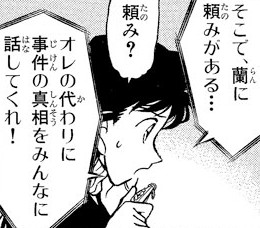
Conan determines the culprit in a series of murders. However, there’s no one around he can use as a conduit for revealing his reasoning. When Ran scolds Conan for wandering around, he accidentally drops an item Professor Agasa made for him, a wireless phone in the form of a large earring. As Ran picks it up, Conan hides and using his bowtie voice changer to sound like Shin’ichi as he calls Ran on the earring phone. He explains that Conan filled him in on the details.
新一:
「そこで、蘭に頼みがある…」
“So with that, I have a favor to ask of you...”
蘭:
「頼み?」
“A favor?”
新一:
「オレの代わりに事件の真相をみんなに話してくれ!」
“In my place, tell everyone the truth of the situation!”
Conan has solved the case, but he has no one to speak through. He hides and calls Ran, using his voice changer to sound like Shin’ichi. 頼みがある, “I have a favor to ask”, sets up the request, and 話してくれ makes it. The two are old friends, so the blunt form doesn’t sound rude.
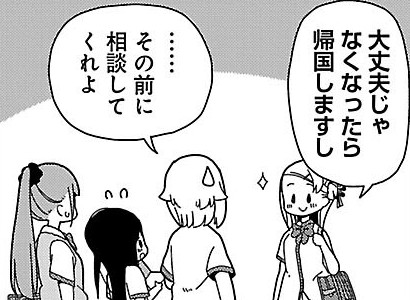
While staying in Japan, Sotoka lives alone in the apartment building her parents own. Aru asks if Sotoka isn’t lonely living alone, but Sotoka says it’s all right.
Sotoka lives alone in Japan and says that if things ever get bad, she’ll just go back to her home country. Nako objects. その前に相談してくれよ is “talk to us before that”. よ presses the point, the way “come on” does.
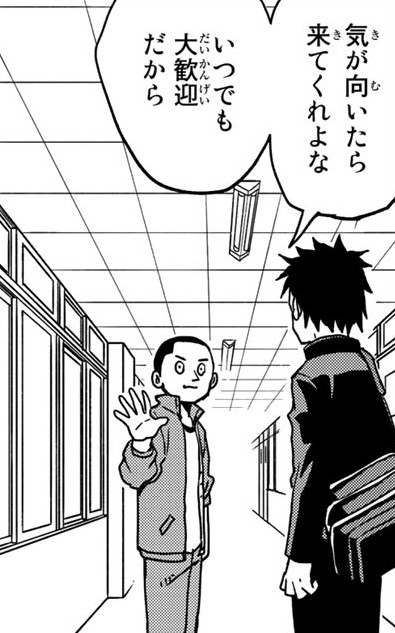
A member of the kendo club asks Ayumu to join the club, so they can win the next tournament. Although Ayumu is well known for his kendo prowess in middle school, he’s in the shogi club now, and rejects the request.
A kendo club member wants Ayumu on the team, and Ayumu turns him down. The member doesn’t push. 来てくれよな still asks him to come by, and よな turns it into a friendly parting line. 気が向いたら, “if you feel like it”, leaves the choice to him.
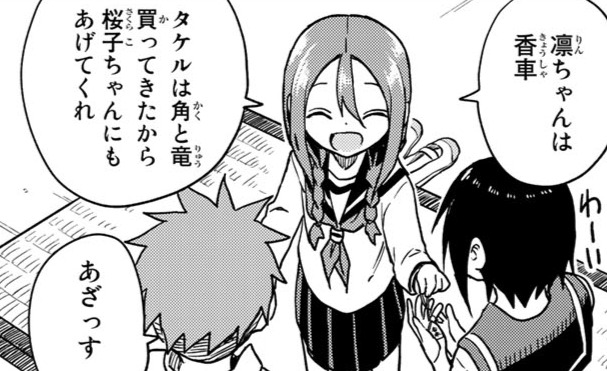
Urushi returns from her school trip with gifts for the underclassmen in the shogi club. First she presents the treats she bought for everyone, then she pulls out shogi piece keychains.
うるし:
「凛ちゃんは香車」
“Rin, this one's the lance.”
「タケルは角と竜買ってきたから桜子ちゃんにもあげてくれ」
“Takeru, I bought a bishop and a dragon, so give one of them to Sakurako too.”
Urushi is back from her school trip with keychains shaped like shogi pieces. She bought two for Takeru, so she asks him to give one to Sakurako. Urushi is a girl, so this shows that “mostly men” is a tendency, not a rule. She’s the senior club member talking to a junior. あげる sends the gift on to Sakurako, and くれ makes passing it along a favor to Urushi.
Casual Requests with a Bare 〜て
Drop ください and the て-form alone becomes a request. 見て! is “look!” and 待って! is “wait!” This is the everyday request between friends and family, and from a parent or teacher to a child. Both men and women use it. In one study of workplace talk, men used it far more often than the command form.
It covers the same ground as 〜てください: asking a favor, giving an instruction, offering something, or telling someone not to worry. The difference is closeness. Said to a stranger or a superior, it sounds overfamiliar.
ね softens a bare て into a gentle reminder or friendly instruction, as in 待ってね, “wait, okay?” よ pushes harder, and it can sound fed up: 聞いてよ is “listen to me, would you!”
Example 1 of 6: You say that, but it's not important with だって
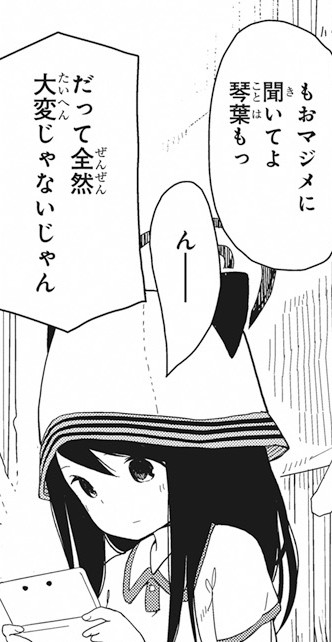
Yui hurries to her clubhouse to tell her friends, Kotoha and Sacchan, about a big case: there’s a cat that looks like a panda. However, Sacchan doesn’t engage in the topic and Kotoha continues playing her video game.
結衣:
「もおマジメに聞いてよ 琴葉もっ」
“Geez, listen seriously. You too, Kotoha.”
さっちゃん:
「だって全然大変じゃないじゃん」
“You say that, but it's not a big deal at all, right?”
Yui runs into the clubhouse with big news about a cat that looks like a panda, but Sacchan barely reacts and Kotoha keeps playing her game. もお, “geez”, and よ make 聞いて sound fed up. She’s asking her friends to take her seriously.
Example 2 of 6: Don't leave your vegetables 〜てはだめだ
At breakfast, Cocoa catches Chino leaving her asparagus. After telling her she mustn’t, Cocoa follows up with ほらちゃんとたべて, “come on, eat it properly”. Cocoa plays big sister to Chino, so the bare て sounds like a parent at the table. ほら, “come on”, gets Chino’s attention first.
Example 3 of 6: Save Rei while it's foggy with 〜うちに
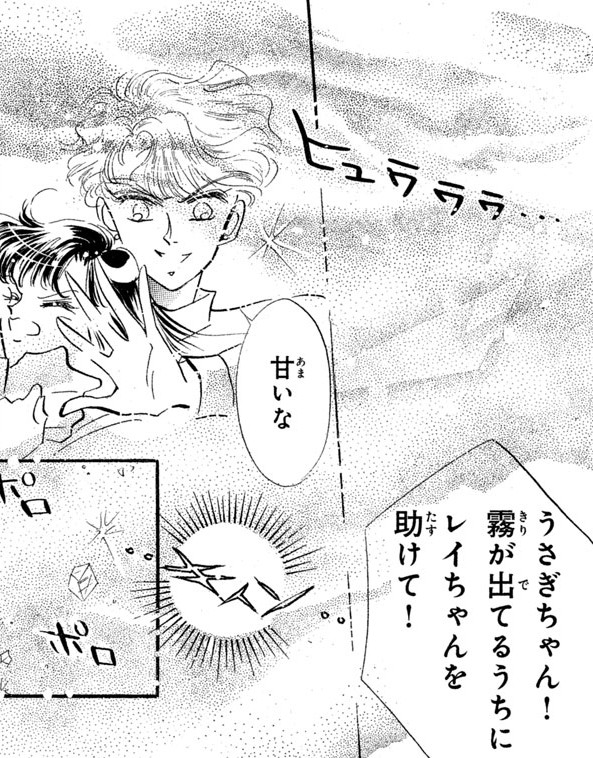
Jadeite has captured Rei, and Ami fills the area with fog to give Usagi a chance. In a crisis there’s no time for ください. 助けて! is the shortest way to say “save her!”, and the two are friends.
Example 4 of 6: Came to be studying with us with 〜ことになる
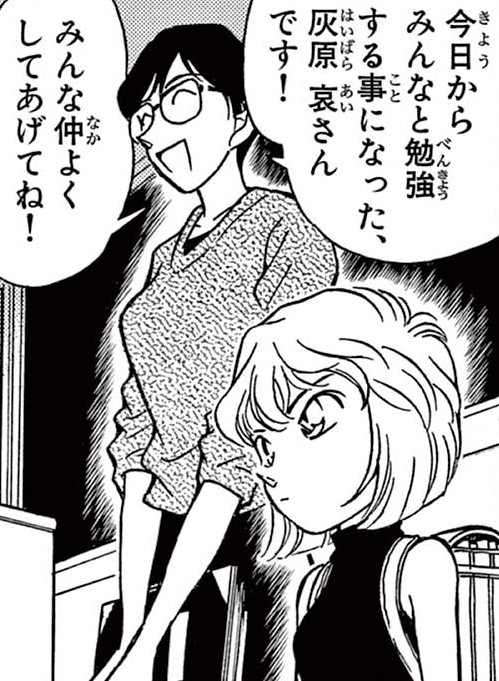
The teacher introduces Haibara, the new transfer student, to the class. 仲良くする is “be friends with” and あげる makes it a kindness toward Haibara. A teacher talking to young children uses the bare て, and ね makes it a warm instruction, “be nice to her, okay?”
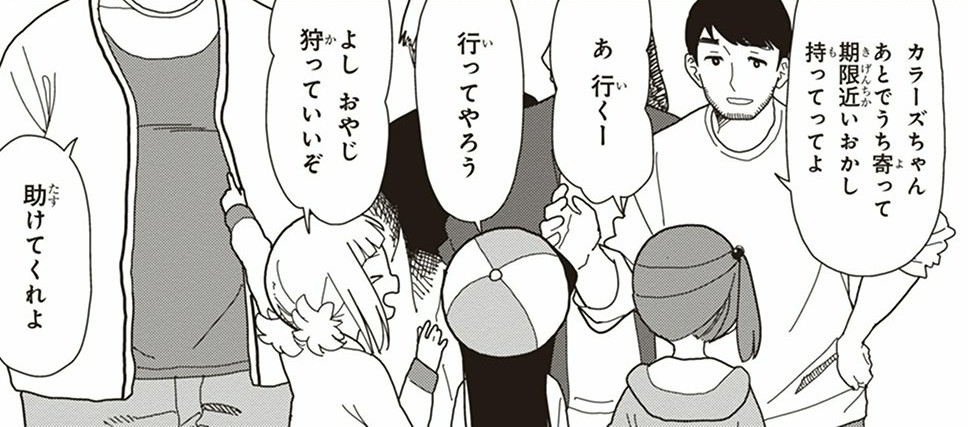
The candy shop owner runs into Colors while out shopping. This line holds two bare て requests: 寄って, “stop by”, and 持ってって, a casual 持っていって, “take some with you”. Taking the snacks is mostly for the girls’ benefit. Encouraging the listener is among the uses of a bare て, and よ makes it insistent, like “go on, take them”.
Example 6 of 6: Relax about what day it is with 安心
Nishikata has just come home from work, and Takagi asks if he knows what day it is. He can’t remember. Takagi lets him off: it isn’t an anniversary, so 安心して, “relax”. The request here is for Nishikata’s sake, not Takagi’s.
Familiar Requests with 〜てちょうだい
ちょうだい is the humble word 頂戴, “receive”, used as a request. 〜てちょうだい sounds close and familiar. It’s the request of a mother to her child, or of anyone in charge talking to someone below them, and women use it more than men. Children use it too, as in おかしちょうだい, “give me a snack”.
Familiar doesn’t mean gentle. A mother who says 静かにしてちょうだい, “be quiet”, is giving an order. Compared with 〜てください, ちょうだい trades distance for closeness.
It’s written in kana or as 頂戴. Informal writing also uses ちょーだい.
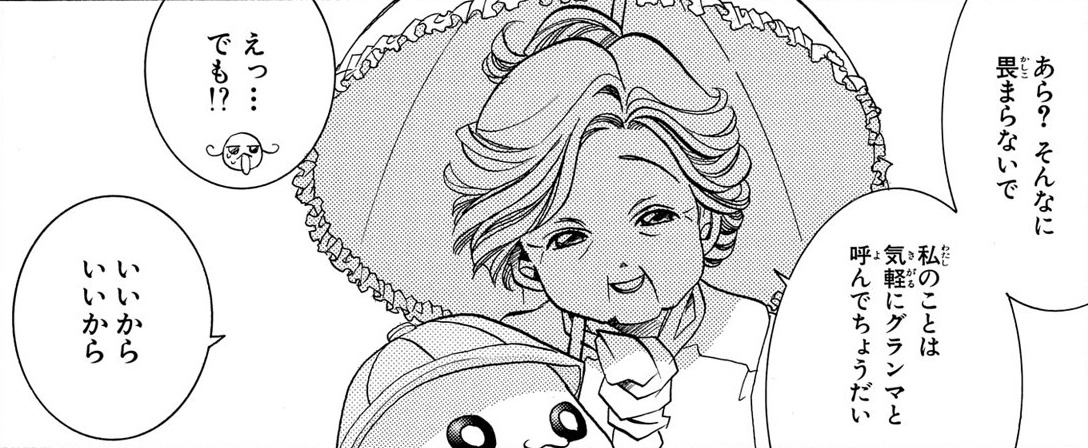
Akari, Aika, and Alice have come to the countryside to train under Grandma, the legendary undine who founded Aria Company. When she greets them by name, Akari blurts out, “Are you… Grandma?” Aika scolds her, then introduces herself with stiff formality, calling the woman “the illustrious Grandmother”, and saying it is an honor to meet her.
Aika has just greeted the founder of Aria Company in her stiffest polite Japanese. Grandma waves the formality away and asks to be called グランマ. 呼んでちょうだい is an older woman speaking warmly to young apprentices, and 気軽に, “casually”, says how she wants to be addressed.
Example 2 of 3: Help me if you're bored with 〜てちょうだい
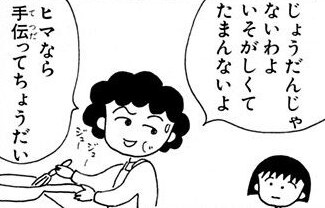
Maruko wakes up early for once, because she fell asleep in the kotatsu the night before. Her mother is busy making breakfast in the kitchen. Maruko wanders in and complains that six in the morning is boring, with nothing good on TV.
Maruko is up unusually early and complains that six in the morning is boring. Her mother is busy cooking breakfast: ヒマなら手伝ってちょうだい, “if you’ve got nothing to do, give me a hand”. It’s a mother’s familiar request to her child, and more of an order than a favor.
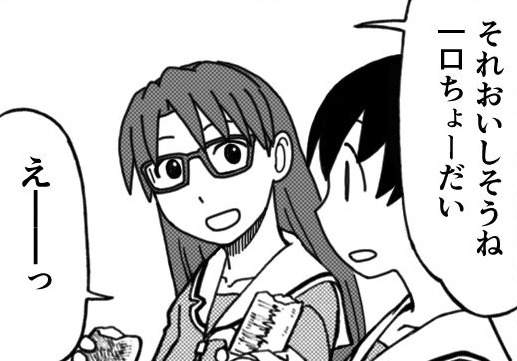
The girls are eating lunch on the school roof, and Yomi likes the look of Tomo’s bread. 一口ちょーだい, “give me a bite”, puts ちょうだい straight after a noun to ask for a thing instead of an action. It’s a friend’s familiar request, and the drawn-out ちょー makes it sound wheedling.
ください is the command form of くださる, the honorific version of くれる. 〜てください is the standard polite request, but whether it fits depends on what’s being asked and who’s asking whom. It does more than ask favors. It gives directions and instructions, as in 次の角を右に曲がってください, “turn right at the next corner”. It also offers and encourages, as in がんばってください, “good luck”, and 安心してください, “don’t worry”.
What it doesn’t do is ask what the listener wants. As an instruction, it assumes the listener will go along, which is why doctors, teachers, and police use it so much. Said by someone with no right to direct the listener, it can come across as presumptuous. Japan’s official keigo guidelines give the example of an invited guest urging others to “please, go ahead and eat”, as if it were their place to offer. For a favor from a superior, Japanese speakers usually switch to a question, like 〜てくださいませんか.
よ after ください presses the listener. 〜てくださいよ can plead, complain, or push back, depending on the tone. ね makes it a friendly reminder: 気をつけてくださいね, “take care, okay?”
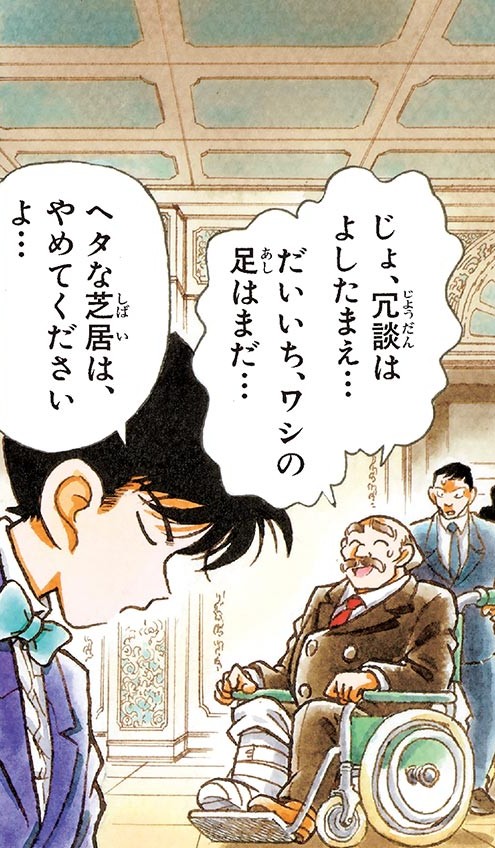
Assisting the police with a murder investigation, Shin’ichi explains how the culprit was able to move without a trace by going out a window and scaling the wall to the next window up. The victim’s husband demands to know who killed his wife, only for Shin’ichi to accuse him.
御主人:
「じょ、冗談はよしたまえ… だいいち、ワシの足はまだ…」
“S-stop joking around.... First of all, my leg is still...”
Shin’ichi is helping the police with a murder case, and he has just named the victim’s husband as the killer. The husband tells him to stop joking and points to his injured leg. Shin’ichi turns the words back on him. やめてください, “please stop”, stays polite to an older man, but ヘタな芝居, “lousy acting”, and よ make it a jab.
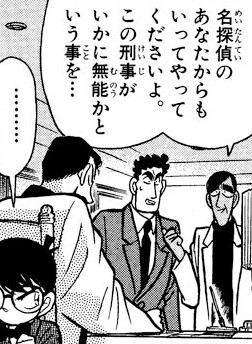
Police detective Yokomizo isn’t about to let Sasai, his prime murder suspect, leave. Sasai reminds the officer that he has photographic proof that he wasn’t near the victim at the time of the murder. He calls for Detective Mouri to back him up.
笹井:
「名探偵のあなたからもいってやってくださいよ。 この刑事がいかに無能かという事を…」
“You, the great detective, should tell him yourself. Just how incompetent this police detective is...”
Detective Yokomizo won’t let his suspect, Sasai, leave. Sasai has a photo showing he wasn’t near the victim, and he turns to Kogorou for backup. Here, 言ってやる amounts to “tell him off”, and 〜てくださいよ makes it a polite plea with an edge, “come on, you tell him”. Calling Kogorou 名探偵, “the great detective”, flatters him onto Sasai’s side.
For “please don’t”, the verb takes its negative form plus で, and the request word follows. 見ない becomes 見ないで, so the ladder runs 見ないで, 見ないでくれ, 見ないでちょうだい, and 見ないでください. Each one carries the same register as its positive partner.
Like its positive partner, ないでください can be caring. 心配しないでください, “don’t worry”, and 無理しないでください, “don’t push yourself”, are for the listener’s sake.
In casual speech, よ often follows, as in Nakahara’s protest below.
Example 1 of 2: Not moving while staring with 〜ながら
Cocoa buys Chino a puzzle to make up for finishing the one Chino had been working on. The two and their friends work at putting the new puzzle together.
チノ:
「ココアさんさっきからピース見つめながら動かない…」
“Cocoa-san has been staring at the puzzle piece while not moving for a while now...”
「その…責任取ろうと無理しないでください」
“Um... Please don't push yourself trying to take responsibility.”
Cocoa finished the puzzle Chino had been working on, so she bought Chino a new one to make up for it. Now the group is putting it together, and Cocoa has been staring at one piece without moving. Chino asks her not to push herself trying to make up for it. This is the caring use. Chino speaks politely to everyone, Cocoa included.
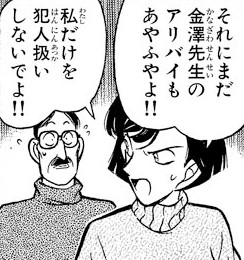
In a snow-covered mountain villa, a room full of suspects listen as Detective Mouri explains how their host was murdered. The accused notes she has a receipt showing she was at the convenience store at the bottom of the mountain when the murder took place.
Detective Mouri is going over a murder in a snowbound mountain villa, and Ms. Nakahara is under suspicion. She points out that Mr. Kanazawa’s alibi is shaky too. 犯人扱いする is “treat someone as the culprit”, and ないでよ, with no ください, makes it an angry protest.
〜てください, 〜てくれ, and 〜てちょうだい all tell the listener what to do. Turning the request into a question leaves the choice with the listener, and that makes it softer. かな after it, as in 〜てくれるかな, makes it more tentative still: “I wonder if you could…” The negative question is softer than the positive one, because it leaves more room for a “no”.
待ってくれる? is a casual “will you wait?”
待ってくれない? is a casual “won’t you wait?” Casual speech shortens it to 待ってくんない?
待ってくれませんか is polite.
待ってくださいませんか is more polite, and it suits a real favor from a stranger or a superior.
〜てくれるか and 〜てくれないか, with か, are the blunter versions men use: おい、変なあだ名で呼ぶのやめてくれないか, “hey, would you stop calling me by that weird nickname?”
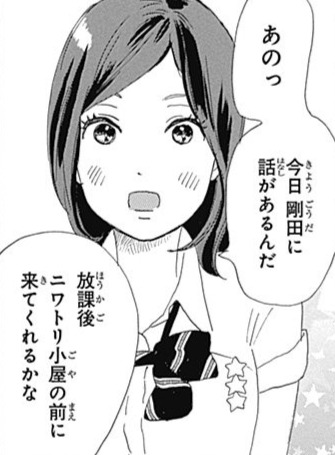
After Takeo (Gouda) has helped her out multiple times, Saijou considers confessing her feelings to him. She waits for him near the shoe lockers before class.
西城:
「あのっ 今日剛田に話があるんだ」
“Um... I need to talk to you today.”
「放課後ニワトリ小屋の前に来てくれるかな」
“Could you come to the chicken coop after school?”
Takeo has helped Saijou out several times, and she’s thinking of telling him how she feels. She waits for him by the shoe lockers before class. 話があるんだ, “I have something to tell you”, sets up the request. かな, “I wonder”, hangs on the end of 来てくれる. She’s asking without quite asking, and it sounds nervous.
〜てもらえる? and 〜ていただけませんか ask for the same favor from the receiver’s side, “can I get you to…?” They’re covered on the 〜てもらう page.
Honorific Requests with お〜ください
For extra respect, the verb’s ます-stem goes between お and ください: 待つ becomes お待ちください, “please wait”. It’s the language of shops, hotels, and announcements, and staff use it with customers. Many する verbs built on a Chinese-origin noun take ご instead, as in ご注意ください, “please be careful”, though some familiar ones take お, as in お電話ください, “please call”.
It’s still a direction, not a question. A clerk who says 少々お待ちください is telling the customer to wait, just very politely. くださいませ is more formal still, as in 少々お待ちくださいませ.
Verbs with a one-syllable stem, such as 寝る and 見る, don’t take this form. They use a separate respectful expression instead, as in ご覧ください, “please look”.