Seeking agreement with ね
Grammar: Particles
Sentence-final ね reaches toward the listener: “right?”, “isn’t it?”. It marks the statement as shared ground, inviting a nod.
ね keeps Japanese conversation cooperative. In manga dialogue, it can make a character sound warm or gentle, or show that they want agreement.
Usage Notes
ね attaches to a complete sentence of any politeness level: 寒いね, 寒いですね. Stretched ねえ works as a standalone attention-getter (“hey…” / “say…”), a different job from the tag use.
ね assumes the listener agrees or knows, while よ assumes the information is new to them. This contrast explains many dialogue endings. よね combines both jobs: assert, then double-check with “…right?”
Formation
View formation details
- Sentence + ね
- 今日はいい天気だね
- "Nice weather today, isn't it?"
- Sentence + よね (assert, then confirm)
- 明日も来るよね?
- "You're coming tomorrow too, right?"
- ねえ (attention-getter)
- ねえ、ちょっと聞いて
- "Hey, listen a sec."
- Mid-sentence ね (pacing)
- それでね、昨日ね、変なことがあったの
- "So, y'know, yesterday, something weird happened."
- Note: Scattered mid-sentence ね keeps the listener along for the ride; common in chatty or childlike speech.
Inviting Agreement
The classic tag, expecting a nod.
ね presents the statement as something the listener can see or feel too, and invites a nod: “isn’t it?” or “right?”. Compliments and shared reactions often end in ね.
- いい天気だね。
- Nice weather, isn’t it?
Example 1 of 19: Preparing by memorizing with 〜ておく

As the experienced barista, Rize is tasked with teaching Cocoa about working at the café.
- リゼ:
- 「メニュー覚えとけよ」
- “Memorize the menu ahead of time.”
- ココア:
- 「コーヒーの種類が多くて難しいねー」
- “The different kinds of coffee are numerous and difficult, huh?”
Rize is training Cocoa as a new barista and tells her to memorize the menu. Cocoa looks it over: 難しいねー, “it’s hard, huh?” ね invites Rize to agree, and the long ー makes it a sigh.
Example 2 of 19: Nothing out of the ordinary with 異常
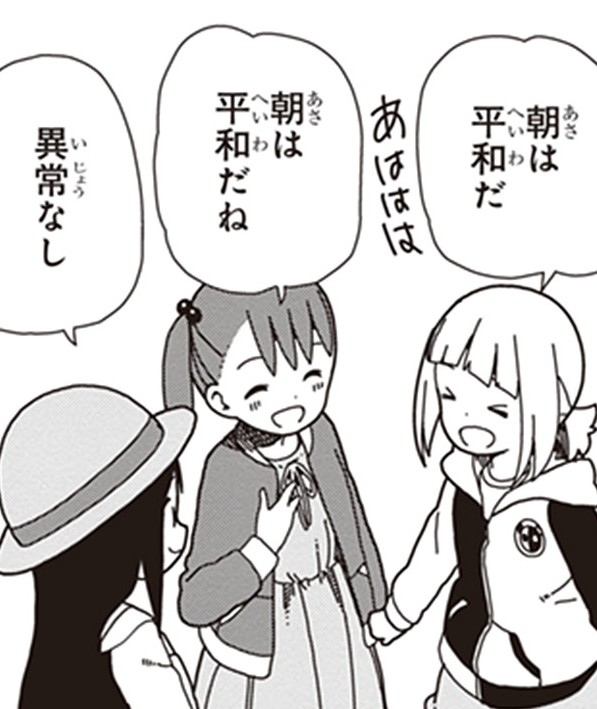
Yui, Sacchan, and Kotoha go on an early-morning patrol to check for any issues in their neighborhood. Because it’s so early, none of the shops are open yet, and the streets are empty.
- さっちゃん:
- 「朝は平和だ」
- “Morning is peaceful.”
- 結衣:
- 「朝は平和だね」
- “Morning is peaceful, isn't it?”
- 琴葉:
- 「異常なし」
- “No abnormalities.”
Yui, Sacchan, and Kotoha are patrolling the neighborhood early in the morning, before any shops open. Sacchan says 朝は平和だ, a plain statement. Yui says the same thing with ね, 平和だね, inviting the others to share the feeling. Kotoha reports no problems.
Example 3 of 19: Because strong players gather here with 〜ので

Cocoa inquires about the board and pieces sitting in front of Chino. Chino says it’s chess and gives a further explanation.
- チノ:
- 「この温泉は強者が集まるのでおじいちゃんは白熱してました」
- “Grandpa would get excited because strong players gather at this hot spring spa.”
- ココア:
- 「温泉に浸かりながらチェス出来るのっていいねー」
- “It's nice being able to play chess while soaking in the hot spring.”
Chino explains that her grandfather got fired up playing chess at this hot spring. Cocoa thinks it sounds great: 温泉に浸かりながらチェス出来るのっていいねー, “playing chess while soaking is nice, isn’t it?” ね shares the thought.
Example 4 of 19: Kindred spirits in golf with 気が合う
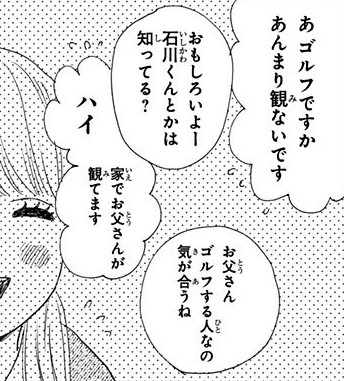
Takeo’s girlfriend Rinko visits to study with him, but Takeo’s parents take turns interrupting them to get to know her better. Takeo’s father, Yutaka, asks if she watches golf.
- 凛子:
- 「あ ゴルフですか。あんまり観ないです」
- “Ah, golf? I don't watch a lot of it.”
- 豊:
- 「おもしろいよー!石川くんとかは知ってる?」
- “It's fun! Do you know about Ishikawa-kun?”
- 凛子:
- 「ハイ。家でお父さんが観てます」
- “I do. My father watches it at home.”
- 豊:
- 「お父さん ゴルフする人なの。気が合うね」
- “So your dad's a golf guy. We're kindred spirits, eh?”
Takeo’s father learns that Rinko’s father watches golf. 気が合うね, “we’d get along”, invites her to agree. It’s a stretch, since he has never met her father, and ね shows how eager he is.
Example 5 of 19: Kindrid spirits in drinking tea with 気が合う
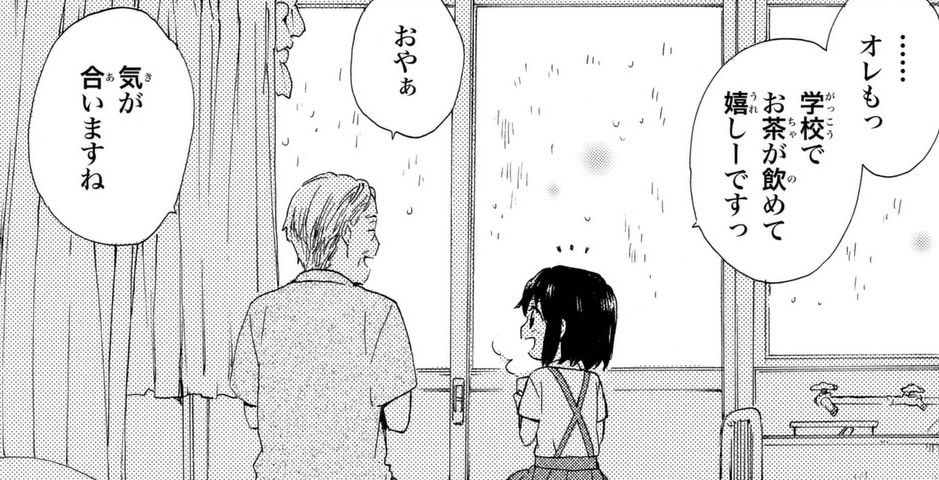
Hinata escorts a classmate to the school nurse. There, she meets an elderly man sipping tea. Seeing her interest, the old man offers her a cup.
- 日向:
- 「……オレもっ 学校でお茶が飲めて嬉しーですっ」
- “It also makes me happy when I can drink tea at school.”
- おじいさん:
- 「おやぁ 気が合いますね」
- “Oh, we're kindred spirits, huh?”
Hinata brought a classmate to the school nurse, where an old man is sipping tea, and he offers her a cup. She says she’s happy to drink tea at school too. 気が合いますね, “we’re kindred spirits”, is the polite version, a warm nod from one tea lover to another.
Example 6 of 19: Looking good in a summer uniform as well with 夏服
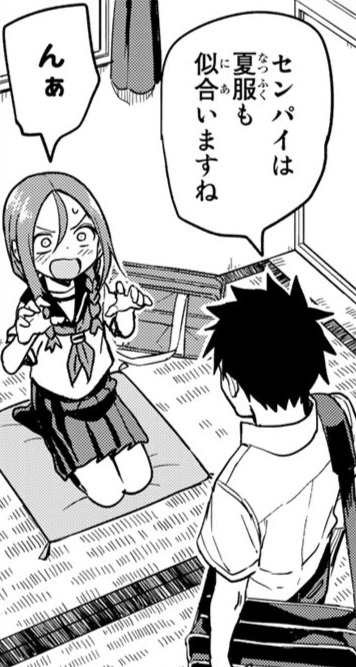
Ayumu goes to the shogi club room after school. There, he and Urushi find they’ve both switched from their winter uniform to their summer uniform on the same day.
- 歩:
- 「センパイは夏服も似合いますね」
- “You look good in your summer uniform too.”
Ayumu and Urushi have both switched to summer uniforms on the same day. 似合いますね, “it suits you”, is a compliment, and ね offers it as something they can both see. Ayumu is polite with his senior.
Example 7 of 19: More of a jaguar vibe with より
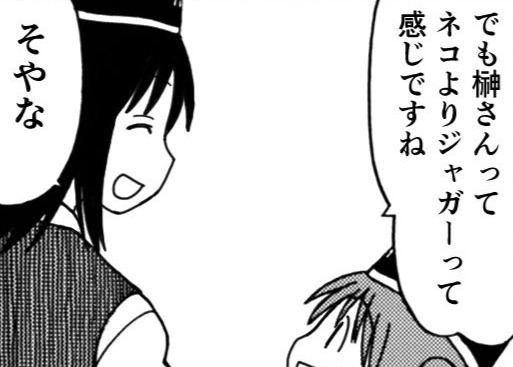
Ayumu and Chiyo get a summer job at Magnetron Hamburger. Their classmate stops by and orders the special that includes a toy of a cat and kitten.
- ちよ:
- 「でも榊さんってネコよりジャガーって感じですね」
- “But Sakaki gives off more of a jaguar vibe than a cat, doesn't she?”
- 歩:
- 「そやな」
- “That's right.”
Chiyo and Ayumu have summer jobs at a burger shop, and Sakaki has just ordered the special that comes with a cat toy. Chiyo thinks Sakaki is more of a jaguar than a cat: ジャガーって感じですね. ね invites agreement, and Ayumu gives it with そやな.
Example 8 of 19: Thanks for the sunset photograph with ありがと
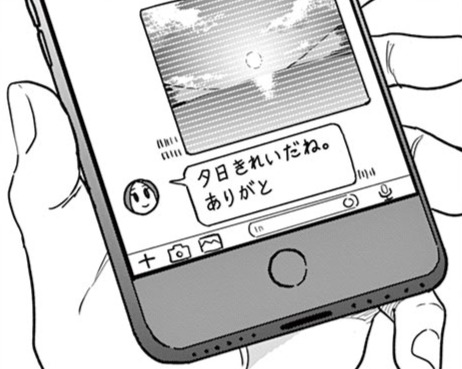
On her way home from the store, Takagi sees Nishikata out jogging. She asks where he’s heading, and he says he doesn’t really have a destination, but he’s jogged as far as the beach before. Takagi doesn’t seem to fully believe him, so after they part ways, Nishikata heads specifically for the beach. Once there, he takes a photograph and sends it to Takagi as proof of his accomplishment.
- 高木:
- 「夕日きれいだね。ありがと」
- “The sunset is pretty, isn't it? Thanks.”
Takagi didn’t quite believe Nishikata jogs all the way to the beach, so he went there and sent her a photo as proof. 夕日きれいだね, “the sunset’s pretty, isn’t it?”, shares the view with him. Then she thanks him.
Example 9 of 19: Cause of incidents in the pool with 原因
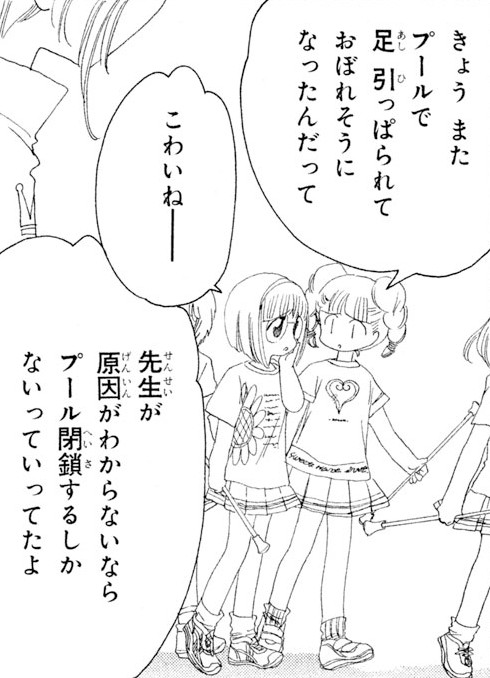
After cheerleading practice, Sakura overhears her friends talking about incidents at the school pool, where Sakura and Chiharu were among those mysteriously pulled underwater.
- 千春:
- 「きょう また プールで足 引っぱられておぼれそうになったんだって」
- “I heard that today, someone got dragged under the water at the pool and almost drowned again.”
- 奈緒子:
- 「こわいねーーー」
- “That's scary!”
- 千春:
- 「先生が原因がわからないならプール閉鎖するしかないっていってたよ」
- “The teacher said that if they can't figure out the cause, they'll have no choice but to close the pool.”
Something keeps pulling students under at the school pool, and Chiharu has heard it happened again today. Naoko reacts: こわいねーーー, “that’s scary!” ね shares the reaction, and the long ー draws it out.
Example 10 of 19: Difficult to discard a photo with 〜がたい
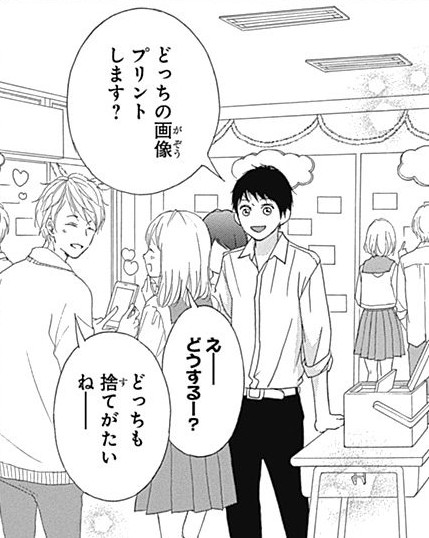
Inui’s class is gathering photos of couples for a school festival contest. Another couple comes to join in.
- 乾:
- 「どっちの画像プリントします?」
- “Which image should I print?”
- 彼女:
- 「えーーー どうするー?」
- “Oh my gosh... What should we do?”
- 彼氏:
- 「どっちも捨てがたいねーーー」
- “Both are hard to abandon.”
Inui’s class is collecting couple photos for a school festival contest, and one couple can’t decide which shot to print. 捨てがたい is “hard to give up”, and ねーーー invites his girlfriend to agree that both are good.
Example 11 of 19: Diving into the river with 飛びこむ
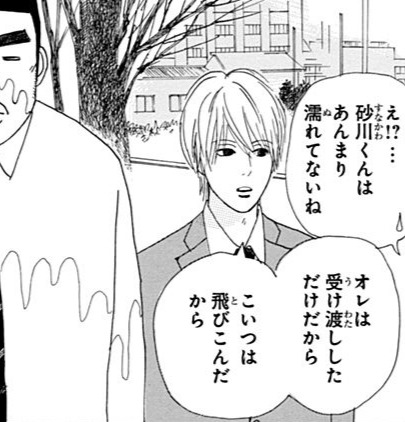
Takeo and Sunakawa meet Yamato at the park. Yamato sees that Takeo is soaked. Sunakawa explains that they saved a child from drowning.
- 大和:
- 「え!?… 砂川くんはあんまり濡れてないね」
- “Huh?!... You're not that wet, Sunakawa.”
- 砂川:
- 「オレは受け渡ししただけだから」
- “I just did the handoff, is all.”
- 「こいつは飛びこんだから」
- “This guy dived right in.”
Takeo and Sunakawa saved a drowning child, and Takeo is soaked. Yamato notices that Sunakawa isn’t: あんまり濡れてないね, “you’re not very wet”. ね makes it an observation she expects him to confirm, and he explains that he only did the handoff.
Example 12 of 19: Don't want you to worry with 〜てほしくない
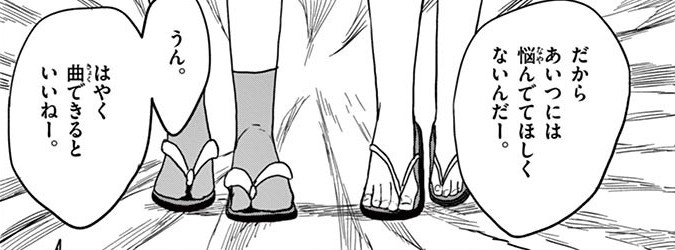
Kagetsu is overworking herself trying to write a song for her group’s upcoming performance.
With a typhoon passing by, she worries their outdoor stage may get ruined. Hototogisu offers to sneak out and check, and Mukuge goes with her.
Outside, Hototogisu says that Kagetsu stops humming when she’s worried, and it’s lonely without her humming.
- ホトトギス:
- 「だからあいつには悩んでてほしくないんだー。」
- “That's why I don't want her to be worrying.”
- ムクゲ:
- 「うん。はやく曲できるといいねー。」
- “Mm-hmm. It'd be nice if she could finish her song quickly.”
Kagetsu has been overworking herself on a song for their performance, and Hototogisu misses her humming. Mukuge agrees: 曲できるといいねー, “I hope she finishes her song soon”. 〜といいね shares a hope.
Example 13 of 19: Feeling you've gained weight with 〜気がする
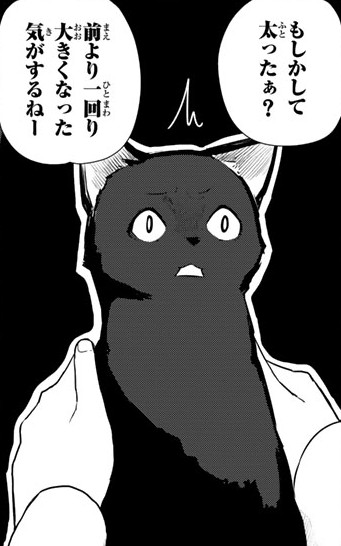
Nao sees Makoto’s cat, Chito. She stops to pet the cat when she notices something.
- なお:
- 「もしかして太ったぁ?前より一回り大きくなった気がするねー」
- “Could it be you've gotten fatter? I feel you've grown a size bigger than before.”
Nao stops to pet Makoto’s cat, Chito, and suspects the cat has put on weight. 〜気がするねー, “I feel like (you’ve gotten bigger)”, invites Makoto to look and agree.
Example 14 of 19: Limited amusement park admission with 入場制限
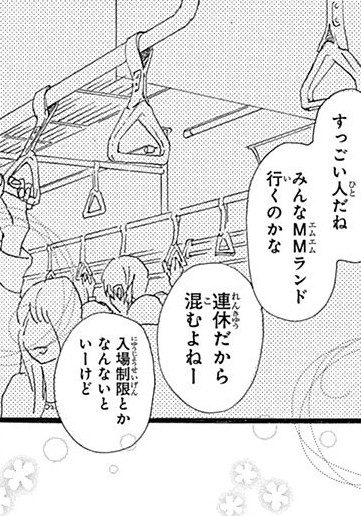
Takeo and his friends board the train bound for the amusement park, MM Land.
- 凛子:
- 「すっごい人だね。みんなMMランド行くのかな」
- “There's a lot of people here. I wonder if everyone's going to MM Land.”
- 隼人:
- 「連休だから混むよねー」
- “It's a long holiday, so it'll be crowded.”
- 愛:
- 「入場制限とかなんないといーけど」
- “I hope they don't restrict admission or anything.”
Takeo and his friends are on the train to MM Land. Rinko notices the crowd: すっごい人だね, “so many people!” Hayato agrees and explains with よね: it’s a long holiday, so it was bound to be crowded.
Example 15 of 19: Should have brought an umbrella with 〜べきだった

On the way home from shopping, it starts raining.
- お母さん:
- 「傘持つべきだったねー。」
- “We should have brought an umbrella, huh?”
- お父さん:
- 「そうだなー。」
- “You're right.”
The family is on the way home from shopping when it starts to rain. 傘持つべきだったねー, “we should have brought an umbrella”, is a shared regret, and ね invites agreement. The father gives it: そうだなー.
Example 16 of 19: That coffee with それ

Cocoa tries to show off her ability to recognize the three types of coffee Chino made for her.
- ココア:
- 「この酸味…キリマンジャロだね」
- “This acidity… it's definitely Kilimanjaro.”
- チノ:
- 「それがブルーマウンテンです」
- “That is Blue Mountain.”
Chino made Cocoa three kinds of coffee, and Cocoa is trying to show off by naming them. キリマンジャロだね, “it’s Kilimanjaro”, uses ね as if Chino will confirm it. She doesn’t: it’s Blue Mountain.
Example 17 of 19: Worth selecting a costume with 〜がいある
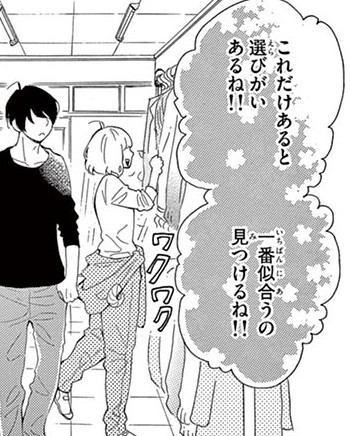
As a member of the student council, Hitsuji comes up with the idea of having a cosplay theme to help build up excitement among students for the school’s sports day. However, Fujiwara, the student council president, fails to dress up. Upon hearing him say he doesn’t have a costume prepared, one of the drama club students suggests he pick from their club’s costumes. While Fujiwara isn’t enthusiastic at the prospect of dressing up, Hitsuji is excited by the club’s wide selection.
- ヒツジ:
- 「これだけあると選びがいあるね!!一番似合うの見つけるね!」
- “When there are this many, it's worth it to choose from! I'll find the one that suits you best!”
Fujiwara didn’t bring a costume for the sports day cosplay, so the drama club offers theirs. Hitsuji is thrilled: 選びがいあるね, “it’s worth choosing from all these!” Her second ね, 見つけるね, is a promise: she’ll find the one that suits him best.
Example 18 of 19: Worth teasing with 〜甲斐がある
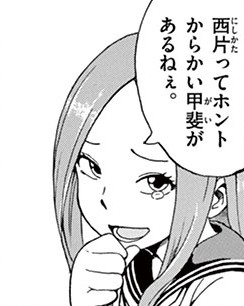
Takagi teases Nishikata, causing him to jump up from his chair and get scolded by the teacher. After sitting back down, Nishikata demands to know why Takagi is laughing.
- 高木:
- 「西片ってホントからかい甲斐があるねぇ。」
- “Teasing you really is worth it.”
Takagi’s teasing made Nishikata jump up from his chair and get scolded by the teacher. When he demands to know why she’s laughing, she tells him: からかい甲斐がある, “you’re worth teasing”. ねぇ invites him to agree, which he won’t.
Example 19 of 19: Receiving a throwing with 〜れる

After learning the fortunes she told didn’t come true for Chino and Rize, Cocoa lists the bad fortune she ran into.
- ココア:
- 「そっかー」
- “I see.”
- 「私あんこが落下してきたりスカートめくれちゃってたりシャロちゃんにお金投げられたり色々あって大変だったよー」
- “All sorts of things happened to me, like Anko falling on me, my skirt flipping up, and having Syaro-chan throw money at me, so it was rough.”
- 「占い勝負はティッピーの勝ちだね」
- “Then Tippy wins the fortune-telling contest.”
Cocoa’s fortunes didn’t come true for Chino and Rize, because all the bad luck landed on her. She draws the conclusion: 占い勝負はティッピーの勝ちだね, “Tippy wins the fortune-telling contest, then”. ね brings the others in on it.
Confirming with よね
The speaker is fairly sure, but wants it locked in.
よね combines よ’s assertion with ね’s check. The speaker states something they believe and asks the listener to back it up: 明日、休みだよね?, “tomorrow’s a day off, right?” Polite speech uses ですよね, and feminine speech has わよね. でしょうね works the same way, often hoping for a “no”.
Example 1 of 14: That said, she'll still show her homework with 〜つつも
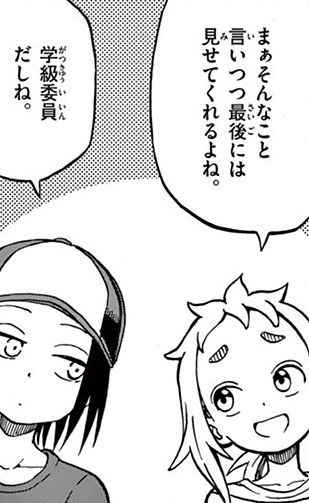
As summer break is half over, talk of summer homework comes up. Yukari says she won’t let Mina copy off of hers.
- ミナ:
- 「まぁそんなこと言いつつ最後には見せてくれるよね」
- “Well, even though she says that, she'll show it to me in the end, you know.”
- サナエ:
- 「学級委員長だしね」
- “She is the class representative, after all.”
Summer break is half over, and Yukari says she won’t let Mina copy her homework. Mina isn’t worried: 最後には見せてくれるよね, “she’ll show me in the end, right?” よね states what Mina believes and checks it with Sanae. Sanae agrees with だしね: Yukari is the class representative, after all.
Example 2 of 14: Limited edition with 限定
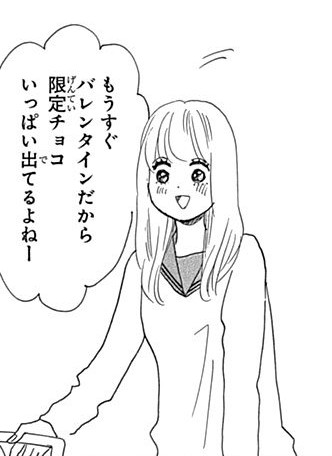
Takeo and Rinko meet up after school and stop somewhere for a drink and to chat. Rinko brings up February 14th, which is right around the corner.
- 凛子:
- 「もうすぐバレンタインだから限定チョコいっぱい出てるよねー」
- “Since it's almost Valentine's, a lot of limited edition chocolates have come out.”
Takeo and Rinko have stopped for a drink after school, and Rinko brings up Valentine’s Day. 限定チョコいっぱい出てるよねー, “lots of limited-edition chocolate is out, right?”, states it and invites Takeo to confirm. She may be hinting at something.
Example 3 of 14: Naru's place with 〜んち
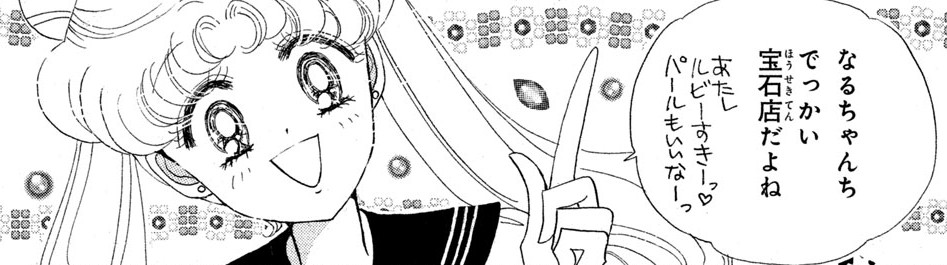
A lunchtime conversation about recent jewelry store robberies gives way to talk about jewelry and the kinds Usagi and her friends would like to own.
- うさぎ:
- 「なるちゃんちでっかい宝石店だよね。あたしルビーすきーっ♡ パールもいいなーっ」
- “Naru 's place is a huge jewelry store, isn't it? (Me, I like rubies. Pearls are also nice.)”
Talk at lunch has turned from jewelry store robberies to jewelry itself. Usagi turns to Naru: なるちゃんちでっかい宝石店だよね, “your family has a huge jewelry store, right?” よね checks something she already knows, and then she lists the jewels she likes.
Example 4 of 14: Surroundings filled with rich girls with 〜だらけ

During a library study session with her friends, Syaro wonders what it would be like if she attended Cocoa and Chiya’s school. She does attend the same school as Rize, but they are in different grades.
- 千夜:
- 「んー…正直窮屈よね」
- “Hmm... Honestly, it feels stifling.”
- 「私だったら周りがお嬢様だらけで気を遣って疲れちゃう」
- “If it were me, I'd get tired of surroundings filled with rich girls and having to act proper.”
Syaro wonders what it would be like to go to Cocoa and Chiya’s school, and Chiya imagines the reverse. 窮屈よね, “it’d be stifling, wouldn’t it?”, drops the だ before よね, which is feminine speech.
Example 5 of 14: Thank you for always being by side with 本当にありがとう
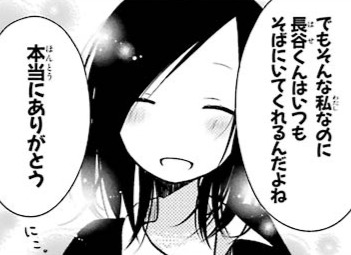
Due to a condition where she loses all memories of friends every Monday morning, Fujimiya acts cold toward classmates to avoid becoming friends. While eating lunch on the roof with Hase, she remarks how hard it is to act that way. Hase says it’s because she’s naturally a nice person. He recalls when he first tried becoming friends with her, how Fujimiya avoided eye contact with him and gave only brief responses. Fujimiya is shocked to hear how she had treated him.
- 藤宮:
- 「でもそんな私なのに長谷くんはいつもそばにいてくれるんだよね」
- “But even though I was like that, Hase-kun, you're always by my side, aren't you?”
- 「本当にありがとう」
- “Thank you, really.”
Fujimiya has just learned how coldly she treated Hase when he first tried to befriend her. いつもそばにいてくれるんだよね, “you’re always by my side, aren’t you?”, states it as a fact and asks him to confirm it. Then she thanks him.
Example 6 of 14: Thank you for the water with ありがとうございました
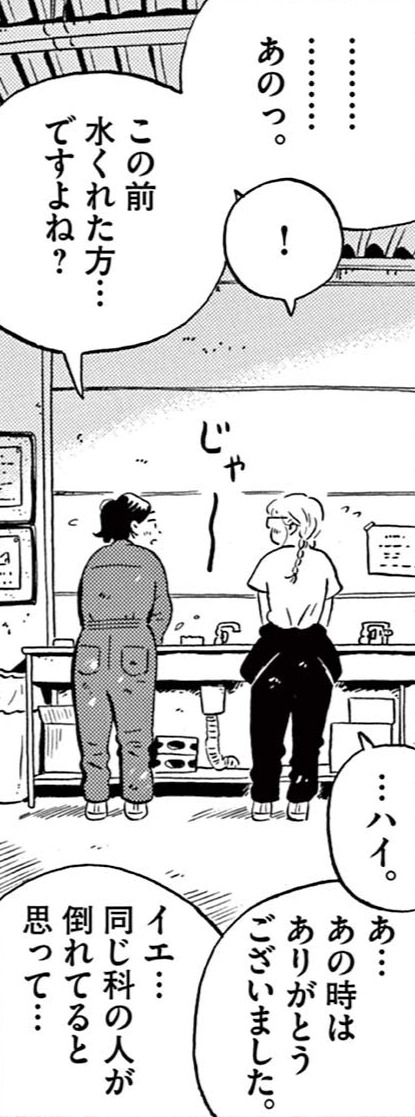
Natsumi tried making new friends from college only to end up drunk and abandoned. At class one day, she finds herself face to face with the helpful person who had found her and briefly helped her afterward.
- なつみ:
- 「……… ……… あのっ。」
- “Um...”
- 「この前水くれた方…ですよね?」
- “You're the one who gave me water before...right?”
- 女:
- 「…はい。」
- “...yes.”
- なつみ:
- 「あ…あの時はありがとうございました。」
- “Ah... Thank you for what you did back then.”
- 女:
- 「イエ…同じ科の人が倒れてると思って…」
- “Not at all... I thought it was someone from the same department who had collapsed...”
Natsumi got drunk and was left behind, and a stranger gave her water. Now she thinks she recognizes that woman in class. ですよね?, “it’s you, isn’t it?”, checks politely. The woman answers はい.
Example 7 of 14: Went to see a kindergarden sports day with 運動会
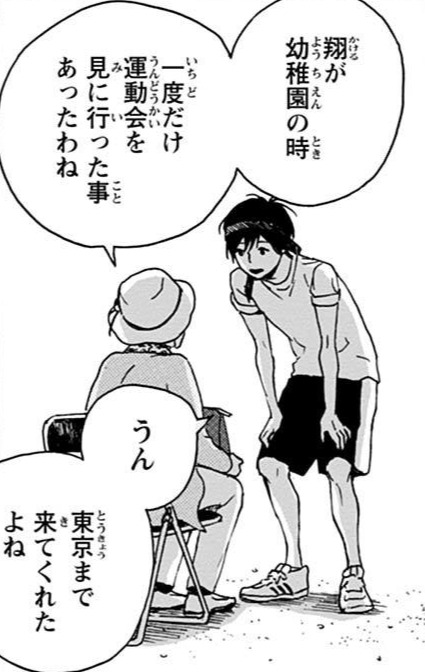
Kakeru’s grandmother unexpectedly shows up at the school sports day event.
- おばあさん:
- 「翔が幼稚園の時一度だけ運動会を見に行った事あったわね」
- “I went to see your sports day just once when you were in kindergarten, didn't I?”
- 翔:
- 「うん 東京まで来てくれたよね」
- “Yeah, you came all the way to Tokyo for me.”
Kakeru’s grandmother shows up unexpectedly at the school sports day. She remembers coming once before, when he was in kindergarten: 見に行った事あったわね. Kakeru confirms it with よね: she came all the way to Tokyo. Each ね checks a shared memory.
Example 8 of 14: Broadcasting music at school with 放送
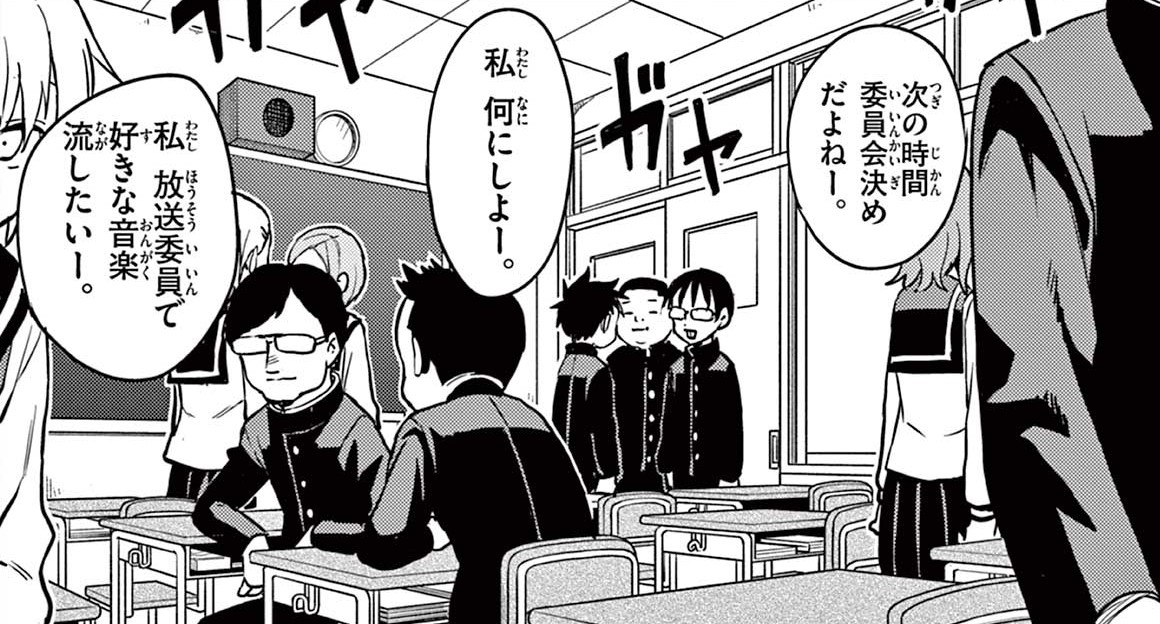
Nishika and Takagi’s class discusses what committees they plan to join.
- 生徒:
- 「次の時間委員会決めだよねー。」
- “Next up is deciding the committee schedule, right?”
- 生徒:
- 「私 何にしよー」
- “What should I pick?”
- 生徒:
- 「私 放送委員で好きな音楽流したいー。」
- “I want to play my favorite music as a member of the broadcasting committee.”
Nishikata and Takagi’s class is talking about which committees to join. 次の時間委員会決めだよねー, “next period we choose committees, right?”, checks the schedule. Then everyone starts deciding.
Example 9 of 14: Experienced drinking tea with 〜た+ことがある

After a misunderstanding brings Cocoa and her friends to the teahouse where Syaro works, the group stays to have some tea.
- ココア:
- 「やっぱダンディー・ライオンだよね!」
- “Dandy Lion is definitely the one!”
- チノ:
- 「飲んだことあるんですか?」
- “Have you drunk it before?”
After a mix-up brings the group to Syaro’s tea shop, Cocoa picks her tea: やっぱダンディー・ライオンだよね!, “Dandy Lion is the one, right?” よね asserts and invites agreement at once. Chino wonders whether Cocoa has actually tried it.
Example 10 of 14: Misseeing something as a ghost as the park lake with 〜ちゃう
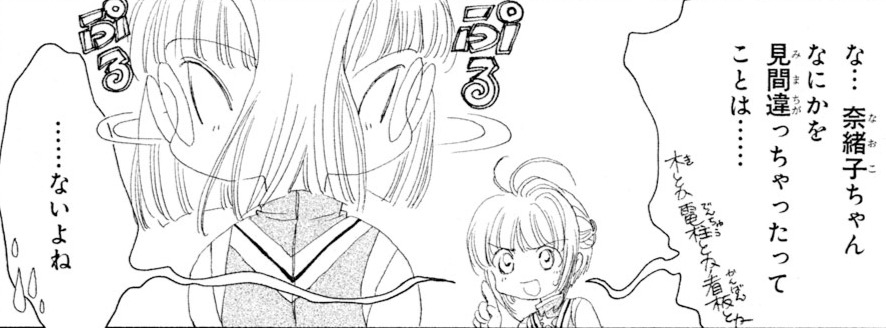
After piano class, Naoko hurries home only to see a ghostly figure appear from within a lake at the park. She recalls the events to her friends at school.
- 桜:
- 「な…奈緒子ちゃん なにかを見間違っちゃったってことは…… (木とか電柱とか看板とか)」
- “Na... Naoko, could it be that you ended up seeing something wrong...... (like a tree or a utility pole or a sign or something)?”
- 「……ないよね」
- “......I guess not.”
Naoko says she saw a ghost rise from the lake in the park. Sakura suggests she mistook something ordinary for it, like a tree or a sign, then backs off: ……ないよね, “no, I guess not”. よね checks, and the pause shows she doesn’t want to push.
Example 11 of 14: Receiving a scolding with 〜れる

Cocoa and her friends visit an indoor hot spring.
- ココア:
- 「小さい頃銭湯で泳いだっけ」
- “Come to think of it, I used to swim at the public bath when I was little.”
- シャロ:
- 「それでよく怒られたわよね」
- “You used to get scolded for that a lot, right?”
Cocoa remembers swimming at the public bath when she was little. Syaro guesses the rest: それでよく怒られたわよね, “and you got scolded for it a lot, right?” わよね is the feminine version, a confident guess that asks for confirmation.
Example 12 of 14: Receiving saying with 〜れる

Cocoa takes a brief break from work to tell Chino something good that just happened.
- ココア:
- 「この前お客さんにココアちゃんはシスター・コンプレックスだねって言われちゃった」
- “Earlier, it was said by a customer that I have a sister complex.”
- チノ:
- 「え…」
- “Ah...”
- ココア:
- 「響きがかっこいいよね」
- “It sounds cool, doesn't it?”
A customer told Cocoa she has a sister complex, and she takes it as a compliment. 響きがかっこいいよね, “it sounds cool, doesn’t it?”, asks Chino to agree. Chino’s え… says she doesn’t.
Example 13 of 14: Yui's grandmother's place with 〜んち
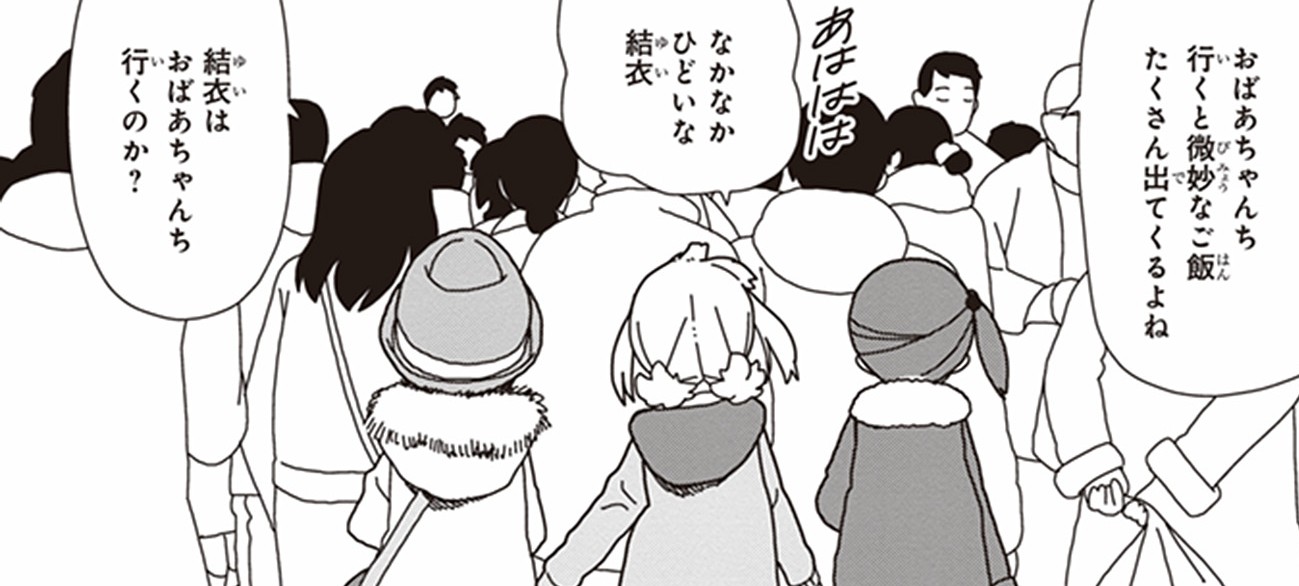
As the end of the year approaches, Yui and her friends discuss which New Year foods they like and dislike.
- 結衣:
- 「おばあちゃんち行くと微妙なご飯たくさん出てくるよね」
- “When I go to my grandma's house, a lot of not-so-good food is served.”
- さっちゃん:
- 「なかなかひどいな結衣」
- “That's pretty bad, Yui.”
- 琴葉:
- 「結衣はおばあちゃんち行くのか?」
- “Are you going to your grandma's house, Yui?”
Yui and her friends are talking about which New Year’s foods they like. At her grandmother’s, a lot of so-so food comes out: 微妙なご飯たくさん出てくるよね. よね asks the others to agree, and Sacchan calls her out.
Example 14 of 14: Additionally, I'm happier having girls here with それに〜
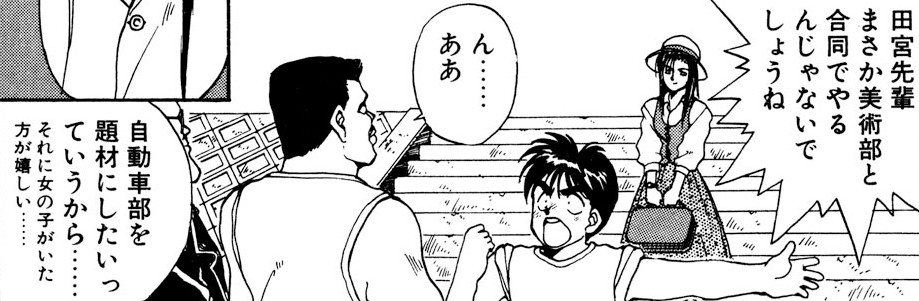
Kei’ichi is excited to spend four days at the beach with his university automobile club and Belldandy. His mood changes when he hears Sayoko call out to him.
- 螢一:
- 「田宮先輩まさか美術部と合同でやるんじゃないでしょうね」
- “Tamiya, don't tell me we're doing this with the art club!”
- 田宮:
- 「ん……ああ。自動車部を題材にしたいっていうから…… それに女の子がいた方が嬉しい…」
- “It's because they said they wanted to use the automobile club as a subject... Additionally, I'm happier having girls here.”
Kei’ichi is looking forward to four days at the beach with the automobile club, until he hears Sayoko call out to him. まさか〜んじゃないでしょうね is “don’t tell me we’re…”. でしょうね asks for confirmation and hopes for a “no”. Tamiya’s answer isn’t the one he wanted.
Softening a Statement
ね rounds the edges off even routine remarks.
ね makes a statement friendlier, even when there’s nothing to agree on. またね, “see you”, ありがとね, “thanks”, and 〜かもね, “maybe”, all sound warmer with it. After a condition, as in 〜たらね, it makes a gentle promise: “when …, okay?”
Example 1 of 11: Reaching out before shopping with 〜ておく

As Chino gathers her things after school, she recalled that Cocoa will be making stew for dinner.
- チノ:
- 「にんじん以外を伝えておこう」
- “I'll let her know in advance everything except carrots.”
- ◯:
- 「またねー」
- “See you!”
- ◯:
- 「バイバーイ」
- “Bye-bye!”
School is over, and Chino is gathering her things, remembering that Cocoa is making stew tonight. Her classmates head off with またねー, “see you!” ね turns a plain また, “again”, into a friendly goodbye.
Example 2 of 11: Coming to visit with 〜に来る

Chiya and Syaro visit Cocoa at the coffee shop.
- ココア:
- 「二人ともこんな天気なのに遊びに来てくれてありがとね」
- “Thanks, both of you, for coming to visit even in weather like this.”
- シャロ:
- 「ちょうどバイトの予定が空白になっただけだし」
- “I just happened to have a gap in my work schedule.”
Chiya and Syaro have come to the café to see Cocoa despite the bad weather. ありがとね is a casual, warm “thanks”, and ね keeps it light. Syaro shrugs it off: her work schedule just happened to be free.
Example 3 of 11: Feeling a bit better with 気が晴れる
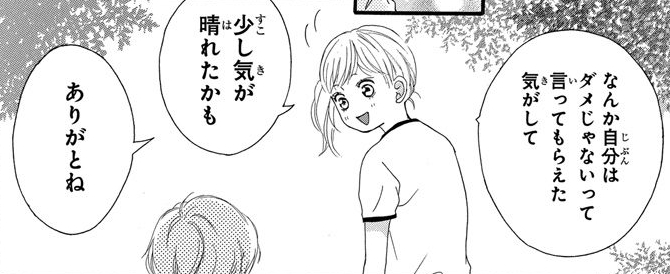
Futaba had been feeling the weight of uncertainty of her standing with Kou. A general discussion about boys and relationships with her friend Kikuchi clears up her feelings.
- 双葉:
- 「なんか自分はダメじゃないって言ってもらえた気がして」
- “It kind of felt like you were telling me I'm not hopeless.”
- 「少し気が晴れたかも」
- “I may be feeling a bit better.”
- 「ありがとね」
- “Thanks.”
Futaba has been anxious about where she stands with Kou, and a talk with Kikuchi has helped. She thanks her with ありがとね, warm and a little shy after admitting she feels better.
Example 4 of 11: Get me some more cookies with おかわり

Mina and Sanae go to Yukari’s house so the three can study. While Yukari studies, the other two slack off to the point when Mina complains that there are no more cookies. Yukari says that’s what happens when you eat them.
- ミナ:
- 「じゃーおかわりくださーい。」
- “Then, get me some more, please!”
- ユカリ:
- 「そのページ終わったらね。」
- “When you finish the page, okay?”
Yukari is studying while Mina and Sanae slack off, and Mina asks for more cookies. そのページ終わったらね, “when you finish the page, okay?”, sets a condition. ね makes it a gentle bargain rather than a refusal.
Example 5 of 11: Reading a book to distract from waiting for a text message with 気を紛らす
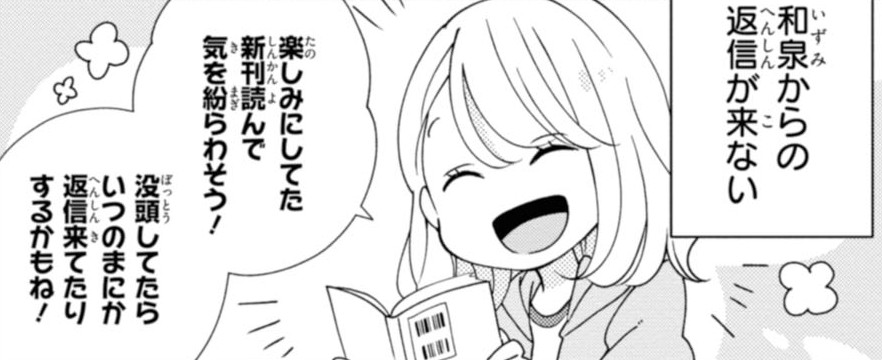
Akari is expecting a text message from Izumi. Unknown to her, Izumi’s response was getting too long, so he switched to his computer to write up an e-mail instead.
- Narration:
- 「和泉からの返信が来ない」
- “I haven't received a reply from Izumi.”
- あかり:
- 「楽しみにしてた新刊読んで気を紛らわそう!」
- “I'll distract myself by reading the new book I've been looking forward to!”
- 「没頭してたらいつのまにか返信来てたりするかもね!」
- “Maybe if I get really absorbed in it, the reply will show up before I know it!”
Akari is waiting for a text from Izumi, so she decides to read a new book to take her mind off it. If she gets absorbed, the reply might show up before she knows it: かもね, “maybe”. ね keeps the hope light, as if she’s telling herself.
Example 6 of 11: Something like a general store with 〜か何か
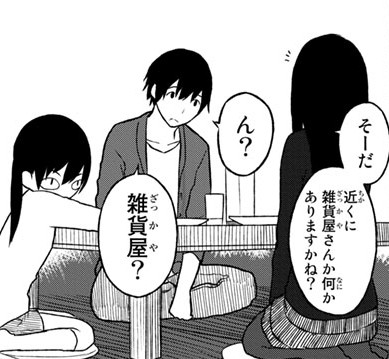
Having just settled in at her relative’s house where she will be living, Makoto has a meal with her cousins.
- 真琴:
- 「そーだ。近くに雑貨屋さんか何かありますかね?」
- “Oh yeah, is there a general store or something nearby?”
- 圭:
- 「ん? 雑貨屋?」
- “Hm? A general store?”
Makoto has just moved in with her relatives and is having dinner with her cousins. 雑貨屋さんか何かありますかね?, “is there a general store or something nearby?”, softens the question with ね, so it sounds less like a demand for information.
Example 7 of 11: Working hard so as to satisfy customers with 〜ように

After visiting Chiya’s family’s café, Cocoa’s sense of work is reinvigorated.
- ココア:
- 「私たちもお客さんに満足してもらえるように頑張らなきゃね」
- “We've got to work hard too so that customers will be satisfied.”
- リゼ:
- 「だなー」
- “Yeah.”
Seeing Chiya’s family’s café has inspired Cocoa. 頑張らなきゃね, “we’ve got to work hard”, is a resolution, and ね brings Rize into it. Rize agrees: だなー.
Example 8 of 11: Have to wear a yukata with 〜なくちゃ
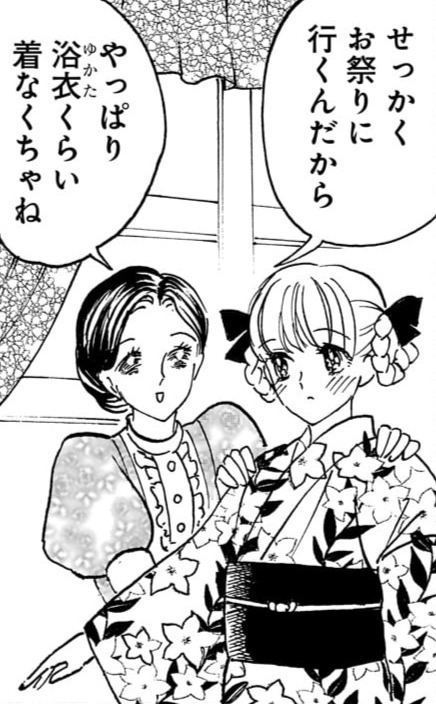
Lulu has plans to visit a local festival with her friends from class. Her mother helps her dress for the occasion.
- ママ:
- 「せっかくお祭りに行くんだから」
- “Since you're going to the festival and all...”
- 「やっぱり浴衣くらい着なくちゃね」
- “You really should wear a yukata at least.”
Lulu is going to a local festival with her friends, and her mother is helping her dress. 浴衣くらい着なくちゃね, “you’ve got to wear a yukata at least”, sounds like advice they both agree on. ね makes it a shared assumption.
Example 9 of 11: Worth the effort to build a garden with 〜甲斐がある
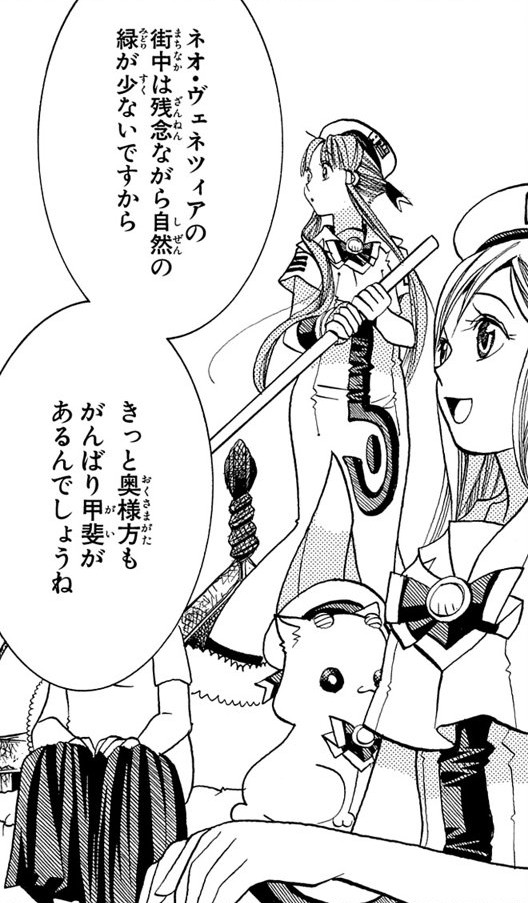
A customer asks Akari to stop the gondola as she sees a house with a fantastic flower garden. The customer asks if it’s a special place, to which Alicia explains it’s an ordinary house. She says the flower bed and gardening are a barometer to measure the caliber of the woman of the household.
- アリシア:
- 「ネオ・ヴェネツィアの街中は残念ながら自然の緑が少ないですから」
- “Since there's regrettably little natural greenery in the city of Neo-Venezia...”
- 「きっと奥様方もがんばり甲斐があるんでしょうね」
- “...surely the housewives also find it worth the effort.”
A customer admires a house’s flower garden, and Alicia explains that a garden is a point of pride for the woman of the house. With so little greenery in Neo-Venezia, the effort must feel worth it: 甲斐があるんでしょうね. でしょうね makes it a gentle guess.
Example 10 of 11: A whiff of crime with 犯罪
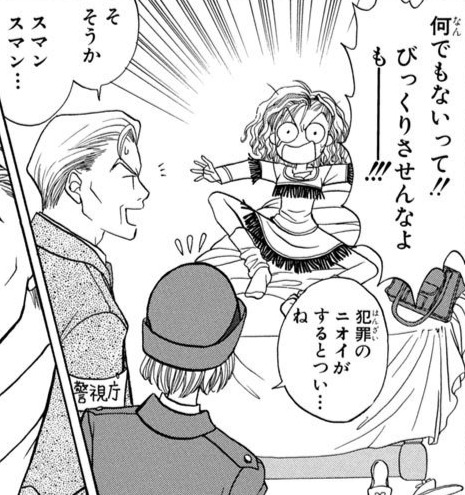
A classmate shows off her new satchel from Meisho Daichi High School. Ran wants one for herself, so she heads down to Shibuya in search of a Meisho Daichi student who’ll give her one. She accidentally steals one, which she later ruminates on in her room. As she talks to herself about how her pride cannot abide stealing, her police officer parents burst into her room, asking what was stolen and who the suspect is.
- 蘭:
- 「何でもないって!! びっくりさせんなよ もーーーー!」
- “It's nothing!! Don't scare me like that! Seriously!!”
- 泰三:
- 「そ そうか スマン スマン…」
- “Oh... okay. Sorry, sorry...”
- 清香:
- 「犯罪のニオイがするとつい…ね」
- “When I smell a crime, I just can't help myself...”
Ran was talking to herself about a theft, and her police officer parents burst in demanding details. Her mother explains: when she smells a crime, she just can’t help it. つい…ね trails off, and ね asks Ran to understand without spelling out the rest.
Example 11 of 11: Finished helping somehow with なんとか
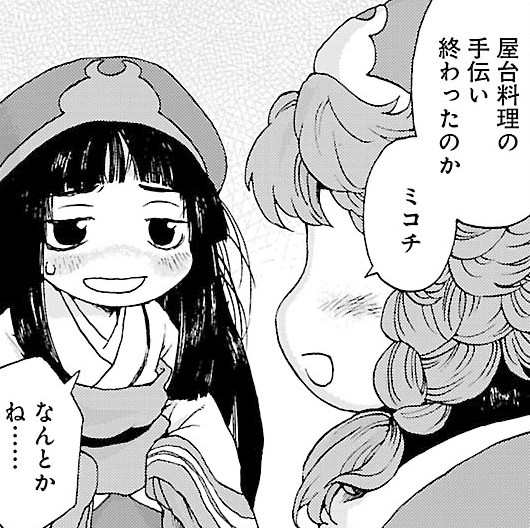
Hakumei is waiting in town. Mikochi joins her and apologizes for being late.
- ハクメイ:
- 「屋台料理の手伝い終わったのか ミコチ」
- “So you're done helping with the stall food, Mikochi?”
- ミコチ:
- 「なんとかね…」
- “Somehow, yeah...”
Mikochi arrives late from helping at the food stalls, and Hakumei asks whether she’s done. なんとかね…, “somehow, yeah…”, is a tired yes. ね keeps the short answer from sounding curt.
Making Sure with からね
〜からね ends a sentence with a reason or a promise and makes sure the listener has heard it. It’s often a reminder or a mild warning, “just so you know”. 先に行くからね is “I’m going ahead, okay?”
Example 1 of 5: Because it's only this road with 〜だけ
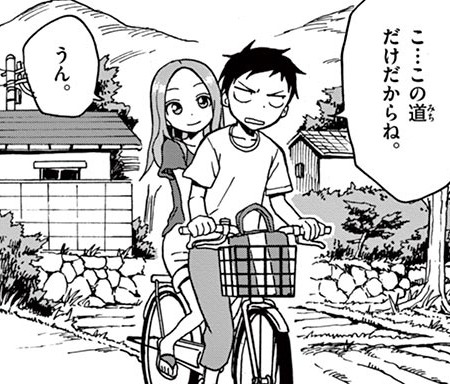
Takagi convinces Nishikata to spend his summer practicing riding his bike with her on the back. One day, she asks Nishikata if he’s progressed on his summer homework, saying they should go to his house to work on it. Since the road back is wide and without cars, Takagi convinces Nishikata to ride doubles to his house.
- 西片:
- 「こ…この道だけだからね。」
- “Because it's only this road, okay?”
Takagi has talked Nishikata into riding double on his bike back to his house, since the road is wide and empty. He sets a condition: この道だけだからね, “only on this road, okay?” からね makes sure she knows he means it.
Example 2 of 5: Challenge deadline with 期限
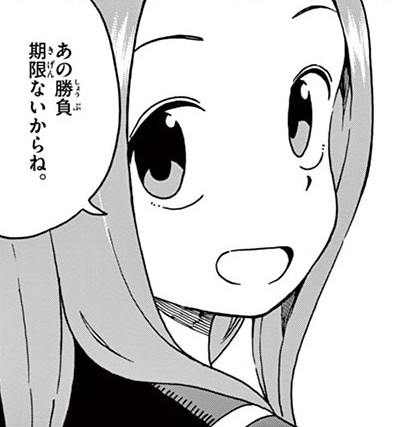
During their walk home after school, Takagi presents Nishikata with an impossible challenge. When he pushes back against it, she comes up with a new challenge, which Nishikata loses. As the two reach the point where they part ways, Takagi stops for a moment.
- 高木:
- 「あの勝負期限ないからね。」
- “There's no deadline for that challenge.”
Nishikata lost Takagi’s challenge on the walk home, and as they reach the spot where they part, she stops. 期限ないからね, “there’s no deadline for that challenge”, is a parting reminder: she hasn’t forgotten, and it isn’t over.
Example 3 of 5: Bus pickup and drop off with 送迎
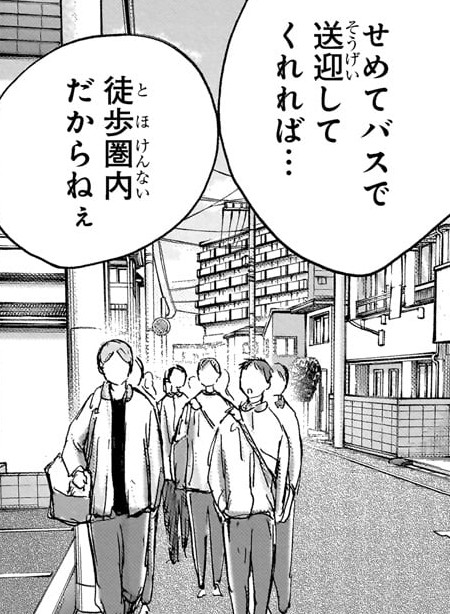
After school, the girls’ basketball team walks to the location where they’re practicing for an upcoming match.
- 生徒:
- 「せめてバスで送迎してくれれば…」
- “If only they'd at least provide a bus to pick us up and drop us off”
- 生徒:
- 「徒歩圏内だからねぇ」
- “It's within walking distance, after all.”
The girls’ basketball team is walking to where they’ll practice for a match, and one of them wishes the school would at least send a bus. Another answers: 徒歩圏内だからねぇ, “well, it’s within walking distance”. からねぇ offers the reason with a resigned shrug.
Example 4 of 5: I'll fix you dinner with 〜てあげる

After a case wraps up, Conan parts ways with Kogoro and Ran to do something. When Conan returns home, Ran gets ready to prepare dinner.
- 蘭:
- 「おなかすいたでしょーー?」
- “You're hungry, right?”
- 「今、何か作ってあげるからね!」
- “I'll make you something right now!”
- コナン:
- 「うん!」
- “'kay!”
Conan comes home after a case, and Ran is sure he’s hungry. 作ってあげるからね, “I’ll make you something”, is a promise, and からね reassures him it’s coming.
Example 5 of 5: Experiencing danger during hide-and-seek with 〜目にあう
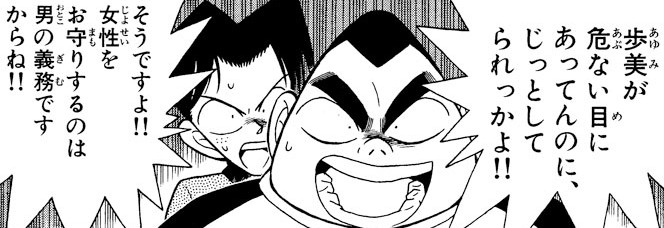
During a hide-and-seek game at the park, Ayumi hides in a car trunk and falls asleep. She wakes to find the car moving and discovers a bag of money, a slimy saw, and what seems like a severed head. Conan, tracking her via their Detective Boys badges, prepares to pursue on his electric skateboard. Genta and Mitsuhiko join him on it, but Conan urges them to stay behind due to the danger.
- 元太:
- 「歩美が危ない目にあってんのに、じっとしてられっかよ!!」
- “Ayumi is in danger, so how can I just stand by and do nothing?”
- 光彦:
- 「そうですよ!! 女性をお守りするのは男の義務ですからね!!」
- “That's right! It's a man's duty to protect women!”
Ayumi is trapped in the trunk of a moving car, and Conan wants Genta and Mitsuhiko to stay behind. Mitsuhiko backs Genta up: protecting women is a man’s duty, 義務ですからね. からね gives the reason and makes sure Conan hears it.
Requests and Advice with 〜てね
ね after a request makes it gentle: 待っててね, “wait for me, okay?” It assumes the listener is happy to go along. Advice works the same way. 〜ことね, “you’d better…”, is common in feminine speech.
Example 1 of 4: Came to be studying with us with 〜ことになる
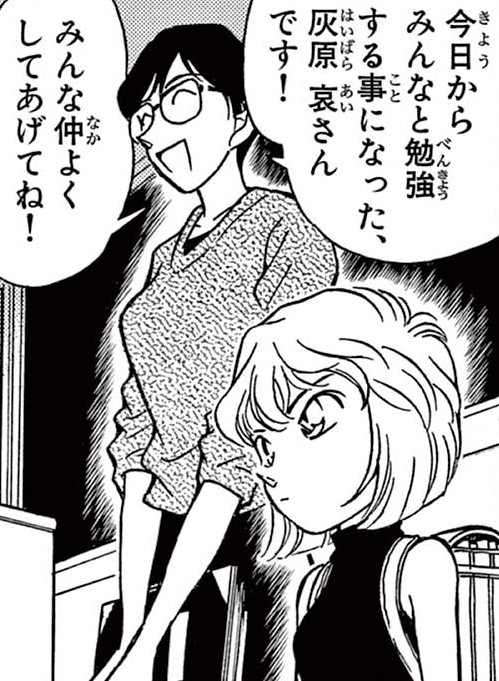
A new student joins Conan’s elementary school classroom. The teacher introduces her.
- 先生:
- 「今日からみんなと勉強する事になった、灰原 哀さんです!」
- “This is Ai Haibara. It came to be that she'll be studying with us starting today.”
- 「みんな仲良くしてあげてね!」
- “Everyone be friendly with her!”
A new student, Ai Haibara, has joined Conan’s class, and the teacher asks everyone to be friends with her: 仲良くしてあげてね. ね makes it a warm request, the kind teachers make to young children.
Example 2 of 4: Clearing out a room with 〜ておく

After Cocoa suggests if she were staying at Chiya’s place rather than Chino’s, that she’d be working for Chiya’s family’s tea house, Chiya takes to the idea.
- 千夜:
- 「じゃあ部屋を空けておくから早速荷物をまとめて来てね」
- “Then I'll clear out a room in advance, so go gather your things and come right away.”
- ココア:
- 「誰か止めてよ!」
- “Somebody stop her!”
Cocoa joked that she’d work at Chiya’s family’s café if she lived there, and Chiya takes her up on it at once. 荷物をまとめて来てね, “go pack your things and come”, is a cheerful request. ね makes it sound already settled, which is why Cocoa wants someone to stop her.
Example 3 of 4: Not only physical wounds with 〜だけじゃなくても
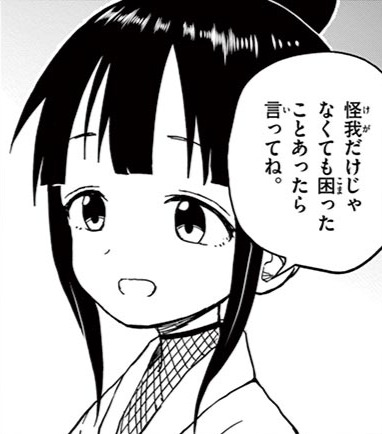
During lunch, Mokurin sees someone new sitting with Tsubaki. She learns that it’s the transfer student, Rindou, who’s joined Tsubaki in the Dog Clan. Mokurin introduces herself as a member of the Monkey Clan, which Tsubaki explains handles medical treatment.
- モクリン:
- 「怪我だけじゃなくても困ったことあったら言ってね。」
- “If you're having trouble with anything, not just injuries, let me know.”
Mokurin meets Rindou, the transfer student who joined Tsubaki’s clan. Mokurin’s clan handles medical care, and she offers more than that: if anything is wrong, 言ってね, “let me know”. ね makes it an open, friendly offer.
Example 4 of 4: Don't underestimate your mother with 甘く見る

Meimi’s mother stops by Meimi’s room with a couple of movie tickets. She says she and Meimi’s father have already seen the movie, so she’s offering them to Meimi. She says the movie is very romantic, and suggests Meimi has someone she’d want to see it with.
- 芽美:
- 「マ… ママ知って…」
- “Mom, you knew...?”
- ママ:
- 「ママを甘く見ないことね」
- “Don't underestimate Mom.”
Meimi’s mother offers her movie tickets and hints that Meimi has someone she’d like to see a romantic movie with. Meimi is shocked that she knows. 〜ないことね is “you’d better not”: 甘く見ないことね, “don’t underestimate your mom”. ね keeps it playful.
Realizing with のね and んだね
のね, and んだね in casual speech, mark something the speaker has just worked out from what they see or hear: “so that’s it” or “I see”. ね asks the listener to confirm the conclusion.
- 疲れてるんだね。
- You’re tired, aren’t you?
Example 1 of 6: Receiving a held image with 〜れる

Syaro returns home after seeing Rize at the store.
- シャロ:
- 「リゼ先輩に余計なイメージもたれた…」
- “A wrong impression of me has become held by Rize-senpai...”
- 「あと頭にへんな生物が…」
- “And there was a strange creature on her head...”
- 千夜:
- 「ココアちゃん達に会ったのね!」
- “So you met Cocoa and the others!”
Syaro comes home upset that Rize got the wrong idea about her, and she mentions a girl with a strange creature on her head. Chiya puts it together: ココアちゃん達に会ったのね!, “so you met Cocoa and the others!” のね marks her conclusion.
Example 2 of 6: Thank you very much for bringing my daughter back with どうもありがとう

Yousuke’s daughter Yotsuba wanders off while he’s moving things into their new home. One of his new neighbors offers to keep an eye out for her. Later, he finds Yotsuba outside with the neighbors.
- 葉介:
- 「あぁ連れて帰ってくれたんだね」
- “Ah, so you brought her back home.”
- 「どうもありがとう」
- “Thank you so much.”
- あさぎ:
- 「いえいえ 私はたいした事はなにも」
- “No, no, it was nothing at all.”
- 恵那:
- 「ただいま…」
- “I'm home...”
Yotsuba wandered off while her father was moving in, and a neighbor offered to watch for her. Now Yousuke finds Yotsuba outside with the neighbors and works out what happened: 連れて帰ってくれたんだね, “so you brought her back”. Then he thanks them.
Example 3 of 6: Demolishing the movie theater with 解体
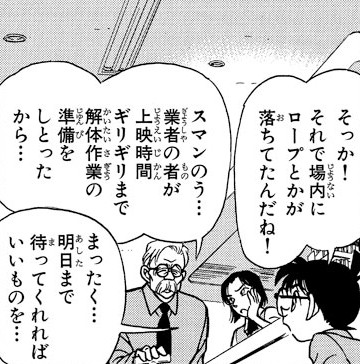
Conan and his friends go to the theater to see a movie. There, they discover this is the last day before the theater closes.
- コナン:
- 「そっか!それで場内にロープとかが落ちてたんだね!」
- “Oh, I see! That's why there were ropes and stuff lying around the venue!”
- オーナー:
- 「スマンのう… 業者の者が上映時間ギリギリまで解体作業の準備をしとったから…」
- “Sorry about that... The contractor's crew was rushing to get the dismantling ready right up until showtime...”
- スタッフ:
- 「まったく… 明日まで待ってくれればいいものを…」
- “Honestly... They could've at least waited until tomorrow...”
Conan and his friends learn it’s the theater’s last day before closing, which explains the ropes he saw lying around: 落ちてたんだね! そっか, “oh, I get it”, and んだね connect what he saw to what he has just learned.
Example 4 of 6: Interested in a defector with 入れ込む
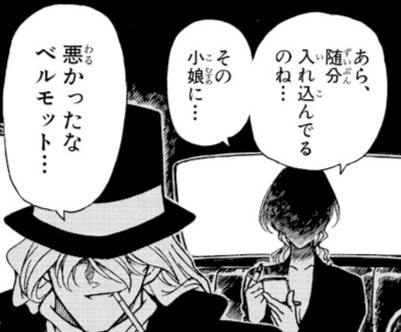
Gin and Vodka finally find Sherry, but after multiple gunshots are fired, she escapes. Vodka thinks they should continue to search for her, but Gin says there’s no way she’ll stay in town after their encounter.
- ベルモット:
- 「あら、随分入れ込んでるのね…」
- “Oh my... You're rather interested in her, aren't you...”
- 「その小娘に…」
- “That little girl...”
- ジン:
- 「悪かったなベルモット…」
- “Sorry, Vermouth...”
Gin let Sherry get away, but he’s sure she has left town. Vermouth picks up on how much he cares: 随分入れ込んでるのね, “you’re quite taken with her”. のね is her conclusion, and a tease.
Example 5 of 6: When you're small with 〜うちは
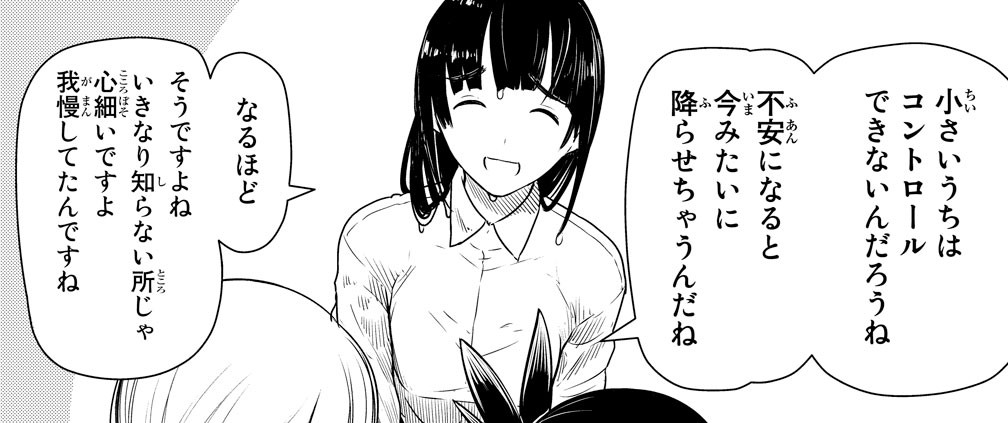
During a visit with Anzu’s family, Makoto receives a request to babysit for another witch. Things are fine at first, but after a while, rain begins to pour inside. Anzu’s mother realizes that the child they’re watching over has rain magic.
- 杏子の母:
- 「小さいうちはコントロールできないんだろうね。不安になると今みたいに降らせちゃうんだね」
- “You don't have control while you're small, right? When he gets uneasy, he makes it rain like just now.”
- 真琴:
- 「なるほど。そうですよね。いきなり知らない所じゃ心細いですよ。我慢してたんですね」
- “I see. So that's it. It's a little scary suddenly being in a place you don't know. You've been patient, haven't you?”
Rain started pouring indoors while Makoto was babysitting a young witch. Anzu’s mother works it out: he can’t control his magic yet, and 降らせちゃうんだね, “so he makes it rain when he’s anxious”. Makoto reaches her own conclusion with polite んですね: he’d been holding it in.
Example 6 of 6: A picked-up earring with イヤリング
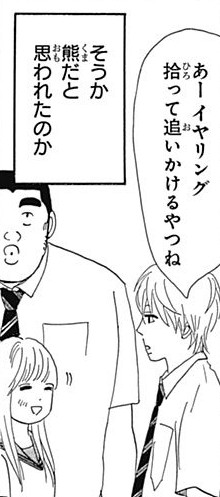
Takeo runs after a mother and her child to give them a shoe they dropped. Due to Takeo’s large size and loud steps, the mother and child get frightened and run from him. After he manages to return the dropped item, Takeo returns to his friends. Rinko remarks that the scene was like “A Bear in the Forest”. Sunakawa recalls the song.
- 砂川:
- 「あーイヤリング拾って追いかけるやつね」
- “Ah, the one who picked up an earring and chased after.”
- 猛男:
- 「そうか 熊だと思われたのか」
- “I see. It's that I was thought of as a bear?”
Takeo chased a mother and child to return a dropped shoe, and they ran from him. Rinko compares it to the song “A Bear in the Forest”. Sunakawa places it: イヤリング拾って追いかけるやつね, “ah, the one where (the bear) picks up an earring and chases after her”.
Echoing Someone’s Words
Repeating someone’s words with ね, as in 留学ねえ…, “studying abroad, huh…”, acknowledges them as something the speaker already knows about. An echo without ね sounds more like the speaker is hearing something unfamiliar.
The echo itself doesn’t say what the speaker thinks. Anyone can echo this way, so a noun with ね here isn’t the feminine pattern of きれいね.
Example 1 of 2: It's not like you're a foreigner with 〜じゃあるまいし
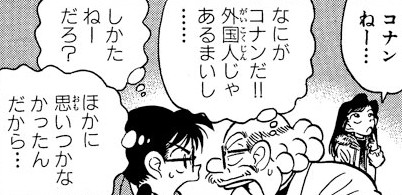
Shin’ichi’s teenage friend Ran enters Professor Agasa’s house looking for him, unaware that he was forced to take a poison that inadvertently turned the teenager into a young child. When Ran sees the boy and asks his name, Shin’ichi recalls Agasa’s suggestion to not reveal who he is. Panicking, he gives the name “Conan”, explaining the oddness of it by saying his father is a fan of author Arthur Conan Doyle.
- 蘭:
- 「コナンねー…」
- “Conan, huh?”
- 阿笠:
- 「なにがコナンだ!! 外国人じゃあるまいし」
- “What's with 'Conan'!? It's not like you're a foreigner...”
- コナン:
- 「しかたねーだろ? ほかに思いつかなかったんだから…」
- “It couldn't be helped, all right? I couldn't think up anything else...”
Shin’ichi, shrunk into a child, blurted out “Conan” when Ran asked his name. Ran turns it over: コナンねー…, “Conan, huh…”. Repeating a word with ね shows the speaker thinking about it.
Example 2 of 2: A sign of summer with 風物詩
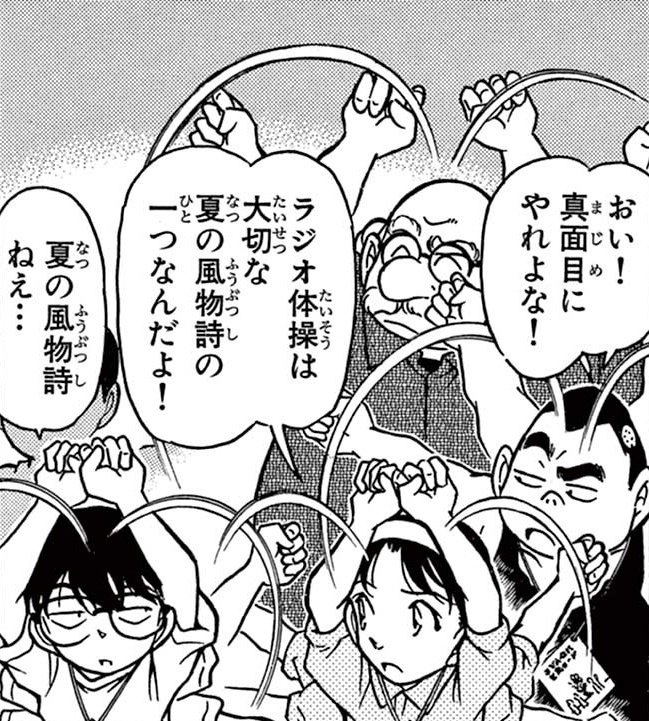
Conan has joined the other children for radio exercises at school. As everyone follows the routine, he broods over how he should be enjoying his summer vacation as a second-year high school student. Instead, he is stuck exercising with elementary schoolers and wonders what he is doing there.
- 元太:
- 「おい! 真面目にやれよな!」
- “Hey! Take this seriously!”
- 歩美:
- 「ラジオ体操は大切な夏の風物詩の一つなんだよ!」
- “Radio exercises are one of those treasured signs of summer!”
- コナン:
- 「夏の風物詩ねえ…」
- “A sign of summer, huh...”
Genta tells Conan to put some effort into the radio exercises, and Ayumi adds that they’re a treasured 風物詩 of summer. Conan echoes her: 夏の風物詩ねえ…, “a sign of summer, huh…”. ね acknowledges a tradition he already knows, and his half-lidded stare shows he doesn’t share her enthusiasm.
Feminine わね
In feminine speech, ね often follows a noun or な-adjective with no だ: きれいね, “it’s pretty”. わね adds soft emphasis after verbs and adjectives, as in 似合ってるわね, “it suits you”. Like わよ, these sound feminine and a little refined, and manga gives them to mothers, older women, and elegant characters.
Example 1 of 8: Asking to have tea with 〜てもいい

Following a misunderstanding, Cocoa and her friends ended up at the tea house where Syaro works.
- ココア:
- 「せっかくだからお茶してってもいいかな?」
- “Since we have the chance, would it be okay if we had some tea ?”
- シャロ:
- 「しょうがないわねー」
- “I guess it can't be helped.”
A misunderstanding brought the group to the tea shop where Syaro works, and Cocoa asks if they can stay for tea. Syaro agrees with a show of reluctance: しょうがないわねー, “I suppose it can’t be helped”. わね gives it a ladylike sigh.
Example 2 of 8: Good-looking winter uniform with 冬服
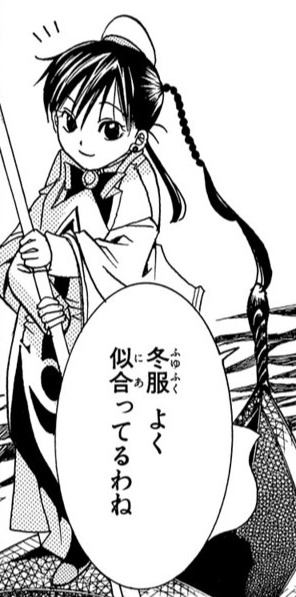
Winter has arrived, and Alicia and Akari have switched to wearing their winter uniforms. The two greet Aika outside.
- アリシア:
- 「冬服 よく似合ってるわね」
- “Your winter uniform looks really good on you.”
Winter has come, and Alicia and Akari have switched to winter uniforms. They meet Aika outside, and Alicia compliments her: よく似合ってるわね, “it suits you well”. Alicia is gentle and grown-up, and わね fits her.
Example 3 of 8: Worth making a meal with 〜甲斐がある
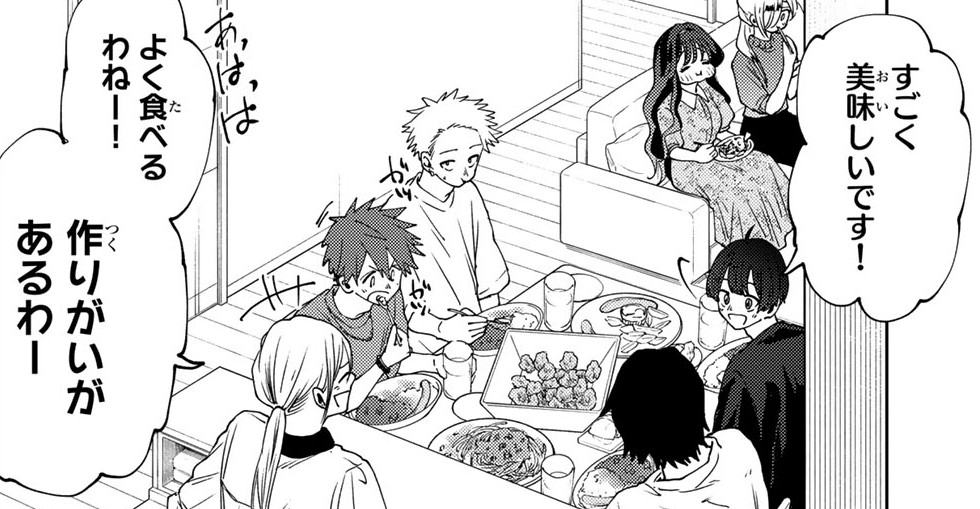
Rintaro’s mother is overjoyed when her son has friends over for the first time in his life. She prepares a large meal for them to eat.
- 絢斗:
- 「すごく美味しいです!」
- “This is incredibly delicious!”
- 杏子:
- 「よく食べるわね! 作りがいがあるわー」
- “You sure do eat a lot! It makes cooking worthwhile!”
Rintaro has friends over for the first time, and his mother has cooked a feast. When they dig in, she’s delighted: よく食べるわね!, “you sure eat a lot!” Her next line says it makes cooking worthwhile.
Example 4 of 8: Better to re-learn how to swim with 〜た+方がいい

Rize and her friends visit an indoor hot spring. Rize admits she doesn’t know how to swim.
- ココア:
- 「私のクロール見てー」
- “Look at my front crawl!”
- シャロ:
- 「泳ぎ方を覚え直した方がいいわね」
- “You had better relearn how to swim.”
Rize has admitted she can’t swim, and Cocoa shows off her front crawl. Syaro gives her verdict: 覚え直した方がいいわね, “you’d better relearn how to swim”. わね makes the advice sound refined, and a little cutting.
Example 5 of 8: Protective hand mirror with 手鏡
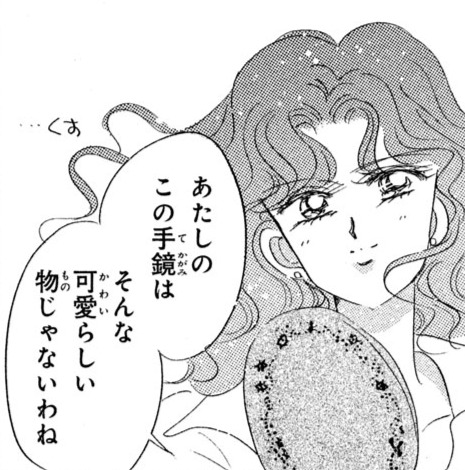
Seeing Chibiusa leaving Hotaru’s house, Haruka and Michiru stop over to pick her up. Michiru asks what the two were talking about, and Chibiusa explains that it was a conversation about amulets and their mysterious protective powers. She asks if Michiru has one. Michiru says her mirror may be protective, to which Chibiusa says it must be an amulet.
- みちる:
- 「あたしのこの手鏡はそんな可愛らしい物じゃないわね」
- “This hand mirror of mine isn't something that cute.”
Chibiusa has been talking with Hotaru about lucky charms, and she asks whether Michiru has one. Michiru’s hand mirror may protect her, but it’s nothing so cute: 可愛らしい物じゃないわね. わね suits her elegant, slightly mysterious manner.
Example 6 of 8: A long-desired kaleidoscope with 万華鏡
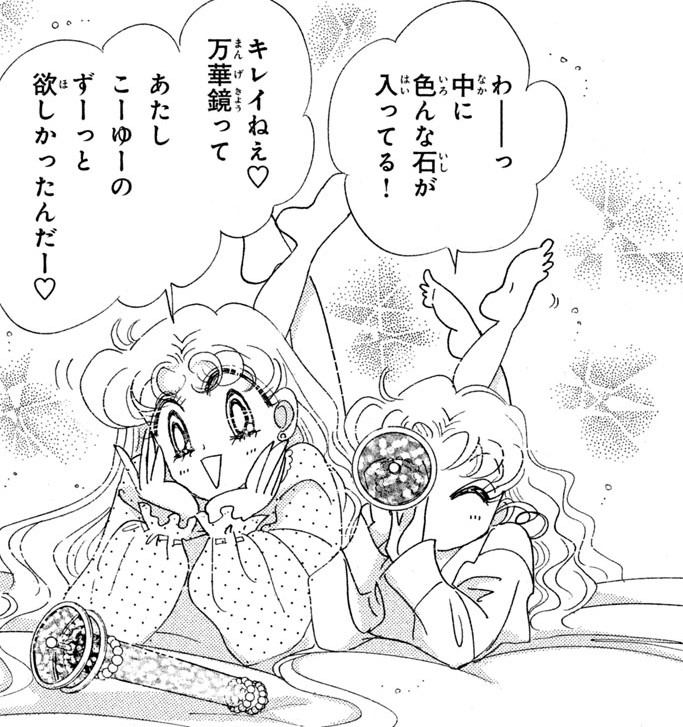
Usagi and Chibiusa look at the kaleidoscopes Mamoru bought them at the carnival.
- ちびうさ:
- 「わーーーっ 中に色んな石が入ってる」
- “Wow! There are all kinds of stones inside!”
- うさぎ:
- 「キレイねえ♡ 万華鏡って」
- “It's so pretty♡ A kaleidoscope...”
- 「あたし こーゆーの ずーっと 欲しかったんだー♡」
- “I've wanted one of these for so long♡”
Mamoru bought Usagi and Chibiusa kaleidoscopes at the carnival. キレイねえ, “it’s so pretty”, follows the な-adjective キレイ with ね and no だ, the feminine pattern. The stretched ねえ shows how taken she is.
Example 7 of 8: Went and brought the wrong textbook with 〜ちゃう
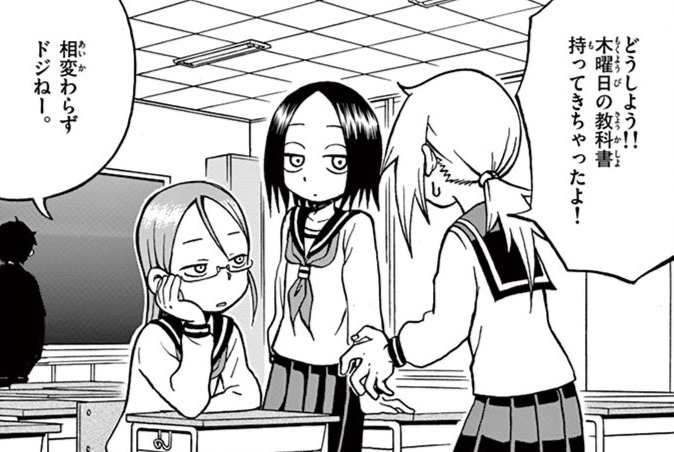
Mina is startled to learn that today is Friday.
- ミナ:
- 「どうしよう!!木曜日の教科書持ってきちゃったよ!」
- “What'll I do?! I ended up bringing my textbook for Thursday!”
- ユカリ:
- 「相変わらずドジねー。」
- “You're such a klutz, as usual.”
Mina has just realized she brought Thursday’s textbook on a Friday. Yukari isn’t surprised: 相変わらずドジねー, “you’re such a klutz, as usual”. The noun ドジ takes ね with no だ.
Example 8 of 8: A poison's composition with 成分
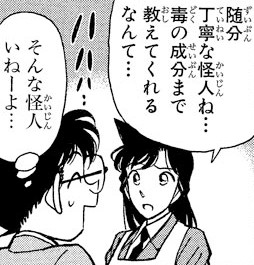
A client tells Detective Mouri about the condition in which she found her deceased husband. Hearing the details, Conan identifies the likely poison, including the composition, the dosage required to kill, and the internal effects it has on a person. When Ran asks how he knows all this, Conan covers by saying the monster villain on the kid’s TV show he watched explained it.
- 蘭:
- 「随分 丁寧な怪人ね… 毒の成分まで教えてくれるなんて…」
- “What a polite villain... Going so far as to tell the poison's composition...”
- コナン:
- 「そんな怪人いねーよ…」
- “No such monster exists...”
Conan explained a poison in detail and claimed he learned it from a TV villain. Ran is impressed by the villain: 随分丁寧な怪人ね, “what a considerate villain”. ね follows the noun directly, with no だ. Conan thinks that no such villain exists.
Mid-Sentence ね
ね can come in the middle of a sentence, after a phrase, to keep the listener with the speaker: 昨日ね、駅でね…, “so yesterday, at the station…”. It’s common in chatty speech, storytelling, and children’s speech. そうですね and そのですね work as fillers while the speaker thinks.
Example 1 of 5: Dueling like in Ancient Rome with 古代
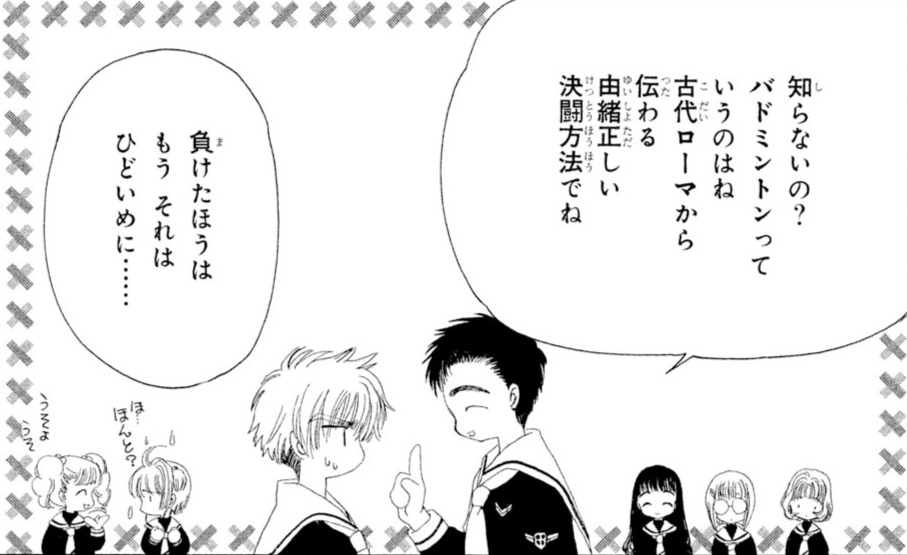
Li seems fired up over something with Sakura. Yamazaki suggests whatever the issue is be settled when they play badminton during that day’s physical education class. Li asks why things have to be settled via badminton.
- 山崎:
- 「知らないの?バドミントンっていうのはね 古代ローマから伝わる由緒正しい決闘方法でね」
- “You don't know? Badminton is a time-honored method of dueling that has been passed down since ancient Rome.”
- 「負けたほうはもう それはひどいめに……」
- “The loser suffers a truly terrible fate.”
Li seems fired up over something with Sakura, and Yamazaki suggests they settle it with badminton in PE. When Li asks why badminton, Yamazaki explains, ね by ね: バドミントンっていうのはね…決闘方法でね. Each ね keeps Li hanging on. Yamazaki is known for tall tales.
Example 2 of 5: Chinese history lesson on talismans with 中国
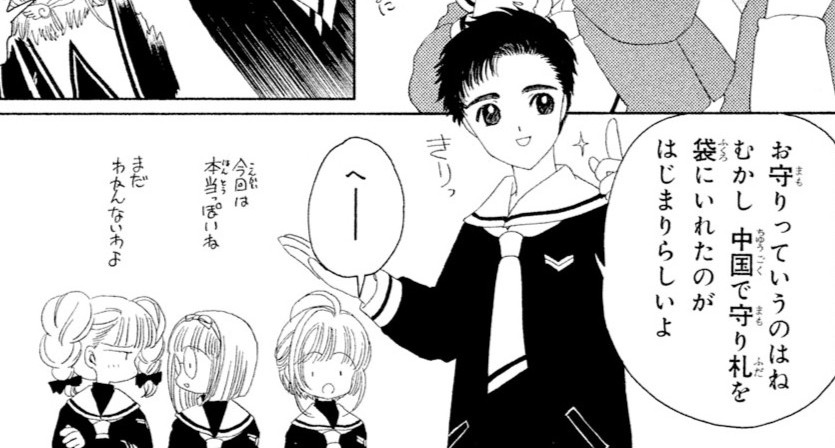
Sakura had to take a detour to get to class. She tells her friends at school about the shrine she saw along the way. Naoko says the talismans from there are popular, as they can grant wishes for things such as exams and romance.
- 山崎:
- 「お守りっていうのはね むかし 中国で守り札を袋にいれたのがはじまりらしいよ」
- “You know, apparently good-luck charms began long ago in China, when people put protective talismans into bags.”
- 奈緒子:
- 「今回は本当っぽいね」
- “This time it sounds true, huh?”
- 千春:
- 「まだ わかんないわよ」
- “We don't know that yet!”
Sakura passed a shrine on the way to school, and Naoko says its charms are popular. Yamazaki starts a history lesson: お守りっていうのはね, “charms, you see…”. The ね after the topic draws everyone in before the claim. Naoko thinks it sounds true this time, with a ね of her own: 本当っぽいね.
Example 3 of 5: Strange incidents on after another in Tokyo with 続出
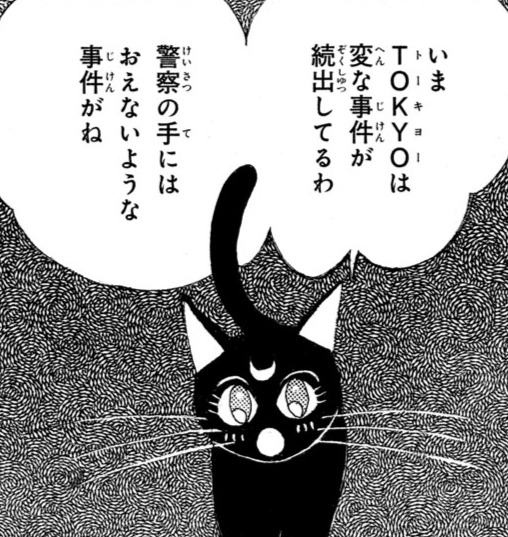
Luna introduces herself to Usagi, but Usagi thinks she’s dreaming if a cat is speaking to her. Luna gives Usagi a special brooch, then proceeds to explain the dire situation that has brought them together.
- ルナ:
- 「いまTOKYOは変な事件が続出してるわ」
- “Strange incidents are popping up all over Tokyo these days.”
- 「警察の手にはおえないような事件がね」
- “Incidents that seem beyond the police's control, you know.”
Luna has given Usagi a brooch and is explaining why they’ve met. Strange incidents keep happening in Tokyo, ones the police can’t handle: 事件がね. The sentence stops on the subject and ね, with the verb from her previous line understood, as if a long story is coming.
Example 4 of 5: Wanted you to eat the cookies I baked with 〜てほしかった

During cooking class, Komura has trouble concentrating as the girl he likes, Mie, and another boy who seems to like her, Azuma, are teamed up and seem to be getting along well together. After class, Komura sulks away. On his way home, Mie catches up with him. She gives him a bag with the cookies she baked in class.
- 三重:
- 「小村くんに食べてほしかったのはね」
- “I wanted you to eat them.”
Komura sulked off after cooking class, where Mie was paired with Azuma. Mie catches up to give him her cookies. 食べてほしかったのはね, “the one I wanted to eat them…”, pauses with ね right before the important part: it’s him.
Example 5 of 5: Underutilized talent with 才能
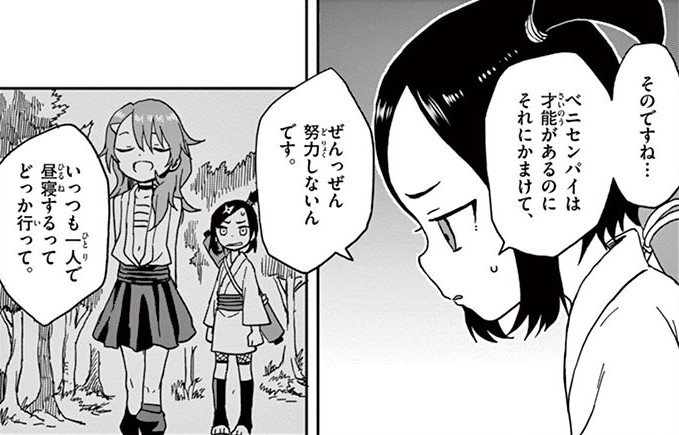
During a free day from training, Touwata and Mizubashou approach Tsubaki to request a favor. She would like Tsubaki to challenge Benisumomo to a one-on-one fight.
- トウワタ:
- 「そのですね… ベニセンパイは才能があるのにそれにかまけて、ぜんっぜん努力しないんです。」
- “Well, you see... Beni-senpai has talent, but she takes it for granted and doesn't put in any effort at all.”
- 「いっつも一人で昼寝するってどっか行って。」
- “She always goes off somewhere to take a nap alone.”
Touwata and Mizubashou have come to ask Tsubaki a favor. Touwata starts with そのですね…, “well, you see…”, a filler while she works up to it. Then it comes out: Beni has talent but never puts in any effort.
Getting Attention with ねえ
Standalone ねえ opens a conversation, often wheedling.
Related Grammar
- Informing with よ
- よ tells the listener something new; ね appeals to what's shared.
- Casual emphasis with さ
- さ is the offhand cousin, tossing statements out without seeking agreement.
- Wondering with かな
- かな turns the sentence inward as a musing instead of outward to the listener.
