The plain imperative
Grammar: Prohibition
The plain imperative is the bare command:
待( ま ) て! “wait!”逃( に ) げろ! “run!”
A godan verb shifts its final sound to the え row; an ichidan verb swaps る for ろ.
Usage Notes
The plain imperative suits urgency, anger, authority, or a speaker pretending to have authority. Between friends, sentence-final よ can soften it: 見( み ) ろよ “hey, look”.
The irregular forms are 来( こ ) い and しろ. The imperative くれ produces the rough request 〜てくれ, “do it for me”.
Formation
View formation details
Godan verb (え-row)
Ichidan verb + ろ
早( はや ) く逃( に ) げろ !"Run , now!"
する → しろ、来( く ) る → 来( こ ) い
〜てくれ (rough request)
ちょっと待( ま ) ってくれ
"Give me a second. (Wait, I'm asking you .)"
Note: くれ is the imperative of くれる; it turns a command into a blunt request.
Imperative + よ (softened)
ほら、見( み ) ろよ
"Hey, look at that."
〜なさい (gentle command)
早( はや ) く寝( ね ) なさい "Go to bed now ."
Note: なさい after the ます-stem is the parental/teacherly command (firm but not rough).
Common Uses
Simple Command
Most commonly, the plain imperative tells someone to do (or not do) something.
からかい上手の高木さん »
Volume 15 » Page 66
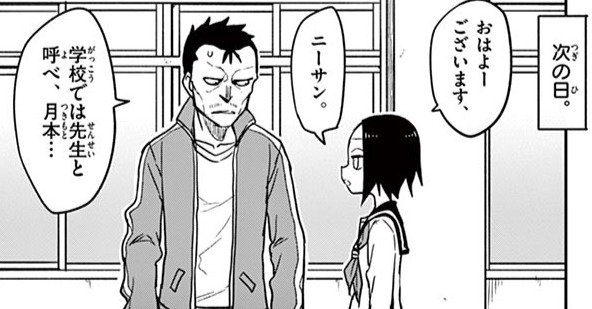
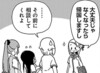
Sanae’s teacher, Mr. Tanabe, has proposed to her older sister, who is also a teacher at the school.
「次( つぎ ) の日( ひ ) 。」
“The following day.”
サナエ:
「おはよーございます、ニーサン。」
“Good morning, Big Brother.”
田辺( たなべ ) :「学校( がっこう ) では先生( せんせい ) と呼( よ ) べ 、月本( つきもと ) …」
“Call me 'Teacher' at school, Tsukimoto.”
Challenge Yourself
Show translation
Challenge
What does Tanabe order Sanae to call him at school?
Clues
学校( がっこう ) ではat school, limiting where the rule applies
先生( せんせい ) とTeacher, quoted as the title to use
呼( よ ) べcall me, a plain command
What does the speaker mean?
She must call him Teacher while they are at school.
先生( せんせい ) と marks the title, 呼( よ ) べ commands its use, and 学校( がっこう ) では limits the instruction to school.
She must call him Big Brother everywhere.
Tanabe corrects ニーサン and supplies 先生( せんせい ) as the school title.
She must call her sister Teacher at home.
Tanabe is telling Sanae what to call him, and the setting specified is school.
She should ask the other students what his name is.
呼( よ ) べ is a direct order to use a title, not a request to investigate his name.
She may choose between Teacher and Big Brother at school.
The imperative gives one required school address, not a choice.
She should stop speaking to him during school hours.
Tanabe regulates how she addresses him. He does not forbid conversation.
Tanabe insists that Sanae call him Teacher at school, whatever family-style title she may use elsewhere.
View Full Example
Urgent Commands
Emergencies strip speech down to the imperative.
名探偵コナン »
Volume 9 » Page 11
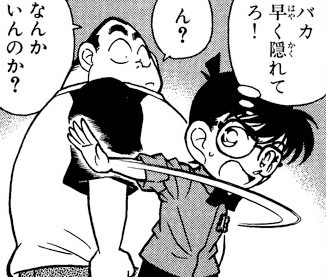
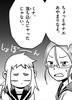
In a game of hide-and-seek, Conan and Ayumu find they’re hiding on the same bench. Their conversation attracts the seeker, Genta, leading him to find Conan. As Ayumu sneaks away unseen, she signals an apology to Conan.
コナン:
「バカ 早( はや ) く隠( かく ) れてろ !」
“Stupid, hurry and hide!”
元太( げんた ) :「ん? なんかいんのか?」
“Mm? Is something there?”
Challenge Yourself
Show translation
Challenge
What does Genta wonder?
Clues
なんか
something
いんのか?
is there?
What does the speaker mean?
Whether something is there.
なんかいんのか is the casual question 'Is something there?'
Whether Conan has already gone home.
The question asks about something being present, not someone leaving.
Whether he should hide on the bench too.
Genta is searching for the source of a sound, not choosing a hiding place.
Why the park has become quiet.
なんか points to an unidentified thing that may be there.
Whether the game has ended.
The contracted いんの asks about existence, not the end of the game.
Why Conan told Ayumi to hurry.
Genta did not hear that instruction. He only reacts to a possible presence.
Genta sees Conan motion and asks if something is there. いんの contracts いるの, while なんか leaves the possible presence unidentified.
View Full Example
Battle Cries
Fights run on imperatives, from taunts to finishing moves.
Rough Requests with てくれ
Blunt masculine speech asks favors with 〜てくれ.
よつばと! »
Volume 1 » Page 8
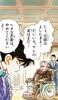
Yotsuba and her father are driving to their new home. As they pass a school letting out, Yotsuba waves to a student. When the student waves back, Yotsuba tells her father to wave too.
よつば:
「おねーちゃんが手( て ) ぇふった! とーちゃんもふれ!」
“The girl waved! Daddy, you wave too!”
父( とう ) さん:「とーちゃん手( て ) がはなせないからな俺( おれ ) の分( ぶん ) もよつばがふって くれ 」
“Dad's hands are full, so Yotsuba, please wave for me too.”
Challenge Yourself
Show translation
Challenge
Why does Yotsuba's father ask her to wave for him?
Clues
とーちゃん手( て ) がはなせないからな
he cannot take his hands away from what he is doing
俺( おれ ) の分( ぶん ) もよつばがふってくれhe asks Yotsuba to give his share of the wave too
What does the speaker mean?
He cannot take his hands off the steering wheel.
手( て ) がはなせない gives the reason, and 俺( おれ ) の分( ぶん ) も asks Yotsuba to wave on his behalf.
He does not know how to wave politely.
The problem is that his hands are occupied, not that he lacks the skill or manners to wave.
The student waved only to Yotsuba.
Dad still wants to return the greeting. He asks Yotsuba to include a wave for him because he cannot do it himself.
He wants Yotsuba to stop waving and hold the wheel.
Dad keeps control of the vehicle and asks Yotsuba to handle the wave, not the steering.
His hands are cold and trembling.
手( て ) がはなせない means he cannot let go or take his hands away. It does not describe temperature or shaking.
He wants two students to wave back at once.
俺( おれ ) の分( ぶん ) means Dad's share of the greeting, not a request aimed at another student.
Yotsuba’s father is driving and cannot take his hands off the steering wheel. He therefore asks Yotsuba to wave once for herself and also give the wave he would have given.
View Full Example
Gentle Requests with なさい
This is a softened command, and is used socially downward, such as from a parent to a child or from a teacher to a student.
この美術部には問題がある! »
Volume 8 » Page 94
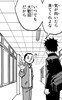
Upon hearing Usami say she’s stopping by the school library, Uchimaki says he wants to go with, and Colette tags along.
内巻( うちまき ) :「本( ほん ) だらけだ!!」
“It's nothing but books!!”
コレット:
「本屋( ほんや ) さんみたいだ!!」
“It's like a book store!!”
宇佐美( うさみ ) :「2人( ふたり ) とも静( しず ) かにし なさい 」
“Quiet down, you two.”
Challenge Yourself
Show translation
Challenge
What surprises Uchimaki and Colette about the library?
Clues
本( ほん ) だらけだthe place is full of books or covered in books
本屋( ほんや ) さんみたいだ"It is like a bookstore," comparing the library to another book-filled place
What does the speaker mean?
The room is packed with books and looks like a bookstore.
本( ほん ) だらけ says books dominate the room, and 本屋( ほんや ) さんみたいだ reinforces that impression.
Books have been left scattered messily across the floor.
だらけ can describe a messy covering, but Colette's bookstore comparison shows that the surprise here is the sheer number of books.
The library has fewer books than a bookstore.
Their exclamations stress abundance. Nothing in either line makes a comparison about having fewer books.
They accidentally entered a bookstore instead of the library.
みたいだ marks resemblance. Colette says the library is like a bookstore, not that it actually is one.
Every book in the library is for sale.
The bookstore comparison describes how the room looks. It does not say the books can be purchased.
The library contains nothing except art books.
本( ほん ) だらけ identifies books generally. The dialogue does not limit them to art books.
Uchimaki reacts to the library as 本( ほん ) だらけ, overwhelmingly full of books. Colette makes the same point by saying it looks like a bookstore.
View Full Example
Although Usami and Uchimaki are the same age and in the same club, Usami’s command comes across like a teacher scolding a noisy student.
Signs and Cheers
The imperative also appears impersonally, such as on signs and in cheering.
Supplemental Examples
Try finding this grammar in the following examples: