Wondering with かな
Grammar: Conjecture » かな
Sentence-final かな wonders aloud, turning a question inward, musing rather than demanding an answer.
Usage Notes
かな follows the plain form; nouns and な-adjectives take it directly, without だ. When aimed at a listener, it asks gently, without the pressure of a direct question: 行けるかな? “think you can make it?”.
かしら is a stereotyped feminine equivalent.
Formation
View formation details
-
Plain form + かな
- 明日、雨降るかな
- "I wonder if it'll rain tomorrow."
-
Noun / な-adjective + かな
- あの人、先生かな
- "Is that person a teacher, I wonder?"
-
〜ないかな (hoping)
- 夏休み、早く来ないかな
- "I wish summer break would hurry up and get here."
-
〜かしら (feminine)
- 大丈夫かしら
- "Will it be all right, I wonder?"
- Note: かしら marks stereotyped feminine or refined speech in fiction.
Musing to Oneself
The interior monologue particle.
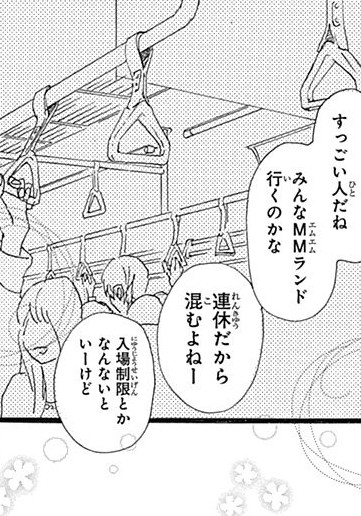
Takeo and his friends board the train bound for the amusement park, MM Land.
- 凛子:
- 「すっごい人だね。みんなMMランド行くのかな」
- “There's a lot of people here. I wonder if everyone's going to MM Land.”
- 隼人:
- 「連休だから混むよねー」
- “It's a long holiday, so it'll be crowded.”
- 愛:
- 「入場制限とかなんないといーけど」
- “I hope they don't restrict admission or anything.”
A Soft Question
かな floats a question without demanding an answer.
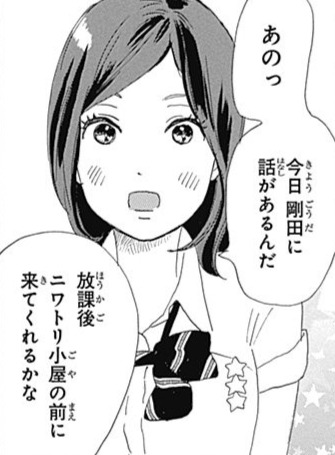
After Takeo (Gouda) has helped her out multiple times, Saijou considers confessing her feelings to him. She waits for him near the shoe lockers before class.
- 西城:
- 「あのっ 今日剛田に話があるんだ」
- “Um... I need to talk to you today.”
- 「放課後ニワトリ小屋の前に来てくれるかな」
- “Could you come to the chicken coop after school?”
Self-Doubt
Characters second-guess themselves in かな.
Hoping with ないかな
The negative plus かな wishes for something to happen.
Related Grammar
-
Presuming with 〜だろう and 〜でしょう
- だろうか wonders more formally; かな keeps it light and personal.
-
Might with 〜かもしれない
- かもしれない weighs a possibility; かな just wonders.
-
Seeking agreement with ね
- ね turns to the listener; かな turns inward.
Supplemental Examples