Ability and capability with 能
能 means ability or capability , and by extension possibility and talent.
Etymology
This kanji is a pictogram originally depicting a bear . The character shows two paws (represented by elements resembling 匕) and a face with an open mouth (stylized as 月). You’ll also find 能 as the central part of 熊, the kanji for bear.
Mnemonics
Bears exemplify ability and capability : they have remarkable physical prowess, strength, and versatility. They are able to climb, swim, run, and manipulate objects with dexterity. The bear reflects the potential to do something.
Capability
能力 (Ability)能力( のうりょく ) means ability or capacity. It can be innate or developed through learning and experience.
It combines 能 (ability ) with 力 (power ) to show capability .
名探偵コナン »
Volume 6 » Page 18
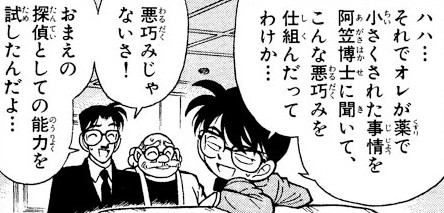
Conan finds himself in the clutches of dangerous pair, only to discover it’s his parents in disguise.
コナン:
「ハハ… それでオレが薬( くすり ) で小( ちい ) さくされた事情( じじょう ) を阿笠( あがさ ) 博士( はかせ ) に聞( き ) いて、こんな悪巧( わるだく ) みを仕組( しく ) んだってわけか…」
“So you heard from Dr. Agasa about how I was shrunk by a drug and cooked up this evil scheme, huh...”
父( とう ) さん:「悪巧( わるだく ) みじゃないさ! おまえの探偵( たんてい ) としての能力( のうりょく ) 試( ため ) してんだよ…」
“It's not an evil scheme! I'm just testing your abilities as a detective...”
Challenge Yourself
Show translation
Challenge
What does Conan's father say the scheme was meant to test?
Clues
おまえの探偵( たんてい ) としての
your ability in your role as a detective
能力( のうりょく ) を試( ため ) してんだI am testing your ability
What does the speaker mean?
Conan's ability as a detective.
探偵( たんてい ) としての能力( のうりょく ) names the specific capacity being tested.
Agasa's ability to keep a secret.
Agasa supplied information, but the test is directed at Conan.
Conan's tolerance for the shrinking drug.
The drug explains his condition. The staged scheme tests his detective work.
His parents' skill at inventing medicine.
They use disguises and a false danger to examine Conan's reasoning.
Conan's willingness to obey his parents.
The role marked by として is detective, not son.
Whether the police can find Agasa.
No police search is being tested in the father's explanation.
Conan’s father denies that the setup was merely an evil scheme. He says it was designed to test Conan’s ability in his role as a detective.
View Full Example
才能 (Talent)才能( さいのう ) means talent or aptitude in a particular field. It often suggests a natural gift, though training can also develop it.
It combines 才 (talent ) with 能 (ability ) to show natural talent .
Example 1 of 2: Better to give up fortune telling with 〜た+方がいい Example 1 of 2
ご注文はうさぎですか? »
Volume 1 » Page 100
Cocoa did fortune telling for her friends, only for all their fortunes to happen to her in a bad way.
チノ:
「ココアさんは人( ひと ) の不幸( ふこう ) の身代( みが ) わりになる才能( さいのう )
“Cocoa, do you have a talent for taking on other people's misfortune?”
リゼ:
「今後( こんご ) 占( うらな ) いやめた方( ほう ) がいいぞ自分( じぶん ) のために」
“For your own sake, you had better stop fortune telling from now on.”
ココア:
「なんで!?」
“Why!?”
Challenge Yourself
Show translation
Challenge
What does リゼ mean in the highlighted line?
Clues
占( うらな ) いやめた方( ほう ) がいい(占:うらな)いやめた(方:ほう)がいい advises Cocoa to stop
What does the speaker mean?
For your own sake, you had better stop fortune telling from now on.
Rize recommends giving up fortune telling after its predictions have caused Cocoa trouble.
Rize advises Cocoa to keep telling fortunes from now on.
The highlighted form is 占( うらな ) いやめた方( ほう ) がいい. Here 占( うらな ) いやめた方( ほう ) がいい advises Cocoa to stop, so this choice does not match the Japanese.
Rize says Cocoa has already stopped fortune-telling.
The highlighted form is 占( うらな ) いやめた方( ほう ) がいい. Here 占( うらな ) いやめた方( ほう ) がいい advises Cocoa to stop, so this choice does not match the Japanese.
Rize tells Chino to give up fortune-telling for Cocoa's sake.
The highlighted form is 占( うらな ) いやめた方( ほう ) がいい. Here 占( うらな ) いやめた方( ほう ) がいい advises Cocoa to stop, so this choice does not match the Japanese.
占( うらな ) いやめた方( ほう ) がいい advises Cocoa to stop. Rize recommends giving up fortune telling after its predictions have caused Cocoa trouble.
View Full Example
Example 2 of 2: Underutilized talent with 才能 Example 2 of 2
くノ一ツバキの胸の内 »
Volume 1 » Page 151
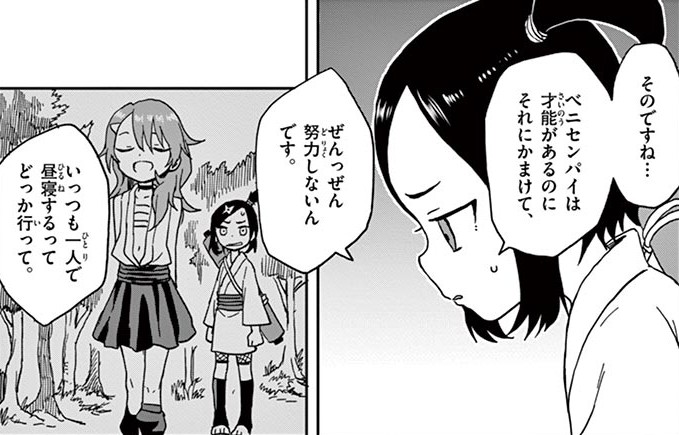
During a free day from training, Touwata and Mizubashou approach Tsubaki to request a favor. She would like Tsubaki to challenge Benisumomo to a one-on-one fight.
トウワタ:
「そのですね… ベニセンパイは才能( さいのう ) 努力( どりょく ) しないんです。」
“Well, you see... Beni-senpai has talent, but she takes it for granted and doesn't put in any effort at all.”
「いっつも一人( ひとり ) で昼寝( ひるね ) するってどっか行( い ) って。」
“She always go off somewhere to take a nap alone.”
Challenge Yourself
Show translation
Challenge
What is Touwata's complaint about Beni-senpai?
Clues
才能( さいのう ) があるのに"even though she has talent," setting up a frustrated contrast
それにかまけて
"resting on that" and neglecting what she should do
ぜんっぜん努力( どりょく ) しない
"does not make any effort at all"
What does the speaker mean?
She relies on her talent and makes no effort.
それ refers to Beni-senpai's 才能( さいのう ) , and それにかまけて…努力( どりょく ) しない states Touwata's complaint.
She works hard but lacks natural talent.
Touwata says Beni-senpai has talent and does not put in effort, the reverse of this reading.
She trains alone because nobody can keep up with her.
The second line says she goes away alone to nap, not to train.
She spends all her effort helping the younger students.
ぜんっぜん努力( どりょく ) しない says she makes no effort at all.
She is talented but too nervous to fight anyone.
Touwata criticizes complacency and napping. She does not mention nervousness.
She wants Tsubaki to teach her the fundamentals.
Touwata wants Tsubaki to challenge Beni-senpai. The line does not present a request from Beni herself.
Touwata concedes that Beni-senpai has 才能( さいのう ) , then complains that she rests on it and makes no effort. Her habit of going off alone to nap supports that accusation.
View Full Example
有能 (Competent)有能( ゆうのう ) means competent, capable, or talented.
It combines 有 (have ) with 能 (ability ) to show possessing ability .
名探偵コナン »
Volume 9 » Page 120
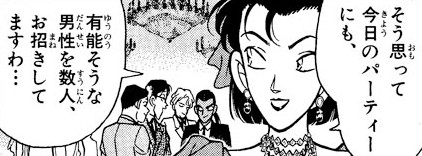
Detective Mouri is invited as a special guest to the birthday party for Reika, daughter of the Yotsui Group’s chairman. At the event, Reika announces her intent to marry.
霊化( れいか ) :「そう思( おも ) って今日( きょう ) のパーティーにも、有能( ゆうのう ) 男性( だんせい ) を数人( すうにん ) 、お招( まね ) きしてますわ…」
“With that in mind, I've invited several promising gentlemen to today's party...”
Challenge Yourself
Show translation
Challenge
What kind of men has Reika invited to the party?
Clues
有能( ゆうのう ) そうな男性( だんせい ) men who seem capable
数人( すうにん ) 、お招( まね ) きしてますI have invited several of them
What does the speaker mean?
Several men who appear capable and promising.
有能( ゆうのう ) そうな describes men who give the impression of being capable.
Several men she already knows are incompetent.
有能( ゆうのう ) means capable, and そうな describes that appearance.
Every male employee in the Yotsui Group.
数人( すうにん ) means several people, not every employee.
Only men who have refused to marry.
The line evaluates their apparent ability, not a history of refusing marriage.
Several musicians hired to perform.
Reika presents the men as possible partners, not entertainers.
Men who invited her to their own parties.
Reika is the one who invited them to today's party.
Reika says she invited several men who look capable. 有能( ゆうのう ) そうな describes her favorable impression rather than proven knowledge of their ability.
View Full Example
無能 (Incompetent)無能( むのう ) means incompetent or incapable. It can describe a person or the lack of ability itself.
It combines 無 (nothing ) with 能 (ability ) to show lack of ability .
名探偵コナン »
Volume 7 » Page 8
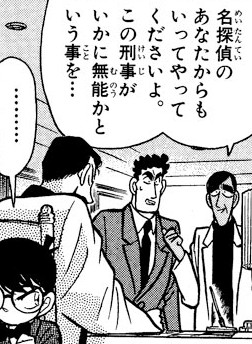
Police detective Yokomizo isn’t about to let Sasai, his prime murder suspect, leave. Sasai reminds the officer that he has photographic proof that he wasn’t near the victim at the time of the murder. He calls for Detective Mouri to back him up.
笹井( ささい ) :「名探偵( めいたんてい ) のあなたからもいってやってくださいよ。 この刑事( けいじ ) がいかに無能( むのう ) 事( こと ) を…」
“You, the great detective, should tell him yourself. Just how incompetent this police detective is...”
Challenge Yourself
Show translation
Challenge
What does Sasai want Mouri to tell the police detective?
Clues
いってやってくださいよ
please tell him
この刑事( けいじ ) がいかに無能( むのう ) か
just how incompetent this detective is
What does the speaker mean?
That the detective is thoroughly incompetent.
いかに無能( むのう ) か emphasizes the degree of the officer's supposed incompetence.
That the detective has solved the case correctly.
無能( むのう ) is a direct insult meaning incompetent.
That Mouri should take over the police department.
Sasai asks Mouri to support his criticism, not accept a new position.
That the detective is refusing to examine a photograph.
The photograph motivates Sasai's confidence, but his request is a broader insult about ability.
That Sasai has confessed to the murder.
Sasai insists that his photographic evidence proves his innocence.
That every officer is equally capable.
この刑事( けいじ ) singles out the officer Sasai is attacking.
Sasai asks the famous detective Mouri to confirm just how incompetent the police detective is. 無能( むのう ) bluntly says that the officer lacks ability.
View Full Example
Exceptional Powers
超能力 (Psychic power)超能力( ちょうのうりょく ) means a psychic or supernatural power beyond ordinary human ability.
It combines 超 (exceed ), 能 (ability ), and 力 (power ) to show extraordinary power .
からかい上手の高木さん »
Volume 7 » Page 36
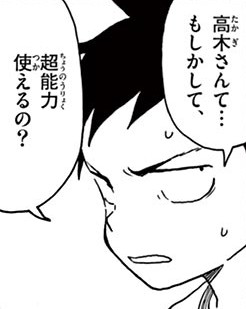
Nishikata and Takagi compete to see who can score higher on the long jump in physical education class. When Nishika lands his jump, he’s a bit shaky. He watches as the spectating Takagi sweeps her arms as if to knock him over, and he falls back, lowering his score. Takagi gives her condolences afterward.
西片( にしかた ) :「高木( たかぎ ) さんて…もしかして、超能力( ちょうのうりょく ) 使( つか ) えるの?」
“Takagi... could it be... you have psychic powers?”
Challenge Yourself
Show translation
Challenge
What does Nishikata suspect Takagi can do?
Clues
もしかして
"by any chance" or "could it be"
超能力( ちょうのうりょく ) 使( つか ) えるの?a casual question asking whether someone can use psychic powers
What does the speaker mean?
She can use psychic powers.
超能力( ちょうのうりょく ) 使( つか ) える asks whether she can use psychic powers.
She can read his thoughts.
Nishikata mentions psychic powers in general. He does not name mind reading.
She is unusually good at the long jump.
The question is about a supernatural ability, not Takagi's athletic skill.
She made him fall on purpose.
He wonders about her ability. The line does not accuse her of acting deliberately.
She knew his score before he jumped.
There is no word for knowing or predicting his score in the question.
She was only pretending to have a power.
Nishikata asks whether the power is real. He does not say she was pretending.
もしかして makes the question speculative, and 超能力( ちょうのうりょく ) 使( つか ) える asks whether Takagi can use psychic powers.
View Full Example
Functional Capacity
機能 (Function)機能( きのう ) means the function or role of an object, system, or one of its parts.
It combines 機 (machine ) with 能 (ability ) to show mechanical ability .
名探偵コナン »
Volume 6 » Page 64
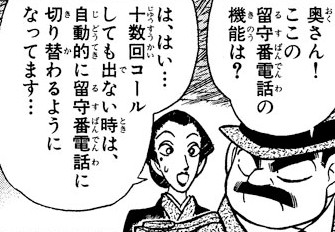
A murder suspect explains how when he called the victim, the phone kept ringing until the answering machine picked up.
目暮( めぐれ ) :「奥( おく ) さん!ここの留守番( るすばん ) 電話( でんわ ) の機能( きのう )
“Ma'am! How does this answering machine function?”
奥( おく ) さん:「は、はい… 十数回( じゅうすうかい ) コールしても出( で ) ない時( とき ) は、自動的( じどうてき ) に留守番( るすばん ) 電話( でんわ ) に切( き ) り替( か ) わるようになってます…」
“Well... When there's no answer after ten rings, it automatically switches to the answering machine...”
Challenge Yourself
Show translation
Challenge
How does the answering machine operate when nobody answers?
Clues
十数回( じゅうすうかい ) コールしても出( で ) ない時( とき ) はwhen nobody answers after more than ten rings
自動的( じどうてき ) に留守番( るすばん ) 電話( でんわ ) に切( き ) り替( か ) わるit automatically switches to the answering machine
What does the speaker mean?
It switches automatically after the phone rings unanswered many times.
The machine changes over automatically when no one answers after more than ten rings.
It hangs up immediately after the first ring.
The phone rings more than ten times before the automatic switch.
It records every call before the telephone rings.
The answering function begins only after the unanswered ringing.
Someone must press a button to activate it.
自動的( じどうてき ) に means the switch happens automatically.
It forwards the call to the police.
The call switches to the answering machine, not to another recipient.
It works only when someone answers the telephone.
The condition is precisely that nobody answers.
If nobody answers after the phone rings more than ten times, the system automatically switches to the answering machine.
View Full Example
性能 (Performance)性能( せいのう ) means the performance or capability of a machine or product.
It combines 性 (nature ) with 能 (ability ) to show inherent capability or performance characteristics.
名探偵コナン »
Volume 2 » Page 57
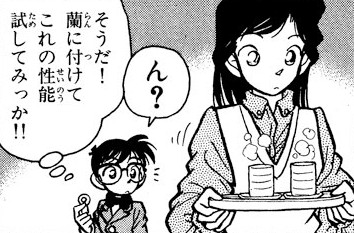
Professor Agasa gives Conan a tracking device. He eagerly looks for an opportunity to see how it works.
コナン:
「そうだ!蘭( らん ) に付( つ ) けてこれの性能( せいのう ) 試( ため ) してみっか!!」
“I know! I'll stick it on Ran and see how it performs!!”
Challenge Yourself
Show translation
Challenge
蘭( らん ) に付( つ ) けてattach it to Ran
これの性能( せいのう ) 試( ため ) してみっか
maybe I will try testing its performance
What does the speaker mean?
Attach it to Ran and see how well it works.
蘭( らん ) に付( つ ) けて states where he will put it before testing its 性能( せいのう ) .
Ask Ran to take the device apart.
付( つ ) ける means attach it, not dismantle it.
Hide it from Ran without turning it on.
His goal is to test its performance, which requires using it.
Give it back to Agasa for repairs.
Conan eagerly wants to try the new device himself.
Use it to measure Ran's physical strength.
The device tracks location. 性能( せいのう ) refers to how well that function works.
Attach it to himself so Ran can find him.
The person marked by に is Ran.
Conan decides to attach the tracker to Ran and try out its performance. 試( ため ) してみっか is his rough, casual way of proposing the test to himself.
View Full Example
Natural Disposition
本能 (Instinct)本能( ほんのう ) means instinct, an inborn impulse that drives behavior without conscious thought or learning.
It combines 本 (origin ) with 能 (ability ) to show innate capability .
三ツ星カラーズ »
Volume 7 » Page 20
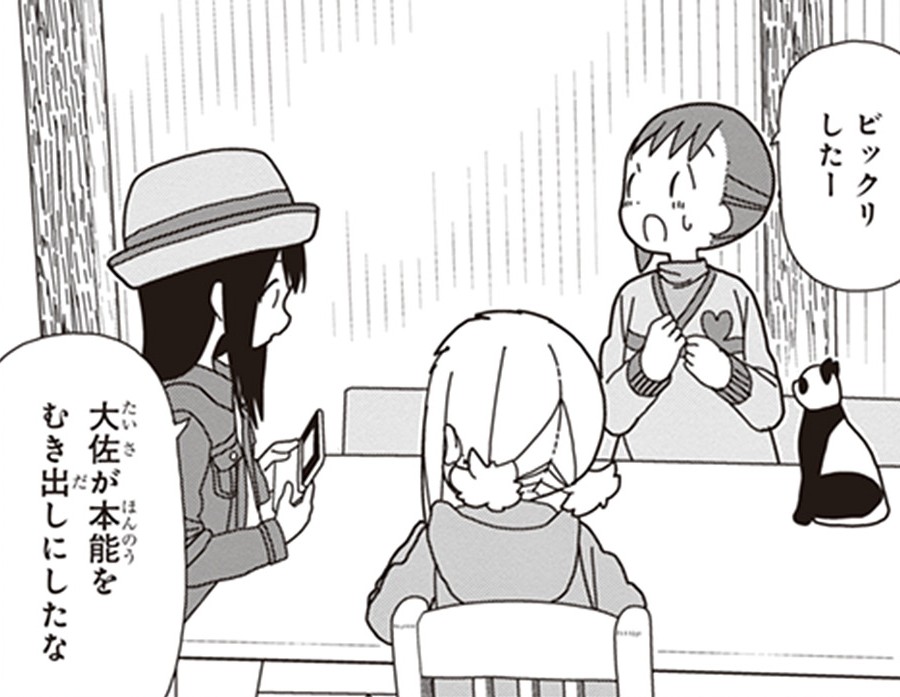
Yui and her friends are in their secret base when a pigeon flies in and lands on the table between them. The group’s cat, Colonel Monochrome, leaps after it, but the pigeon escapes.
結衣( ゆい ) :「ビックリしたー」
“That surprised me!”
琴葉( ことは ) :「大佐( たいさ ) が本能( ほんのう ) 出( だ ) しにしたな」
“The Colonel laid bare his instincts.”
Challenge Yourself
Show translation
Challenge
What does Kotoha say the Colonel's leap after the pigeon revealed?
Clues
大佐( たいさ ) が本能( ほんのう ) をむき出( だ ) しにしたthe Colonel laid his instincts bare
What does the speaker mean?
His natural hunting instincts.
本能( ほんのう ) is the instinct that the Colonel exposed when he leapt after the bird.
His fear of birds.
The Colonel pursues the pigeon, and Kotoha calls the reaction instinct rather than fear.
His ability to obey Yui's commands.
No command causes the leap. The phrase describes an inborn drive coming out.
His wish to leave the clubhouse.
The object marked by を is 本能( ほんのう ) , not a desire to leave.
His surprise at seeing the girls.
Yui is the one who says she was surprised. Kotoha comments on the cat's instinct.
His habit of sleeping on the table.
The comment follows his leap after the pigeon, not an act of sleeping.
Kotoha says the Colonel laid bare his natural instincts when he chased the pigeon. 本能( ほんのう ) is what he exposed, marked as the object by を.
View Full Example
Possibility
可能 (Possible)可能( かのう ) means possible, feasible, or permitted.
It combines 可 (can ) with 能 (ability ) to show possibility .
Example 1 of 2: An established alibi with 成立 Example 1 of 2
名探偵コナン »
Volume 24 » Page 83
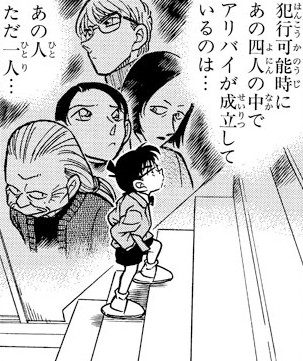
Following a murder made to look like an accidental death, Conan reviews the whereabouts of the four suspects at the time.
コナン:
「犯行( はんこう ) 可能( かのう ) 時( じ ) にあの四人( よにん ) の中( なか ) でアリバイが成立( せいりつ ) しているのは…」
“Among those four, the one with an established alibi during the time the crime could have been committed is...”
「あの人( ひと ) ただ一人( ひとり ) …」
“...that person alone...”
Challenge Yourself
Show translation
Challenge
How many of the four suspects have an alibi that holds up?
Clues
あの四人( よにん ) の中( なか ) で
among those four people
アリバイが成立( せいりつ ) しているのは…あの人( ひと ) ただ一人( ひとり )
that person alone has an established alibi
What does the speaker mean?
Only one of them.
ただ一人( ひとり ) limits the valid alibi to a single person among the four.
All four of them.
Conan singles out one person rather than clearing the whole group.
Exactly two of them.
一人( ひとり ) gives the count as one.
Three of them.
The line identifies only one established alibi.
None of them.
Conan says one person's alibi does hold up.
The number is still completely unknown.
He has already narrowed the valid alibis to one person.
Among the four suspects, Conan says only one person has an alibi that is established as valid during the possible time of the crime.
View Full Example
Example 2 of 2: Possibility of building a time machine with 可能 Example 2 of 2
orange »
Volume 2 » Page 30
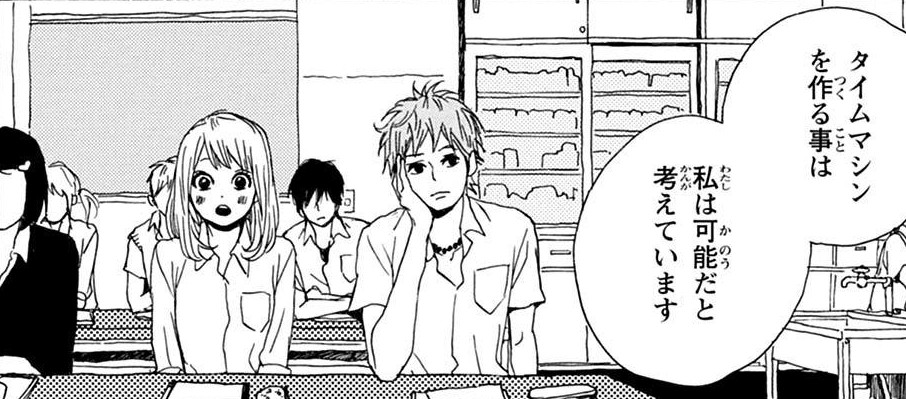
After handing test results to class, the teacher talks about theories of time travel.
先生( せんせい ) :「タイムマシンを作( つく ) る事( こと ) は私( わたし ) は可能( かのう ) 考( かんが ) えています」
“I believe it is possible to build a time machine.”
Challenge Yourself
Show translation
Challenge
What position does the teacher take on building a time machine?
Clues
タイムマシンを作( つく ) る事( こと ) は
as for the act of building a time machine
可能( かのう ) だis possible
〜と考( かんが ) えています
thinks or holds the view that
What does the speaker mean?
The teacher believes that building a time machine is possible.
可能( かのう ) だ is the quoted claim, and と考( かんが ) えています presents it as the teacher's considered view.
The teacher says that a time machine has already been built.
可能( かのう ) だ describes feasibility. The sentence does not use a completed form of 作( つく ) る or claim that a machine exists.
The teacher believes that building a time machine is impossible.
The claim is affirmative 可能( かのう ) だ. An impossible reading would need 不可能( ふかのう ) or another negative expression.
The teacher says that only the teacher personally can build one.
私( わたし ) は marks whose opinion follows. It does not limit the ability to build a time machine to the teacher.
The teacher orders the students to build a time machine.
と考( かんが ) えています reports a belief. The line contains no command or request directed at the students.
The teacher reports that every scientist agrees time travel is possible.
私( わたし ) は narrows the statement to the teacher's own view. No other researchers or shared consensus are mentioned.
The act of building a time machine becomes the topic with 事( こと ) は. The teacher calls that act 可能( かのう ) and uses と考( かんが ) えています to present it as a personal conclusion.
View Full Example
不可能 (Impossible)不可能( ふかのう ) means impossible or unable to be done.
It combines 不 (not ) with 可能 (possible ) to show the absence of possibility .
Example 1 of 2: Hidden behind the short hand with 短針 Example 1 of 2
怪盗セイント・テール »
Volume 1 » Page 54
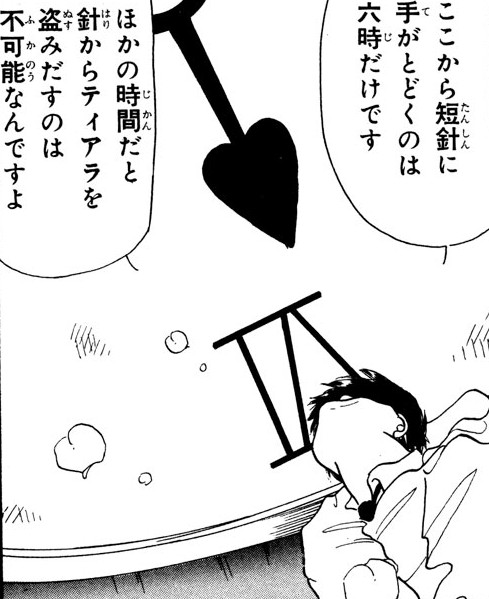
Asuka Jr. is tasked with guarding a jeweled tiara, which Saint Tail has stated her intention to steal. The owner tells Asuka Jr. it’s been hidden behind the short hand on a clock tower, so Asuka Jr. waits below the face of the clock for Saint Tail’s arrival. He tells the owner that Saint Tail will likely arrive precisely at 6 o’clock.
アスカ Jr.:
「ここから短針( たんしん ) に手( て ) がとどくのは六( ろく ) 時( じ ) だけです」
“The hour hand is only within reach from here at six o'clock.”
「ほかの時間( じかん ) と針( はり ) からティアラを盗( ぬす ) みだすのは不可能( ふかのう )
“At any other time, it would be impossible to steal the tiara from the hand, you see.”
Challenge Yourself
Show translation
Challenge
What does Asuka Jr. say about reaching the hour hand from here?
Clues
手( て ) がとどくto be within reach
六( ろく ) 時( じ ) だけonly at six o'clock
What does the speaker mean?
The hour hand is within reach only at six o'clock.
六( ろく ) 時( じ ) だけ identifies the only time when 手( て ) がとどく is true.
The hour hand stays within reach until six o'clock.
だけ means "only". The line would need まで to express "until six o'clock".
The hour hand is within reach for six hours.
六( ろく ) 時( じ ) means six o'clock. A duration of six hours would be 六時間( ろくじかん ) .
ここから sets the viewpoint to “from here”. The clause ending in のは introduces what Asuka Jr. is discussing, and 六( ろく ) 時( じ ) だけです identifies six o’clock as the only time the hour hand is within reach.
View Full Example
Example 2 of 2: Indiscriminate murder would be one thing if with 〜ならともかく Example 2 of 2
名探偵コナン »
Volume 5 » Page 110
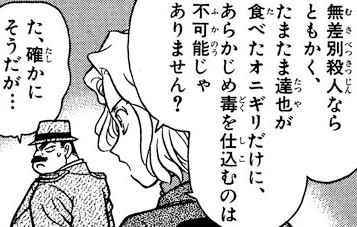
Sonoko is invited to a band’s after party. During the get-together, the band’s singer Tatsuya eats a rice ball only to collapse and die. The police are called in, and Inspector Megure discovers the victim was poisoned. He accuses the man who prepared the food, but Conan bites into a rice ball to show it’s safe. The victim’s manager, Mari, agrees.
麻理( まり ) :「無差別( むさべつ ) 殺人( さつじん ) ならともかく、たまたま達也( たつや ) が食( た ) べたオニギリだけに、あらかじめ毒( どく ) を仕込( しこ ) むのは不可能( ふかのう )
“If it were indiscriminate murder, that's one thing but since it was just the rice ball Tatsuya happened to eat, wouldn't it be impossible to poison it beforehand?”
目暮( めぐれ ) :「た、確( たし ) かにそうだが…」
“Th-that's true.”
Challenge Yourself
Show translation
Challenge
Why does Mari say the rice ball could not have been poisoned beforehand?
Clues
無差別( むさべつ ) 殺人( さつじん ) ならともかくindiscriminate murder would be one thing
たまたま達也( たつや ) が食( た ) べたオニギリだけ
only the rice ball Tatsuya happened to eat
What does the speaker mean?
Nobody could predict which rice ball Tatsuya would happen to choose.
たまたま and だけ make the targeted choice too specific to arrange blindly in advance.
Every rice ball had already been tested and found safe.
Mari argues from the unpredictability of Tatsuya's choice, not from laboratory testing.
Tatsuya prepared all of the rice balls himself.
The line does not say who prepared every rice ball. It focuses on which one he happened to eat.
The poison could only work in a drink.
Mari questions how poison could be placed in the chosen rice ball, not whether food can carry it.
The poison was added after Tatsuya ate.
She discusses whether it could have been planted beforehand.
An indiscriminate poisoning would also have been impossible.
〜ならともかく treats indiscriminate murder as the more imaginable case.
Mari contrasts an indiscriminate attack with the precise poisoning of the one rice ball Tatsuya happened to eat. Without knowing his choice, planting the poison beforehand seems impossible.
View Full Example