Absence and nothingness with 無
無 means a state where an object or action lacks purpose, value, or effect. It expresses that no matter how hard you try, it will not lead to results, or that something makes no sense (nonsense).
Ability and Knowledge
無能 (Incompetent)無能( むのう ) means incompetent or incapable. It can describe a person or the lack of ability itself.
It combines 無 (nothing ) with 能 (ability ) to show lack of ability .
名探偵コナン »
Volume 7 » Page 8
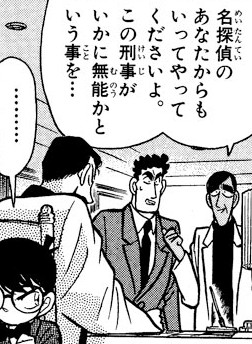
Police detective Yokomizo isn’t about to let Sasai, his prime murder suspect, leave. Sasai reminds the officer that he has photographic proof that he wasn’t near the victim at the time of the murder. He calls for Detective Mouri to back him up.
笹井( ささい ) :「名探偵( めいたんてい ) のあなたからもいってやってくださいよ。 この刑事( けいじ ) がいかに無能( むのう ) 事( こと ) を…」
“You, the great detective, should tell him yourself. Just how incompetent this police detective is...”
Challenge Yourself
Show translation
Challenge
What does Sasai want Mouri to tell the police detective?
Clues
いってやってくださいよ
please tell him
この刑事( けいじ ) がいかに無能( むのう ) か
just how incompetent this detective is
What does the speaker mean?
That the detective is thoroughly incompetent.
いかに無能( むのう ) か emphasizes the degree of the officer's supposed incompetence.
That the detective has solved the case correctly.
無能( むのう ) is a direct insult meaning incompetent.
That Mouri should take over the police department.
Sasai asks Mouri to support his criticism, not accept a new position.
That the detective is refusing to examine a photograph.
The photograph motivates Sasai's confidence, but his request is a broader insult about ability.
That Sasai has confessed to the murder.
Sasai insists that his photographic evidence proves his innocence.
That every officer is equally capable.
この刑事( けいじ ) singles out the officer Sasai is attacking.
Sasai asks the famous detective Mouri to confirm just how incompetent the police detective is. 無能( むのう ) bluntly says that the officer lacks ability.
View Full Example
Limits and Possibility
無理 (Impossible)無理( むり ) means impossible, unreasonable, or too demanding. In conversation, it can mean “that’s impossible” or warn someone not to push too hard.
It combines 無 (without ) with 理 (reason ) to show something without reasoning .
Example 1 of 2: I'd totally die in the heat with 〜じゃう Example 1 of 2
ホリミヤ »
Volume 1 » Page 45
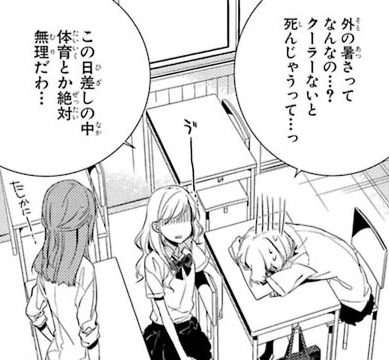
On a summer day, Hori and her friends in class can’t ignore the heat.
由紀( ゆき ) :「外( そと ) の暑( あつ ) さってなんなの…? クーラーないと死( し ) んじゃうって…っ」
“What's with this heat outside...? I'd totally die without the AC...”
「この日差( ひざ ) しのなか体育( たいいく ) とか絶対( ぜったい ) 無理( むり )
“There's no way I can do PE in this blazing sun...”
Challenge Yourself
Show translation
Challenge
What does Yuki say would happen without air conditioning?
Clues
クーラーないと
if there is no air conditioning, with が omitted
死( し ) んじゃうwould end up dying, said as an exaggerated reaction
What does the speaker mean?
She would end up dying from the heat.
クーラーないと sets the lack of AC as the condition, and 死( し ) んじゃう gives the exaggerated result.
The air conditioner would stop working because of the heat.
ない describes the absence of AC. The subject of 死( し ) んじゃう is Yuki, not the machine.
She would have to leave class and exercise outside.
Yuki says outdoor PE is impossible in the sunlight. She does not present it as the result of having no AC.
She would become accustomed to the heat eventually.
死( し ) んじゃう gives a disastrous result, even if exaggerated. It does not suggest adaptation.
She would refuse to turn on the air conditioner.
Yuki treats AC as necessary relief. She does not reject using it.
She would already have died before reaching school.
The condition is hypothetical and present. She says what would happen without AC, not that it has already happened.
Yuki exaggerates that she would die without air conditioning. 死( し ) んじゃう contracts 死( し ) んでしまう and presents death as the extreme unwanted result.
View Full Example
Example 2 of 2: Not moving while staring with 〜ながら Example 2 of 2
ご注文はうさぎですか? »
Volume 1 » Page 113
Cocoa buys Chino a puzzle to make up for finishing the one Chino had been working on. The two and their friends work at putting the new puzzle together.
チノ:
「ココアさんさっきからピース見( み ) つめながら動( うご ) かない…」
“Cocoa-san has been staring at the puzzle piece while not moving for a while now...”
「その…責任( せきにん ) 取( と ) ろうと無理( むり )
“Um... Please don't push yourself trying to take responsibility.”
Challenge Yourself
Show translation
Challenge
What does チノ mean in the highlighted line?
Clues
見( み ) つめながら動( うご ) かない(見:み)つめながら(動:うご)かない combines simultaneous actions
What does the speaker mean?
Cocoa-san has been staring at the puzzle piece while not moving for a while now...
Cocoa keeps staring at the piece while remaining motionless. Cocoa is the subject of both actions.
Chino says Cocoa keeps moving without looking at the puzzle piece.
The highlighted form is 見( み ) つめながら動( うご ) かない. Here 見( み ) つめながら動( うご ) かない combines simultaneous actions, so this choice does not match the Japanese.
Chino says Cocoa stopped staring at the piece a moment ago.
The highlighted form is 見( み ) つめながら動( うご ) かない. Here 見( み ) つめながら動( うご ) かない combines simultaneous actions, so this choice does not match the Japanese.
Chino tells Cocoa to keep staring and avoid moving.
The highlighted form is 見( み ) つめながら動( うご ) かない. Here 見( み ) つめながら動( うご ) かない combines simultaneous actions, so this choice does not match the Japanese.
見( み ) つめながら動( うご ) かない combines simultaneous actions. Cocoa keeps staring at the piece while remaining motionless. Cocoa is the subject of both actions.
View Full Example
Presence and Omission
無事 (Safety)無事( ぶじ ) means safe, unharmed, or without incident.
It combines 無 (without ) with 事 (incident ) to show being without incident .
ストロボ・エッジ »
Volume 1 » Page 23
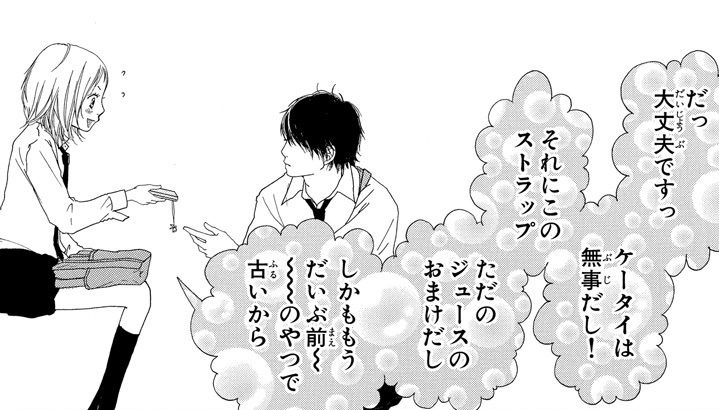
After school, Ninako notices Ren sleeping a few seats away on the train. When Ren wakes and rushes for his stop, he knocks Ninako’s phone from her hand. The phone hits the floor, and the strap charm breaks. Ren misses his exit while apologizing and offers to replace the charm.
仁奈子( になこ ) :「だっ 大丈夫( だいじょうぶ ) ですっ」
“I—it's all right.”
「ケータイは無事( ぶじ )
“Since my cell phone is safe!”
「それにこのストラップただのジュースのおまけだし」
“Furthermore, this strap is just a juice prize.”
「しかももうだいぶ前( まえ ) 〜〜〜〜のやつで古( ふる ) いから」
“Plus, it's from way back when, so it's old.”
Challenge Yourself
Show translation
Challenge
Why does Ninako say Ren does not need to replace the broken charm?
Clues
ケータイは無事( ぶじ ) だし
her phone itself is unharmed, offered as one reason
それにこのストラップただのジュースのおまけだし
besides that, the strap was only a free extra from a juice purchase
しかももうだいぶ前( まえ ) のやつで古( ふる ) いから
what is more, it is old and from a long time ago
What does the speaker mean?
The phone is safe, and the charm was only an old promotional extra.
Ninako stacks three reasons: the phone is unharmed, the strap was a mere おまけ, and it was already old.
The charm did not break when the phone hit the floor.
Ninako is minimizing the loss after the charm breaks. She does not deny that it was damaged.
She has another identical charm waiting at home.
She says the broken one was cheap and old. No replacement charm appears in her explanation.
Ren already paid her for the damage.
Ren offers to replace the charm, but Ninako argues that replacement is unnecessary.
The charm belongs to the juice company rather than to her.
おまけ explains how she obtained the charm. It does not mean the company still owns it.
She wanted an excuse to throw the charm away.
Ninako reassures Ren by downplaying the charm's value and age. She does not say she wanted it broken.
Ninako piles up reasons to ease Ren’s guilt. Her phone is fine, the broken strap was only a free juice bonus, and it was already old. それに adds the second reason to the first.
View Full Example
無断 (Without permission)無断( むだん ) means without permission or prior notice.
It combines 無 (without ) with 断 (decision ) to show something done without approval .
くノ一ツバキの胸の内 »
Volume 1 » Page 106
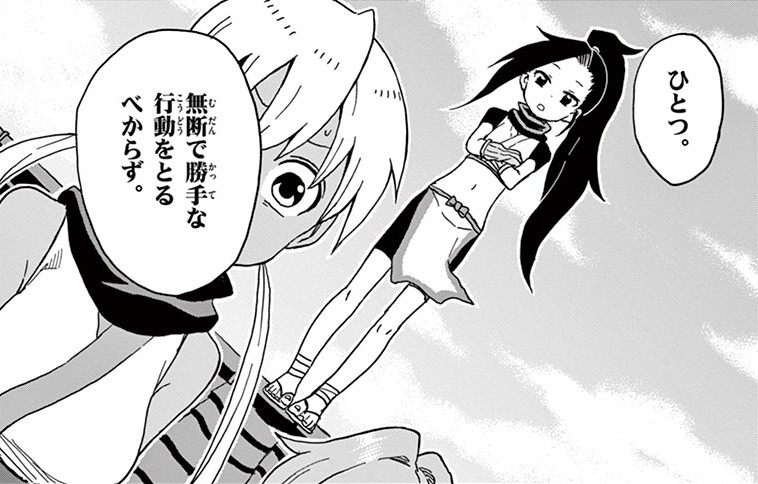
Sazanka sneaks out of class, leaving the teacher to send Asagao to bring her back. As Asagao chases Sazanka across the rooftops near the upper grade classroom, Tsubaki spots them. She meets them up on the roof and recites the school’s first rule.
ツバキ:
「ひとつ。無断( むだん ) 勝手( かって ) な行動( こうどう ) をとるべからず。」
“One: Doing as you please without permission is strictly forbidden.”
Challenge Yourself
Show translation
Challenge
What does the school rule forbid?
Clues
無断( むだん ) で"without permission" or "without authorization"
勝手( かって ) な行動( こうどう ) をとる"to take self-directed action"
〜べからず
a formal rule stating that an action is strictly forbidden
What does the speaker mean?
Acting on one's own without permission.
無断( むだん ) で supplies the lack of permission, and 勝手( かって ) な行動( こうどう ) をとる names the forbidden conduct.
Going onto a rooftop during training.
The scene happens on a roof, but the rule names unauthorized, self-directed action in general.
Leaving class after receiving permission.
無断( むだん ) で means without permission, so approved action is not what the rule describes.
Chasing another student across school grounds.
The chase prompts Tsubaki to cite the rule, but the wording prohibits acting as one pleases without approval.
Reciting school rules in casual language.
べからず gives the rule a formal tone. The rule does not ban casual speech.
Taking action unless a classmate comes along.
The line concerns authorization, not whether someone acts alone or with a classmate.
Tsubaki recites a rule against 無断( むだん ) で勝手( かって ) な行動( こうどう ) をとる, taking unauthorized action on one’s own judgment. The formal べからず marks it as strictly forbidden.
View Full Example