Becoming and accomplishing with 成
成 primarily means to become , to achieve , to complete , or to grow into adulthood . It carries a strong connotation of growth, success, and seeing a task through to the end.
Agreement
賛成 (Agreement)賛成( さんせい ) means agreement with an opinion, proposal, or action.
It combines 賛 (approve ) with 成 (accomplish ) to show supporting something to be accomplished .
キラキラとギラギラ »
Volume 2 » Page 136
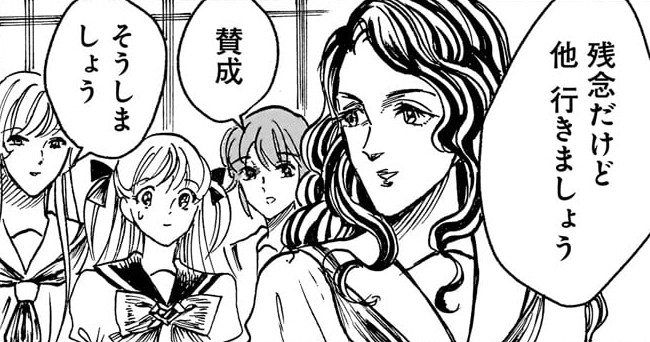
After moving and transferring schools, Lulu has finally made some friends in class. Following some after-school shopping, they stop by the group’s favorite café, only to find it filled to the brim with hoodlums.
響子( きょうこ ) :「残念( ざんねん ) だけど 他( ほか ) 行( い ) きましょう」
“Too bad... let's just go somewhere else.”
清美( きよみ ) :「賛成( さんせい )
“Agreed.”
美代子( みよこ ) :「そうしましょう」
“Yeah, let's do that.”
Challenge Yourself
Show translation
Challenge
What does Kiyomi agree to do?
Clues
他( ほか ) 行( い ) きましょうlet's go somewhere else
賛成( さんせい ) agreement with the suggestion just made
What does the speaker mean?
Go somewhere else instead of staying at the crowded café.
Kyoko proposes 他( ほか ) 行( い ) きましょう, and Kiyomi's standalone 賛成( さんせい ) accepts that proposal.
Wait at the café until the hoodlums leave.
The suggestion is to go elsewhere, not remain and wait.
Ask the hoodlums to share their tables.
Kiyomi agrees with leaving. No request to the other customers appears.
Return home without visiting another place.
他( ほか ) 行( い ) きましょう proposes another destination. It does not mean ending the outing.
Let Miyoko choose whether the group should leave.
Kiyomi directly voices agreement, and Miyoko then agrees as well.
Visit the same café again after shopping tomorrow.
The group is deciding what to do now. Nothing in the exchange schedules a later visit.
Kyoko suggests going somewhere else because their usual café is full. Kiyomi answers with 賛成( さんせい ) , a concise way to accept the proposal, and Miyoko follows with そうしましょう.
View Full Example
Completion
成功 (Success)成功( せいこう ) means success in reaching a goal. It can also mean gaining status, fame, or wealth.
It combines 成 (accomplish ) with 功 (achievement ) to show successful accomplishment .
三ツ星カラーズ »
Volume 3 » Page 127
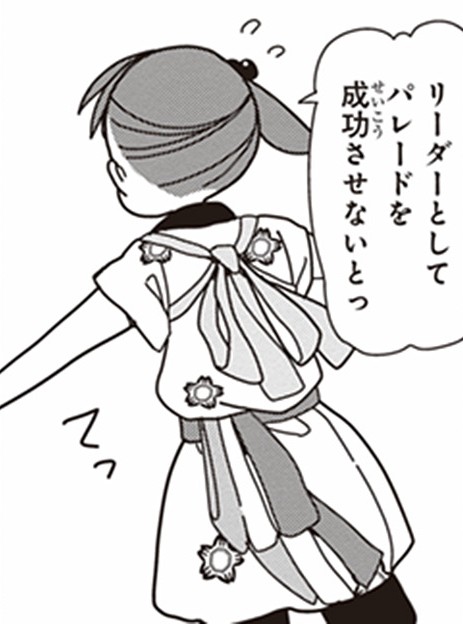
Yui’s class is participating in a parade at a festival. Yui wonders if Sacchan and Kotoha will come to watch.
結衣( ゆい ) :「リーダーとしてパレードを成功( せいこう )
“As the leader, I have to make sure the parade is a success.”
Challenge Yourself
Show translation
Challenge
What responsibility does Yui place on herself as leader?
Clues
リーダーとして
in her role as leader
パレードを成功( せいこう ) させないと
she has to make the parade succeed
What does the speaker mean?
Make sure the parade succeeds.
成功( せいこう ) させる means to make something succeed, and 〜ないと expresses what Yui feels she must do.
Choose someone else to lead the parade.
リーダーとして accepts her own role rather than transferring it.
Watch the parade without taking part.
Yui speaks about causing its success, which places her inside the effort.
Cancel the parade if her friends do not attend.
The line contains no cancellation condition. Her concern is making the parade successful.
Convince Sacchan and Kotoha to join the parade.
Her friends are not named in this line, and the object of 成功( せいこう ) させる is the parade itself.
Finish her leader duties before the parade begins.
Her stated duty concerns the parade's outcome, not completing separate work beforehand.
Yui sees the parade’s success as her responsibility because she is the leader. The causative 成功( せいこう ) させる says she must bring that success about.
View Full Example
完成 (Completion)完成( かんせい ) means completion, when something is fully finished.
It combines 完 (complete ) with 成 (accomplish ) to show bringing to completion .
三ツ星カラーズ »
Volume 8 » Page 43
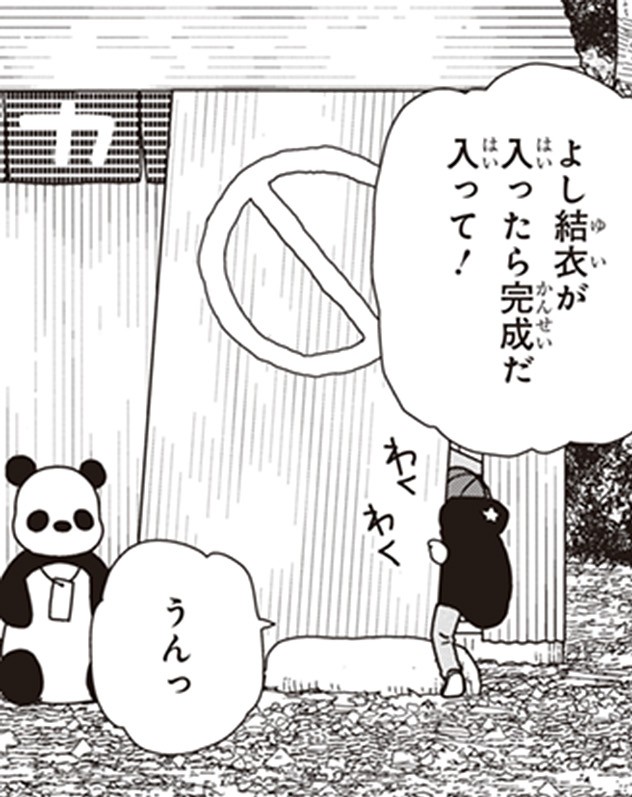
Planning for winter temperature drops, Yui and her friends use cardboard and masking tape to cover all the openings in their clubhouse. The final step is to close the door and see how it works.
友達( ともだち ) :「よし結衣( ゆい ) が入( はい ) ったら完成( かんせい ) 入( はい ) って!」
“Yui, once you're in, it's complete. Get in!”
結衣( ゆい ) :「うんっ」
“Right!”
Challenge Yourself
Show translation
Challenge
What final step will make the clubhouse insulation complete?
Clues
結衣( ゆい ) が入( はい ) ったら完成( かんせい ) だonce Yui gets inside, it is complete
入( はい ) ってget in, a direct request to Yui
What does the speaker mean?
Yui getting inside the clubhouse.
結衣( ゆい ) が入( はい ) ったら sets Yui's entry as the condition for 完成( かんせい ) .
Yui covering one more opening with tape.
The work described in this line is finished once Yui enters. No further taping is requested.
Everyone leaving the clubhouse together.
入( はい ) る means to enter, and Yui alone is named as the subject.
Closing the project until winter arrives.
完成( かんせい ) means the project becomes complete now, not that it is postponed.
Testing the insulation from outside.
The speaker tells Yui 入( はい ) って, so the test requires her to be inside.
Replacing the cardboard with a permanent wall.
The line treats the current setup as complete after Yui enters. It does not propose rebuilding it.
The group considers the insulation complete once Yui gets inside. 入( はい ) ったら sets her entry as the last condition, and the immediate 入( はい ) って urges her to do it.
View Full Example
成果 (Achievement)成果( せいか ) means a positive result produced by someone’s work or effort.
It combines 成 (accomplish ) with 果 (fruit ) to show the fruit of accomplishment .
三ツ星カラーズ »
Volume 8 » Page 85
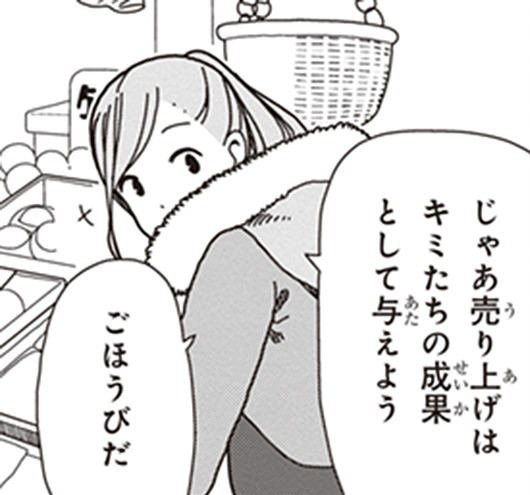
Sacchan’s mother has an overstock of bananas at her fruit shop, so she gives them to Sacchan and her friends to sell around the neighborhood. Later, Sacchan returns having sold all the bananas.
お母( かあ ) さん:
「じゃあ売( う ) り上( あ ) げはキミたちの成果( せいか ) 与( あた ) えよう」
“Then I'll give you the sales as your reward.”
「ごほうびだ」
“Consider it a bonus.”
Challenge Yourself
Show translation
Challenge
What does Sacchan's mother decide to do with the sales proceeds?
Clues
売( う ) り上( あ ) げはキミたちの成果( せいか ) として与( あた ) えようI will give you the proceeds as the result of your work
ごほうびだ
it is a reward
What does the speaker mean?
Give the proceeds to the girls as their reward.
与( あた ) えよう states her decision to give, and キミたちの成果( せいか ) treats the sales as the girls' earned result.
Keep the proceeds to buy more bananas.
She says she will give the proceeds and then calls them a reward.
Donate the proceeds to nearby shops.
キミたち identifies the girls as the recipients, not other stores.
Pay the girls only if they sell another batch.
She speaks about the existing 売( う ) り上( あ ) げ and gives no new condition.
Count the proceeds as payment for the bananas they ate.
She calls the money their 成果( せいか ) and ごほうび, not repayment of a debt.
Use the proceeds to reward herself for assigning the job.
キミたちの and 与( あた ) えよう direct the reward to the girls.
Sacchan’s mother lets the girls keep the sales proceeds as the result of their work. Her follow-up ごほうびだ states the practical meaning plainly: the money is their reward.
View Full Example
作成 (Creation)作成( さくせい ) means creating or preparing something (such as a document or data) in a finished, usable form.
It combines 作 (make ) with 成 (accomplish ) to show making something into a finished form .
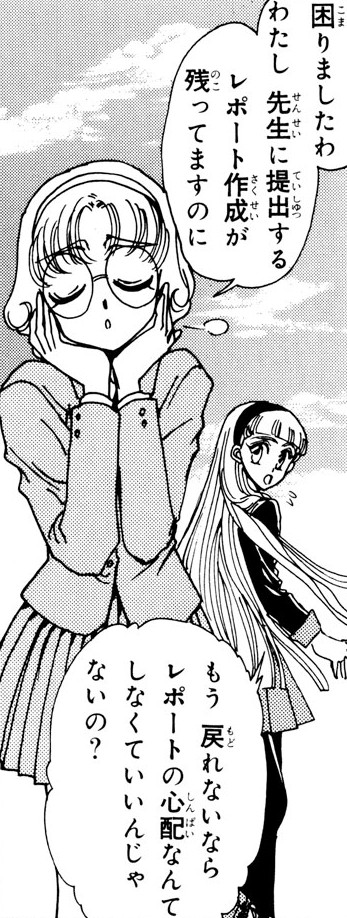
魔法騎士レイアース »
Volume 1 » Page 47
Fuu finds herself spirited away to another world, along with two other girls. A wizard appears before them, saying they cannot return home until they accomplish a specific goal.
風( ふう ) :「困( こま ) りましたわ。 わたし 先生( せんせい ) に提出( ていしゅつ ) するレポート作成( さくせい ) 残( のこ ) ってますのに」
“Oh dear. I've still got to write that report to hand in to the teacher...”
海( うみ ) :「もう 戻( もど ) れないならレポートの心配( しんぱい ) なんてしなくていいんじゃないの?」
“If we can't go back anyway, isn't there no point worrying about the report?”
Challenge Yourself
Show translation
Challenge
Why does Umi say Fuu does not need to worry about her unfinished report?
Clues
先生( せんせい ) に提出( ていしゅつ ) するレポート作成( さくせい ) が残( のこ ) ってますのにFuu still has a report to finish and submit to her teacher
もう戻( もど ) れないなら
Umi treats being unable to return home as the condition
What does the speaker mean?
If they cannot return home, Fuu cannot submit it to her teacher.
戻れないなら sets up the possibility that they cannot go home. The report is meant for Fuu's teacher, so she would have no way to submit it.
The wizard has agreed to finish the report for Fuu.
Umi does not mention the wizard doing the work. Her point depends on whether they can return home.
Fuu's teacher has canceled the assignment.
Fuu says the report remains unfinished. Nothing in either line says the teacher canceled it.
作成 shows that Fuu has already completed the report.
作成が残ってます means the work of preparing the report still remains. It is not complete.
Umi plans to return alone and submit the report for Fuu.
戻れない refers to their inability to go back. Umi does not offer to deliver the report herself.
The report matters only if Fuu becomes a mage.
Umi links the report to returning home, not to whether Fuu becomes a mage.
Fuu is worried because she still has to finish a report for her teacher. Umi reasons that if they cannot return home, Fuu cannot submit it anyway, so worrying about it serves no purpose.
View Full Example
Formation
成立 (Establishment)成立( せいりつ ) means establishment or formation. It can also describe a contract, agreement, or decision taking effect.
It combines 成 (become ) with 立 (stand ) to show something brought into standing existence .
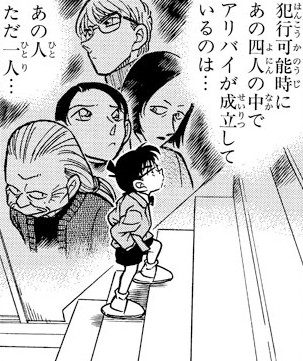
名探偵コナン »
Volume 24 » Page 83
Following a murder made to look like an accidental death, Conan reviews the whereabouts of the four suspects at the time.
コナン:
「犯行( はんこう ) 可能( かのう ) 時( じ ) にあの四人( よにん ) の中( なか ) でアリバイが成立( せいりつ )
“Among those four, the one with an established alibi during the time the crime could have been committed is...”
「あの人( ひと ) ただ一人( ひとり ) …」
“...that person alone...”
Challenge Yourself
Show translation
Challenge
How many of the four suspects have an alibi that holds up?
Clues
あの四人( よにん ) の中( なか ) で
among those four people
アリバイが成立( せいりつ ) しているのは…あの人( ひと ) ただ一人( ひとり )
that person alone has an established alibi
What does the speaker mean?
Only one of them.
ただ一人( ひとり ) limits the valid alibi to a single person among the four.
All four of them.
Conan singles out one person rather than clearing the whole group.
Exactly two of them.
一人( ひとり ) gives the count as one.
Three of them.
The line identifies only one established alibi.
None of them.
Conan says one person's alibi does hold up.
The number is still completely unknown.
He has already narrowed the valid alibis to one person.
Among the four suspects, Conan says only one person has an alibi that is established as valid during the possible time of the crime.
View Full Example
成分 (Component)成分( せいぶん ) means the ingredients or components that make up a substance or product.
It combines 成 (form ) with 分 (part ) to show the parts that form something .
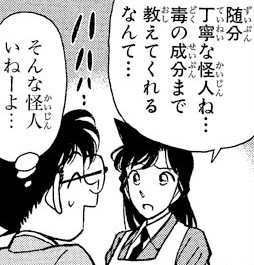
名探偵コナン »
Volume 14 » Page 15
A client tells Detective Mouri about the condition in which she found her deceased husband. Hearing the details, Conan identifies the likely poison, including the composition, the dosage required to kill, and the internal effects it has on a person. When Ran asks how he knows all this, Conan covers by saying the monster villain on the kid’s TV show he watched explained it.
蘭( らん ) :「随分( ずいぶん ) 丁寧( ていねい ) な怪人( かいじん ) ね… 毒( どく ) の成分( せいぶん ) 教( おし ) えてくれるなんて…」
“What a polite villain... Going so far as to tell the poison's composition...”
コナン:
「そんな怪人( かいじん ) いねーよ…」
“No such monster exists...”
Challenge Yourself
Show translation
Challenge
What makes Ran sarcastically call the television villain considerate?
Clues
毒( どく ) の成分( せいぶん ) までeven the poison's composition
教( おし ) えてくれるなんてto think that he would tell you
What does the speaker mean?
He supposedly explained even the poison's composition.
まで shows that the implausibly detailed explanation went as far as the chemical composition.
He warned viewers never to use poison.
Ran focuses on the technical information he supposedly provided, not a safety warning.
He gave Conan an antidote.
No antidote is mentioned. Conan claims the show supplied his knowledge.
He politely apologized to every victim.
丁寧( ていねい ) is sarcastic here because of the thorough explanation.
He concealed the poison's identity from Conan.
The supposed villain did the opposite by explaining its composition.
He taught Ran how to make a television program.
The information concerns the poison, not producing the show.
Ran mocks Conan’s excuse by imagining a villain helpful enough to explain even the poison’s chemical makeup. Conan’s reply admits that no such villain exists.
View Full Example
Growth
成長 (Growth)成長( せいちょう ) means growth. It can describe a living thing becoming larger or a person, skill, or organization developing.
It combines 成 (become ) with 長 (grow ) to show growth to maturity .
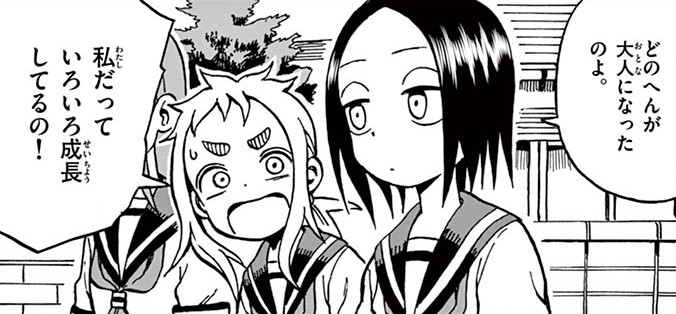
あしたは土曜日 »
Volume 春・夏 » Page 36
Mina buys a can of coffee, even though she’s bad at bitter drinks. When her friends question her, she says she’s grown up a bit and should be able to drink it.
サナエ:
「どのへんが大人( おとな ) になったのよ。」
“What part of you has grown up?”
ミナ:
「私( わたし ) だっていろいろ成長( せいちょう )
“I've grown in lots of ways!”
Challenge Yourself
Show translation
Challenge
How does Mina answer Sanae's challenge?
Clues
私( わたし ) だってeven I or me too
いろいろ
in various ways
成長( せいちょう ) してるhas grown or developed
〜の!
an emphatic, insistent ending
What does the speaker mean?
She insists that she has grown in many different ways.
私( わたし ) だって pushes back against Sanae, while いろいろ成長( せいちょう ) してる makes a broad claim about Mina's growth.
She says she has only grown taller.
いろいろ broadens the claim to various kinds of growth. Mina does not limit it to height.
She agrees that she has not grown up at all.
成長( せいちょう ) してる is a positive claim that her growth is already evident.
She claims that Sanae has become an adult.
私( わたし ) だって makes Mina herself the person whose growth is at issue.
She asks Sanae which part of her should change.
Sanae asks the question. Mina answers with an emphatic statement rather than another question.
She says drinking coffee is what made her grow.
The scene links coffee with Mina's attempt to act grown-up, but her line does not say coffee caused her 成長( せいちょう ) .
Mina defensively insists that even she has grown in various ways. The contracted してる presents that growth as a current result, and the final の adds force.
View Full Example
Results
成績 (Grades)成績( せいせき ) means results, grades, or performance at school or work.
It combines 成 (accomplish ) with 績 (results ) to show the results of what was accomplished .
Example 1 of 2: Distracted by test scores with 気が散る Example 1 of 2
美少女戦士セーラームーン »
Volume 8 » Page 305
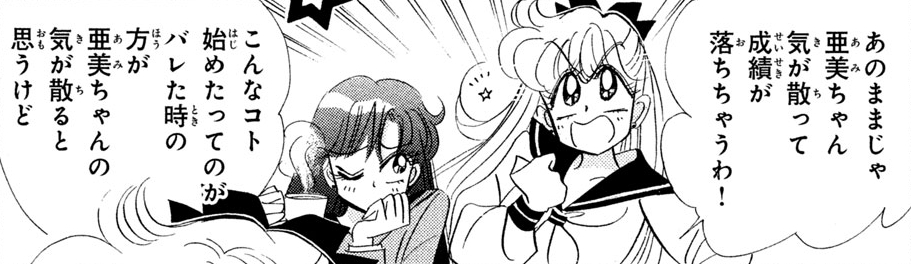
Ami is used to getting the top grade on mock exams, but when another name starts tying her scores, she begins to get flustered. Her friend Minako suggests they investigate the person behind the name, but Rei isn’t so sure.
美奈子( みなこ ) :「あのままじゃ 亜美( あみ ) ちゃん気( き ) が散( ち ) って成績( せいせき ) 落( お ) ちちゃうわ!」
“The way things are, Ami-chan'll be distracted, and her grades will drop!”
レイ:
「こんなコト 始( はじ ) めたってのがバレた時( とき ) の方( ほう ) が亜美( あみ ) ちゃんの気( き ) が散( ち ) ると思( おも ) うけど」
“I think Ami-chan will be more distracted when she finds out we've started something like this.”
Challenge Yourself
Show translation
Challenge
Why does Rei question Minako's plan to investigate Ami's rival?
Clues
こんなコト始( はじ ) めたってのがバレた時( とき )
Ami may discover that her friends started this investigation
時( とき ) の方( ほう ) が亜美( あみ ) ちゃんの気( き ) が散( ち ) るRei thinks that discovery would distract Ami even more
What does the speaker mean?
Ami may be more distracted if she learns they investigated her rival.
バレた時の方が compares the moment Ami finds out with her current worry, and Rei says that would scatter her attention more.
Ami's grades will improve too much if they identify the rival.
Both speakers worry about distraction and falling grades. Rei does not predict an excessive improvement.
The rival will stop taking mock exams if Minako investigates.
Rei's concern is Ami's reaction to discovering the plan, not whether the rival keeps taking tests.
Ami already asked Rei to investigate the other student.
Rei worries about the investigation being exposed, which means Ami has not requested or approved it.
Minako's plan will distract Rei instead of Ami.
Rei explicitly names 亜美ちゃん as the person whose attention would be scattered.
Ami will be upset only if her score falls below Minako's.
The comparison concerns Ami finding out about the secret investigation, not a score comparison with Minako.
Minako thinks investigating the rival will protect Ami from distraction. Rei argues that Ami would be even more distracted if she discovered that her friends had started such an investigation behind her back.
View Full Example
Example 2 of 2: Getting good grades in school with 成績 Example 2 of 2
からかい上手の(元)高木さん »
Volume 13 » Page 44
Yukari stops by the preschool where Mina works, just as Takagi is there picking up her daughter. Yukari compares her life with theirs.
ユカリ:
「高木( たかぎ ) ちゃんは成績( せいせき )
“Takagi-chan got good grades and had it together.”
「ミナは料理( りょうり ) が得意( とくい ) だったりするじゃない。」
“And Mina's good at cooking and such, right?”
Challenge Yourself
Show translation
Challenge
Which strengths does Yukari assign to Takagi and Mina?
Clues
高木( たかぎ ) ちゃんは成績( せいせき ) よくてTakagi got good grades
しっかりしてた
was dependable or had it together
ミナは料理( りょうり ) が得意( とくい )
Mina is good at cooking
What does the speaker mean?
Takagi had good grades and was dependable; Mina is good at cooking.
Yukari links 成績( せいせき ) よくて and しっかりしてた to Takagi, then gives 料理( りょうり ) が得意( とくい ) as Mina's strength.
Takagi was good at cooking; Mina had good grades.
This swaps the qualities assigned to the two women.
Both Takagi and Mina were known mainly for good grades.
Only Takagi is described with 成績( せいせき ) . Mina's example is cooking.
Both women were good cooks but unreliable students.
Yukari calls Takagi dependable and gives cooking as Mina's skill.
Takagi struggled in school while Mina helped her study.
成績( せいせき ) よくて is positive, and no help with studying is mentioned.
Yukari says neither woman had a useful strength.
The lines list positive qualities as Yukari compares herself with them.
Yukari remembers Takagi as academically strong and dependable. She then points to cooking as one of Mina’s strengths.
View Full Example
高木さん/からかい上手の(元)高木さん-volume-13-page-44-panel-3.jpg)