Below and lowering with 下
下 means below , down , or lower . It describes position or movement beneath something and extends in compounds to lower rank, decline, and rejection.
Etymology
This kanji is an ideogram, with the short stroke written beneath a baseline to indicate what is below .
Clothing
下着 (Underwear)下着( したぎ ) means underwear or clothes worn beneath outer clothing.
It combines 下 (beneath ) with 着 (wear ) to show clothing worn underneath .
ご注文はうさぎですか? »
Volume 1 » Page 14
While changing into her uniform, Rize hid in the closet when she sensed someone unfamiliar nearby. Cocoa, feeling as though she was being watched, opened the closet door.
ココア:
「下着( したぎ ) 姿( すがた ) の…ドロボーさん?」
“A burglar… in their underwear?”
リゼ:
「完全( かんぜん ) に気配( けはい ) を殺( ころ ) してたつもりなのに」
“I thought I completely suppressed my presence, and yet...”
Challenge Yourself
Show translation
Challenge
What does リゼ mean in the highlighted line?
Clues
殺( ころ ) してたつもり〜たつもり shows Rize's belief about what she had done
What does the speaker mean?
I thought I completely suppressed my presence, and yet...
In 気配( けはい ) を殺( ころ ) してたつもり, Rize means she thought she had successfully hidden her presence.
Rize says she intended to make her presence obvious to Cocoa.
The highlighted form is 殺( ころ ) してたつもり. Here 〜たつもり shows Rize's belief about what she had done, so this choice does not match the Japanese.
Rize says she hid perfectly and Cocoa never found her.
The highlighted form is 殺( ころ ) してたつもり. Here 〜たつもり shows Rize's belief about what she had done, so this choice does not match the Japanese.
Rize says Cocoa was the one hiding in the closet.
The highlighted form is 殺( ころ ) してたつもり. Here 〜たつもり shows Rize's belief about what she had done, so this choice does not match the Japanese.
〜たつもり shows Rize’s belief about what she had done. In 気配( けはい ) を殺( ころ ) してたつもり, Rize means she thought she had successfully hidden her presence.
View Full Example
Levels
低下 (Decline)低下( ていか ) means a decline or drop in value, level, quality, or degree.
It combines 低 (low ) with 下 (down ) to show something going downward .
よつばと! »
Volume 1 » Page 13
Jumbo helps his friend Yousuke move into his new house. After unboxing things, Yousuke stops for a break.
葉介( ようすけ ) :「なんか俺( おれ ) 体力( たいりょく ) 低下( ていか ) 手( て ) がふるふる…」
“Man, I feel like my stamina is dropping... My hands are shaking...”
ジャンボ:
「おまえさ 近所( きんじょ ) にあいさつで配( くば ) る粗品( そしな ) とか用意( ようい ) してるか?」
“Hey, are you preparing any little gifts to hand out to your neighbors when you go around saying hello?”
Challenge Yourself
Show translation
Challenge
What change does Yousuke notice after moving boxes?
Clues
体力( たいりょく ) 低下( ていか ) してんなあhe feels that his stamina is declining
手( て ) がふるふるhis trembling hands show the physical fatigue
What does the speaker mean?
His stamina has dropped and his hands are trembling.
体力( たいりょく ) 低下( ていか ) names the decline, and 手( て ) がふるふる gives the physical sign he notices.
His hands have become stronger from carrying boxes.
The trembling supports a loss of stamina, not an increase in strength.
His body temperature has fallen.
低下( ていか ) modifies 体力( たいりょく ) , stamina, rather than temperature.
He has recovered enough to keep working without rest.
Yousuke stops for a break and comments on declining stamina. He is not announcing a recovery.
His neighbor is tired from preparing gifts.
Yousuke speaks about 俺( おれ ) , himself, before Jumbo changes the subject to neighbor gifts.
His hands are shaking because the room is cold.
The line links the trembling to physical exertion and reduced stamina, not cold weather.
Yousuke realizes that moving boxes has worn him out more than expected. He calls it a drop in stamina and points to his trembling hands as evidence.
View Full Example
Movement
落下 (Fall)落下( らっか ) means a fall, drop, or descent. It is used for things physically coming down, such as rocks, rain, or a person falling from a height.
It combines 落 (fall ) with 下 (down ) to show something falling downward .
ご注文はうさぎですか? »
Volume 1 » Page 100
After learning the fortunes she told didn’t come true for Chino and Rize, Cocoa lists the bad fortune she ran into.
ココア:
「そっかー」
“I see.”
「私( わたし ) あんこが落下( らっか ) 金( かね ) 投( な ) げられたり色々( いろいろ ) あって大変( たいへん ) だったよー」
“All sorts of things happened to me, like Anko falling on me, my skirt flipping up, and having Sharo-chan throw money at me, so it was rough.”
「占( うらな ) い勝負( しょうぶ ) はティッピーの勝( か ) ちだね」
“Then Tippy wins the fortune-telling contest.”
Challenge Yourself
Show translation
Challenge
Which interpretation best matches the highlighted line?
Clues
投( な ) げられたり〜たり lists the things that happened to Cocoa
What does the speaker mean?
All sorts of things happened to me, like Anko falling on me, my skirt flipping up, and having Sharo-chan throw money at me, so it was rough.
The line gives examples rather than a complete list. 投( な ) げられたり presents Cocoa as affected by Syaro throwing money.
Cocoa says she threw money at Syaro during the unlucky day.
The highlighted form is 投( な ) げられたり. Here 〜たり lists the things that happened to Cocoa, so this choice does not match the Japanese.
Cocoa says Syaro caught money that someone else threw.
The highlighted form is 投( な ) げられたり. Here 〜たり lists the things that happened to Cocoa, so this choice does not match the Japanese.
Cocoa says the money was a deliberate reward rather than part of her bad luck.
The highlighted form is 投( な ) げられたり. Here 〜たり lists the things that happened to Cocoa, so this choice does not match the Japanese.
〜たり lists the things that happened to Cocoa. The line gives examples rather than a complete list. 投( な ) げられたり presents Cocoa as affected by Syaro throwing money.
View Full Example
Places
廊下 (Hallway)廊下( ろうか ) means a corridor or hallway connecting rooms in a building.
It combines 廊 (covered passage ) with 下 (under ) to show a passage under a roof .
Example 1 of 2: Forgotten homework with 宿題 Example 1 of 2
あずまんが大王 »
Volume 1年生 » Page 9
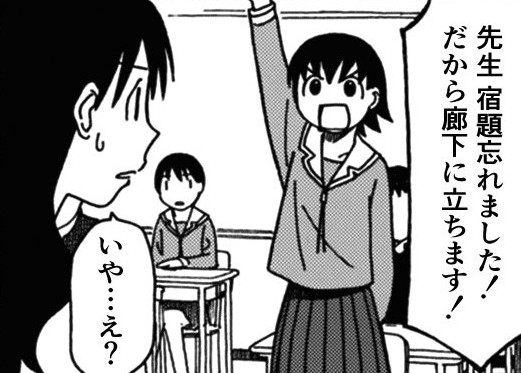
Tomo stands from her desk and raises her hand.
とも:
「先生( せんせい ) 宿題( しゅくだい ) 忘( わす ) れました!だから廊下( ろうか ) 立( た ) ちます!」
“Teacher, I forgot my homework! So I'll stand in the hall!”
Challenge Yourself
Show translation
Challenge
What consequence does Tomo announce for forgetting her homework?
Clues
宿題( しゅくだい ) 忘( わす ) れましたI forgot the homework
だから
so or therefore
廊下( ろうか ) に立( た ) ちますI will stand in the hallway
What does the speaker mean?
She says she will stand in the hallway.
だから links forgetting the homework to Tomo's announced response, 廊下( ろうか ) に立( た ) ちます.
She says she will finish the homework in the hallway.
立( た ) ちます means she will stand there. No action of completing homework appears.
She asks the teacher to stand in the hallway.
Tomo is the omitted subject of 立( た ) ちます. She is announcing what she herself will do.
She promises to bring the homework tomorrow.
The line gives an immediate consequence, not a plan for the next day.
She says the teacher forgot to assign homework.
先生( せんせい ) is the person Tomo addresses. Tomo is the one who forgot the homework.
She concludes that there was no homework.
宿題( しゅくだい ) 忘( わす ) れました assumes the homework existed and says Tomo forgot it.
Tomo reports that she forgot her homework and then uses だから to present standing in the hallway as the consequence.
View Full Example
Example 2 of 2: Leaving the futon out with 〜っぱなし Example 2 of 2
よつばと! »
Volume 9 » Page 143
Yotsuba invites her neighbors over for coffee. She first gives the three a tour of the house, leading up to the kitchen.
風香( ふうか ) :「洗( あら ) い物( もの ) がたまってるのが気( き ) になる…」
“It bothers me that these dishes are piled up...”
あさぎ:
「私( わたし ) は廊下( ろうか ) 気( き ) になる」
“What bothers me is the dust built up in the hallway.”
恵那( えな ) :「おふとんだしっぱなしが気( き ) になる」
“It bothers me that the futon is left laying out.”
Challenge Yourself
Show translation
Challenge
Which mess bothers Ena?
Clues
おふとんだしっぱなし
the futon was taken out and left that way
が気( き ) になる
marks that lingering state as what bothers her
What does the speaker mean?
The futon has been left out.
出( だ ) しっぱなし describes something taken out and left as it is, and Ena makes that the subject of 気( き ) になる.
Dirty dishes are piled up in the kitchen.
That is Fuuka's concern. Ena specifically points to the futon left out.
Dust has collected in the hallway corner.
Asagi notices the hallway dust, while Ena comments on the futon.
Someone folded the futon too early.
The problem is that the futon remains out, not that it was put away prematurely.
The bedding was washed but not dried.
出( だ ) しっぱなし concerns leaving the futon out. The line does not mention washing it.
The house has no place to store a futon.
Ena notices its current messy state. She does not claim the house lacks storage.
Ena is bothered that the futon was taken out and never put away. 出( だ ) しっぱなし focuses on the unchanged state left behind after the original action.
View Full Example
Status
部下 (Subordinate)部下( ぶか ) means a subordinate, someone who works under a superior in an organization or chain of command.
It combines 部 (section ) with 下 (lower ) to show someone lower in position .
Example 1 of 2: Experience with sleepovers with 〜た+ことがある Example 1 of 2
ご注文はうさぎですか? »
Volume 1 » Page 69
Cocoa thinks Rize is nervous about staying overnight with her and Chino.
リゼ:
「いや… 親父( おやじ ) の部下( ぶか ) 誘( さそ ) われたワイルドなキャンプしか経験( けいけん ) した事( こと ) ないから…」
“Well... I've only had the experience of those wild camping trips my dad's subordinates invited me on...”
「こんなの初( はじ ) めてで…」
“I've never done anything like this before...”
ココア:
「ワイルド?」
“Wild?”
Challenge Yourself
Show translation
Challenge
What does リゼ mean in the highlighted line?
Clues
経験( けいけん ) した事( こと ) ない〜た(事:こと)がある = have had the experience of...
What does the speaker mean?
Well... I've only had the experience of those wild camping trips my dad's subordinates invited me on...
The highlighted pattern expresses past experience at least once.
Rize says she often attends ordinary sleepovers with friends.
The highlighted form is 経験( けいけん ) した事( こと ) ない. Here 〜た事( こと ) がある = have had the experience of..., so this choice does not match the Japanese.
Rize says she has never gone camping before.
The highlighted form is 経験( けいけん ) した事( こと ) ない. Here 〜た事( こと ) がある = have had the experience of..., so this choice does not match the Japanese.
Rize says she invited her father's subordinates to stay at her home.
The highlighted form is 経験( けいけん ) した事( こと ) ない. Here 〜た事( こと ) がある = have had the experience of..., so this choice does not match the Japanese.
〜た事( こと ) がある = have had the experience of…. The highlighted pattern expresses past experience at least once.
View Full Example
Example 2 of 2: Getting onto a subway car with 飲み込む Example 2 of 2
名探偵コナン »
Volume 15 » Page 83
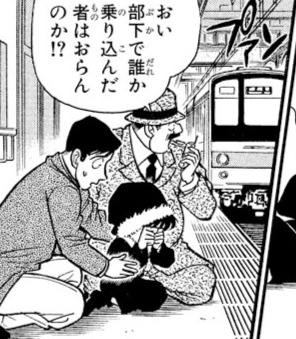
Following the kidnapping of a pop music duo, the police are forced to rely on Conan and his friends to deliver the ransom. The kids speak to one of the kidnappers by phone at the subway station, with the police force watching from a distance. When a subway car is about to close its doors, the kids suddenly bolt onto the nearest car, three of the four making it on before the doors close.
目暮( めぐれ ) :「おい部下( ぶか ) 誰( だれ ) か乗( の ) り込( こ ) んだ者( もの ) はおらんのか!?」
“Hey! Did any of you get on?!”
Challenge Yourself
Show translation
Challenge
What does Megure demand to know from his subordinates?
Clues
部下( ぶか ) で誰( だれ ) かanyone among the subordinates
乗( の ) り込( こ ) んだ者( もの ) はおらんのかis there nobody who boarded?
What does the speaker mean?
Whether any officer managed to board the subway car.
乗( の ) り込( こ ) んだ者( もの ) asks for a subordinate who got into the car.
Whether every officer got off at the same station.
The verb is 乗( の ) り込( こ ) む, to board, not to get off.
Who instructed the children to board.
Megure asks about his own subordinates' response, not who directed the children.
Whether the subway car was completely empty.
His concern is whether one of his officers made it aboard.
Which officer bought the subway tickets.
No ticket purchase is mentioned in the demand.
Whether anyone stopped the train from departing.
The doors closed, so Megure asks who got onto the moving pursuit route.
Megure demands to know whether any of his subordinates managed to board the subway car with the children. おらん is his blunt negative form of おる.
View Full Example