Binding and results with 結
結 means tie , bind , or join . In compounds, it can also refer to forming something, reaching a conclusion, or a result .
Etymology
This kanji isa phono-semantic compound comprised of 糸 (thread) as the semantic component and 吉 as the phonetic component (ケツ).
Formation
結晶 (Crystal)結晶( けっしょう ) means a crystal. Figuratively, it can be the product of sustained effort, as in “the crystallization of hard work”.
It combines 結 (congeal, form together ) with 晶 (sparkling clarity ) to show matter bound into a clear crystalline form .
ARIA The MASTERPIECE »
Volume 4 » Page 226
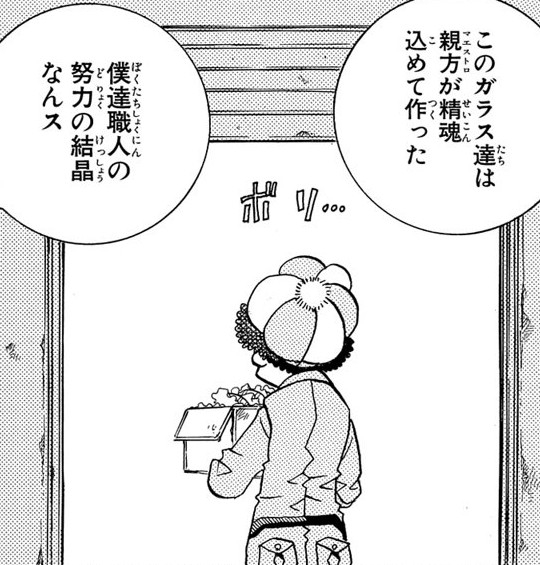
Akari picks up a box containing glassware items for her to transport. One of the employees from the shop making the glassware takes the box from her to place in her gondola. After he does this a second time, Akari says she can help carry the boxes, but he refuses.
職人( しょくにん ) :「このガラス達( たち ) は親方( マエストロ ) が精魂( せいこん ) 込( こ ) めて作( つく ) った」
“These pieces of glass were made with the maestro's heart and soul poured into them.”
「僕達( ぼくたち ) 職人( しょくにん ) の努力( どりょく ) の結晶( けっしょう )
“They're the crystallization of our craftsmen's efforts.”
View Full Example
Outcomes
結局 (In the end)結局( けっきょく ) means “in the end”, “after all”, or “ultimately”, once everything has played out.
It combines 結 (end, conclude ) with 局 (situation, stage ) to show the final situation reached .
それでも歩は寄せてくる »
Volume 2 » Page 134
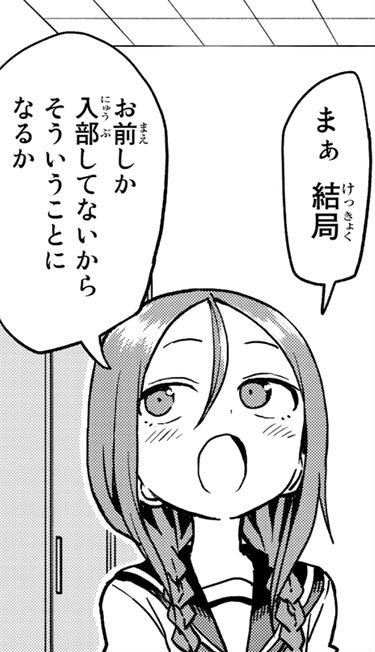
Urushi and Ayumu give their makeshift clubroom a cleaning to welcome potential new members. Considering that Urushi was the only club member before he joined, Ayumu remarks how she alone had cleaned the room for his sake last year.
うるし:
「まぁ 結局( けっきょく )
“Well, in the end...”
「お前( まえ ) しか入部( にゅうぶ ) してないからそういうことになるか」
“You were the only new member, so it ended up as you say, huh?”
Challenge Yourself
Show translation
Challenge
What conclusion does Urushi reluctantly accept?
Clues
お前( まえ ) しか入部( にゅうぶ ) してないから
"because nobody but you joined the club"
そういうことになるか
"I suppose it ends up meaning that," accepting the result of the situation.
What does the speaker mean?
Her cleaning last year effectively ended up being for Ayumu.
Because お前( まえ ) しか入部( にゅうぶ ) してない, Ayumu was the only person who joined, so Urushi accepts his interpretation with そういうことになるか.
Ayumu must clean the room alone from now on.
Urushi is looking back at what her earlier cleaning amounted to. She does not assign Ayumu a new duty.
The clubroom was cleaned for several new members.
お前( まえ ) しか…してない says Ayumu was the only person who joined.
Urushi has decided to stop recruiting new members.
The line explains the result of last year's situation, not a new decision about recruiting.
Ayumu joined only because the room was clean.
しか marks Ayumu as the sole new member. It does not give his reason for joining.
They should move the club to a different room.
Nothing in the conclusion concerns changing rooms.
Ayumu was the only person who joined, so Urushi’s effort to clean the room for potential members ended up benefiting him alone. She concedes that this is そういうことになる, what the situation amounts to.
View Full Example
結論 (Conclusion)結論( けつろん ) means a conclusion reached through reasoning, discussion, or examination of facts.
It combines 結 (tie together ) with 論 (reasoning ) to show a reasoned conclusion tied up at the end .
名探偵コナン »
Volume 16 » Page 18
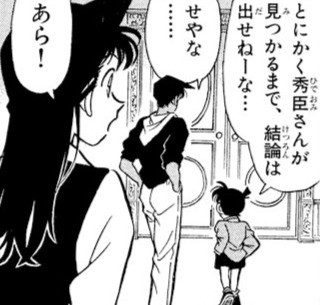
Conan and Heiji end up staying at the same mansion when a murder occurs. They decide to put their heads together to try and determine who the culprit is.
コナン:
「とにかく秀臣( ひでおみ ) さんが見( み ) つかるまで、結論( けつろん ) 出( だ ) せねーな…」
“Anyway, I guess we can't come to a conclusion until we find Hideomi...”
平次( へいじ ) :「せやな……」
“That's right.”
蘭( らん ) :「あら!」
“Oh!”
Challenge Yourself
Show translation
Challenge
Why do Conan and Heiji hold off on reaching a conclusion?
Clues
秀臣( ひでおみ ) さんが見( み ) つかるまでuntil Hideomi is found
結論( けつろん ) は出( だ ) せねーwe cannot reach a conclusion
What does the speaker mean?
They need Hideomi to be found first.
〜まで with the negative says they cannot conclude the case before Hideomi is found.
They have already agreed on the culprit.
結論( けつろん ) は出( だ ) せねー says they cannot yet settle on an answer.
They are waiting for Ran to choose between their theories.
The stated condition is finding Hideomi, not Ran's judgment.
They need the police to leave the mansion.
No departure by the police is tied to their conclusion.
They cannot understand each other's dialect.
Heiji immediately agrees with Conan using せやな.
They have decided there was no murder.
They are still investigating the murder and lack a final conclusion.
Conan says they cannot draw a conclusion until Hideomi is found, and Heiji agrees. The negative potential 出( だ ) せねー means they are not yet able to reach one.
View Full Example