Body and substance with 体
体 primarily means “body” or “the shape or structure of something”. It is an important character used not only to refer to the physical body but also to the essence or structure of things, and even to the idea of acquiring or mastering something.
Etymology
This kanji is built from 亻 (person) and 本 (root, base, origin). These invoke imagery of the person together with the base or central structure that supports them, bringing attention to the body’s main frame and essential substance.
Bodies
身体 (Body)身体( しんたい ) means the body or physical body. It is a formal and general word for the human body as a whole.
It combines 身 (body ) with 体 (body or substance ) to show the physical body .
ご注文はうさぎですか? »
Volume 1 » Page 24
Tippy is glad that Cocoa is around to be friends with Chino, but it’s a problem for him.
ティッピー:
「だがその勝手( かって ) に抱( だ ) きつかれると困( こま ) るというか」
“But being hugged like that without warning is a bit troubling.”
「わしもほら今( いま ) はこんな身体( からだ ) 一応( いちおう ) アレだし…」
“I may have a body like this now, but I'm still, you know...”
Challenge Yourself
Show translation
Challenge
What does ティッピー mean in the highlighted line?
Clues
抱( だ ) きつかれる(抱:だ)きつかれる presents Tippy as the one being hugged
What does the speaker mean?
But being hugged like that without warning is a bit troubling.
Cocoa is the omitted performer, while Tippy describes the unwanted hugs from his own affected position.
Tippy asks Cocoa to hug him more often without warning.
The highlighted form is 抱( だ ) きつかれる. Here 抱( だ ) きつかれる presents Tippy as the one being hugged, so this choice does not match the Japanese.
Tippy says he is the one who keeps hugging Cocoa.
The highlighted form is 抱( だ ) きつかれる. Here 抱( だ ) きつかれる presents Tippy as the one being hugged, so this choice does not match the Japanese.
Tippy says his current body makes the unwanted hugs no concern at all.
The highlighted form is 抱( だ ) きつかれる. Here 抱( だ ) きつかれる presents Tippy as the one being hugged, so this choice does not match the Japanese.
抱( だ ) きつかれる presents Tippy as the one being hugged. Cocoa is the omitted performer, while Tippy describes the unwanted hugs from his own affected position.
View Full Example
死体 (Dead body)死体( したい ) refers to the body of a dead person or animal. It is blunt and clinical, so it can sound cold when used for a person.
It combines 死 (dead ) with 体 (body ) to show a dead body .
名探偵コナン »
Volume 1 » Page 139
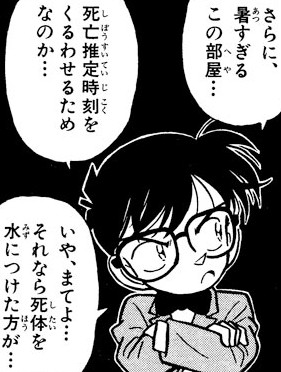
Upon walking in on a murder scene, Conan goes right to work making observations about the blood-covered body and its surroundings. He notes how the room is torn apart save for one upright chair beside the deceased.
コナン:
「さらに、暑( あつ ) すぎるこの部屋( へや ) …」
“Furthermore, this room is too warm...”
「死亡推定時刻( しぼうすいていじこく ) をくるわせるためなのか…」
“Is it to confuse the estimated time of death...?”
「いや、まてよ… それなら死体( したい ) 水( みず ) につけた方( ほう ) が…」
“No, wait... If that's the case, it would be better to put the corpse in water...”
Challenge Yourself
Show translation
Challenge
What possible purpose does Conan consider for the overheated room?
Clues
暑( あつ ) すぎるこの部屋( へや ) this room that is too hot
死亡推定時刻( しぼうすいていじこく ) をくるわせるためなのかperhaps to throw off the estimated time of death
What does the speaker mean?
To distort the estimated time of death.
Conan explicitly considers whether the heat was meant to confuse the death-time estimate.
To make the victim leave the room voluntarily.
Conan connects the temperature to forensic timing, not to driving someone outside.
To melt the murder weapon.
No melting weapon is mentioned. The possible target is the estimated time of death.
To dry water from the floor.
Water appears only in Conan's alternative thought about the body.
To conceal the smell of poison.
The line considers heat as a way to alter the apparent death time.
To keep the investigators comfortable.
The room is 暑( あつ ) すぎる, excessively hot, and Conan treats that as suspicious.
Conan briefly suspects that someone overheated the room to disrupt the estimated time of death. He then questions the theory and considers another method.
View Full Example
体育 (Physical education)体育( たいいく ) means physical education, exercise taught to develop fitness and physical skills.
It combines 体 (body ) with 育 (raise/develop ) to show the cultivation of the body .
ホリミヤ »
Volume 1 » Page 45
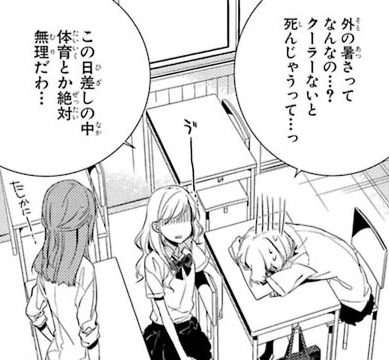
On a summer day, Hori and her friends in class can’t ignore the heat.
由紀( ゆき ) :「外( そと ) の暑( あつ ) さってなんなの…? クーラーないと死( し ) んじゃうって…っ」
“What's with this heat outside...? I'd totally die without the AC...”
「この日差( ひざ ) しのなか体育( たいいく ) 絶対( ぜったい ) 無理( むり ) だわ…」
“There's no way I can do PE in this blazing sun...”
Challenge Yourself
Show translation
Challenge
What does Yuki say would happen without air conditioning?
Clues
クーラーないと
if there is no air conditioning, with が omitted
死( し ) んじゃうwould end up dying, said as an exaggerated reaction
What does the speaker mean?
She would end up dying from the heat.
クーラーないと sets the lack of AC as the condition, and 死( し ) んじゃう gives the exaggerated result.
The air conditioner would stop working because of the heat.
ない describes the absence of AC. The subject of 死( し ) んじゃう is Yuki, not the machine.
She would have to leave class and exercise outside.
Yuki says outdoor PE is impossible in the sunlight. She does not present it as the result of having no AC.
She would become accustomed to the heat eventually.
死( し ) んじゃう gives a disastrous result, even if exaggerated. It does not suggest adaptation.
She would refuse to turn on the air conditioner.
Yuki treats AC as necessary relief. She does not reject using it.
She would already have died before reaching school.
The condition is hypothetical and present. She says what would happen without AC, not that it has already happened.
Yuki exaggerates that she would die without air conditioning. 死( し ) んじゃう contracts 死( し ) んでしまう and presents death as the extreme unwanted result.
View Full Example
解体 (Dismantling)解体( かいたい ) means taking something apart. It can refer to dismantling a machine, demolishing a building, disbanding an organization, or dissecting a body.
It combines 解 (separate ) with 体 (body ) to show a body being taken apart .
名探偵コナン »
Volume 23 » Page 12
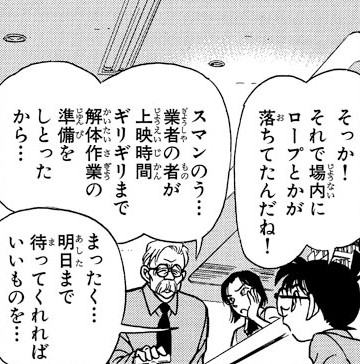
Conan and his friends go to the theater to see a movie. There, they discover this is the last day before the theater closes.
コナン:
「そっか!それで場内( じょうない ) にロープとかが落( お ) ちてたんだね!」
“Oh, I see! That's why there were ropes and stuff lying around the venue!”
オーナー:
「スマンのう… 業者( ぎょうしゃ ) の者( もの ) が上映( じょうえい ) 時間( じかん ) キリキリまで解体( かいたい ) 作業( さぎょう ) の準備( じゅんび ) をしとったから…」
“Sorry about that... The contractor's crew was rushing to get the dismantling ready right up until showtime...”
スタッフ:
「まったく… 明日( あした ) まで待( ま ) ってくれればいいものを…」
“Honestly... They could've at least waited until tomorrow...”
Challenge Yourself
Show translation
Challenge
Why were ropes and other materials lying around the theater?
Clues
解体( かいたい ) 作業( さぎょう ) の準備( じゅんび ) preparations for demolition work
上映( じょうえい ) 時間( じかん ) キリキリまでright up until showtime
What does the speaker mean?
Contractors had been preparing to demolish the theater until showtime.
The owner connects the materials to last-minute preparations for 解体( かいたい ) 作業( さぎょう ) .
The staff had decorated the theater for a festival.
The materials belonged to demolition preparations, not decorations.
The audience brought ropes for the final screening.
The owner says the contractor's crew left them during its work.
Workers had finished rebuilding the theater.
解体( かいたい ) means dismantling or demolition, not reconstruction.
The ropes were clues deliberately planted by Conan.
Conan notices them and then learns their practical source from the owner.
The staff planned to move the screening outside.
The issue is demolition work being prepared too close to the screening time.
The contractor’s crew had been preparing the theater for demolition right up until showtime. That work explains the ropes and other materials left inside.
View Full Example
Conflict and Force
体力 (Physical strength)体力( たいりょく ) means physical strength, stamina, or endurance.
It combines 体 (body ) with 力 (power ) to show the power of the body .
よつばと! »
Volume 1 » Page 13
Jumbo helps his friend Yousuke move into his new house. After unboxing things, Yousuke stops for a break.
葉介( ようすけ ) :「なんか俺( おれ ) 体力( たいりょく ) 低下( ていか ) してんなあ… 手( て ) がふるふる…」
“Man, I feel like my stamina is dropping... My hands are shaking...”
ジャンボ:
「おまえさ 近所( きんじょ ) にあいさつで配( くば ) る粗品( そしな ) とか用意( ようい ) してるか?」
“Hey, are you preparing any little gifts to hand out to your neighbors when you go around saying hello?”
Challenge Yourself
Show translation
Challenge
What change does Yousuke notice after moving boxes?
Clues
体力( たいりょく ) 低下( ていか ) してんなあhe feels that his stamina is declining
手( て ) がふるふるhis trembling hands show the physical fatigue
What does the speaker mean?
His stamina has dropped and his hands are trembling.
体力( たいりょく ) 低下( ていか ) names the decline, and 手( て ) がふるふる gives the physical sign he notices.
His hands have become stronger from carrying boxes.
The trembling supports a loss of stamina, not an increase in strength.
His body temperature has fallen.
低下( ていか ) modifies 体力( たいりょく ) , stamina, rather than temperature.
He has recovered enough to keep working without rest.
Yousuke stops for a break and comments on declining stamina. He is not announcing a recovery.
His neighbor is tired from preparing gifts.
Yousuke speaks about 俺( おれ ) , himself, before Jumbo changes the subject to neighbor gifts.
His hands are shaking because the room is cold.
The line links the trembling to physical exertion and reduced stamina, not cold weather.
Yousuke realizes that moving boxes has worn him out more than expected. He calls it a drop in stamina and points to his trembling hands as evidence.
View Full Example