Boundaries and worlds with 界
界 primarily means “boundary” or “a defined area or society”.
Etymology
界 is a phono-semantic compound built from 田 (field ) and 介 as the sound component, with the original sense of boundary lines dividing fields.
Human and Social Worlds
世界 (World)世界( せかい ) means the world, human society, or a particular sphere of activity or expertise.
It combines 世 (society ) with 界 (world ) to show the world of human society .
ARIA The MASTERPIECE »
Volume 2 » Page 129
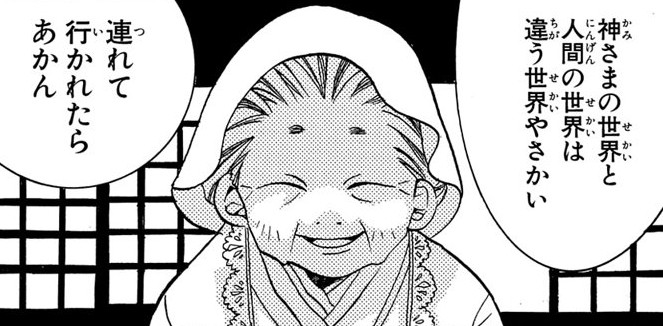
Alicia and Akari visit an island that’s modeled after part of Japan back on Earth. There, an elderly local woman tells the two of the fox spirits that visit the human world there. Akari is excited at the prospect of meeting one, but the old woman gives her a warning: on rare occasion, a fox will take a person back home with them.
おばあさん:
「神( かみ ) さまの世界( せかい ) 人間( にんげん ) の世界( せかい ) 違( ちが ) うやさかい」
“The god world and the human world are different.”
「連( つ ) れて行( い ) かれたらあかん」
“Therefore, it is bad to follow along.”
View Full Example
Limits and Boundaries
限界 (Limit)限界( げんかい ) means the limit or boundary beyond which something cannot go.
It combines 限 (limit ) with 界 (boundary ) to show a boundary line .
あしたは土曜日 »
Volume 秋・冬 » Page 16
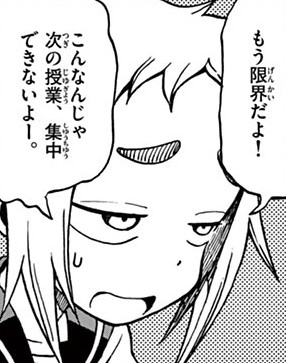
Mina wants to hurry and eat her lunch, as she’s very hungry. Yukari reminders her they still have one more class first.
ミナ:
「もう限界( げんかい ) 次( つぎ ) の授業( じゅぎょう ) 、集中( しゅうちゅう ) できないよー。」
“I'm already at my limit! As things are, come next class I won't be able to concentrate.”
Challenge Yourself
Show translation
Challenge
Why does Mina think the next class will go badly?
Clues
もう限界( げんかい ) だ
already at one's limit
こんなんじゃ
if things stay like this
集中( しゅうちゅう ) できないcannot concentrate
What does the speaker mean?
She is too hungry to concentrate through another class.
もう限界( げんかい ) だ describes Mina's hunger as unbearable, and こんなんじゃ connects that condition to being unable to concentrate.
She thinks the next class will be too difficult to understand.
Mina says she cannot 集中( しゅうちゅう ) , but she does not criticize the class material as difficult.
She is worried that she will arrive late for class.
The problem is her condition during class, not whether she can arrive on time.
She wants to skip class because she is sleepy.
Nothing in the line mentions sleep. Her 限界( げんかい ) comes from the hunger described in the scene.
She believes the next class has been canceled.
次( つぎ ) の授業( じゅぎょう ) is treated as something she still has to sit through.
She says eating lunch has already ruined her concentration.
Mina has not eaten lunch yet. こんなんじゃ refers to remaining as hungry as she is now.
Mina says she has reached her limit from hunger. If she has to remain like this, she believes she will be unable to concentrate in the next class.
View Full Example
視界 (Field of view)視界( しかい ) means one’s field of vision or how clearly one can see it.
It combines 視 (look ) with 界 (range ) to show the range of sight .
ARIA The MASTERPIECE »
Volume 1 » Page 213
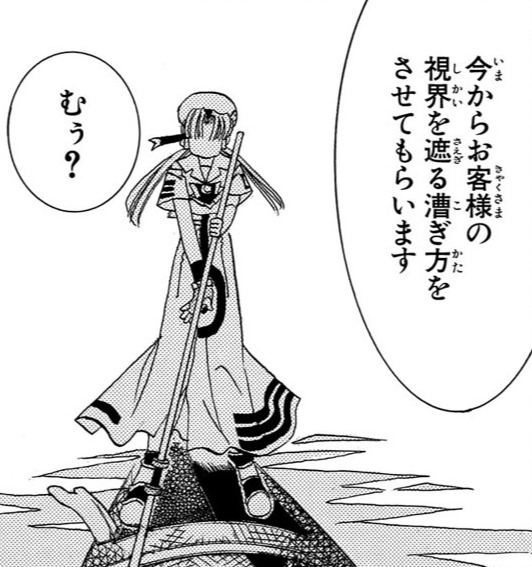
Akatsuki asks Akari for a gondola ride to his destination. Along the way, he asks whether he’ll make his deadline. Akari suggests Alicia should take over, but Akatsuki says he’s Akari’s customer (and paying the cheaper fare). Realizing her responsibility, Akari turns the gondola around so she can use her high-speed backward rowing. Alicia apologizes to Akatsuki for the turnaround.
アリシア:
「今( いま ) からお客様( きゃくさま ) の視界( しかい ) 遮( さえぎ ) る漕( こ ) ぎ方( かた ) をさせてもらいます」
“From now on, she'll be using a rowing technique that blocks your view.”
暁( あかつき ) :「むぅ?」
“Mm?”
Challenge Yourself
Show translation
Challenge
What is Alicia announcing?
Clues
今から
starting now, from here on
遮( さえぎ ) る漕( こ ) ぎ方( かた ) a rowing method that blocks something
させてもらいます
politely receive permission to do it
What does the speaker mean?
Akari is about to row in a way that blocks his view.
今( いま ) から sets the start, and 遮( さえぎ ) る漕( こ ) ぎ方( かた ) is the technique that blocks the customer's view. させてもらいます frames it as permission received.
She is giving Akatsuki permission to row the gondola.
させてもらう is permission received, not granted. Alicia's side is the one doing the rowing, and the customer is the one whose allowance is implied.
She is complaining that something is blocking her own view.
The 視界( しかい ) in the line belongs to お客様( きゃくさま ) , the customer. It is his view that the technique blocks.
She is ending the ride because he will miss his deadline.
The deadline came up earlier in the conversation. This line only announces the rowing technique, and 今から points to a change in how Akari rows, not a stop.
She wants him to close his eyes and rest.
Nothing in the line mentions closing his eyes. The 視界( しかい ) gets blocked by the rowing position itself, not by a request to him.
Alicia politely announces that, starting now, Akari will row in a way that blocks the customer’s view, framed as receiving permission to use that technique.
View Full Example
Other Realms
他界 (Passing away)他界( たかい ) is a respectful euphemism for a person’s death.
It combines 他 (other ) with 界 (world ) to show the other world .
名探偵コナン »
Volume 26 » Page 139
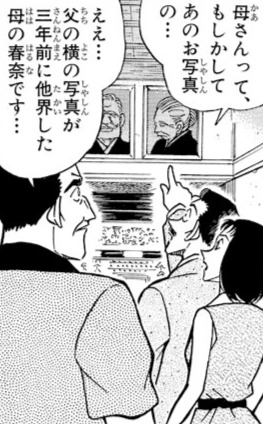
Kogoro takes a client to the home of someone she’d be communicating with via pagers. They show the household family a music box that was left to the client by her correspondence partner. The music it plays reminds the homeowner of the koto his mother used to play.
小五郎( こごろ ) :「母( かあ ) さんってもしかしてあのお写真( しゃしん ) の…」
“By 'Mom', could that be the one in that photo…?”
常雄( つねお ) :「ええ… 父( ちち ) の横( よこ ) の写真( しゃしん ) が三年( さんねん ) 前( まえ ) に他界( たかい ) 母( はは ) の春菜( はるな ) です…」
“Yes... The photo beside my father's is my mother, Haruna, who passed away three years ago...”
Challenge Yourself
Show translation
Challenge
Who is shown in the photograph beside the father's photograph?
Clues
父( ちち ) の横( よこ ) の写真( しゃしん ) the photograph beside my father's
三年( さんねん ) 前( まえ ) に他界( たかい ) した母( はは ) の春菜( はるな ) ですis my mother Haruna, who died three years ago
What does the speaker mean?
His late mother, Haruna.
The speaker identifies the adjacent photograph as his mother Haruna, who passed away three years earlier.
His living sister, Haruna.
He calls her 母( はは ) , his mother, and says she passed away.
His father as a young man.
The father's photograph is the reference point beside the photograph being identified.
The client who brought the music box.
The line identifies a deceased family member, not the visiting client.
His grandmother, who died that year.
The relationship is mother, and the death occurred three years ago.
An unknown woman the family is trying to identify.
The speaker clearly names the woman as Haruna and explains her relationship.
The photograph beside his father’s shows his mother Haruna, who passed away three years before. The stacked の phrases locate the photograph before he identifies its subject.
View Full Example
異世界 (Other world)異世界( いせかい ) means another world or dimension. In modern fiction, it usually means a fantasy world of magic and monsters.
It combines 異 (other ) with 世界 (world ) to show another world separate from ordinary reality.
キラキラとギラギラ »
Volume 1 » Page 173
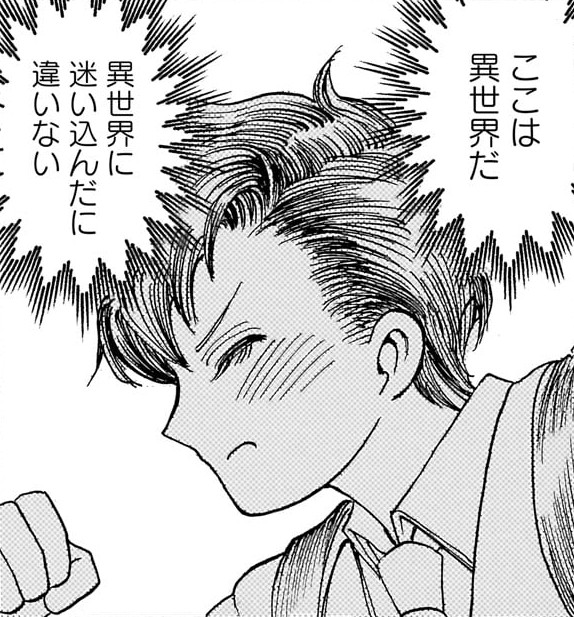
Zen lived in a glittering, idyllic town until his family moved. During his first day of school, he found everyone to be glaring and rugged. Rather than being gentle and playful, his classmates sought a brawl and chased after him.
禅( ぜん ) :「ここは異世界( いせかい )
“This is another world.”
「異世界( いせかい ) 迷( まよ ) い込( こ ) んだに違( ちが ) いない」
“I must have wandered into another world.”
Challenge Yourself
Show translation
Challenge
What conclusion does Zen reach about his new surroundings?
Clues
ここは異世界( いせかい ) だ
this place is another world
異世界( いせかい ) に迷( まよ ) い込( こ ) んだhe wandered into another world
に違( ちが ) いない
there is no doubt, expressing a strong conclusion
What does the speaker mean?
He must have wandered into another world.
Zen names the place as an 異世界( いせかい ) , and に違( ちが ) いない marks that explanation as his firm conclusion.
He has returned to the town where he used to live.
Zen calls the place an entirely different world because it feels unlike his former home.
He is uncertain whether he entered the correct classroom.
に違( ちが ) いない shows strong certainty, and his conclusion concerns the whole world around him.
He believes his classmates came from another world.
Zen says that he wandered into the other world. He does not say that the classmates traveled into his.
He plans to search for a route into another world.
迷( まよ ) い込( こ ) んだ is past tense, so he believes the wandering has already happened.
He realizes that he became lost on the way to school.
迷( まよ ) い込( こ ) む can involve losing one's way, but its destination here is explicitly an 異世界( いせかい ) , not an ordinary route.
Zen is so shocked by the rough school that he treats it as another world. 迷( まよ ) い込( こ ) んだ describes accidentally ending up there, and に違( ちが ) いない shows that he considers this the only possible explanation.
View Full Example