Childhood and small things with 子
子 means child . It can refer to a son or daughter, a young person, or someone’s offspring.
In words such as 電子( でんし ) , 子 takes a different turn and marks something tiny.
The kanji also appears as borrowed from Chinese where it acts as a noun-forming suffix.
Etymology
The old forms of 子 picture a small child.
Appearance
様子 (State)様子( ようす ) is how someone or something looks, seems, or is doing. It can describe a person’s condition, the mood of a place, or the state of a situation.
It combines 様 (appearance ) with 子 (aspect ) to show the way something looks .
キラキラとギラギラ »
Volume 2 » Page 32
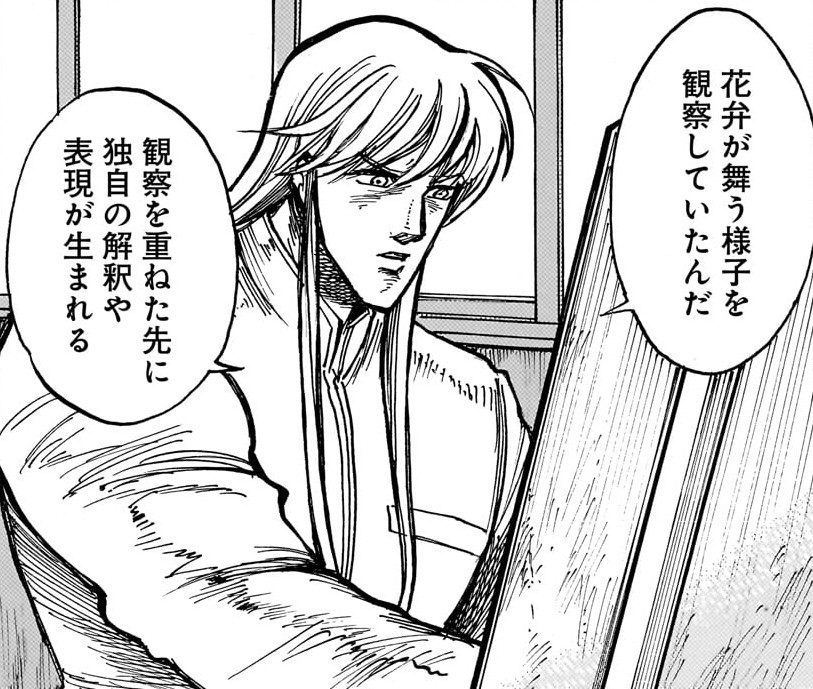
As she models for a sketch, Lulu recalls seeing Hideki blowing flower petals into the air. She brings it up to him.
秀樹( ひでき ) :「花弁( はなびら ) が舞( ま ) う様子( ようす ) 賢察( けんさつ ) していたんだ」
“I was observing the petals as they danced.”
「観察( かんさつ ) を重( かさ ) ねた先( さき ) に独自( どくじ ) の解釈( かいしゃく ) や表現( ひょうげん ) が生( う ) まれる」
“Through repeated observation, unique interpretations and expressions emerge.”
Challenge Yourself
Show translation
Challenge
What does Hideki say repeated observation can produce?
Clues
観察( かんさつ ) を重( かさ ) ねた先( さき ) にbeyond the stage of repeated observation
独自( どくじ ) の解釈( かいしゃく ) や表現( ひょうげん ) が生( う ) まれるone's own interpretations and expressions emerge
What does the speaker mean?
Original interpretations and ways of expressing them.
独自( どくじ ) marks the interpretations as one's own, and 解釈( かいしゃく ) や表現( ひょうげん ) names what repeated observation produces.
A perfectly literal copy of the flower petals.
Hideki says observation leads to 独自( どくじ ) の解釈( かいしゃく ) , a personal reading, rather than mere duplication.
An explanation of why the petals stopped moving.
The petals' movement is what he observes. The result he names is artistic interpretation and expression.
A faster method for finishing the sketch.
観察( かんさつ ) を重( かさ ) ねる stresses repeated looking, not saving time.
Proof that every artist sees the same thing.
独自( どくじ ) means unique or one's own, so the line points to individual readings.
A decision to stop observing and rely on memory.
Hideki treats repeated observation as the process that gives rise to the later interpretation.
Hideki says that sustained observation eventually gives an artist a personal interpretation and a way to express it. 先( さき ) に places those results beyond the repeated observation that produces them.
View Full Example
Children
子供 (Child)子供( こども ) is the everyday word for a child. It can also refer to children as a group.
It combines 子 (child ) with 供 (accompany ) to show a young child attending adults .
Example 1 of 2: Don't care if it troubles you with 知ったことか Example 1 of 2
三ツ星カラーズ »
Volume 1 » Page 138
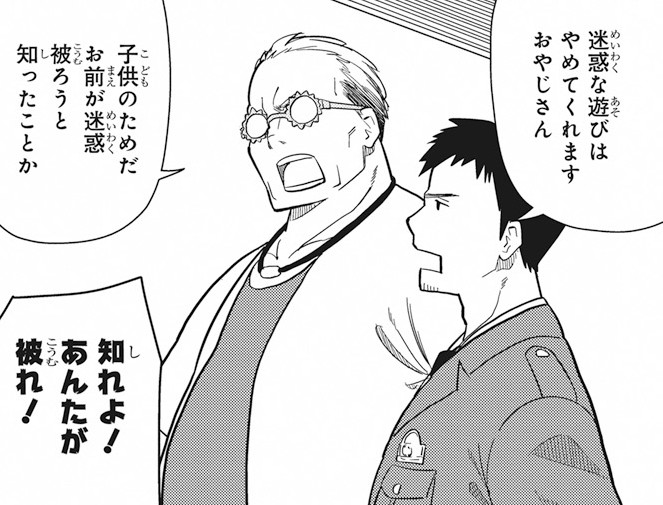
Oyaji presented Colors with a bomb to defuse via a riddle, which led to problems for Officer Saitou. After Colors successfully defuses the bomb, Saitou tells Oyaji to stop playing bothersome games.
おやじ:
「子供( こども ) 前( まえ ) が迷惑( めいわく ) 被( かうむ ) ろうと知( し ) ったことか」
“It's for the kids. I don't care if it will cause you trouble.”
Challenge Yourself
Show translation
Challenge
How does Oyaji respond to Saitou's complaint about the bomb game?
Clues
子供( こども ) のためだit is for the children
お前( まえ ) が迷惑( めいわく ) 被( かうむ ) ろうと知( し ) ったことか
even if it causes you trouble, what do I care
What does the speaker mean?
He says it is for the children and he does not care if Saitou is inconvenienced.
子供( こども ) のため gives Oyaji's justification, while 知( し ) ったことか dismisses Saitou's trouble as none of his concern.
He apologizes for causing Saitou trouble.
知( し ) ったことか rejects concern rather than expressing regret.
He promises to stop making games for the children.
Oyaji defends the game as being for the children and makes no promise to stop.
He says Saitou should create the next bomb game.
The line discusses whether Saitou suffers inconvenience, not who should design another game.
He claims that the bomb never caused anyone trouble.
迷惑( めいわく ) 被( かうむ ) ろうと concedes that Saitou may suffer trouble. Oyaji simply does not care.
He asks Saitou whether the children enjoyed the game.
The final か is rhetorical in the idiom 知( し ) ったことか, not a request for Saitou's report.
Oyaji justifies the game as something done for the children, then dismisses any trouble it causes Saitou. 知( し ) ったことか means that Saitou’s inconvenience is not his concern.
View Full Example
Example 2 of 2: Easy to drink with 〜やすい Example 2 of 2
ご注文はうさぎですか? »
Volume 1 » Page 63
Syaro’s friends stop by the tea house where she works. The group has difficulty deciding what to order.
シャロ:
「チノちゃんは甘( あま ) い香( かお ) りで飲( の ) みやすいカモミールはどう?」
“For Chino, how about the fragrant and easy to drink chamomile?”
チノ:
「子供( こども )
“I'm not a child.”
シャロ:
「リゼ先輩( せんぱい ) は最近( さいきん ) 眠( ねむ ) れないって言( い ) ってましたから」
“Since you said you haven't been sleeping well lately, Rize-senpai...”
「ラベンダーがオススメです」
“I recommend lavender.”
リゼ:
「ほー」
“Oh?”
Challenge Yourself
Show translation
Challenge
What does シャロ mean in the highlighted line?
Clues
飲( の ) みやすい(飲:の)みやすい means easy to drink
What does the speaker mean?
For Chino, how about sweet-smelling chamomile? It's easy to drink.
飲( の ) む changes to the stem 飲( の ) み before やすい.
Syaro says chamomile is too sweet for Chino to drink.
The highlighted form is 飲( の ) みやすい. Here 飲( の ) みやすい means easy to drink, so this choice does not match the Japanese.
Syaro asks Chino to recommend tea for her.
The highlighted form is 飲( の ) みやすい. Here 飲( の ) みやすい means easy to drink, so this choice does not match the Japanese.
Syaro warns that chamomile is difficult for children to drink.
The highlighted form is 飲( の ) みやすい. Here 飲( の ) みやすい means easy to drink, so this choice does not match the Japanese.
飲( の ) みやすい means easy to drink. 飲( の ) む changes to the stem 飲( の ) み before やすい.
View Full Example
女子 (Girl)女子( じょし ) labels girls or women as a group or category.
It combines 女 (female ) with 子 (child ) to show a female child .
からかい上手の高木さん »
Volume 17 » Page 84
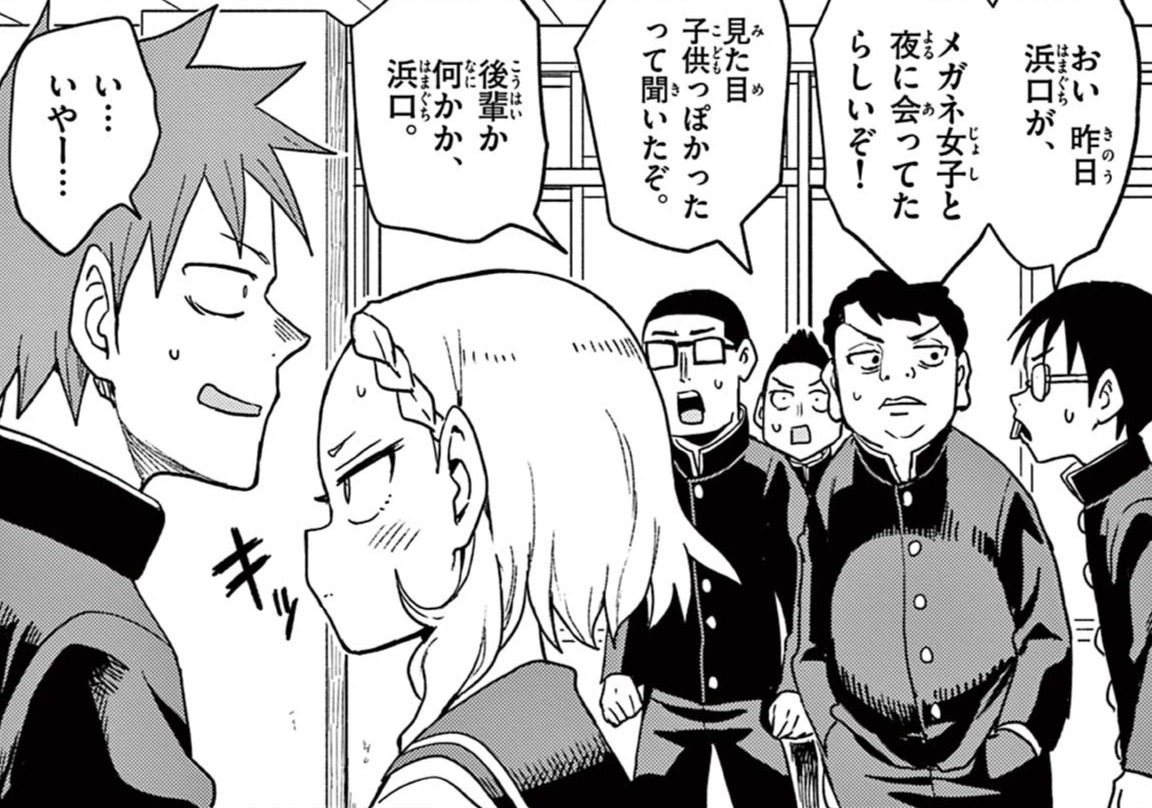
On a nighttime walk, Hamaguchi sees Hokujou casually dressed and wearing glasses. She’s fine with Hamaguchi seeing her like this, as they’ve known each other for a long time, but she tells him not to tell their classmates. At school the next morning…
高尾( たかお ) :「おい 昨日( きのう ) 浜口( はまぐち ) が、メガネ女子( じょし ) 夜( よる ) に会( あ ) ってたらしいぞ!」
“Hey, I heard Hamaguchi was hanging out with a girl in glasses last night!”
生徒( せいと ) A:「見( み ) た目( め ) 子供( こども ) っぽかったって聞( き ) いたぞ。」
“I heard she looked kind of childish.”
生徒( せいと ) B:「後輩( こうはい ) か何( なに ) かか、浜口( はまぐち ) 。」
“Is she a junior or something, Hamaguchi?”
浜口( はまぐち ) :「い… いやー…」
“Uh... well...”
Challenge Yourself
Show translation
Challenge
What does the classmate guess about the girl Hamaguchi met?
Clues
メガネ女子( じょし )
the girl in glasses
後輩( こうはい ) か何( なに ) かa junior or something
〜か、浜口( はまぐち )
asks Hamaguchi to confirm the guess
What does the speaker mean?
She might be Hamaguchi's junior or someone like that.
後輩( こうはい ) か何( なに ) か offers junior as a tentative category for the girl in glasses.
She is definitely Hamaguchi's younger sister.
The guess is 後輩( こうはい ) , not younger sister, and か何( なに ) か keeps it uncertain.
She is a teacher Hamaguchi met at school.
No teacher is mentioned. The proposed category is a junior.
Hamaguchi met several girls wearing glasses.
The rumor concerns one メガネ女子( じょし ) . か何( なに ) か lists possible identity, not additional people.
The girl asked Hamaguchi to become her junior.
The classmate is guessing what relationship she already has to Hamaguchi, not reporting a request.
Hamaguchi says he does not know the girl.
Hamaguchi only hesitates in response. The identity claim comes from his classmate.
The classmate tentatively guesses that the girl in glasses might be Hamaguchi’s junior or someone in a similar relationship.
View Full Example
迷子 (Lost child)迷子( まいご ) is someone who is lost, especially a child separated from an adult. It can also describe a lost pet or someone who does not know where to go.
It combines 迷 (lost ) with 子 (child ) to show a child who has lost the way .
ARIA The MASTERPIECE »
Volume 2 » Page 31
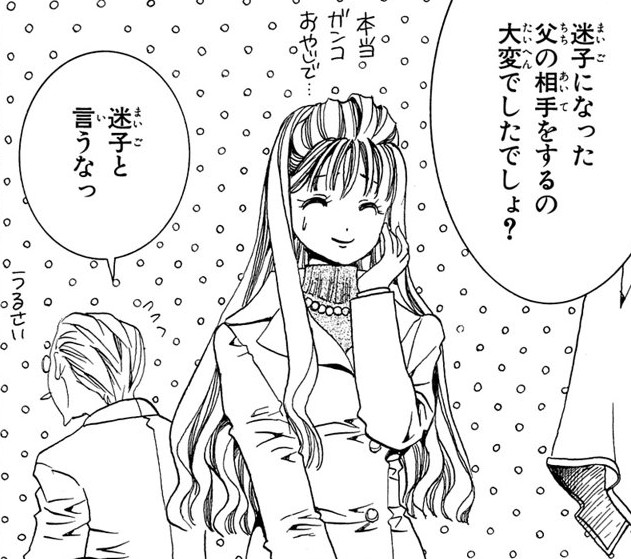
Akari encounters an older gentleman looking for a police box, so he can report his missing daughter and son-in-law. Akari offers to take him around and see if they can find the couple. Once they are reunited, the daughter thanks Akari for finding her father.
娘( むすめ ) :「迷子( まいご ) 父( ちち ) の相手( あいて ) をするの大変( たいへん ) でしたでしょ?」
“It must have been tough dealing with my dad when he got lost, right?”
「本当( ほんとう ) ガンコおやじで…」
“He really is a stubborn old man...”
父( とう ) さん:「迷子( まいご ) 言( い ) うなっ」
“Don't say lost!”
「うるさい」
“Annoying...”
View Full Example