Choosing and selection with 選
The kanji 選 means to choose or select, picking out from among alternatives.
- Grade 4
- JLPT N3 (estimate)
- WaniKani level 13
- 15 strokes
Words with 選
- Competitive Selection
- Public Selection
- Lotteries and Draws
The bold kana are the part 選 contributes.
How to Read 選
The same holds for compounds off this page. With kana attached, 選 is えら. 選ぶ is to choose, and 選ばれる is to be chosen.
At the end of a word 〜選 is a round of a contest or a result in one, as in 予選 and 当選.
Etymology
This kanji is the simplified form of 檢, a phono-semantic compound comprised of 辵 (movement) as the semantic component and 巽 as the phonetic component (セン).
Etymology Research
Xu Shen’s Shuowen Jiezi, finished around 100 CE, defines 選 as 遣也, “to dispatch, to send away,” and analyzes it as 從辵、巽, from 辵 and 巽, with 巽 supplying the sound. The same entry adds a second gloss immediately: 一曰選,擇也, “one account says 選 means to choose.” The Chinese University of Hong Kong’s database quotes the entry in full, including the 思沇切 pronunciation, and files the character as a heteronym, 破音字. CUHK, 選
That second clause is the most useful thing in the entry. Because Xu Shen recorded it, “to choose” was already an attested sense of the character in the Eastern Han, not something that grew up later in Japanese. Any account that presents the dispatching sense as the whole original meaning and the choosing sense as a derivative has to account for the dictionary putting both in one place.
CUHK’s entry shows no oracle-bone examples for 選. It does catalog bronze forms, small-seal forms, and excavated manuscript forms, and it reads the bronze graph as 止 plus 巽 rather than 辵 plus 巽. 止 is a foot, so the meaning element is a foot in motion, and 辵 is the later standardized form of that idea. Taking Xu Shen’s 遣也 gloss at face value, CUHK marks the reconstruction with 疑, doubtful, and proposes an original sense of respectfully sending someone off, which is what dispatching a subordinate would mean. CUHK, 選
How the 巽 component looked is where the accounts part company, and it is not a cosmetic disagreement. CUHK’s entry for 巽 follows Chen Bingxin in reading the bronze graph as two 卩, kneeling figures, and takes 順服, “submission,” as the original sense. The entry cites 易・雜卦傳 「巽,伏也」 and 廣雅・釋詁 「巽,順也」 in support, and reports that the bronze graph is also used as a name for a music pipe. CUHK, 巽
Heibonsha’s Jitsū reads the same component the other way. It takes 巽 to be a stage in front of a god where two people dance side by side and are offered up, glosses it from Shuowen 2b as 饗, and derives the senses すぐれる and えらぶ from へば則ちととのふ in 詩経 齊風 猗嗟. The same source also reports, accurately and awkwardly, that Shuowen’s headword for 巽 is 具也, “to have, to provide,” with Xu Xuan’s note that all things are provided and 丌 is the stand they are presented on. It gives 選 the readings 字音 セン and 字訓 そろう, えらぶ, and for the 中古音 it points to Shuowen 巽, which is 蘇困切. Heibonsha, Jitsū, 選, via Kotobank
So three accounts of 巽 are on the table, submission, ritual offering, and simple provision, and the two standard Japanese dictionaries do not agree about which one the outline shows. What they agree on is the mechanical analysis. Both call 選 a phono-semantic compound with 巽 as the sound element, and neither claims a settled chronology.
The step from dispatching to choosing is short, and CUHK presents it as a proposal rather than a documented sequence. Its argument is that 遣送, sending away, and 捨棄, discarding, belong to the same field, and that choosing is exactly 取捨, taking some and leaving the rest. That is a semantic bridge, not a dated chain, and CUHK is explicit that the original sense is uncertain. CUHK, 選
Attested uses in classical Chinese fit both halves of the word’s range. 春秋左伝 襄公九年 is cited for the sense of choosing. 戰國策 齊策一 has 「其良士選卒亦殪」 and 呂氏春秋 愛類 has 「非必堅甲利兵,選卒練士也」, where 選卒 is a conscripted elite, and 淮南子 兵略訓 is cited for 選挙 meaning picking out and recommending talent. Shogakukan, 精選版 日本国語大辞典, 選, via Kotobank, CUHK, 選
Bronze and Han documents also show 選 standing in for other characters, which is worth knowing before reading any early graph as evidence of meaning. The 九年衛鼎 inscription uses 選 for 䍻, a lambskin, in the phrase 「羝皮二、選(䍻)皮二」. The Mawangdui 養生方 uses it for 蠃, a snail, in a medicinal recipe. The 銀雀山漢簡 have 選卒 where other texts write 算卒, and CUHK ties that to 論語・子路 「何足算也」 against 鹽鐵論 「何足選哉」. In the other direction, Qin slips and Han silk manuscripts read 巽 for 選, as in 睡虎地秦簡・老子甲本巻後古佚書 「材巽海内之衆」. CUHK, 選, CUHK, 巽
The pronunciation history is stable. 說文 gives 思沇切, a 心 initial, voiceless, in the departing tone of the 山韻仙 rhyme at the third division, and 廣韻 adds 息眷切 with a 去 tone in the same rhyme. Modern Mandarin has xuǎn, and the Japanese on-reading セン comes from the same 系 rhyme group via 呉音. CUHK, 選
撰 is a sibling of 選 rather than a variant of it in the modern system, though classical usage blurs them badly. 精選版 日本国語大辞典 heads its entry 選・撰, and Japanese Wiktionary lists 撰, 銓, and 籤 as substitute characters with 撰択, 撰集, 銓衡, 抽籤, and 当籤 as the resulting words. All three sit outside the 常用漢字 list, which is the practical reason 選 is the form to learn. The 新撰組 business is the same issue in public: the group’s own seal used 選, surviving letters carry both spellings, and れいわ新撰組 is wrong because the party name is registered as れいわ新選組. Shogakukan, 精選版 日本国語大辞典, 選, via Kotobank, Kanjikai Kanken Kyokai, 漢字カフェ
Japanese usage has its own history, and most of it predates the political sense. 選ぶ is cited from a 729 imperial edict in 続日本紀 as 択比, えらひ, in the form 「己が夜気(やけ)授くる人をば一日二日と択比」, and the native noun えり appears in 増鏡, completed around 1368 to 1376, in 「後白川の法皇の御孫えりの時」. The ritsuryō state used the word for appointments rather than votes. 令義解 (718) 選叙 sets out the criteria as 徳行 first, then 才用, then 労効, and 続日本紀 和銅四年 (711) uses 予選 for fixing a quota of people, which is a very different thing from a qualifying round. 選挙 came into Japanese already carrying the talent-recruitment sense, first attested in 菅家文草, written around 900, in 「教授我無レ失、選挙我有レ平」. It only picked up the modern sense of electing a group’s officers later, and the earliest example 精選版 日本国語大辞典 offers is 津田真道’s 泰西国法論 of 1868, not any Japanese source. Shogakukan, Digital Daijisen, 選ぶ, via Kotobank, Shogakukan, 精選版 日本国語大辞典, 選挙, via Kotobank, Shogakukan, Digital Daijisen, 予選, via Kotobank
The sources do not settle which bronze graph is earliest, whether 辵 or 止 is the element to point at, how the dispatching sense relates in date to the choosing sense, or which reading of 巽 the outline actually shows. They also cannot tell us where the native Japanese word えらぶ came from, and this history says nothing about the origin of the word. The movement-and-dispatch picture is a serviceable memory aid, but it is one reading among several and should be labeled that way.
Competitive Selection
選手 (せんしゅ) (Athlete)
選手 is a person who competes in a sport, especially as a member of a team or a squad.
It combines 選 (selected) with 手 (person / performer) to show a person selected for performance.
Example 1 of 2: A future soccer player with 選手
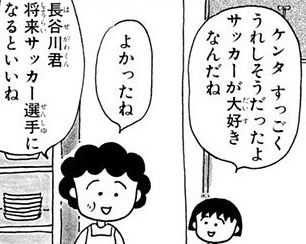
Maruko’s classmate Kenta Hasegawa loves soccer. Today at school he signed up for the soccer club, and Fujiki and Hamaji joined along with him. Back home, Maruko tells her mother the news.
- まる子:
- 「ケンタ すっごくうれしそうだったよ サッカーが大好きなんだね」
- “Kenta looked super happy. He really loves soccer, doesn't he?”
- お母さん:
- 「よかったね」
- “Good for him.”
- 「長谷川君 将来サッカー選手になるといいね」
- “I hope Hasegawa grows up to be a soccer player.”
Example 2 of 2: Player Nishikata one step from victory with 選手
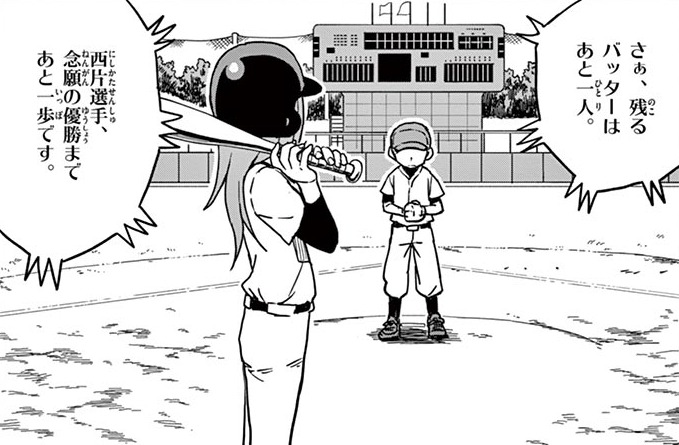
Nishikata has been reading a baseball manga whose hero throws a magic pitch. Alone in the classroom, he acted out the pitch with a ping-pong ball, and Takagi saw him. She promised to keep quiet if he can strike her out, so he faces her with a ball while she holds a broom as a bat. To focus, he pictures himself pitching in a big game.
- アナウンサー:
- 「さぁ、残るバッターはあと一人。」
- “All right, just one batter left.”
- 「西片選手、念願の優勝まであと一歩です。」
- “Nishikata is one step away from the championship he's dreamed of.”
選抜 (せんばつ) (Selection)
選抜 is picking the best few out of many, as for a team or a special class. A 選抜チーム is a select team.
It combines 選 (choose) with 抜 (pull out) to show drawing out the chosen ones.
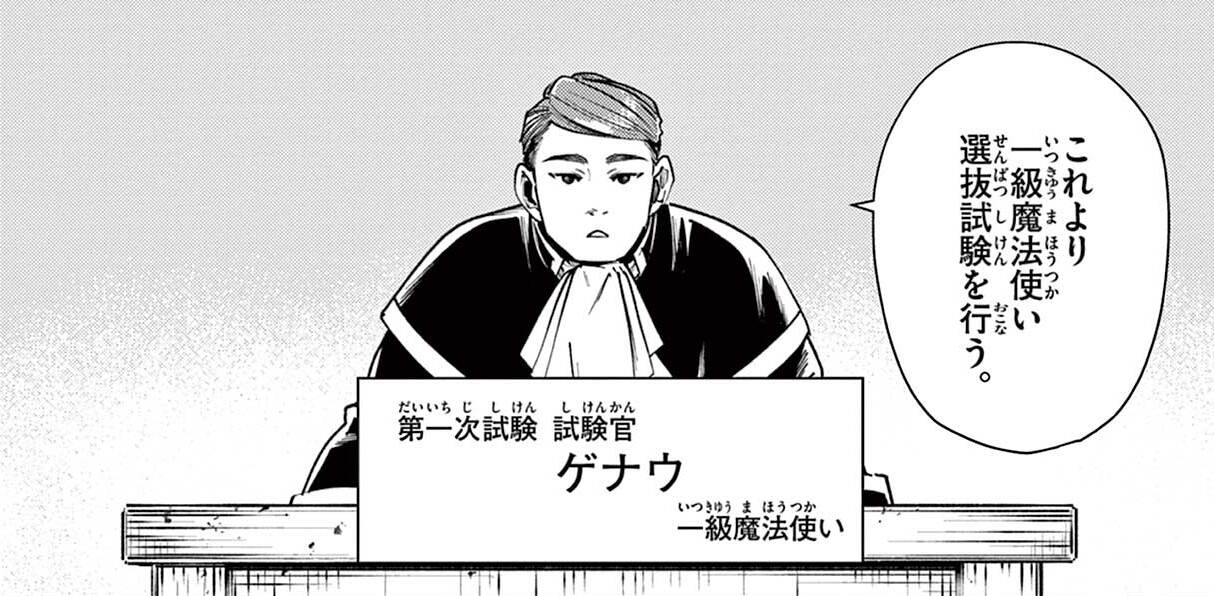
Frieren’s party needs a first-class mage to travel farther north, so Frieren and Fern come to Äußerst to take the first-class mage exam. It’s held only once every three years, many years nobody passes, and examinees sometimes die. After two months of training, the candidates gather in the hall of the Continental Magic Association.
- ゲナウ:
- 「これより一級魔法使い選抜試験を行う。」
- “We will now hold the first-class mage selection exam.”
厳選 (げんせん) (Careful selection)
厳選 is picking only the best after strict sorting. Shops and menus use it of ingredients, as in 厳選素材.
It combines 厳 (strict) with 選 (choose) to show choosing with strict standards.
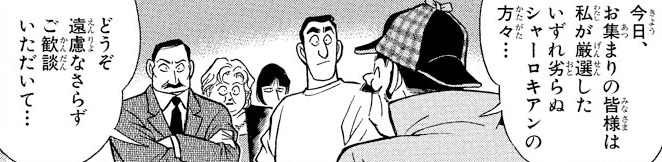
Kogoro, Ran, and Conan have come on a tour for Sherlock Holmes fans that Conan entered without asking. On the drive, the other guests traded talk about their favorite Holmes stories. Now the group has reached Pension Mycroft, where the owner, Kanaya, introduces himself as the man who planned the tour.
- 金谷:
- 「今日、お集まりの皆様は私が厳選したいずれ劣らぬシャーロキアンの方々…」
- “Everyone gathered here today is a Sherlockian I hand-picked, each one as devoted as the next...”
- 「どうぞ遠慮なさらずご歓談いただいて…」
- “Please don't be shy. Enjoy each other's company...”
選手権 (せんしゅけん) (Championship)
選手権 is a championship, a contest held to decide the best player or team. It also refers to the title the winner holds.
It combines 選手 (athlete) with 権 (right / title) to show the title of champion among competitors.
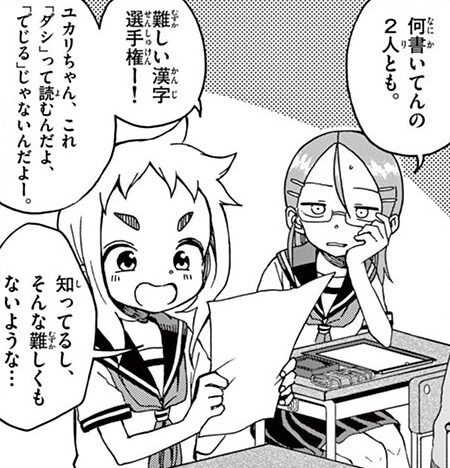
In calligraphy class, the teacher tells everyone to write a word they like and hand it in by the end of class. Yukari settles on something plain. Then Mina shouts that she’s done, and she and Sanae hold up their sheets. Mina’s reads 出汁 and Sanae’s reads 韋駄天.
- ユカリ:
- 「何書いてんの2人とも。」
- “What are you two writing?”
- ミナ:
- 「難しい漢字選手権ー!」
- “The hard kanji championship!”
- 「ユカリちゃん、これ「ダシ」って読むんだよ、「でじる」じゃないんだよー。」
- “Yukari, this is read "dashi", not "dejiru"!”
- ユカリ:
- 「知ってるし、そんな難しくもないような…」
- “I know that, and it's not even that hard...”
予選 (よせん) (Preliminary round)
予選 is the early round of a contest that decides who goes on to the main event.
It combines 予 (beforehand) with 選 (select) to show selection done in advance.
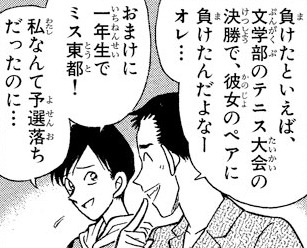
Kogoro, Ran, Sonoko, and Conan are guests at a villa where a university mystery club is celebrating member Asami’s birthday. The club’s vice president adds that the party also honors Asami’s novel, which just won a newcomer award. Morimoto, whose own story reached the final round of judging, says he can’t complain about losing to the club’s rising star.
- 野口:
- 「負けたといえば、文学部のテニス大会の決勝で、彼女のペアに負けたんだよなーオレ…」
- “Speaking of losing, I lost to her doubles team in the final of the literature department's tennis tournament...”
- 宮崎:
- 「おまけに一年生でミス東都!私なんて予選落ちだったのに…」
- “On top of that, she was Miss Toto as a freshman! I didn't even make it past the preliminaries...”
選考 (せんこう) (Selection)
選考 is going over candidates or entries and deciding who passes, as for a prize, a job, or a team.
It combines 選 (choose) with 考 (consider) to show choosing through deliberation.
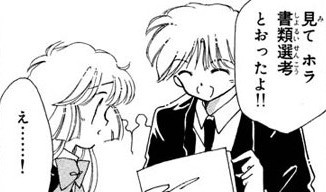
Some time ago, Sawatari photographed Meimi and sent the picture in to a cosmetics company that was looking for an image girl to promote its new shampoo. Now he runs up to her at school, calling out that he has big news about the contest.
- 佐渡:
- 「見て ホラ 書類選考とおったよ!!」
- “Look, see? You got through the paper screening!”
- 芽美:
- 「え……!」
- “Huh...!”
Decisions
選ぶ (えらぶ) (To choose)
選ぶ is to pick one from several options.
Example 1 of 2: Choosing a menu item with 〜ておく
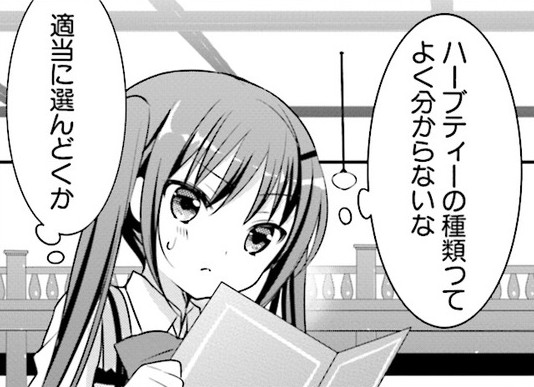
After a misunderstanding brings Rize and her friends to the teahouse where Syaro works, the group stays to have some tea.
- リゼ:
- 「ハーブティーの種類ってよく分からないな」
- “I don't really know the different kinds of herbal tea.”
- 「適当に選んどくか」
- “I'll just pick something for now?”
Example 2 of 2: Worth selecting a costume with 〜がいある
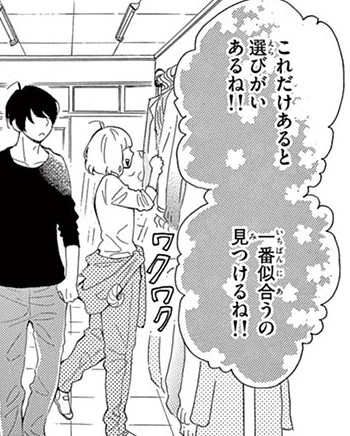
As a member of the student council, Hitsuji comes up with the idea of having a cosplay theme to help build up excitement among students for the school’s sports day. However, Fujiwara, the student council president, fails to dress up. Upon hearing him say he doesn’t have a costume prepared, one of the drama club students suggests he pick from their club’s costumes. While Fujiwara isn’t enthusiastic at the prospect of dressing up, Hitsuji is excited by the club’s wide selection.
- ヒツジ:
- 「これだけあると選びがいあるね!!一番似合うの見つけるね!」
- “When there are this many, it's worth it to choose from! I'll find the one that suits you best!”
選択 (せんたく) (Selection)
選択 is picking one out of several, or the pick made. A 選択肢 is an option, and 選択科目 is an elective class.
It combines 選 (choose) with 択 (select) to show deliberate choosing.
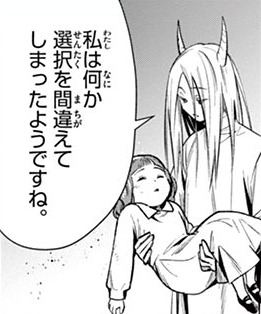
Years ago, Himmel spared a demon child who had eaten a villager’s daughter, and the village chief took the demon in. Now the demon has killed the chief. She tells the grieving mother that she sensed her murderous intent every day and wants to live in peace, so she has brought a replacement for the daughter she ate. The girl in her arms is the chief’s own daughter.
- 魔族:
- 「私は何か選択を間違えてしまったようですね。」
- “It seems I've made the wrong choice somewhere.”
選別 (せんべつ) (Sorting)
選別 is sorting things into groups by kind or quality, or screening out the ones you want.
It combines 選 (choose) with 別 (separate) to show separating things by choosing among them.
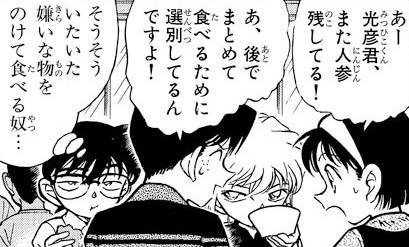
Conan sulks that he’s a high schooler stuck eating elementary school lunch. Haibara says she enjoys it, since at her school in America she ate alone in a self-service cafeteria. Conan admits that school lunch felt nostalgic to him at first.
- 歩美:
- 「あー光彦君、また人参残してる!」
- “Ah, Mitsuhiko, you're leaving your carrots again!”
- 光彦:
- 「あ、後でまとめて食べるために選別してるんですよ!」
- “Oh, I'm just sorting them out so I can eat them all at once later!”
- コナン:
- 「そうそう いたいた 嫌いな物をのけて食べる奴…」
- “Oh yeah, there was always one. The kid who pushes the food he hates aside and eats around it...”
選択肢 (せんたくし) (Option)
選択肢 means an option or possible choice. It refers to one branch among a set of alternatives.
It combines 選択 (selection) with 肢 (branch / limb) to show a branching choice.
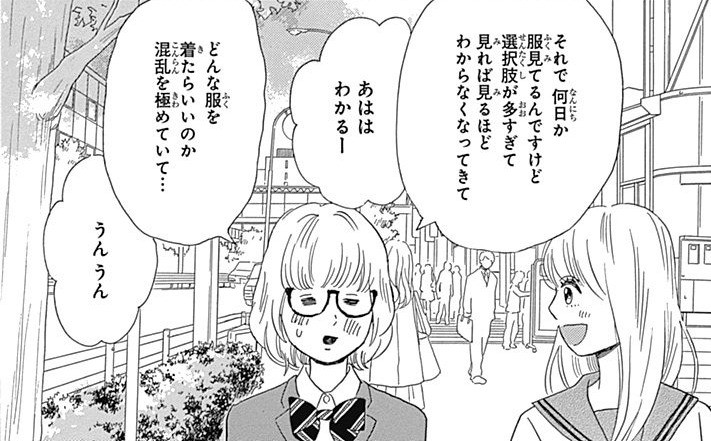
Yukika has invited Sunakawa to go out with her, and he has agreed. She texted Yamato that she was in town shopping for clothes but couldn’t decide, and Yamato came to meet her. Yamato tells her it makes sense to put in the effort when she’s going out with the person she likes.
- ゆきか:
- 「それで何日か服見てるんですけど選択肢が多すぎて見れば見るほどわからなくなってきて」
- “So I've been looking at clothes for a few days, but there are too many options. The more I look, the less sure I am.”
- 大和:
- 「あはは わかるー」
- “Ha ha, I know the feeling.”
- ゆきか:
- 「どんな服を着たらいいのか混乱を極めていて…」
- “I'm completely lost on what I should wear...”
- 大和:
- 「うんうん」
- “Uh-huh.”
Public Selection
選挙 (せんきょ) (Election)
選挙 is a vote to fill an office, from the national Diet down to a school’s student council.
It combines 選 (choose) with 挙 (raise / put forward) to show choosing someone to put forward.
Example 1 of 2: Trading a vote for help with 選挙
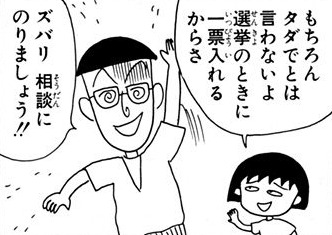
A rumor that Maruko and Hamaji are a couple has spread through the class, and their classmates won’t stop teasing them. They have even passed around a mock newspaper about it. Maruko asks Maruo, the class representative, to save her from the rumor, and he is delighted that she came to him for a favor.
- まる子:
- 「もちろん タダでとは言わないよ 選挙のときに一票入れるからさ」
- “Of course, I'm not asking you to do it for free. I'll give you my vote at election time.”
- 丸尾くん:
- 「ズバリ 相談にのりましょう!!」
- “Precisely! I shall take up your case!!”
Example 2 of 2: Election season on a quiet island with 選挙
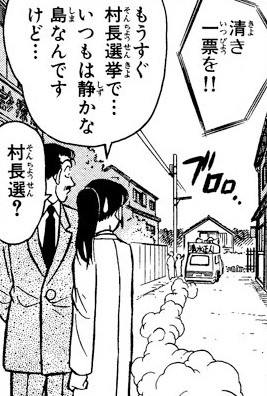
Kogoro, Ran, and Conan have come to Tsukikage Island because of a letter signed by Keiji Aso, a pianist who died twelve years ago. On their way to ask the village mayor about him, Ran stops Narumi, a doctor at the island clinic, for directions. Narumi, who is also from Tokyo, praises the island’s clean air and how quiet it is. Just then a campaign van rolls past, blaring a candidate’s name.
- 選挙カー:
- 「清き一票を!!」
- “...your precious vote!!”
- 成実:
- 「もうすぐ村長選挙で…いつもは静かな島なんですけど…」
- “The election for village mayor is coming up... It's usually a quiet island, though...”
- 小五郎:
- 「村長選?」
- “A mayoral race?”
当選 (とうせん) (Election victory)
当選 is winning an election, or being picked as a winner in a lottery or prize drawing.
It combines 当 (hit / correspond) with 選 (selection) to show being the one selected.
Example 1 of 3: Reelected class representative with 当選
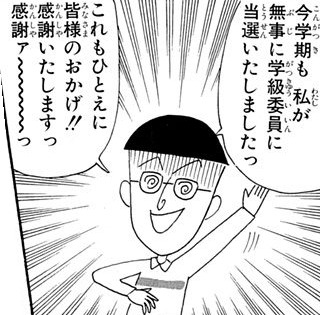
The second term has just begun at Maruko’s school, and her class has held its vote for class representative. Maruo held the post last term and loves the job.
- 丸尾くん:
- 「今学期も 私が 無事に学級委員に 当選いたしましたっ」
- “This term, too, I have been duly elected class representative!”
- 「これもひとえに 皆様のおかげ!! 感謝いたしますっ 感謝ァ〜〜〜っ」
- “I owe it all to you, everyone!! I thank you! Thaaank youuu!”
Example 2 of 3: The winning lottery numbers with 当選番号
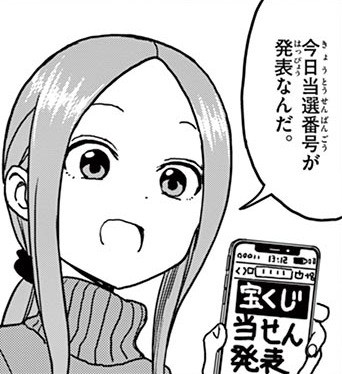
Chi is holding a fan of lottery tickets. When Nishikata asks what they are, Takagi tells him she got them from a raffle.
- 高木:
- 「今日当選番号が発表なんだ。」
- “They announce the winning numbers today.”
Example 3 of 3: Unluckily winning a tour with 当選
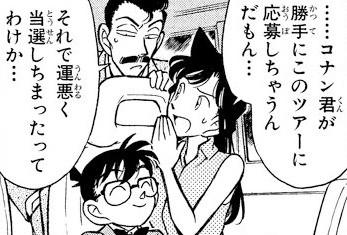
Kogoro, Ran, and Conan are riding to a pension with a group of Sherlock Holmes fans on a tour for Holmes enthusiasts. Kogoro, who has no interest in Holmes, grumbles that he can’t see why he has to take part. Ran starts to explain, but Conan cuts in to tell the other fans that his favorite story is “The Sign of the Four”.
- 蘭:
- 「…コナン君が勝手にこのツアーに応募しちゃうんだもん…」
- “...Conan went and entered us in this tour without asking...”
- 小五郎:
- 「それで運悪く当選しちまったってわけか…」
- “And then we had the bad luck to win, huh...”
落選 (らくせん) (Rejection)
落選 is failing to be chosen, as when an entry is turned down in a contest or a candidate loses an election.
It combines 落 (fall) with 選 (selection) to show falling out of a selection.
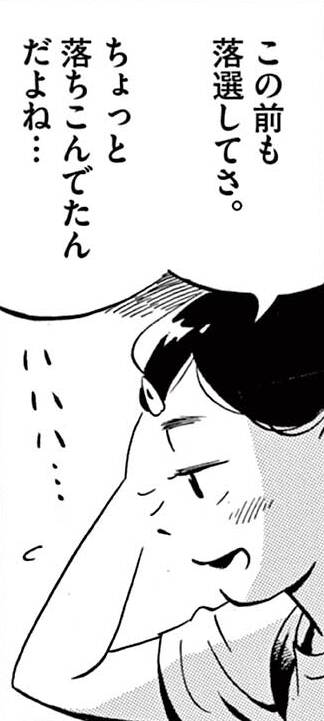
Natsumi walks home at night with Akari, her coworker at the restaurant. When Natsumi mentions that she’s aiming to become a manga artist, Akari says she loves manga and asks to see her work. Natsumi insists it isn’t good enough to show anyone yet.
- なつみ:
- 「この前も落選してさ。」
- “I got rejected again the other day.”
- 「ちょっと落ちこんでたんだよね…」
- “I've been kind of down about it...”
選 (せん) (Election; selection)
選 is a selection or an election. After a noun it often stands for a whole election or contest, as in 村長選, a village mayor’s race.
Kogoro, Ran, and Conan have come to Tsukikage Island because of a letter signed by Keiji Aso, a pianist who died twelve years ago. On their way to ask the village mayor about him, Ran stops Narumi, a doctor at the island clinic, for directions. Narumi, who is also from Tokyo, praises the island’s clean air and how quiet it is. Just then a campaign van rolls past, blaring a candidate’s name.
- 選挙カー:
- 「清き一票を!!」
- “...your precious vote!!”
- 成実:
- 「もうすぐ村長選挙で…いつもは静かな島なんですけど…」
- “The election for village mayor is coming up... It's usually a quiet island, though...”
- 小五郎:
- 「村長選?」
- “A mayoral race?”
Lotteries and Draws
抽選 (ちゅうせん) (Lottery)
抽選 means a lottery, raffle, or drawing of lots. It refers to selection by pulling out a winning lot or ticket.
It combines 抽 (draw out) with 選 (choose) to show choosing by drawing.
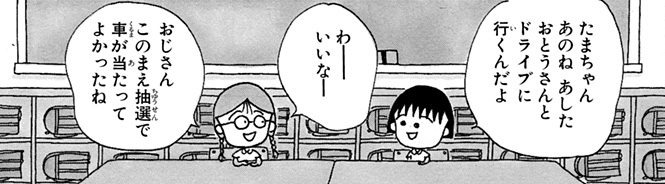
Maruko and Tama-chan talk at school.
- まる子:
- 「たまちゃん あのね あした おとうさんと ドライブに行くんだよ」
- “Tama-chan, guess what? Tomorrow I'm going for a drive with my dad!”
- たまちゃん:
- 「わー いいなー」
- “Wow, lucky you!”
- 「おじさん このまえ抽選で車が当たって よかったね」
- “Your dad was so lucky to win a car in that prize draw the other day.”
Building Bigger Words
These patterns come up again and again in manga. Learn the pattern and you can read words you've never seen.
〜選手 せんしゅ (a player of a sport)
- 野球選手 やきゅうせんしゅ baseball player
- サッカー選手 サッカーせんしゅ soccer player
- スポーツ選手 スポーツせんしゅ athlete
- 選手権 せんしゅけん championship
〜選 せん (a round or result of a contest)
- 予選 よせん qualifying round
- 本選 ほんせん main round
- 抽選 ちゅうせん prize draw
- 落選 らくせん failing to be chosen
選〜 せん (picking out)
- 選考 せんこう screening of candidates
- 選出 せんしゅつ electing, picking
- 選別 せんべつ sorting
- 選曲 せんきょく choice of songs
選〜 えら (forms of 選ぶ)
- 選び方 えらびかた how to choose
- 選ばれし者 えらばれしもの the chosen one
Where 選 Breaks the Pattern
The meaning above carries you through most words. These are the ones where it won't, or where the reading is a surprise.
- 選択肢 (せんたくし) options
The choices on offer, on a test or in a dilemma. 選択肢がない is having no other option.
- 手段を選ばない (しゅだんをえらばない) to stop at nothing
A set phrase. Someone who doesn’t choose their means will do anything to win.
- 人選 (じんせん) choice of people
Who gets picked for a job. 人選ミス is choosing the wrong person.
- 選りすぐり (よりすぐり) the pick of the bunch
A rare kun reading. It is also read えりすぐり.
Check Yourself
What does 選 mean?
Choosing and selection.
Read These Without Furigana
選手
選抜
厳選
選手権
予選
選ぶ
Work Out a New Word
You met 選択 above. 肢 is a limb or branch. Read 選択肢 and say what the speaker suggests.
「ていうか、もう逃げるって選択肢でいいんじゃないかなぁ?」
Show the answer
選択肢, an option. “I mean, isn’t running away a perfectly good option at this point?”
抽 is to draw out. Read 抽選 and say how the uncle got his car.
「おじさんこのまえ抽選で車が当たってよかったね」
Show the answer
抽選, a prize draw. “Uncle, it was great that you won a car in that draw the other day.”