服 means clothing as a standalone noun, read ふく. Its other senses include obeying or accepting, performing duties, observing mourning, and taking medicine.
Etymology
This kanji isa phono-semantic compound comprised of 舟 (boat) as the semantic component and 𠬝 as the phonetic component (フク).
Etymology Research
The Chinese University of Hong Kong’s Multi-function Chinese Character Database treats 服 as a later phonosemantic development of 𠬝, an earlier graph associated with subduing and submission, with 凡 subsequently added. It describes some bronze forms as changing 凡 into a 舟-like shape. Qin and Han manuscript forms and the small-seal form retain 舟; the modern classification under 月 reflects a later graphic change. This history gives no reason to interpret today’s left side as the moon or flesh. CUHK, 服
Early uses and proposed origins need separate treatment. CUHK reports 服 as a place name in oracle-bone inscriptions and as an office or duty in bronze inscriptions. Its example from the 班簋 concerns a royal appointment to succeed another person’s office. These attestations do not by themselves prove a clothing or side-boat origin. CUHK also records Lin Jieming’s alternative account of a person presenting a tray in service, with serving as the original meaning. CUHK, 服
Shirakawa Shizuka’s Jitsu instead analyzes the left component as 舟 representing a ritual basin, an early form of 盤, and the right component as phonetic. It proposes a submission or service ritual before the basin and relates this to assigned duties and status. This is a named interpretation, not an agreed reconstruction. It differs from both the side-boat account already on this page and CUHK’s analysis involving added 凡. The accounts agree that the modern 月 shape is inadequate for explaining the character’s origin. Heibonsha, Jitsu, 服
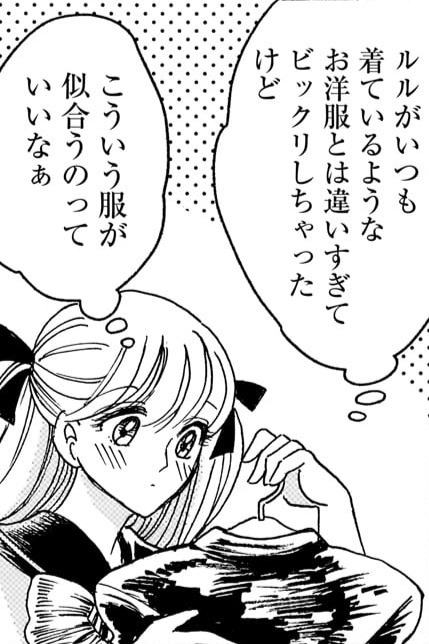
Lulu goes clothes shopping with her friends from class. The outfits at the clothing shop are glaring, but Kyouko tries one on and Lulu finds the very suited to her.
ルル:
「ルルがいつも着ているようなお洋服とは違いすぎてビックリしちゃったけど」
“They were so different from the clothes I usually wear that I was surprised, but...”
「こういう服が似合うのっていいなぁ」
“It must be nice to look good in clothes like these.”
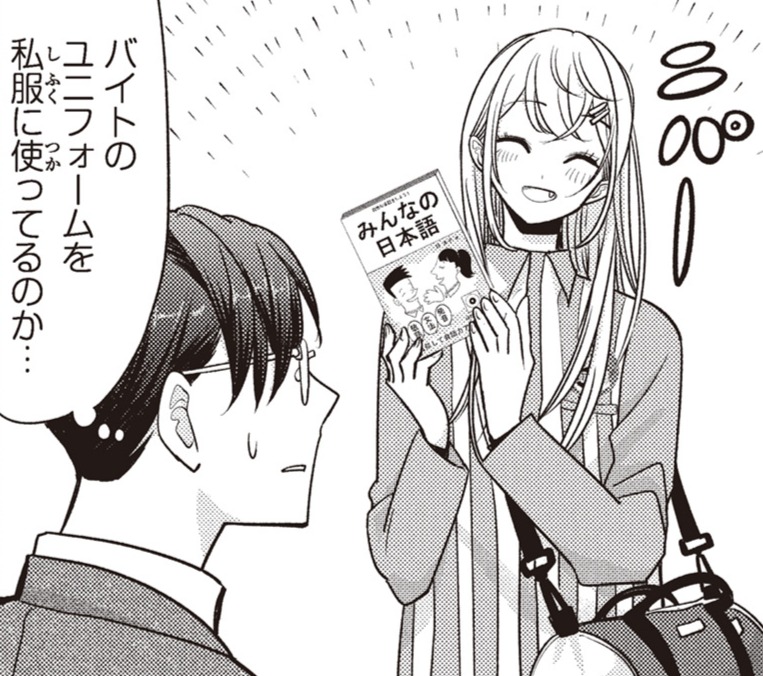
Kumada stops by the library to read up on bears, in hope of finding a solution to the bear living in his apartment. As he skims through some books, the foreigner who works at the local convenience store notices him.
熊田:
「バイトのユニフォームを私服に使ってるのか…」
“She's using her part-time job uniform as her regular clothes, huh…”
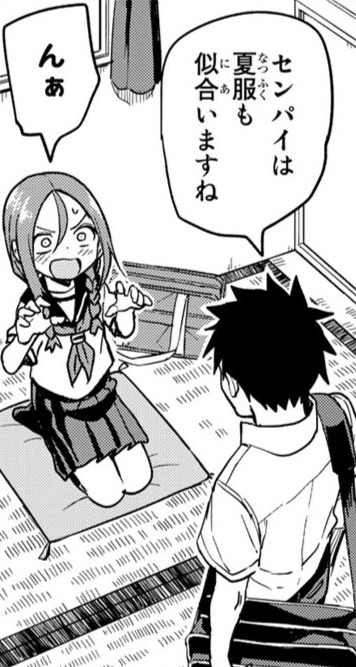
Ayumu goes to the shogi club room after school. There, he and Urushi find they’ve both switched from their winter uniform to their summer uniform on the same day.