Continuation and connection with 続
続 primarily conveys the meanings of continuing without interruption , to continue , and to connect .
Etymology
This kanji is a phono-semantic compound . The old form 續 is comprised of 糸 (thread) as the semantic component and 𧶠 as the phonetic component (ゾク), later simplified into the modern education form 続.
Ongoing Continuation
存続 (Survival)存続( そんぞく ) means continued existence, especially when an organization or institution remains in operation.
It combines 存 (exist ) with 続 (continue ) to show existing on into the future .
名探偵コナン »
Volume 4 » Page 52
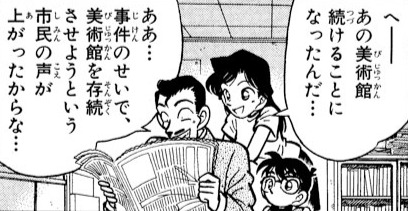
Following the solving of a murder case, Detective Mouri reads an article about the museum where the murder took place.
蘭( らん ) :「へーーー あの美術館( びじゅつかん ) 続( つづ ) けることになったんだ…」
“Wow... So they decided to keep the art museum open after all...”
毛利( もうり ) :「ああ… 事件( じけん ) のせいで美術館( びじゅつかん ) を存続( そんぞく ) 市民( しみん ) の声( こえ ) が上( あ ) がったからな…」
“Yeah... Because of the incident, there was a public outcry to keep the art museum open...”
Challenge Yourself
Show translation
Challenge
Why was the museum kept open?
Clues
事件( じけん ) のせいでbecause of the incident
美術館( びじゅつかん ) を存続( そんぞく ) させようという市民( しみん ) の声( こえ ) が上( あ ) がったcitizens called for the museum to remain in operation
What does the speaker mean?
The incident prompted citizens to demand its preservation.
The public voices calling for 存続( そんぞく ) arose because of the incident.
The owner finished repairing it after the incident.
The line credits public pressure, not completed repairs.
The city had already planned to expand it.
The decision followed citizens speaking up to keep it from closing.
The murder case was proven to be fictional.
The real incident drew attention and created support for the museum.
Visitors stopped discussing the museum entirely.
Citizens actively raised their voices in favor of continued operation.
Ran personally bought the museum.
Ran observes the outcome. She is not identified as its purchaser.
The incident caused citizens to call for the museum to keep operating, and that public response led to the decision not to close it.
View Full Example
続行 (Continuation)続行( ぞっこう ) means continuing or resuming something already under way.
It combines 続 (continue ) with 行 (carry out ) to show continuing to carry something forward .
怪盗セイント・テール »
Volume 1 » Page 8
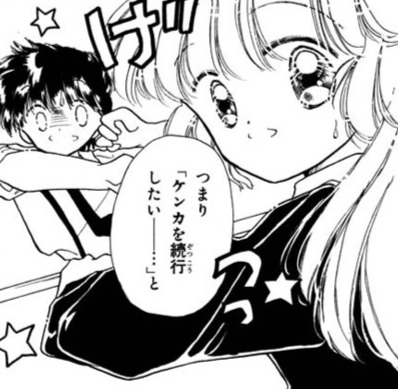
Meimi can’t stand Asuka Jr. speaking ill of her secret alter ego, Saint Tail, and the two get into a fight over it before class. Seira tugs at Meimi’s shirt, but Meimi says, “Don’t stop me, Seira.” The teacher’s voice repeats back, “‘Don’t stop me’…”
シスター:
「つまり『ケンカを続行( ぞっこう )
“In other words, 'I want to keep on fighting...'”
Challenge Yourself
Show translation
Challenge
How does the Sister interpret Meimi's demand not to be stopped?
Clues
つまり
the Sister is restating the implication of Meimi's words
ケンカを続行( ぞっこう ) したい
Meimi wants to continue the fight
What does the speaker mean?
Meimi wants to keep the fight going.
ケンカを続行したい directly paraphrases her demand as wanting to continue the quarrel.
Meimi wants Seira to join the fight.
The Sister interprets Meimi's words as a wish to continue, not a request for another participant.
Meimi is asking to continue the discussion after class.
The object of 続行したい is ケンカ, the fight, rather than a later discussion.
Meimi wants Asuka Jr. to stop insulting Seira.
The paraphrase focuses on Meimi continuing her fight with Asuka Jr.; it does not concern an insult toward Seira.
Meimi has decided to apologize for fighting.
続行したい expresses a desire to carry on, which is the opposite of ending the dispute with an apology.
Meimi does not realize that the teacher is present.
The teacher's arrival makes the scene awkward, but her paraphrase addresses what Meimi's words mean.
The Sister uses つまり to spell out the implication of Meimi’s demand. By paraphrasing it as ケンカを続行したい, she treats “don’t stop me” as a declaration that Meimi wants to keep fighting.
View Full Example
Sequences and Repetition
連続 (Continuation)連続( れんぞく ) means a sequence or continuation without interruption.
It combines 連 (link ) with 続 (continue ) to show things linked in unbroken sequence .
Example 1 of 2: In the same class since preschool with 連続 Example 1 of 2
俺物語!! »
Volume 8 » Page 6
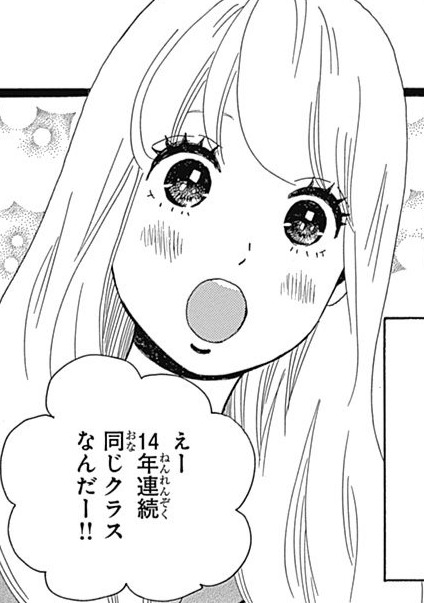
With the new school year, Takeo and Sunakawa are in the same class again. Takeo tells his girlfriend, Yamato, about it.
大和( やまと ) :「えー 14年( ねん ) 連続( れんぞく ) 同( おな ) じクラスなんだー!!」
“Wow, you've been in the same class together for 14 years in a row!!”
Challenge Yourself
Show translation
Challenge
What surprises Yamato about Takeo and Sunakawa?
Clues
14年( ねん ) 連続( れんぞく ) 同( おな ) じクラス
the same class for fourteen consecutive years
What does the speaker mean?
They have been classmates for fourteen years in a row.
14年( ねん ) 連続( れんぞく ) gives the uninterrupted span, and 同( おな ) じクラス names what kept repeating.
They have attended fourteen different schools together.
The repeated item is the same class, not a change of schools.
They will be separated after fourteen years.
Yamato reacts to them being together again. The line does not predict separation.
They are in class number fourteen this year.
年( ねん ) makes fourteen a count of years, not a classroom number.
They have known each other for fourteen months.
The counter is 年( ねん ) , years, not months.
They have repeated the same school year fourteen times.
連続( れんぞく ) describes sharing a class each year, not failing and repeating a grade.
Yamato is amazed that Takeo and Sunakawa have landed in the same class for fourteen consecutive years. 連続( れんぞく ) marks the unbroken repetition.
View Full Example
Example 2 of 2: Singing one song after another with 連続 Example 2 of 2
一週間フレンズ。 »
Volume 6 » Page 5
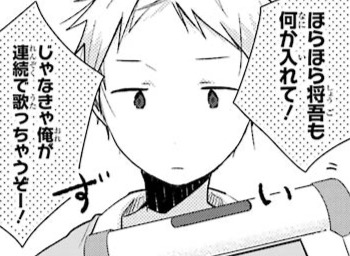
To distract himself from things going on with Fujimiya, Hase goes to karaoke, bringing Shougo with him.
長谷( はせ ) :「ほらほら翔吾( しょうご ) も何( なに ) か入( い ) れて!」
“Come on, come on, Shougo! Put something in, too!”
「じゃなきゃ俺( おれ ) が連続( れんぞく ) 歌( うた ) っちゃうぞー!」
“Otherwise, I'll just keep singing one after another!”
Challenge Yourself
Show translation
Challenge
What will Hase do if Shougo does not choose a song?
Clues
じゃなきゃ
if not, a casual shortening of じゃなければ
俺( おれ ) が連続( れんぞく ) で歌( うた ) っちゃうぞーI will end up singing continuously, delivered as a teasing warning
What does the speaker mean?
He will keep choosing and singing songs himself.
俺( おれ ) が makes Hase the singer, and 連続( れんぞく ) で says he will sing songs without a break.
He will stop the karaoke session immediately.
歌( うた ) っちゃう predicts that Hase will sing, not that he will end the session.
He will choose a song and make Shougo sing it.
俺( おれ ) が identifies Hase as the person who will sing.
He will wait silently until Shougo makes a choice.
Hase warns that he will fill the gap by singing continuously, not wait in silence.
He will ask Shougo to sing a duet with him.
The line says 俺( おれ ) が, and there is no word that includes both of them as singers.
He will leave because he cannot think of another song.
Hase sounds ready to keep singing. The line does not mention leaving or running out of songs.
Hase tells Shougo to put in a song. Otherwise, Hase will keep singing one after another himself. ぞー turns the prediction into a playful warning.
View Full Example
続出 (One after another)続出( ぞくしゅつ ) describes similar things appearing or happening one after another. News reports often use it for a string of problems or incidents.
It combines 続 (continue ) with 出 (come out ) to show things coming out continuously .
美少女戦士セーラームーン »
Volume 1 » Page 28
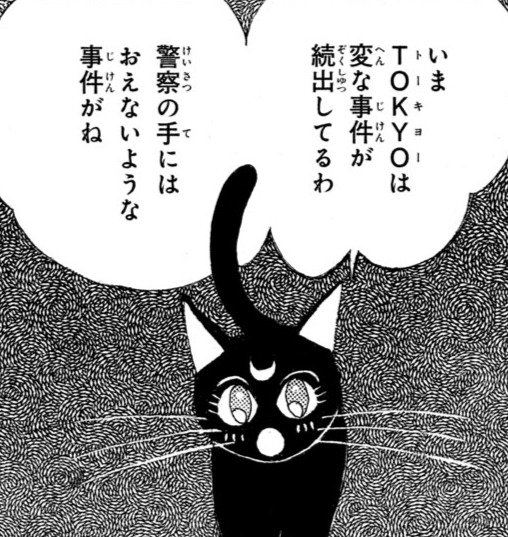
Luna introduces herself to Usagi, but Usagi thinks she’s dreaming if a cat is speaking to her. Luna gives Usagi a special brooch, then proceeds to explain the dire situation that has brought them together.
ルナ:
「いまTOKYOは変( へん ) な事件( じけん ) が続出( ぞくしゅつ )
“Strange incidents are popping up all over Tokyo these days.”
「警察( けいさつ ) の手( て ) にはおえないような事件( じけん ) がね」
“Incidents that seem beyond the police's control, you know.”
Challenge Yourself
Show translation
Challenge
What situation does Luna say Tokyo is facing?
Clues
変( へん ) な事件( じけん ) が続出( ぞくしゅつ ) してるstrange incidents are continuing to appear one after another
警察( けいさつ ) の手( て ) にはおえないような事件( じけん ) the incidents seem beyond what the police can handle
What does the speaker mean?
Strange incidents are appearing in succession beyond police control.
続出してる describes repeated new incidents, and 警察の手にはおえない says they seem too much for the police to handle.
One old case has kept the police busy for years.
続出 means multiple incidents are appearing one after another, not one case continuing for a long time.
The police are causing strange incidents throughout Tokyo.
The police are described as unable to handle the incidents, not as their cause.
Tokyo has returned to normal after a series of crimes.
してる presents the incidents as an ongoing situation now, not something that has ended.
Only Luna and Usagi have noticed a single minor problem.
Luna describes repeated serious incidents that exceed ordinary police control.
The police have solved each incident as soon as it appeared.
手にはおえない means the cases appear beyond their ability to manage, not that they solved them promptly.
Luna tells Usagi that strange incidents are appearing one after another across Tokyo. She adds that these cases seem beyond the police, which explains why Usagi’s new role is necessary.
View Full Example