Counting and planning with 計
計 has two main meanings: to tally or total , and a plan or scheme .
Etymology
This kanji is an ideogrammic compound made from 言 (say ) and 十 (a complete number or tally ), giving the image of speaking numbers one by one until a total is measured and a course of action can be planned .
Amounts
余計 (Excessive)余計( よけい ) means excessive, unnecessary, or more than needed.
It combines 余 (extra ) with 計 (measure ) to show more than the proper amount .
ご注文はうさぎですか? »
Volume 1 » Page 58
Syaro returns home after seeing Rize at the store.
シャロ:
「リゼ先輩( せんぱい ) に余計( よけい )
“A wrong impression of me has become held by Rize-senpai...”
「あと頭( あたま ) にへんな生物( せいぶつ ) が…」
“And there was a strange creature on her head...”
千夜( ちや ) :「ココアちゃん達( たち ) に会( あ ) ったのね!」
“So you met Cocoa and the others!”
Challenge Yourself
Show translation
Challenge
What does シャロ mean in the highlighted line?
Clues
もたれた
イメージもたれた means Rize formed an impression
What does the speaker mean?
Rize-senpai formed a strange impression of me...
The literal image of something "being held" becomes "Rize has an impression of me" in this context.
Syaro says she formed an odd impression of Rize.
The highlighted form is もたれた. Here イメージもたれた means Rize formed an impression, so this choice does not match the Japanese.
Syaro says she wanted Rize to misunderstand her.
The highlighted form is もたれた. Here イメージもたれた means Rize formed an impression, so this choice does not match the Japanese.
Syaro says Rize's favorable opinion of her remained unchanged.
The highlighted form is もたれた. Here イメージもたれた means Rize formed an impression, so this choice does not match the Japanese.
イメージもたれた means Rize formed an impression. The literal image of something “being held” becomes “Rize has an impression of me” in this context.
View Full Example
Planning
計画 (Plan)計画( けいかく ) means a plan that sets out what will be done, when, how, and by whom.
It combines 計 (plan ) with 画 (draw out ) to show a drawn out plan of action.
名探偵コナン »
Volume 5 » Page 83
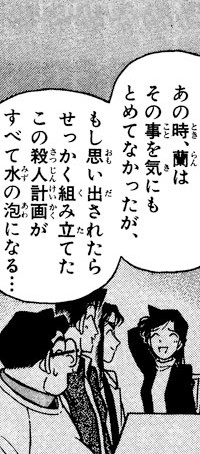
After discovering who the murderer is, Conan explains why the murderer went after Ran. He pinpoints when Ran unknowingly discovered a vital clue.
コナン:
「あの時( とき ) 、蘭( らん ) の事( こと ) 気( き ) にもとめてなかったが、もし思( おも ) い出( だ ) されたらせっかく組( く ) み立( た ) てたこの殺人( さつじん ) 計画( けいかく ) 水( みず ) の泡( あわ ) になる…」
“Ran didn't think anything of it at the time, but if she remembered it, all the murderous plans he worked so hard on putting together would go up in smoke.”
Challenge Yourself
Show translation
Challenge
What would happen if Ran remembered the clue?
Clues
もし思( おも ) い出( だ ) されたら
if she were to remember it
この殺人( さつじん ) 計画( けいかく ) がすべて水( みず ) の泡( あわ ) になる
the entire murder plan would come to nothing
What does the speaker mean?
The culprit's carefully prepared plan would be ruined.
水( みず ) の泡( あわ ) になる means that all the effort put into the plan would be wasted.
Ran would forget the clue permanently.
The condition is that Ran remembers it, not that she forgets it.
The culprit would have time to rebuild the plan.
The idiom describes the existing plan collapsing, not a chance to begin again.
The murder would be mistaken for an accident.
Remembering the clue would threaten the culprit's concealment rather than strengthen it.
Conan's investigation would have to stop.
The wasted effort belongs to the culprit's murder plan.
Ran would become part of the plan willingly.
Her memory would expose a clue and undermine the plan.
If Ran remembered what she had noticed, the culprit’s carefully assembled murder plan would fall apart. 水( みず ) の泡( あわ ) になる says that the invested effort would come to nothing.
View Full Example
Timekeeping
時計 (Clock)時計( とけい ) means a clock, watch, or other device that measures and displays time.
It combines 時 (time ) with 計 (measure ) to show a device that measures time .
Example 1 of 2: Skilled clock maker with 職人 Example 1 of 2
名探偵コナン »
Volume 17 » Page 118
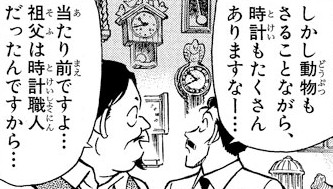
Having received a letter requesting help solving a mystery, Kogoro finds himself in a house filled with animal designs everywhere, including the doors, the chairs, and the plates. His attention turns to the clocks covering the walls.
小五郎( こごろう ) :「しかし動物( どうぶつ ) もさることながら、時計( とけい )
“But aside from the animals, there are also a lot of clocks, huh...”
男( おとこ ) :「当( あ ) たり前( まえ ) ですよ... 祖父( そふ ) は時計( とけい ) 職人( しょくにん ) だったんですから...」
“Of course there are... Grandfather was a clock maker, after all...”
Challenge Yourself
Show translation
Challenge
Why does the house contain so many clocks?
Clues
当( あ ) たり前( まえ ) ですよof course
祖父( そふ ) は時計( とけい ) 職人( しょくにん ) だったんですからbecause Grandfather was a clockmaker
What does the speaker mean?
The grandfather was a clockmaker.
だったんですから gives the grandfather's work as the reason the clocks are unsurprising.
The grandfather collected clocks but never worked on them.
時計( とけい ) 職人( しょくにん ) identifies his occupation as a skilled clock artisan.
Kogoro brought the clocks for the investigation.
The clocks were already part of the house because of its former resident.
Every animal design in the house hides a clock.
The speaker explains the abundance through the grandfather's trade, not a design trick.
The house currently operates as a clock shop.
The line tells us what the grandfather used to do, not the building's present business.
The clocks were gifts from Kogoro's clients.
Their source is tied to the grandfather being a clockmaker.
The many clocks are natural to the household because the speaker’s grandfather was a clockmaker. だったんですから supplies that explanatory reason.
View Full Example
Example 2 of 2: Dazed by a wristwatch with 気が遠くなる Example 2 of 2
美少女戦士セーラームーン »
Volume 6 » Page 264
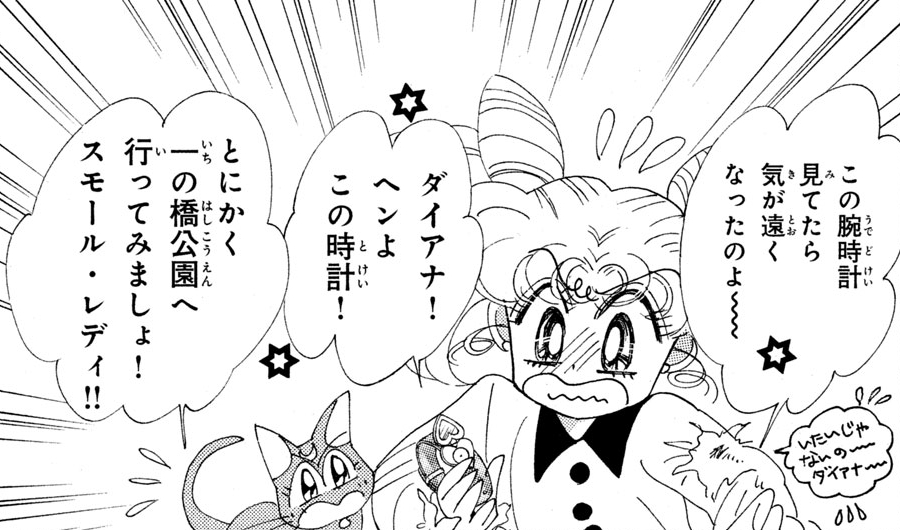
At the stroke of midnight, Chibiusa wakes to a mysterious glow from her new wristwatch. She gets out of bed in a daze, and begins to leave the room. Her cat, Diana, bites her on the arm, returning Chibiusa from her trance.
ちびうさ:
「この腕時計( うでとけい ) 見( み ) てたら気( き ) が遠( とお ) くなったのよ〰〰」
“When I looked at this wristwatch, I became lightheaded〰”
「ダイアナ! ヘンよ この時計( とけい )
“Diana! Something is strange about this watch!”
「とにかく 一( いち ) の橋( はし ) 公園( こうえん ) へ行( い ) ってみましょ! スモール・レディ!!」
“Anyway, let's try going to Ichinohashi Park! Small Lady!!”
Challenge Yourself
Show translation
Challenge
What does Chibiusa say happened while she looked at the wristwatch?
Clues
この腕時計( うでとけい ) 見( み ) てたら
the event occurred while she was looking at this wristwatch
気( き ) が遠( とお ) くなったshe became faint, dazed, or detached from her surroundings
What does the speaker mean?
She became dazed while looking at it.
見てたら gives the situation in progress, and 気が遠くなった describes the dazed state that followed.
She fell asleep before she had a chance to look at it.
見てたら says she was looking at the watch when the change happened.
She remembered where she had lost the watch.
気が遠くなった concerns consciousness becoming faint or distant, not recovering a memory.
Diana frightened her by suddenly showing her the watch.
Chibiusa identifies looking at the watch as the trigger. Diana later snaps her out of the trance.
She calmly decided to visit the park after checking the time.
Her dazed reaction and ヘンよ show that the watch affected her strangely, not that she made a normal plan.
The watch stopped working when midnight arrived.
She says the watch is strange because it made her feel dazed. She does not say it stopped.
Chibiusa says that she became dazed while looking at the wristwatch. 気が遠くなった describes her fading awareness, and her next line identifies the watch as the source of the strange experience.
View Full Example
腕時計 (Wristwatch)腕時計( うでどけい ) means a wristwatch.
It combines 腕 (arm ) with 時計 (clock ) to show a clock worn on the arm .
美少女戦士セーラームーン »
Volume 6 » Page 264
At the stroke of midnight, Chibiusa wakes to a mysterious glow from her new wristwatch. She gets out of bed in a daze, and begins to leave the room. Her cat, Diana, bites her on the arm, returning Chibiusa from her trance.
ちびうさ:
「この腕時計( うでとけい ) 見( み ) てたら気( き ) が遠( とお ) くなったのよ〰〰」
“When I looked at this wristwatch, I became lightheaded〰”
「ダイアナ! ヘンよ この時計( とけい ) !」
“Diana! Something is strange about this watch!”
「とにかく 一( いち ) の橋( はし ) 公園( こうえん ) へ行( い ) ってみましょ! スモール・レディ!!」
“Anyway, let's try going to Ichinohashi Park! Small Lady!!”
Challenge Yourself
Show translation
Challenge
What does Chibiusa say happened while she looked at the wristwatch?
Clues
この腕時計( うでとけい ) 見( み ) てたら
the event occurred while she was looking at this wristwatch
気( き ) が遠( とお ) くなったshe became faint, dazed, or detached from her surroundings
What does the speaker mean?
She became dazed while looking at it.
見てたら gives the situation in progress, and 気が遠くなった describes the dazed state that followed.
She fell asleep before she had a chance to look at it.
見てたら says she was looking at the watch when the change happened.
She remembered where she had lost the watch.
気が遠くなった concerns consciousness becoming faint or distant, not recovering a memory.
Diana frightened her by suddenly showing her the watch.
Chibiusa identifies looking at the watch as the trigger. Diana later snaps her out of the trance.
She calmly decided to visit the park after checking the time.
Her dazed reaction and ヘンよ show that the watch affected her strangely, not that she made a normal plan.
The watch stopped working when midnight arrived.
She says the watch is strange because it made her feel dazed. She does not say it stopped.
Chibiusa says that she became dazed while looking at the wristwatch. 気が遠くなった describes her fading awareness, and her next line identifies the watch as the source of the strange experience.
View Full Example