The kanji 国 has the core meaning of a country or state, land enclosed within a political boundary.
Etymology
This kanji isa phono-semantic compound comprised of 囗 (enclosure) as the semantic component and 或 as the phonetic component (コク).
This kanji is the modern simplified form of 國.
Etymology Research
The older writing 或 already represented a country or territory before 國 became established. The Chinese University of Hong Kong identifies 國 with an outer enclosure in Western Zhou bronze inscriptions. It analyzes 囗 as a boundary sign and 或 as the phonetic component. Its examples include the Cai Hou bells, where 國 denotes a state. An earlier 或 in the He zun inscription can be interpreted as 國 or 域, so that example does not settle a sharp distinction between country and region. CUHK Multi-function Chinese Character Database
The Japanese dictionaries differ in emphasis. Kanjipedia classifies 國 as combining meaning and sound. Heibonsha’s Jitsu instead classifies it as semantic composition, interpreting 或 as a settlement defended with a weapon and the added enclosure as an outer wall. Jitsu gives the capital settlement as the original referent, whereas CUHK gives the state. A historical phonetic role does not supply an ordinary modern Japanese reading for 或. Kanjipedia, Jitsu
For the modern shape, Kanjipedia explains 国 through the variant 囯 with an added dot. Taishukan’s Kanji Bunka Shiryokan also considers development from cursive 國. It documents the dotted 国 beside 國 in a 1589 edition of Unpo Irohashu, so the shape predates postwar standardization. Its first appearance and the exact route to that shape remain uncertain. Reading the modern 玉 as a treasure inside a country’s walls would be a memory aid, not the documented ancient formation. Kanjipedia, Taishukan
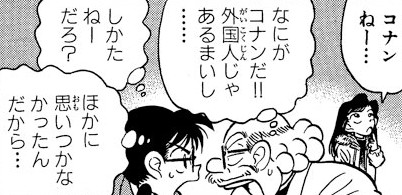
Shin’ichi’s teenage friend Ran enters Professor Agasa’s house looking for him, unaware that he was forced to take a poison that inadvertently turned the teenager into a young child. When Ran sees the boy and asks his name, Shin’ichi recalls Agasa’s suggestion to not reveal who he is. Panicking, he gives the name “Conan”, explaining the oddness of it by saying his father is a fan of author Arthur Conan Doyle.
欄:
「コナンねー…」
“Conan, huh?”
阿笠:
「なにがコナンだ!! 外国人じゃあるまいし」
“What's with 'Conan'!? It's not like you're a foreigner...”
コナン:
「しかたねーだろ? ほかに思いつかなかったんだから…」
“It couldn't be helped, all right? I couldn't think up anything else...”
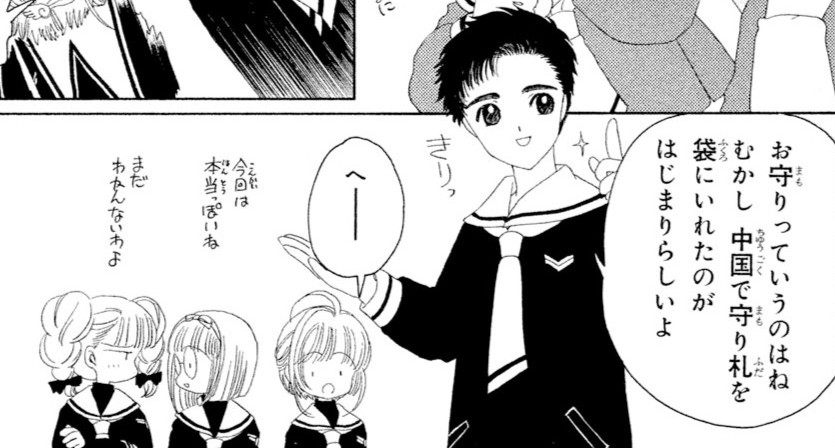
Sakura had to take a detour to get to class. She tells her friends at school about the shrine she saw along the way. Naoko says the talismans from there are popular, as they can grant wishes for things such as exams and romance.
山崎:
「お守りっていうのはね むかし 中国で守り札を袋にいれたのがはじまりらしいよ」
“You know, apparently good-luck charms began long ago in China, when people put protective talismans into bags.”
As she explores, Yotsuba finds a playground. She stops to inspect one of the swings, unfamiliar with what it is. A girl passing by notices her and wonders who she is.
女の子:
「なんかかわった… 外国の子…?」
“She seems kind of unusual… A kid from another country…?”
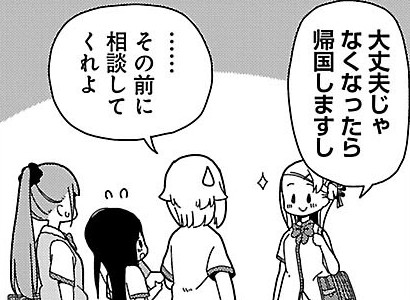
While staying in Japan, Sotoka lives alone in the apartment building her parents own. Aru asks if Sotoka isn’t lonely living alone, but Sotoka says it’s all right.
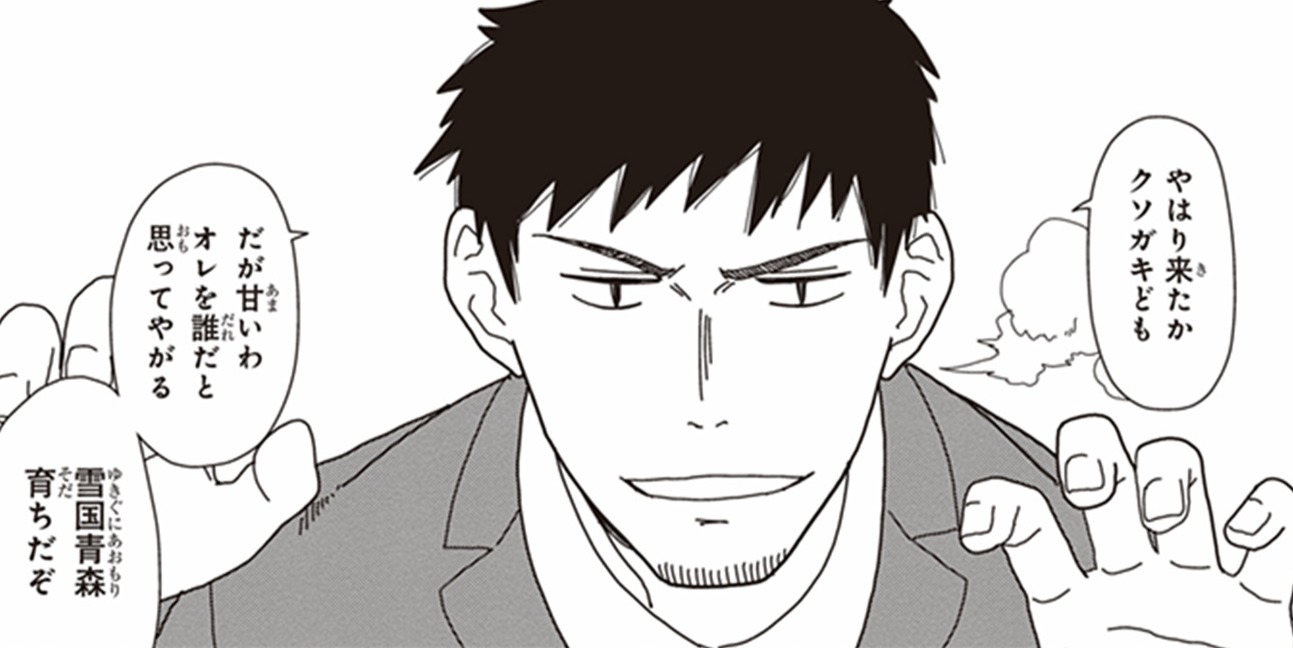
Sacchan, Yui, and Kotoha play in the snow in various ways. After running out of things to do, Sacchan comes up with an idea. They head over to Officer Saitou and greet him with snowballs in hand.
斎藤:
「やはり来たか クソガキども」
“So you came after all, you little brats.”
「だが甘いわ オレを誰だと思ってやがる」
“But you underestimate me! Just who do you think I am?”