Crimes and offenders with 犯
犯 primarily means “to violate rules or laws” or “a person who has committed a crime”.
Etymology
This kanji is a phono-semantic compound comprised of 犭 / 犬 (dog) as the semantic component and 𢎘, later written in the changed form 㔾, as the phonetic component (ハン) providing the reading ハン. It originally meant a dog breaking through a fence, and the meaning extends to describing conduct that goes beyond one’s proper bounds.
Criminal Acts
犯罪 (Crime)
犯罪 means a crime or criminal offense.
It combines 犯 (offense) with 行 (act) to show a criminal act.
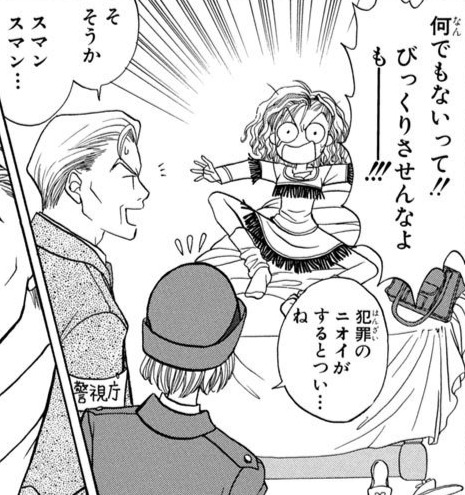
A classmate shows off her new satchel from Meisho Daichi High School. Ran wants one for herself, so she heads down to Shibuya in search of a Meisho Daichi student who’ll give her one. She accidentally steals one, which she later ruminates on in her room. As she talks to herself about how her pride cannot abide stealing, her police officer parents burst into her room, asking what was stolen and who the suspect is.
- 蘭:
- 「何でもないって!! びっくりさせんなよ もーーーー!」
- “It's nothing!! Don't scare me like that! Seriously!!”
- 泰三:
- 「そ そうか スマン スマン…」
- “Oh... okay. Sorry, sorry...”
- 清香:
- 「犯罪のニオイがするとつい…ね」
- “When I smell a crime, I just can't help myself...”
犯行 (Criminal act)
犯行 means the commission of a crime or the criminal act itself.
It combines 犯 (offense) with 行 (act) to show a criminal act.
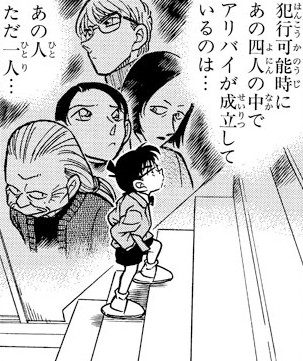
Following a murder made to look like an accidental death, Conan reviews the whereabouts of the four suspects at the time.
- コナン:
- 「犯行可能時にあの四人の中でアリバイが成立しているのは…」
- “Among those four, the one with an established alibi during the time the crime could have been committed is...”
- 「あの人ただ一人…」
- “...that person alone...”
Legal Roles
共犯 (Accomplice)
共犯 means complicity in a crime or an accomplice who takes part in it.
It combines 共 (together) with 犯 (offense) to show committing a crime together.
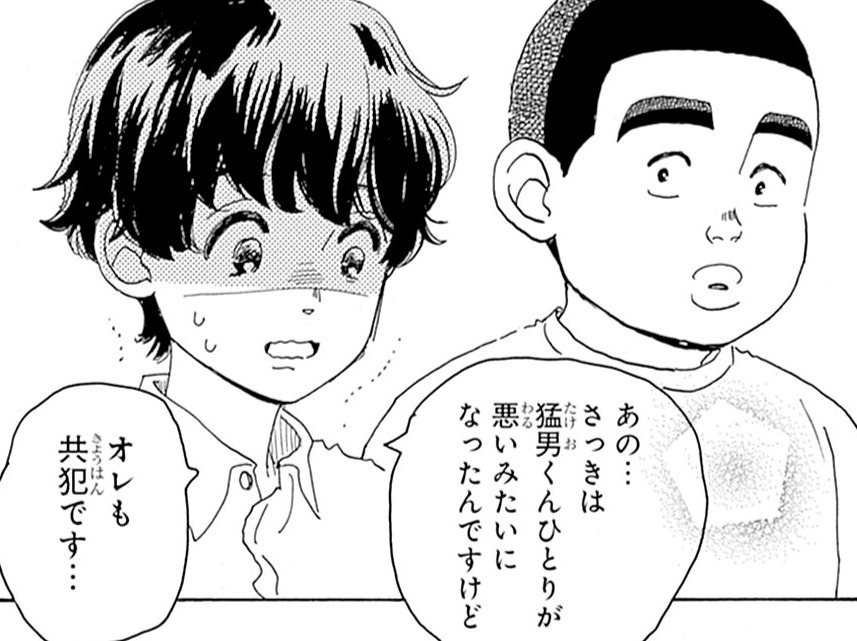
Yacchin eats little and dislikes many foods, so his friend Takeo helps by eating the parts of his lunch he doesn’t like. A teacher catches sight of this and yells at them not to give or take food from one another. When the coast is clear, Takeo continues, only to be sighted and punished by the teacher. Yacchin goes up to the teacher afterward.
- やっちん:
- 「あの… さっきは猛男くんひとりが悪いみたいになったんですけどオレも共犯です…」
- “Um... It seemed like Takeo was the only one at fault just now, but I was in on it too...”
Offenders
犯人 (Criminal)
犯人 means the culprit or person who committed a crime.
It combines 犯 (offense) with 人 (person) to show the person who committed the crime.
Example 1 of 2: Don't reveal it with 〜てはだめだ

While telling ghost stories at night, Rize relays the tale from her childhood, of a frightened servant who felt she was being watched while walking home one night.
- リゼ:
- 「犯人はホフク前進の練習をしていた私だ」
- “I was the culprit. I was practicing crawling on my stomach.”
- ◯:
- 「バラしちゃだめじゃん!!」
- “You shouldn't reveal it!”
Example 2 of 2: Don't suspect only me with 〜だけ
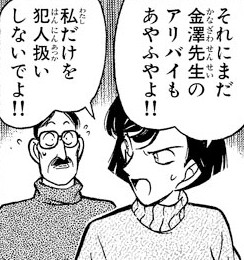
In a snow-covered mountain villa, a room full of suspects listen as Detective Mouri explains how their host was murdered. The accused notes she has a receipt showing she was at the convenience store at the bottom of the mountain when the murder took place.
- 中原:
- 「それにまだ金澤先生のアリバイもあやふやよ!!」
- “Moreover, Mr. Kanazawa's alibi is also vague!”
- 「私だけを犯人扱いしないでよ!!」
- “Don't treat only me as the suspect!”