Death and dying with 死
The kanji 死 means death , dead , or to die . It covers the end of life and what remains afterward.
It also has figurative uses. A 死角( しかく ) is a blind spot, while 必死( ひっし ) describes someone acting as if their life depended on it. These uses give 死 broader senses such as inactive , desperate , and fatal .
Etymology
死 is a phono-semantic compound . 歺, meaning bare bones or remains, carries the meaning, while 尸 supplied the sound in an early form. The bones tie 死 to death and the remains left when life ends.
Death
死体 (Dead body)死体( したい ) refers to the body of a dead person or animal. It is blunt and clinical, so it can sound cold when used for a person.
It combines 死 (dead ) with 体 (body ) to show a dead body .
名探偵コナン »
Volume 1 » Page 139
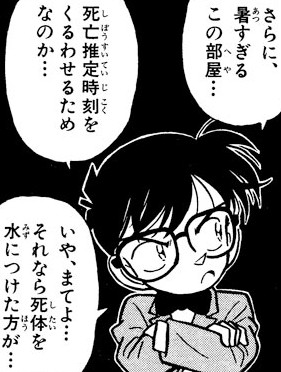
Upon walking in on a murder scene, Conan goes right to work making observations about the blood-covered body and its surroundings. He notes how the room is torn apart save for one upright chair beside the deceased.
コナン:
「さらに、暑( あつ ) すぎるこの部屋( へや ) …」
“Furthermore, this room is too warm...”
「死亡推定時刻( しぼうすいていじこく ) をくるわせるためなのか…」
“Is it to confuse the estimated time of death...?”
「いや、まてよ… それなら死体( したい ) 水( みず ) につけた方( ほう ) が…」
“No, wait... If that's the case, it would be better to put the corpse in water...”
Challenge Yourself
Show translation
Challenge
What possible purpose does Conan consider for the overheated room?
Clues
暑( あつ ) すぎるこの部屋( へや ) this room that is too hot
死亡推定時刻( しぼうすいていじこく ) をくるわせるためなのかperhaps to throw off the estimated time of death
What does the speaker mean?
To distort the estimated time of death.
Conan explicitly considers whether the heat was meant to confuse the death-time estimate.
To make the victim leave the room voluntarily.
Conan connects the temperature to forensic timing, not to driving someone outside.
To melt the murder weapon.
No melting weapon is mentioned. The possible target is the estimated time of death.
To dry water from the floor.
Water appears only in Conan's alternative thought about the body.
To conceal the smell of poison.
The line considers heat as a way to alter the apparent death time.
To keep the investigators comfortable.
The room is 暑( あつ ) すぎる, excessively hot, and Conan treats that as suspicious.
Conan briefly suspects that someone overheated the room to disrupt the estimated time of death. He then questions the theory and considers another method.
View Full Example
死因 (Cause of death)死因( しいん ) is the illness, injury, or event that caused someone to die. It is common in medical reports, police investigations, and legal records.
It combines 死 (death ) with 因 (cause ) to show the cause behind a death .
名探偵コナン »
Volume 16 » Page 25
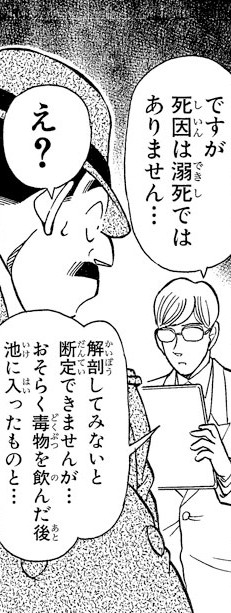
Inspector Megure suggests the murder suspect committed suicide by drowning himself. The medical examiner disagrees.
監察医( かんさつい ) :「ですが死因( しいん ) 溺死( できし ) ではありません…」
“However, drowning wasn't the cause of death...”
目暮( めぐれ ) :「え?」
“What?”
監察医( かんさつい ) :「解剖( かいぼう ) してみないと断定( だんてい ) できませんが… おそらく毒物( どくぶつ ) を飲( の ) んだあと池( いけ ) に入( はい ) ったものと…」
“I can't say for certain without an autopsy... but it's likely he took poison and then entered the pond...”
Challenge Yourself
Show translation
Challenge
What does the medical examiner suspect happened before the victim entered the pond?
Clues
おそらく毒物( どくぶつ ) を飲( の ) んだあと
probably after drinking poison
池( いけ ) に入( はい ) ったhe entered the pond
What does the speaker mean?
He drank poison.
The examiner tentatively places drinking 毒物( どくぶつ ) before entering the pond.
He drowned before taking any poison.
The examiner says drowning was not the cause of death and suspects poison first.
He performed an autopsy on someone else.
The examiner needs an autopsy performed on this victim to confirm the cause.
He was rescued from the pond alive.
The scene concerns determining the cause of the victim's death.
He accidentally drank pond water.
The suspected substance is 毒物( どくぶつ ) , poison.
He entered the pond before consuming anything.
あと places the pond entry after the suspected poisoning.
The examiner suspects that the victim drank poison and then entered the pond. An autopsy is still needed before that cause can be stated with certainty.
View Full Example
溺死 (Drowning death)溺死( できし ) is death caused by drowning.
It combines 溺 (drown ) with 死 (death ) to show dying in water .
名探偵コナン »
Volume 16 » Page 25
Inspector Megure suggests the murder suspect committed suicide by drowning himself. The medical examiner disagrees.
監察医( かんさつい ) :「ですが死因( しいん ) は溺死( できし )
“However, drowning wasn't the cause of death...”
目暮( めぐれ ) :「え?」
“What?”
監察医( かんさつい ) :「解剖( かいぼう ) してみないと断定( だんてい ) できませんが… おそらく毒物( どくぶつ ) を飲( の ) んだあと池( いけ ) に入( はい ) ったものと…」
“I can't say for certain without an autopsy... but it's likely he took poison and then entered the pond...”
Challenge Yourself
Show translation
Challenge
What does the medical examiner suspect happened before the victim entered the pond?
Clues
おそらく毒物( どくぶつ ) を飲( の ) んだあと
probably after drinking poison
池( いけ ) に入( はい ) ったhe entered the pond
What does the speaker mean?
He drank poison.
The examiner tentatively places drinking 毒物( どくぶつ ) before entering the pond.
He drowned before taking any poison.
The examiner says drowning was not the cause of death and suspects poison first.
He performed an autopsy on someone else.
The examiner needs an autopsy performed on this victim to confirm the cause.
He was rescued from the pond alive.
The scene concerns determining the cause of the victim's death.
He accidentally drank pond water.
The suspected substance is 毒物( どくぶつ ) , poison.
He entered the pond before consuming anything.
あと places the pond entry after the suspected poisoning.
The examiner suspects that the victim drank poison and then entered the pond. An autopsy is still needed before that cause can be stated with certainty.
View Full Example