Difference and strangeness with 異
The kanji 異 has a meaning of standing apart from the ordinary. The core meanings are different and strange .
From this sense of being unlike what is normal, 異 extends to other , unusual , abnormal , and even ideas or beliefs that diverge from the accepted norm.
Abnormal States and Events
異常 (Abnormality)異常( いじょう ) means abnormal, unusual, or outside the normal range. It can describe behavior, a malfunction, a medical finding, or an extreme degree.
It combines 異 (different ) with 常 (usual ) to show something unlike the ordinary .
Example 1 of 2: Nothing out of the ordinary with 異常 Example 1 of 2
三ツ星カラーズ »
Volume 7 » Page 73
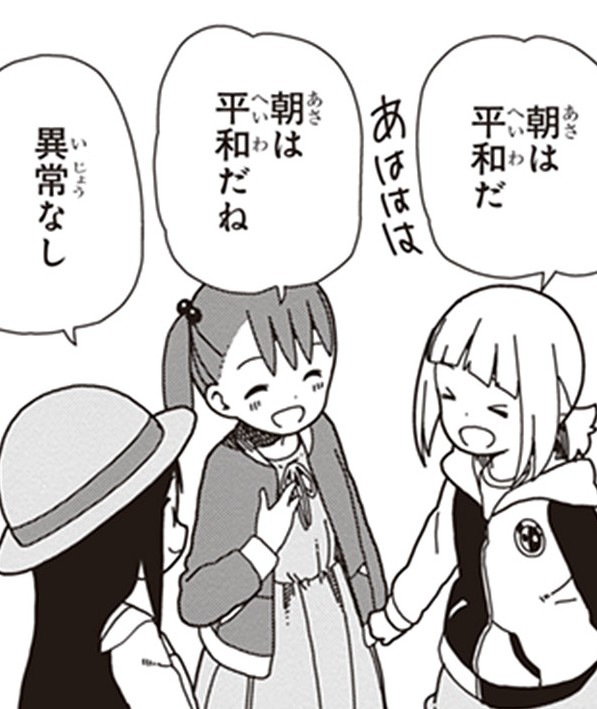
Yui, Sacchan, and Kotoha go on an early-morning patrol to check for any issues in their neighborhood. Because it’s so early, none of the shops are open yet, and the streets are empty.
さっちゃん:
「朝( あさ ) は平和( へいわ ) だ」
“Morning is peaceful.”
結衣( ゆい ) :「朝( あさ ) は平和( へいわ ) だね」
“Morning is peaceful, isn't it?”
琴葉( ことは ) :「異常( いじょう )
“No abnormalities.”
Challenge Yourself
Show translation
Challenge
What conclusion does Kotoha give after the early-morning patrol?
Clues
異常( いじょう ) なしno abnormalities or nothing unusual
What does the speaker mean?
There is nothing out of the ordinary.
異常( いじょう ) names an abnormality, and なし says none is present.
The empty streets are dangerously abnormal.
なし negates the presence of an abnormality rather than declaring one.
The patrol found one serious problem.
異常( いじょう ) なし is a zero-problem report.
Morning patrols should be canceled.
Kotoha reports the result of this patrol and gives no recommendation about future patrols.
The shops have opened earlier than usual.
The line contains no statement about opening times. It simply reports no abnormalities.
The neighborhood is peaceful only at night.
Yui and Sacchan call the morning peaceful, and Kotoha confirms that nothing unusual is present.
Kotoha gives the clipped patrol report 異常( いじょう ) なし, meaning that they found nothing unusual. Its terse style fits the Colors’ pretend public-safety mission.
View Full Example
Example 2 of 2: Taking too much caffeine with 〜すぎる Example 2 of 2
ご注文はうさぎですか? »
Volume 1 » Page 55
Thinking Syaro doesn’t like the taste of coffee, Cocoa suggests adding sugar and milk. Syaro says the bitterness isn’t the issue.
シャロ:
「カフェインを摂( と ) りすぎると異常( いじょう )
“It seems if I consume too much caffeine, I get abnormally hyper.”
「自分( じぶん ) じゃよく分( わ ) からないんだけど」
“I can't really tell myself, though.”
◯:
「コーヒー酔( よ ) い!?」
“Drunk on coffee!?”
Challenge Yourself
Show translation
Challenge
What does シャロ mean in the highlighted line?
Clues
摂( と ) りすぎる(摂:と)りすぎる means consuming an excessive amount
What does the speaker mean?
It seems if I consume too much caffeine, I get abnormally hyper.
摂( と ) る changes to the stem 摂( と ) り before すぎる, and caffeine is the thing taken in.
Syaro says coffee bitterness is what makes her hyper.
The highlighted form is 摂( と ) りすぎる. Here 摂( と ) りすぎる means consuming an excessive amount, so this choice does not match the Japanese.
Syaro says too much caffeine always makes her sleepy.
The highlighted form is 摂( と ) りすぎる. Here 摂( と ) りすぎる means consuming an excessive amount, so this choice does not match the Japanese.
Syaro says caffeine has no effect on her and she can tell immediately.
The highlighted form is 摂( と ) りすぎる. Here 摂( と ) りすぎる means consuming an excessive amount, so this choice does not match the Japanese.
摂( と ) りすぎる means consuming an excessive amount. 摂( と ) る changes to the stem 摂( と ) り before すぎる, and caffeine is the thing taken in.
View Full Example
異様 (Strangeness)異様( いよう ) describes something strange, unsettling, or conspicuously unlike the norm.
It combines 異 (strange ) with 様 (appearance ) to show a strange appearance or manner .
名探偵コナン »
Volume 21 » Page 119
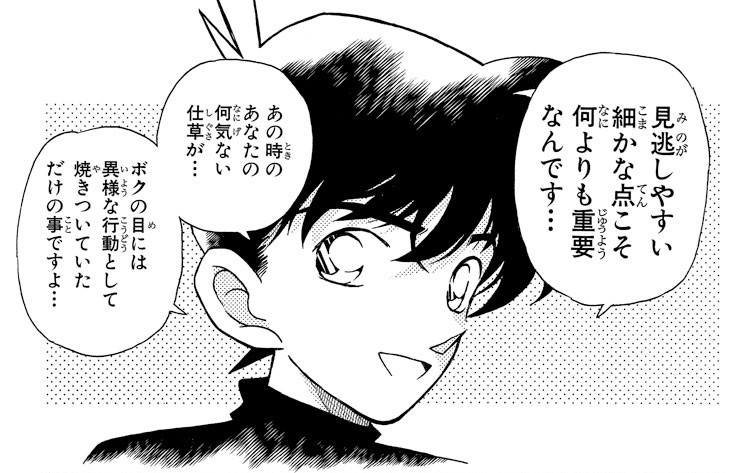
Shin’ichi reveals the details of a murder. The culprit asks how Shin’ichi discovered the hidden weapon, and he explains it was due to a specific movement the culprit made.
新一( しんいち ) :「見逃( みのが ) しやすい細( こま ) かな点( てん ) こそ何( なに ) よりも重要( じゅうよう ) なんです…」
“It's precisely those subtle details that are easy to overlook that matter most of all...”
「あの時( とき ) のあなたの何気( なにげ ) ない仕草( しぐさ ) が…」
“That casual gesture of yours back then...”
「僕( ぼく ) の目( め ) には異様( いよう ) 行動( こうどう ) として焼( や ) きついてただけの事( こと ) ですよ…」
“It's just that it was etched in my mind as strange behavior...”
Challenge Yourself
Show translation
Challenge
Why did the culprit's casual gesture stay in Shin'ichi's memory?
Clues
僕( ぼく ) の目( め ) には異様( いよう ) な行動( こうどう ) としてin my eyes, as strange behavior
焼( や ) きついてたit was etched into my memory
What does the speaker mean?
It struck him as unnaturally strange behavior.
異様( いよう ) な行動( こうどう ) explains why the otherwise casual gesture stood out.
It was the most ordinary action at the scene.
Shin'ichi says it appeared 異様( いよう ) , abnormal or out of place.
The culprit repeated it after confessing.
The line refers to the gesture at the earlier moment, not a later confession.
Someone photographed the movement for him.
焼( や ) きつく is figurative here, meaning the sight remained vividly in his mind.
It caused him to overlook all the smaller details.
He says small, easily missed details are especially important.
The gesture directly revealed the culprit's name.
It served as suspicious behavioral evidence, not a spoken identification.
The gesture looked casual, but Shin’ichi saw it as strangely out of place. That abnormal impression caused it to remain vividly etched in his memory.
View Full Example
Differences in Society
異性 (Opposite sex)異性( いせい ) means the opposite sex or a person of a different sex from oneself.
It combines 異 (other ) with 性 (sex ) to show the other sex .
くノ一ツバキの胸の内 »
Volume 2 » Page 41
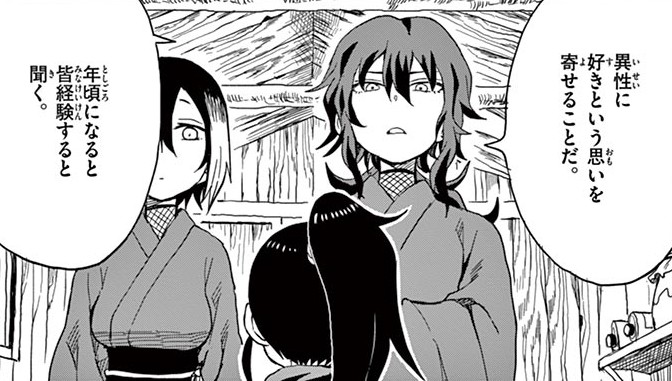
During a ninja training exercise, Tsubaki disguises herself as the teacher’s assistant in the hope of getting close enough to take the teacher’s mask. When the teacher unknowingly reveals that keeping boys and girls separate has been aided by lying to the female ninjas about men being scary, Tsubaki accidentally drops her disguise. The teacher has no choice but to take Tsubaki into her confidence and explain the reason for the separation, starting with the word “love”, of which Tsubaki is unfamiliar.
ハナ先生( せんせい ) :
「異性( いせい ) 好( す ) きという思( おも ) いを寄( よ ) せることだ。」
“It means harboring feelings of affection for someone of the opposite sex.”
「年頃( としごろ ) になると皆( みな ) 経験( けいけん ) すると聞( き ) く。」
“I hear that everyone goes through this when they reach a certain age.”
Challenge Yourself
Show translation
Challenge
How does Hana-sensei define love?
Clues
異性( いせい ) にmarks people of the opposite sex as the target of the feelings
好( す ) きという思( おも ) いを寄( よ ) せることだ"It is to harbor feelings called liking or affection."
年頃( としごろ ) になると皆( みな ) 経験( けいけん ) すると聞( き ) くshe has heard that everyone experiences it when they reach a certain age
What does the speaker mean?
Harboring feelings of affection for someone of the opposite sex.
異性( いせい ) に marks the target, and 好( す ) きという思( おも ) いを寄( よ ) せる describes directing affectionate feelings toward that person.
Being admired by someone of the opposite sex.
The person with the feelings is the understood subject. 異性( いせい ) に marks where those feelings are directed, not who sends them.
Becoming friends with every person of the opposite sex.
Hana-sensei defines an affectionate feeling, not friendship or a duty involving everyone.
Feeling afraid whenever someone mentions men.
Fear is part of the lie told to the students. The definition uses 好( す ) き, feelings of liking.
Reaching the age when ninja training becomes difficult.
年頃( としごろ ) になると refers to an age when people experience love, not difficulty in training.
Hearing stories about affection without experiencing it.
Hana-sensei says she has heard that everyone experiences love. Hearsay is the source of her claim, not the definition itself.
Hana-sensei defines love as directing 好( す ) きという思( おも ) い toward the 異性( いせい ) , someone of the opposite sex. She adds that she has heard people experience it when they reach a certain age.
View Full Example
Other Worlds and Places
異世界 (Other world)異世界( いせかい ) means another world or dimension. In modern fiction, it usually means a fantasy world of magic and monsters.
It combines 異 (other ) with 世界 (world ) to show another world separate from ordinary reality.
キラキラとギラギラ »
Volume 1 » Page 173
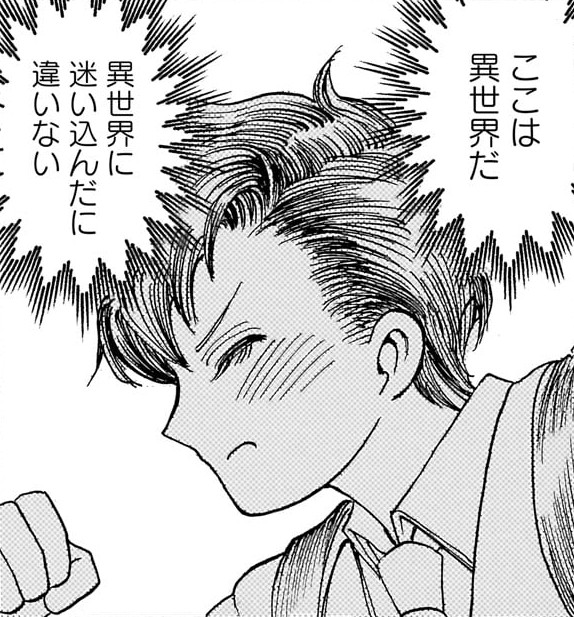
Zen lived in a glittering, idyllic town until his family moved. During his first day of school, he found everyone to be glaring and rugged. Rather than being gentle and playful, his classmates sought a brawl and chased after him.
禅( ぜん ) :「ここは異世界( いせかい )
“This is another world.”
「異世界( いせかい ) 迷( まよ ) い込( こ ) んだに違( ちが ) いない」
“I must have wandered into another world.”
Challenge Yourself
Show translation
Challenge
What conclusion does Zen reach about his new surroundings?
Clues
ここは異世界( いせかい ) だ
this place is another world
異世界( いせかい ) に迷( まよ ) い込( こ ) んだhe wandered into another world
に違( ちが ) いない
there is no doubt, expressing a strong conclusion
What does the speaker mean?
He must have wandered into another world.
Zen names the place as an 異世界( いせかい ) , and に違( ちが ) いない marks that explanation as his firm conclusion.
He has returned to the town where he used to live.
Zen calls the place an entirely different world because it feels unlike his former home.
He is uncertain whether he entered the correct classroom.
に違( ちが ) いない shows strong certainty, and his conclusion concerns the whole world around him.
He believes his classmates came from another world.
Zen says that he wandered into the other world. He does not say that the classmates traveled into his.
He plans to search for a route into another world.
迷( まよ ) い込( こ ) んだ is past tense, so he believes the wandering has already happened.
He realizes that he became lost on the way to school.
迷( まよ ) い込( こ ) む can involve losing one's way, but its destination here is explicitly an 異世界( いせかい ) , not an ordinary route.
Zen is so shocked by the rough school that he treats it as another world. 迷( まよ ) い込( こ ) んだ describes accidentally ending up there, and に違( ちが ) いない shows that he considers this the only possible explanation.
View Full Example