Distances and range with 距
The kanji 距 primarily concerns separation or distance. Other uses include a bird’s spur, a spur on a flower, and resistance or refusal.
Etymology
This kanji isa phono-semantic compound comprised of 足 (foot) as the semantic component and 巨 as the phonetic component (キョ).
Etymology Research
The Chinese character 距 is a semantic and phonetic compound. 足, shown in its left-hand form 𧾷, supplies the foot or leg domain; 巨 supplies the sound. Both Kanjipedia’s account from Kadokawa’s revised Shinjigen and the Chinese University of Hong Kong’s database identify the original referent as the spur projecting from the back of a rooster’s or pheasant’s leg. The latter quotes Shuowen Jiezi: “距,雞距也。从足,巨聲。” Kanjipedia, 距, CUHK, 距
CUHK displays bronze-script and small-seal forms. It says the 巨 part of the bronze form resembles an old form of 巨 recorded in Shuowen. The bronze inscriptions it discusses use 距 as a personal name and in the name of a weapon, 距末. They attest the written form, but those uses alone do not prove that the spur sense was already in use in the surviving bronze examples. CUHK, 距
Early texts cited by CUHK use 距 for “reach” or “arrive at” and later for a distance from a point in time. Kanjipedia describes the separation sense as a borrowing from the spur word; CUHK describes distance as a later extension. The sources agree on the spur as the proposed starting sense but frame the route to “distance” differently. 巨 supplies sound in their analyses, not an image of giant strides. CUHK, 距, Kanjipedia, 距
Basic Separation
距離 (Distance)
距離 refers to the “gap” or “length” between two places, things, or people.
It combines 距 (distance) with 離 (separation) to show a space between separated points.
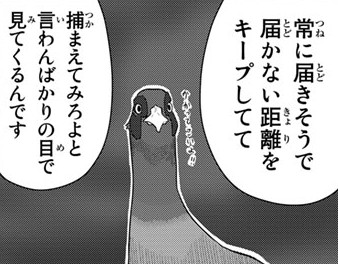
Kei and Chinatsu watch as their cousin, Makoto, chases a pheasant back and forth across the field. During a break in the chase, Makoto explains her fascination with the bird.
- 真琴:
- 「常に届きそうで届かない距離をキープしてて」
- “Constantly seeming like you can reach and keeping a distance you can't...”
- 「捕まえてみろよと言わんばかりの目で見てくるんです」
- “It's been looking with eyes as if to say, try and catch me!”