Distribution and arrangement with 配
The kanji 配 centers on the ideas of distribute and arrange .
Etymology
This kanji isa phono-semantic compound comprised of 酉 (wine jar) as the semantic component and 己 as the phonetic component (ハイ).
Older explanations connect it with pairing wine with a person or position, then extending to allotment and arrangement.
Allocation
配布 (Distribution)配布( はいふ ) means distributing or handing out items such as flyers, documents, or supplies.
It combines 配 (allot / distribute ) with 布 (spread out ) to show something spread among people .
三ツ星カラーズ »
Volume 3 » Page 112
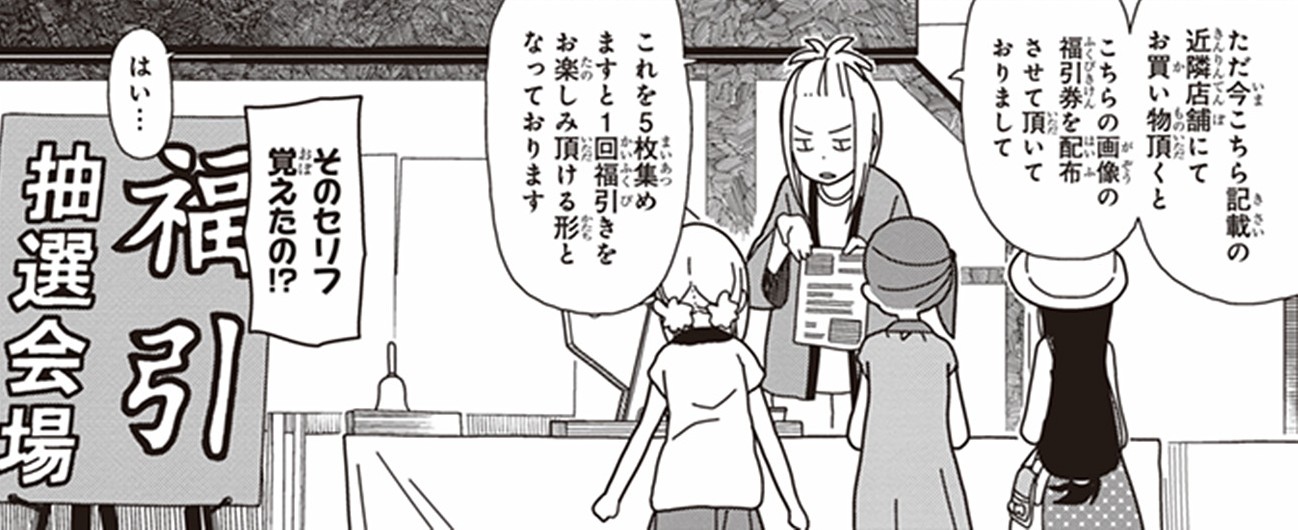
Upon entering the mall, Yui notices a lottery wheel. Sacchan and Kotoha join her, the two quickly pestering Subaru, the part-timer working the lottery, with random questions. Subaru pushes on with her script.
すばる:
「ただ今( いま ) こちら記載( きさい ) の近隣( きんりん ) 店舗( てんぽ ) にてお買( か ) い物( もの ) 頂( いただ ) くとこちらの画像( がぞう ) の福引券( ふくびきけん ) を配布( はいふ ) 頂( いただ ) いておりまして」
“Currently, when you make a purchase at a neighborhood store, we are distributing the raffle tickets shown in this image.”
「これを5( ご ) 枚集( あつ ) めますと1回( いっかい ) 福引( ふくび ) きをお楽( たの ) しみ頂( いただ ) ける形( かたち ) となっております」
“If you collect five tickets, you'll be able to enjoy one lottery draw.”
さっちゃん:
「そのセリフ覚えたの!?」
“You memorized that line!?”
すばる:
「はい…」
“Yes...”
Challenge Yourself
Show translation
Challenge
What must shoppers do to receive one lottery draw?
Clues
近隣( きんりん ) 店舗( てんぽ ) にてお買( か ) い物( もの ) 頂( いただ ) くと... 福引券( ふくびきけん ) を配布( はいふ ) shopping at a listed nearby store earns raffle tickets
これを5( ご ) 枚( まい ) 集( あつ ) めますと1回( いっかい ) 福引( ふくび ) き
collecting five tickets allows one lottery draw
What does the speaker mean?
Shop at participating nearby stores and collect five raffle tickets.
Purchases at the listed 近隣( きんりん ) 店舗( てんぽ ) produce tickets, and 5( ご ) 枚( まい ) is the amount needed for one draw.
Make five purchases at the mall's lottery counter.
The purchases happen at listed nearby stores, while the counter distributes or redeems the tickets.
Collect one ticket from each of five different neighborhoods.
The script requires five tickets but does not require five neighborhoods or five different stores.
Show the pictured ticket once to receive five draws.
The quantity is reversed: five tickets allow one draw.
Memorize the clerk's script and repeat it at a nearby store.
Sacchan comments on Subaru memorizing the script, but that is not a customer requirement.
Buy five lottery tickets directly from Subaru.
The 福引券( ふくびきけん ) are distributed after store purchases rather than sold as lottery entries.
A purchase at one of the listed nearby stores earns a raffle ticket. Shoppers collect five of those tickets to receive one turn at the lottery.
View Full Example
Concern
心配 (Worry)心配( しんぱい ) means worry, concern, or anxiety about what might go wrong. With する, it means “to worry”.
It combines 心 (mind ) with 配 (distribute ) to show a mind spread out in concern .
Example 1 of 4: Creating a report with 作成 Example 1 of 4
魔法騎士レイアース »
Volume 1 » Page 47
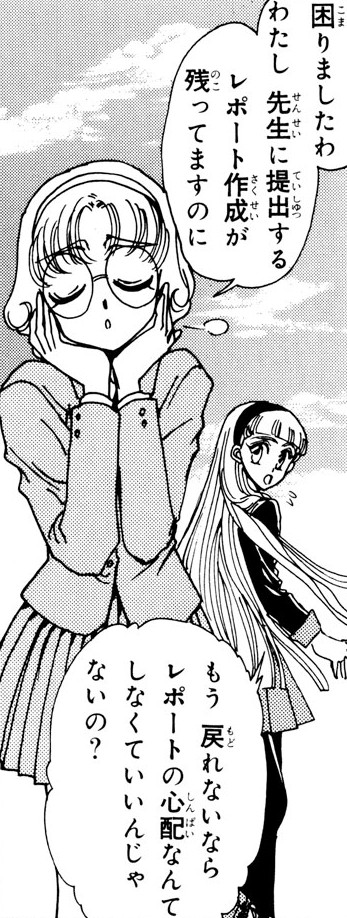
Fuu finds herself spirited away to another world, along with two other girls. A wizard appears before them, saying they cannot return home until they accomplish a specific goal.
風( ふう ) :「困( こま ) りましたわ。 わたし 先生( せんせい ) に提出( ていしゅつ ) するレポート作成( さくせい ) が残( のこ ) ってますのに」
“Oh dear. I've still got to write that report to hand in to the teacher...”
海( うみ ) :「もう 戻( もど ) れないならレポートの心配( しんぱい )
“If we can't go back anyway, isn't there no point worrying about the report?”
Challenge Yourself
Show translation
Challenge
Why does Umi say Fuu does not need to worry about her unfinished report?
Clues
先生( せんせい ) に提出( ていしゅつ ) するレポート作成( さくせい ) が残( のこ ) ってますのにFuu still has a report to finish and submit to her teacher
もう戻( もど ) れないなら
Umi treats being unable to return home as the condition
What does the speaker mean?
If they cannot return home, Fuu cannot submit it to her teacher.
戻れないなら sets up the possibility that they cannot go home. The report is meant for Fuu's teacher, so she would have no way to submit it.
The wizard has agreed to finish the report for Fuu.
Umi does not mention the wizard doing the work. Her point depends on whether they can return home.
Fuu's teacher has canceled the assignment.
Fuu says the report remains unfinished. Nothing in either line says the teacher canceled it.
作成 shows that Fuu has already completed the report.
作成が残ってます means the work of preparing the report still remains. It is not complete.
Umi plans to return alone and submit the report for Fuu.
戻れない refers to their inability to go back. Umi does not offer to deliver the report herself.
The report matters only if Fuu becomes a mage.
Umi links the report to returning home, not to whether Fuu becomes a mage.
Fuu is worried because she still has to finish a report for her teacher. Umi reasons that if they cannot return home, Fuu cannot submit it anyway, so worrying about it serves no purpose.
View Full Example
Example 2 of 4: Don't worry with すんな Example 2 of 4
俺物語!! »
Volume 6 » Page 56
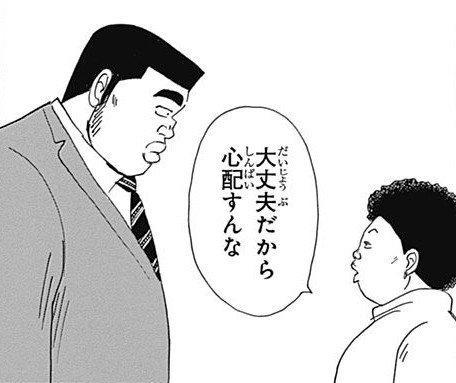
Takeo takes his pregnant mother to the hospital, as she’s getting close to delivery. Once there, she gives Takeo and his friend Suna a list of things to take care of during her stay.
母( かあ ) さん:「大丈夫( だいじょうぶ ) から心配( しんぱい )
“I'll be fine, so don't worry.”
Challenge Yourself
Show translation
Challenge
Why does Takeo's mother tell him not to worry?
Clues
大丈夫( だいじょうぶ ) だからbecause she will be all right
心配( しんぱい ) すんなdo not worry, a blunt casual contraction of (心配:しんぱい)するな
What does the speaker mean?
She says she will be fine.
大丈夫( だいじょうぶ ) gives her reason, and から links it to the command not to worry.
She says the hospital visit has been canceled.
She reassures him that she is all right. She does not say the visit is canceled.
She wants Takeo to leave before the delivery.
The command concerns worrying, not leaving the hospital.
She says Suna will handle every task for him.
Neither Suna nor the task list appears in this line. Her own condition is the reason.
She orders Takeo to hide his concern from her.
心配( しんぱい ) すんな tells him not to worry, not merely to conceal it.
She thinks Takeo is the one who needs medical care.
大丈夫( だいじょうぶ ) refers to her reassurance about herself in this context.
Takeo’s mother reassures him that she will be all right, so he should not worry. すんな contracts するな and makes the command sound direct and familiar.
View Full Example
Example 3 of 4: They'll target not just me with 〜だけじゃなく〜も Example 3 of 4
名探偵コナン »
Volume 1 » Page 120
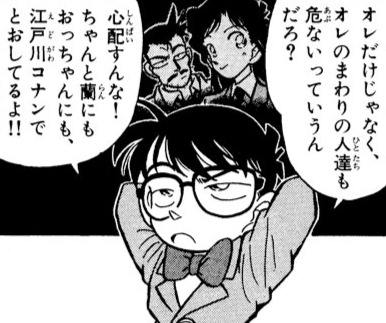
After Shin’ichi was forced to take a deadly drug that instead shrank him back to a child, he took on the undercover name Conan and went to stay with his childhood friend Ran and her detective father in the hope of a lead to the black-clad men who drugged him. He later discusses with Professor Agasa about how useless Detective Mouri is. The professor reminds Conan that the poison was supposed to have killed him, so he can’t rush and let others know his true identity.
コナン:
「オレだけじゃなく、オレのまわりの人達( ひとたち ) も危( あぶ ) ないっていうんだろ?」
“You're saying it won't be just me, but the people around me will be in danger too, right?”
「心配( しんぱい ) 蘭( らん ) にもおっちゃんにも、江戸川( えどがわ ) コナンでとおしてるよ!!」
“Don't worry! I'm keeping up the Conan Edogawa act with Ran and the old man, too!!”
Challenge Yourself
Show translation
Challenge
Who does Conan say would be in danger if his situation became known?
Clues
オレだけじゃなく
not just me
オレのまわりの人達( ひとたち ) も危( あぶ ) ない
the people around me would be in danger too
What does the speaker mean?
Both Conan and the people around him.
だけじゃなく...も expands the danger from Conan to the people around him.
Only Conan himself.
だけじゃなく explicitly says the danger would not stop with Conan.
Only Ran and Kogoro.
Conan refers more broadly to the people around him, not only those two.
Only the men dressed in black.
The black-clad men are the threat. Conan is describing who could be harmed by them.
Nobody, because Conan has already revealed his identity.
Conan says he is still maintaining his cover identity with Ran and Kogoro.
Professor Agasa, but not Conan.
Conan includes himself first, then adds the people around him.
Conan understands Agasa’s warning to mean that exposing his identity would endanger more than Conan alone. The paired pattern だけじゃなく…も includes everyone around him as well.
View Full Example
Example 4 of 4: Visiting at every break with 〜ごとに Example 4 of 4
ふだつきのキョーコちゃん »
Volume 1 » Page 11
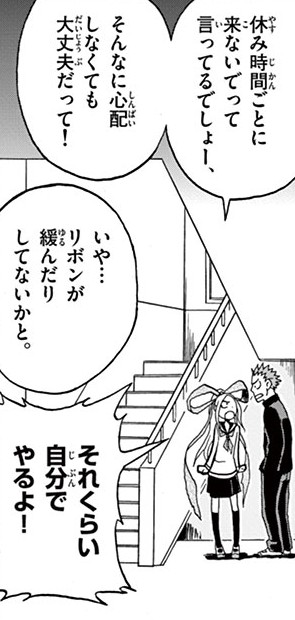
Due to concern about his sister’s ribbon, which seals away her need to attack people for their blood, Kenji takes every opportunity he can to check up on her in at school.
キョーコ:
「休( やす ) み時間( じかん ) ごとに来( こ ) ないでって言( い ) ってるでしょー、そんなに心配( しんぱい ) 大丈夫( だいじょうぶ ) だって!」
“I'm telling you, you don't need to check up on me every break period. I'll be fine even without you worrying about me!”
ケンジ:
「いや… リボンが緩( ゆる ) んだりしてないかと。」
“No, I'm just checking whether your ribbon's come loose.”
キョーコ:
「それくらい自分( じぶん ) でやるよ!」
“I can handle that much on my own!”
Challenge Yourself
Show translation
Challenge
What does Kyouko want Kenji to stop doing?
Clues
休( やす ) み時間( じかん ) ごとに来( こ ) ないでdo not come to see her at every break
そんなに心配( しんぱい ) しなくても大丈夫( だいじょうぶ )
she will be fine without him worrying so much
What does the speaker mean?
Visiting her at every break to check the ribbon.
休( やす ) み時間( じかん ) ごとに means at every break, and 来( こ ) ないで tells Kenji not to keep coming.
Coming to school whenever the ribbon is loose.
Kenji worries that the ribbon might loosen, but Kyouko objects to his visits at every break, not emergency help.
Telling other students why she wears the ribbon.
The complaint concerns how often Kenji checks on her. She does not mention him revealing her secret.
Asking her to tighten the ribbon by herself.
Kyouko says she can handle that herself. Kenji is the one repeatedly coming to check it.
Worrying about her only after the school day ends.
Kyouko wants less constant worry. She does not ask him to move the same checks to after school.
Waiting until each break before returning to class.
ごとに marks repeated visits during every break, not a request to wait before going back to class.
Kyouko wants Kenji to stop checking on her during every break. He is worried that her ribbon might come loose, but she insists that she can manage it herself and will be fine without so much attention.
View Full Example
Logistics
配達 (Delivery)配達( はいたつ ) means the delivery of letters, packages, meals, or other items to a recipient or destination.
It combines 配 (distribute ) with 達 (reach ) to show distribution that reaches the recipient .
それでも歩は寄せてくる »
Volume 6 » Page 4
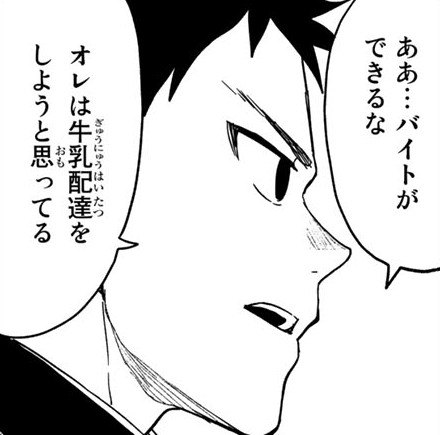
Takeru and Ayumu talk about now being in high school.
歩( あゆむ ) :「ああ…バイトができるな」
“Yeah, I can get a part-time job.”
「オレは牛乳( ぎゅうにゅう ) 配達( はいたつ )
“I'm thinking of doing milk delivery.”
Challenge Yourself
Show translation
Challenge
What part-time job is Ayumu considering?
Clues
バイトができるな
"Now I can get a part-time job."
オレは牛乳( ぎゅうにゅう ) 配達( はいたつ ) をしようと思( おも ) ってる
"I am thinking of doing milk delivery."
What does the speaker mean?
Delivering milk.
牛乳( ぎゅうにゅう ) 配達( はいたつ ) names milk delivery, and しようと思( おも ) ってる marks it as Ayumu's current plan.
Working at a shogi shop.
Ayumu discusses part-time work, but the job he names is milk delivery.
Studying instead of taking a job.
バイトができるな shows that he is pleased he can now work part time.
Delivering newspapers with Takeru.
The item being delivered is 牛乳( ぎゅうにゅう ) , milk, and Ayumu frames it as his own plan.
Helping at the school cafeteria.
No cafeteria appears in the line. The stated work is 牛乳( ぎゅうにゅう ) 配達( はいたつ ) .
Starting the job immediately that day.
しようと思( おも ) ってる describes an intention under consideration, not an immediate start.
Ayumu says he can now take a part-time job and follows with 牛乳( ぎゅうにゅう ) 配達( はいたつ ) をしようと思( おも ) ってる. He is thinking of delivering milk.
View Full Example