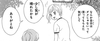
Dividing and portions with 分
The kanji 分 has the core meanings of divide and part .
It begins with the act of separating something into pieces. From there it grows into portions, categories, ingredients, analysis, and even “one’s share” or “one’s own part.”
Etymology
An ideogrammic compound , 分 combines 八 (“to separate”) + 刀 (“knife”), to mean separating something, as with a knife.
Breakdown
分解 (Decomposition)分解( ぶんかい ) means taking something apart or breaking it down into its components.
It combines 分 (divide ) with 解 (separate ) to show separating something into pieces .
老女的少女ひなたちゃん »
Volume 2 » Page 120
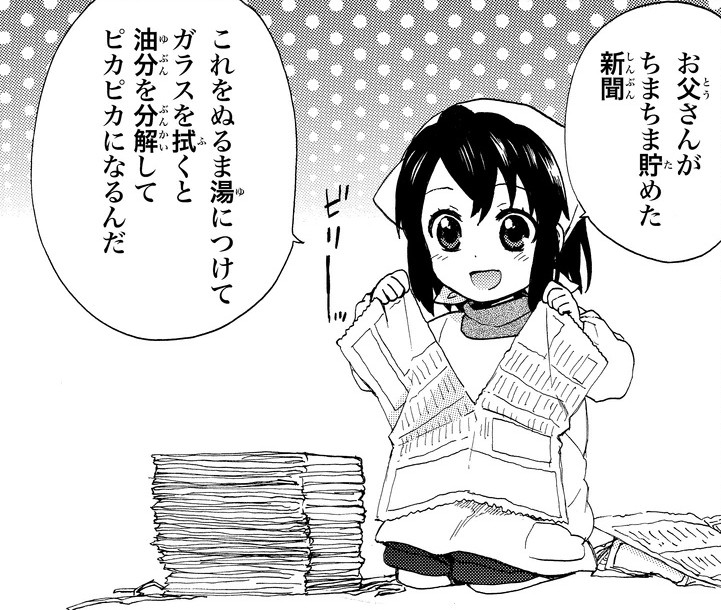
Hinata dedicates the month of December to giving her home a complete cleaning.
ひなた:
「お父さんがちまちま貯( た ) めた新聞( しんぶん ) …」
“The old newspapers Dad's been saving forever...”
「これをぬるま湯( ゆ ) につけてガラスを拭( ふ ) くと油分( ゆぶん ) を分解( ぶんかい )
“Soak them in warm water and wipe the glass, and they cut through the grease and get it sparkling clean.”
Challenge Yourself
Show translation
Challenge
What does Hinata say the soaked newspapers do when used on the glass?
Clues
油分( ゆぶん ) を分解( ぶんかい ) してthey break down the oily residue
ピカピカになるんだ
the result is that the glass becomes sparkling clean
What does the speaker mean?
They break down the grease and leave the glass sparkling.
油分を分解して describes breaking down the grease, and ピカピカになる gives the clean, shiny result.
They break the glass into pieces so it can be replaced.
The object marked by を is 油分, the grease, not the glass. 分解 acts on the residue.
They add an oily coating that protects the glass.
Hinata says the grease is broken down and removed, not added as a protective layer.
They polish the newspapers until the paper becomes shiny.
The newspapers are the cleaning tool. ピカピカになる describes the result on the glass.
They dissolve completely when placed in warm water.
The newspapers are soaked and then used to wipe the glass. The line does not say the paper dissolves.
They prevent Hinata's father from saving more newspapers.
Hinata repurposes the newspapers her father saved. She explains their cleaning effect, not a way to stop him collecting them.
Hinata soaks the old newspapers in warm water and uses them to wipe the glass. She says they break down the oily residue, which leaves the glass sparkling clean.
View Full Example
Components
成分 (Component)成分( せいぶん ) means the ingredients or components that make up a substance or product.
It combines 成 (form ) with 分 (part ) to show the parts that form something .
名探偵コナン »
Volume 14 » Page 15
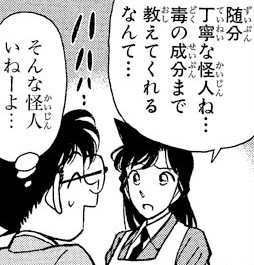
A client tells Detective Mouri about the condition in which she found her deceased husband. Hearing the details, Conan identifies the likely poison, including the composition, the dosage required to kill, and the internal effects it has on a person. When Ran asks how he knows all this, Conan covers by saying the monster villain on the kid’s TV show he watched explained it.
蘭( らん ) :「随分( ずいぶん ) 丁寧( ていねい ) な怪人( かいじん ) ね… 毒( どく ) の成分( せいぶん ) 教( おし ) えてくれるなんて…」
“What a polite villain... Going so far as to tell the poison's composition...”
コナン:
「そんな怪人( かいじん ) いねーよ…」
“No such monster exists...”
Challenge Yourself
Show translation
Challenge
What makes Ran sarcastically call the television villain considerate?
Clues
毒( どく ) の成分( せいぶん ) までeven the poison's composition
教( おし ) えてくれるなんてto think that he would tell you
What does the speaker mean?
He supposedly explained even the poison's composition.
まで shows that the implausibly detailed explanation went as far as the chemical composition.
He warned viewers never to use poison.
Ran focuses on the technical information he supposedly provided, not a safety warning.
He gave Conan an antidote.
No antidote is mentioned. Conan claims the show supplied his knowledge.
He politely apologized to every victim.
丁寧( ていねい ) is sarcastic here because of the thorough explanation.
He concealed the poison's identity from Conan.
The supposed villain did the opposite by explaining its composition.
He taught Ran how to make a television program.
The information concerns the poison, not producing the show.
Ran mocks Conan’s excuse by imagining a villain helpful enough to explain even the poison’s chemical makeup. Conan’s reply admits that no such villain exists.
View Full Example
油分 (Oil content)油分( ゆぶん ) means the oil or fat contained in something. It can also refer to oily residue on a surface.
It combines 油 (oil ) with 分 (component ) to show the oily component of something .
老女的少女ひなたちゃん »
Volume 2 » Page 120
Hinata dedicates the month of December to giving her home a complete cleaning.
ひなた:
「お父さんがちまちま貯( た ) めた新聞( しんぶん ) …」
“The old newspapers Dad's been saving forever...”
「これをぬるま湯( ゆ ) につけてガラスを拭( ふ ) くと油分( ゆぶん ) 分解( ぶんかい ) してピカピカになるんだ」
“Soak them in warm water and wipe the glass, and they cut through the grease and get it sparkling clean.”
Challenge Yourself
Show translation
Challenge
What does Hinata say the soaked newspapers do when used on the glass?
Clues
油分( ゆぶん ) を分解( ぶんかい ) してthey break down the oily residue
ピカピカになるんだ
the result is that the glass becomes sparkling clean
What does the speaker mean?
They break down the grease and leave the glass sparkling.
油分を分解して describes breaking down the grease, and ピカピカになる gives the clean, shiny result.
They break the glass into pieces so it can be replaced.
The object marked by を is 油分, the grease, not the glass. 分解 acts on the residue.
They add an oily coating that protects the glass.
Hinata says the grease is broken down and removed, not added as a protective layer.
They polish the newspapers until the paper becomes shiny.
The newspapers are the cleaning tool. ピカピカになる describes the result on the glass.
They dissolve completely when placed in warm water.
The newspapers are soaked and then used to wipe the glass. The line does not say the paper dissolves.
They prevent Hinata's father from saving more newspapers.
Hinata repurposes the newspapers her father saved. She explains their cleaning effect, not a way to stop him collecting them.
Hinata soaks the old newspapers in warm water and uses them to wipe the glass. She says they break down the oily residue, which leaves the glass sparkling clean.
View Full Example
Degree and Extent
随分 (Awfully)随分( ずいぶん ) means considerably, very, or awfully.
This compound uses 随 (follow ) to give the word its sense of awfully .
名探偵コナン »
Volume 14 » Page 15
A client tells Detective Mouri about the condition in which she found her deceased husband. Hearing the details, Conan identifies the likely poison, including the composition, the dosage required to kill, and the internal effects it has on a person. When Ran asks how he knows all this, Conan covers by saying the monster villain on the kid’s TV show he watched explained it.
蘭( らん ) :「随分( ずいぶん ) 丁寧( ていねい ) な怪人( かいじん ) ね… 毒( どく ) の成分( せいぶん ) まで教( おし ) えてくれるなんて…」
“What a polite villain... Going so far as to tell the poison's composition...”
コナン:
「そんな怪人( かいじん ) いねーよ…」
“No such monster exists...”
Challenge Yourself
Show translation
Challenge
What makes Ran sarcastically call the television villain considerate?
Clues
毒( どく ) の成分( せいぶん ) までeven the poison's composition
教( おし ) えてくれるなんてto think that he would tell you
What does the speaker mean?
He supposedly explained even the poison's composition.
まで shows that the implausibly detailed explanation went as far as the chemical composition.
He warned viewers never to use poison.
Ran focuses on the technical information he supposedly provided, not a safety warning.
He gave Conan an antidote.
No antidote is mentioned. Conan claims the show supplied his knowledge.
He politely apologized to every victim.
丁寧( ていねい ) is sarcastic here because of the thorough explanation.
He concealed the poison's identity from Conan.
The supposed villain did the opposite by explaining its composition.
He taught Ran how to make a television program.
The information concerns the poison, not producing the show.
Ran mocks Conan’s excuse by imagining a villain helpful enough to explain even the poison’s chemical makeup. Conan’s reply admits that no such villain exists.
View Full Example
Measures
五分 (Five minutes or fifty percent)五分( ごふん ) means five minutes. With the reading 五分( ごぶ ) , it means five tenths, or half.
It combines 五 (five ) with 分 (part ) to indicate a division into five parts.
カードキャプターさくら »
Volume 1 » Page 22
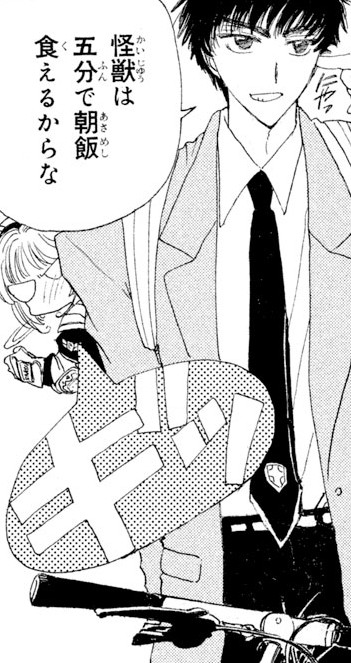
At breakfast, Touya teases Sakura for stomping down the stairs like a giant monster. He finishes eating and heads out on his bike to meet his friend Yukito on their way to school. Sakura hurries to eat her breakfast and get her roller blades on, so she can see Yukito, too. When they reach Yukito, he commends Sakura for being up early.
桃矢( とうや ) :「怪獣( かいじゅう ) は五分( ごふん ) 朝飯( あさめし ) 食( く ) えるからな」
“Well, monsters can finish breakfast in five minutes.”
Challenge Yourself
Show translation
Challenge
What does Touya imply by calling Sakura 怪獣?
Clues
怪獣( かいじゅう ) giant monster
五分( ごふん ) でin five minutes
朝飯( あさめし ) breakfast, in rough casual speech
食( く ) えるcan eat, the potential form of the rough verb (食:く)う
からな
gives the reason with an assertive ending
What does the speaker mean?
He teases that, as a monster, she can finish breakfast in five minutes.
Touya jokingly treats 怪獣( かいじゅう ) as Sakura's identity and uses it to explain why she can eat so quickly.
He warns that a monster will steal her breakfast in five minutes.
怪獣( かいじゅう ) is the topic that can eat the breakfast. Nothing in the line says another monster will arrive or steal it.
He orders her to wait five minutes before eating.
五分( ごふん ) で marks the time needed to complete the eating. It does not mean to wait for five minutes.
He says that monsters eat breakfast every five minutes.
Here で marks the span needed to finish an action, not how often the action repeats.
He praises her for choosing a healthy breakfast.
The line says nothing about what the breakfast contains. The joke is about how quickly the monster can eat it.
He admits that he cannot finish his own breakfast.
食( く ) える is affirmative, can eat, and its topic is 怪獣( かいじゅう ) . Touya is teasing Sakura rather than describing himself.
Touya continues his monster joke by making 怪獣( かいじゅう ) the topic. 五分( ごふん ) で says how quickly the meal can be finished.
View Full Example
Personal Identity
自分 (Oneself)自分( じぶん ) means oneself, myself, yourself, or one’s own, depending on context.
It combines 自 (self ) with 分 (part ) to show one's own part .
名探偵コナン »
Volume 16 » Page 91
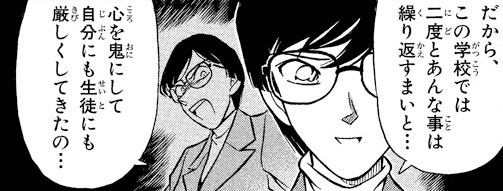
Conan’s classmates aren’t fond of their new teacher’s strict attitude. Ms. Kobayashi explains how at her last school, she couldn’t bring herself to be strict, and it allowed her students to get so out of control that students were injured in a fight.
小林( こばやし ) :「だから、この学校( がっこう ) では二度( にど ) とあんな事( こと ) は繰( く ) り返( かえ ) すまいと…」
“Therefore, to keep from repeating that kind of situation at this school...”
「心( こころ ) を鬼( おに ) にして自分( じぶん ) 生徒( せいと ) にも厳( きび ) しくしてきたの…」
“I hardened my heart and became strict, with myself and with my students...”
Challenge Yourself
Show translation
Challenge
How did Ms. Kobayashi respond to the trouble at her previous school?
Clues
心( こころ ) を鬼( おに ) にしてhardening her heart
自分( じぶん ) にも生徒( せいと ) にも厳( きび ) しくしてきたshe has been strict with herself and her students
What does the speaker mean?
She made herself strict with both herself and her students.
心( こころ ) を鬼( おに ) にして explains the resolve behind her continuing strictness.
She decided never to teach children again.
She remained a teacher and changed how strictly she managed the class.
She became strict only with the injured students.
自分( じぶん ) にも生徒( せいと ) にも includes herself and all her students.
She asked another teacher to discipline the class.
The line describes the stance she herself has maintained.
She tried to forget what had happened.
Her goal is to avoid repeating the incident, so she acts on the lesson she learned.
She allowed the students to set their own rules.
Her response was greater strictness, not less supervision.
Determined not to repeat the earlier incident, Ms. Kobayashi hardened her heart and became strict with herself as well as her students.
View Full Example