Eating and food with 食
食 conveys both the action of “eating” and the concept of “food” or “a meal”.
- Grade 2
- JLPT N5 (estimate)
- WaniKani level 6
- 9 strokes
Words with 食
- Eating Activities
- 食べる たべる To eat
- 食う くう To eat
- 試食 ししょく Food tasting
- 大食い おおぐい Big eater
- 食べかけ たべかけ Half-eaten
- Meals
- 食事 しょくじ Meal
- 夕食 ゆうしょく Dinner
- 朝食 ちょうしょく Breakfast
- 給食 きゅうしょく School lunch
- 給食当番 きゅうしょくとうばん Lunch duty
- Food Supply
- 食材 しょくざい Ingredients
- 食料 しょくりょう Food supplies
- 食品 しょくひん Food product
- 食べもの たべもの Food
- Eating Places
- 食堂 しょくどう Dining hall
- Appetite
- 食欲 しょくよく Appetite
- Eating Tools
- 食器 しょっき Tableware
- Expressions
The bold kana are the part 食 contributes. Words in a dashed box have no manga example yet.
How to Read 食
しょく in compounds. Two verbs share the kanji. 食べる is the ordinary word for eating. 食う is rougher, and mostly male speech.
く voices to ぐ after another word, as in 大食い.
Etymology
This kanji is a pictograph of the shape of a food vessel with a lid or cover.
Eating Activities
食べる (たべる) (To eat)
食べる is to put food in your mouth, chew, and swallow it.
Example 1 of 14: According to the rules with 〜によると
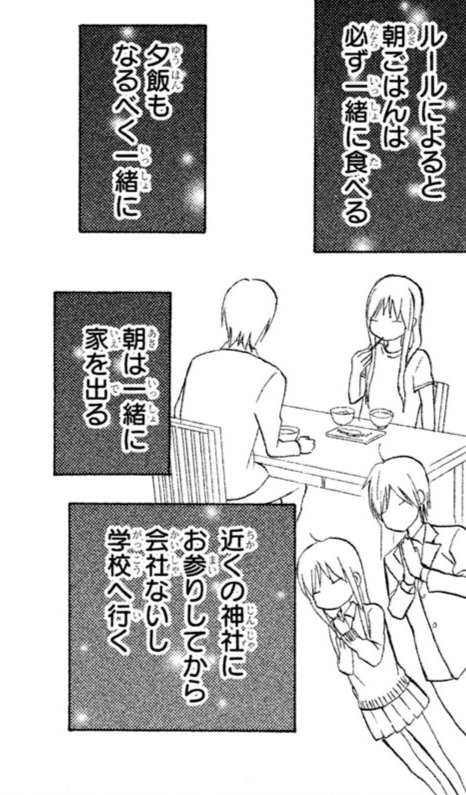
Now that Mao is living at Hiro’s house, Hiro presents her with a list of rules. Before going to bed, Mao looks the list over.
- 真魚:
- 「ルールによると朝ごはんは必ず一緒に食べる」
- “According to the rules, we must always eat breakfast together.”
- 「夕飯もなるべく一緒に」
- “We should eat dinner together too, as often as possible.”
- 「朝は一緒に家を出る」
- “We leave the house together in the morning.”
- 「近くの神社にお参りしてから会社ないし学校へ行く」
- “After praying at the nearby shrine, we go to work or school.”
Example 2 of 14: Amount eaten with 〜分
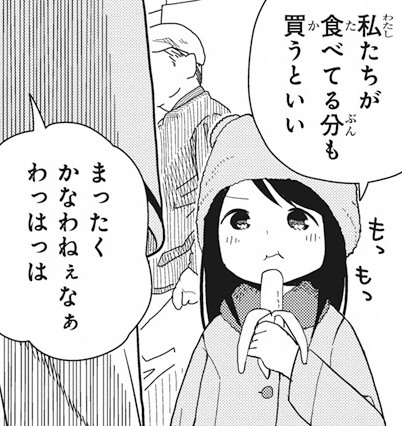
Sacchan and her friends are tasked with going around and selling excess bananas from her mother’s fruit shop. They offer a banana to a shop owner, and when he eats it, Sacchan says he needs to pay for it. The owner realizes he fell for their trap, but offers to buy a bunch.
- 琴葉:
- 「私たちが食べてる分も買うといい」
- “You should also buy the amount we're eating.”
- おやじ:
- 「まったく。かなわねぇなぁ。わっはっは」
- “Good grief, I'm outclassed. Wahahah!”
Example 3 of 14: Finishing her noodles for her with 〜きれない
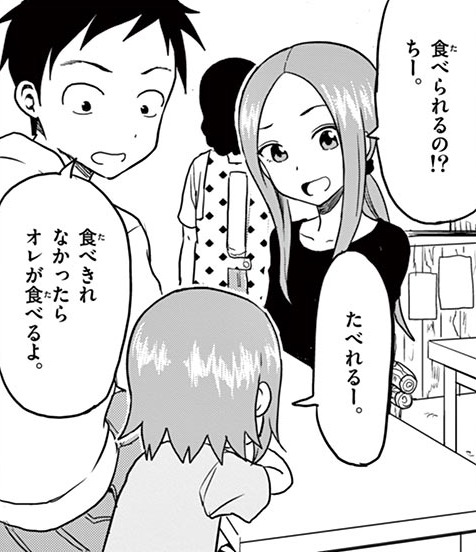
Nishikata, Takagi, and their daughter Chii stop at a restaurant that serves fresh soumen noodles. Nishikata orders a large serving, and Chii asks for a large one too.
- 高木:
- 「食べられるの!? ちー。」
- “You can eat that much, Chii?!”
- ちー:
- 「たべれるー。」
- “I can!”
- 西片:
- 「食べきれなかったらオレが食べるよ。」
- “If you can't finish it, I'll eat the rest.”
Example 4 of 14: Having you eat carrots for me with 〜てもらう
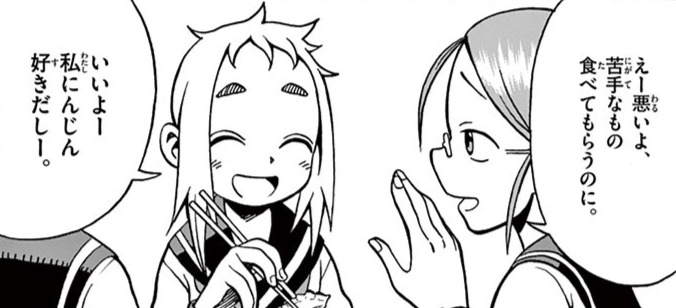
Yukari offers Mina the carrots from her lunch, as Yukari doesn’t like carrots. Mina gladly accepts them and offers Yukari one of her dumplings in return.
- ユカリ:
- 「えー悪いよ、苦手なもの食べてもらうのに。」
- “Eh~, I feel bad making you eat something I don't like.”
- ミナ:
- 「いいよー 私にんじん好きだしー。」
- “It's fine~ I like carrots anyway~.”
Example 5 of 14: Heating leftover pancakes with チンする
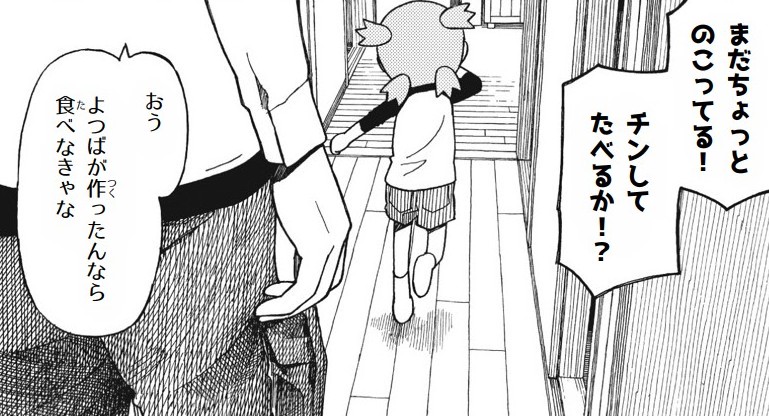
During Jumbo’s visit, Yotsuba tells him she made pancakes earlier.
- よつば:
- 「まだちょっとのこってる!チンしてたべるか!?」
- “There's some left over! Shall I heat it up to up to eat?”
- ジャンボ:
- 「おう。よつばが作ったんなら食べなきゃな」
- “Sure. If you made them, I have to eat some.”
Example 6 of 14: Hoping baked bread is tasty with 〜といい
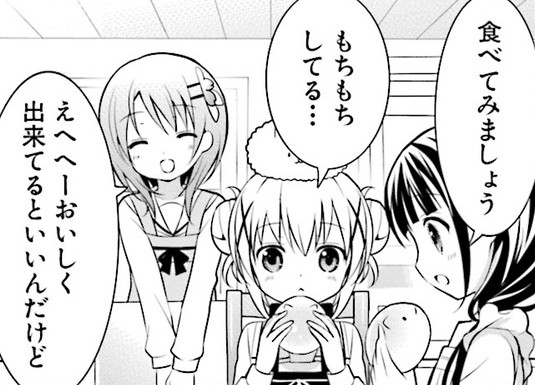
After teaching her friends how to bake bread, Cocoa surprises them with a special menu item she created.
- 千夜:
- 「食べてみましょう」
- “Let's try it.”
- チノ:
- 「もちもちしてる…」
- “It's so soft and chewy...”
- ココア:
- 「えへへーおいしく出来てるといいんだけど」
- “I hope it came out tasty, but...”
Example 7 of 14: Indiscriminate murder would be one thing if with 〜ならともかく
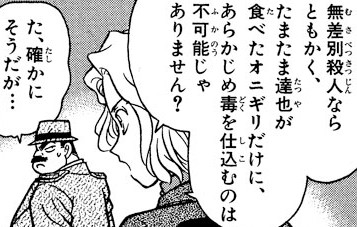
Sonoko is invited to a band’s after party. During the get-together, the band’s singer Tatsuya eats a rice ball only to collapse and die. The police are called in, and Inspector Megure discovers the victim was poisoned. He accuses the man who prepared the food, but Conan bites into a rice ball to show it’s safe. The victim’s manager, Mari, agrees.
- 麻理:
- 「無差別殺人ならともかく、たまたま達也が食べたオニギリだけに、あらかじめ毒を仕込むのは不可能じゃありません?」
- “If it were indiscriminate murder, that's one thing but since it was just the rice ball Tatsuya happened to eat, wouldn't it be impossible to poison it beforehand?”
- 目暮:
- 「た、確かにそうだが…」
- “Th-that's true, but...”
Example 8 of 14: Lunch on the rooftop with 屋上
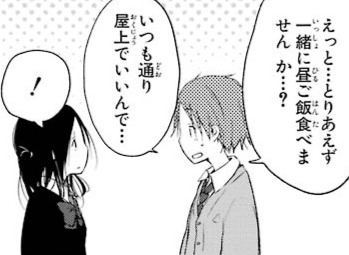
After Hase finally became friends with Fujimiya, her warning came to pass: her weekly memory reset, which causes her to forget her friends on Monday morning, left her with no recollection of spending time with Hase last week. Hase asks Fujimiya to be his friend, but realizes that it was too sudden, so he decides to create an opportunity to remind her of last week.
- 長谷:
- 「えっと…とりあえず 一緒に昼ご飯食べません か…?」
- “Um, for now, how about we have lunch together...?”
- 「いつも通り屋上でいいんで…」
- “On the rooftop, as usual, is fine...”
Example 9 of 14: No time to leisurely eat with 呑気
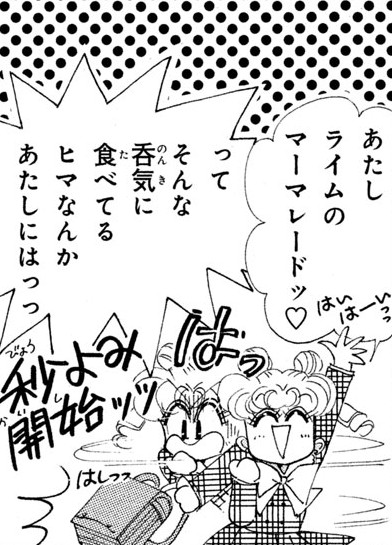
After an enemy attack changes Usagi and Mamoru into kids, Usagi wakes to find the two of them living together as a couple. As Usagi wanders into the dining room, Mamoru is placing a plate of french toast on the table. He greets her and asks Usagi what type of jam she wants on her toast. Usagi responds, then realizes she needs to get to school.
- うさぎ:
- 「あたし ライムのマーマレードッ」
- “I'll have lime marmalade!”
- 「ってそんな呑気に食べてるヒマなんかあたしにはっっ」
- “Ah, I don't have any time to be leisurely eating!”
Example 10 of 14: Sent with a gift from mom with 〜される
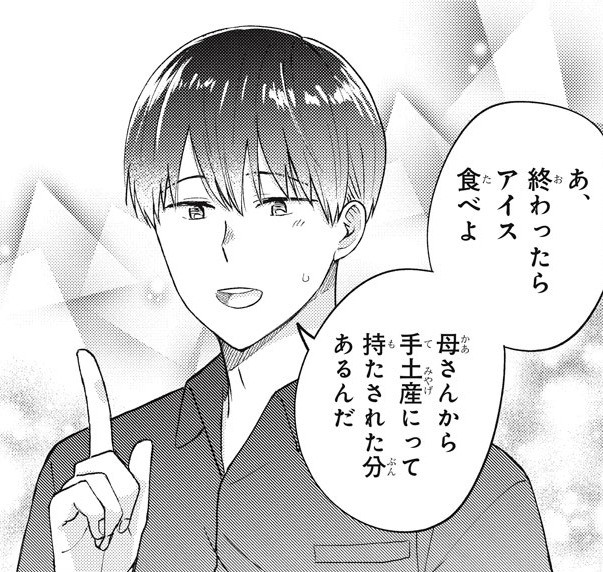
With summer vacation almost over, Makoto still hasn’t finished her homework. Tsukasa comes over to cheer her on through her last assignment, but she soon slumps over the table, worn out.
- 司:
- 「あ、終わったらアイス食べよ」
- “Oh, let's have ice cream when you're done.”
- 「母さんから手土産にって持たされた分あるんだ」
- “My mom sent me over with some as a gift.”
Example 11 of 14: Too easily lured by food with 釣られる
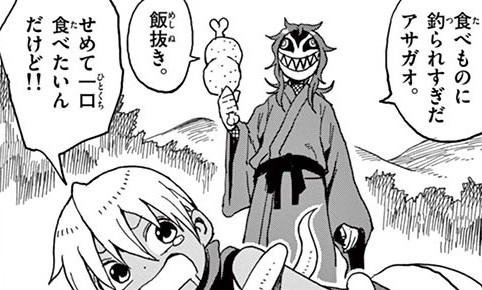
Ms. Hana has canceled lessons for a game of tag. She plays a man chasing the students, to teach them to run from men, and anyone she catches goes without dinner. While the girls hide, a drumstick of meat lies out in the open. Asagao leaps for it, ignoring a warning that it’s an obvious trap, and snakes wrap around her.
- ハナ先生:
- 「食べものに釣られすぎだアサガオ。」
- “You're way too easy to lure with food, Asagao.”
- 「飯抜き。」
- “No dinner for you.”
- アサガオ:
- 「せめて一口食べたいんだけど!!」
- “At least let me have one bite!”
Example 12 of 14: Want you to eat my rice ball with 〜てほしい
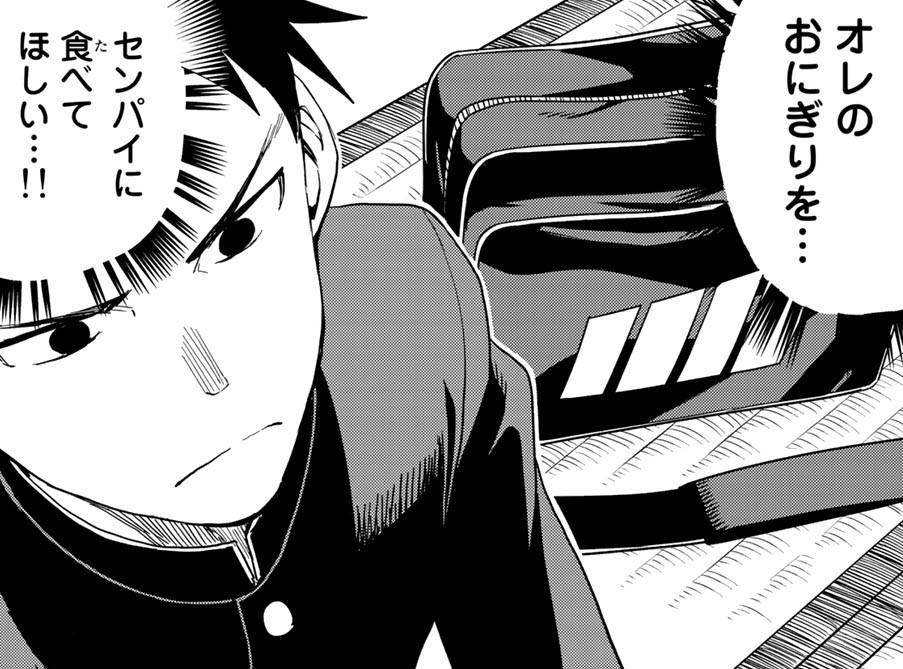
As they start a shogi game after school, Ayumu hears Urushi’s stomach growl. She pretends there wasn’t a sound, but Ayumu realizes she’s hiding that she’s hungry. If he can avoid embarrassing her, Ayumu has the solution in his school bag.
- 歩:
- 「オレのおにぎりを… センパイに食べてほしい…!!」
- “I want her to eat my rice ball.”
Example 13 of 14: Wanted you to eat the cookies I baked with 〜てほしかった
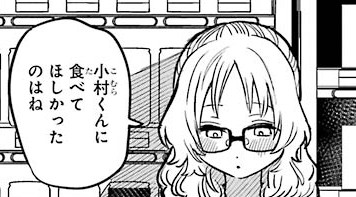
During cooking class, Komura has trouble concentrating as the girl he likes, Mie, and another boy who seems to like her, Azuma, are teamed up and seem to be getting along well together. After class, Komura sulks away. On his way home, Mie catches up with him. She gives him a bag with the cookies she baked in class.
- 三重:
- 「小村くんに食べてほしかったのはね」
- “I wanted you to eat them.”
Example 14 of 14: Worth making a meal with 〜甲斐がある
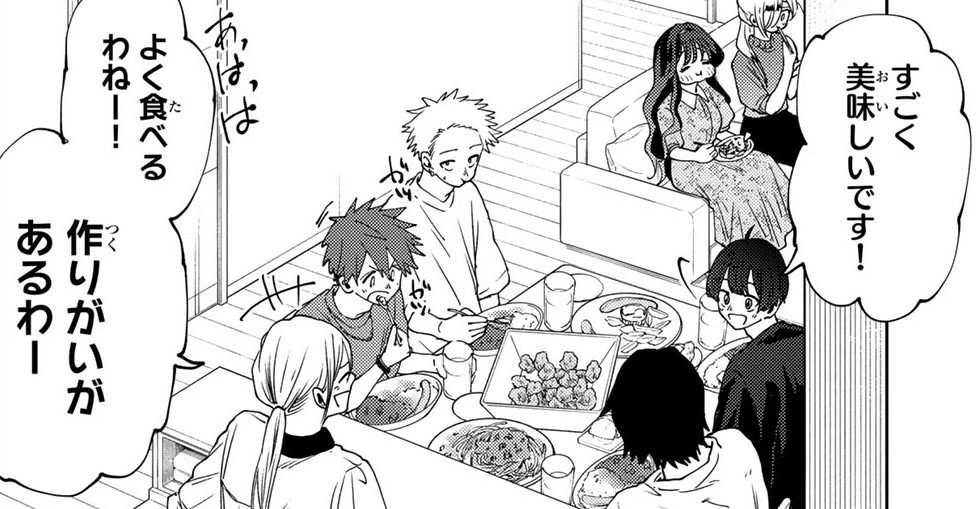
Rintaro’s mother is overjoyed when her son has friends over for the first time in his life. She prepares a large meal for them to eat.
- 絢斗:
- 「すごく美味しいです!」
- “This is incredibly delicious!”
- 杏子:
- 「よく食べるわね! 作りがいがあるわー」
- “You sure do eat a lot! It makes cooking worthwhile!”
食う (くう) (To eat)
食う is a rough, casual word for “to eat”, used mostly by men.
Example 1 of 3: Eating breakfast like a giant monster with 怪獣
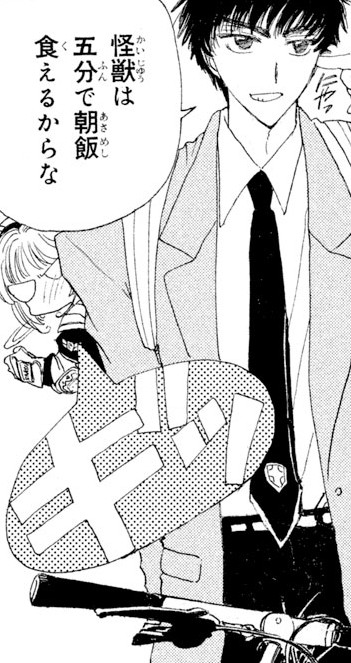
At breakfast, Touya teases Sakura for stomping down the stairs like a giant monster. He finishes eating and heads out on his bike to meet his friend Yukito on their way to school. Sakura hurries to eat her breakfast and get her roller blades on, so she can see Yukito, too. When they reach Yukito, he commends Sakura for being up early.
- 桃矢:
- 「怪獣は五分で朝飯食えるからな」
- “Well, monsters can finish breakfast in five minutes.”
Example 2 of 3: Don't make me laugh with 笑わせんな
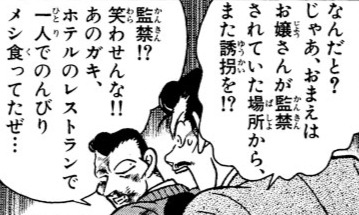
Ran and Kogoro find the kidnapped Akiko and they apprehend the kidnapper. Believing the butler to have arranged the kidnapping, Kogoro accuses the kidnapper being an accomplice. The kidnapper denies working with someone, saying he encountered the child in the hotel by chance.
- 小五郎:
- 「なんだと?じゃあ、おまえはお嬢さんが監禁されていた場所から、また誘拐を!?」
- “What?! So you kidnapped her all over again, from the very place where the young lady was being held captive!?”
- 誘拐犯:
- 「監禁!?笑わせんな!!あのガキ、ホテルのレストランで一人でのんびりメシ食ってたぜ…」
- “Held captive?! Don't make me laugh!! That brat was eating a leisurely meal all by herself in the hotel restaurant...”
Example 3 of 3: I'd have to trade side dishes with 〜なきゃなんねー
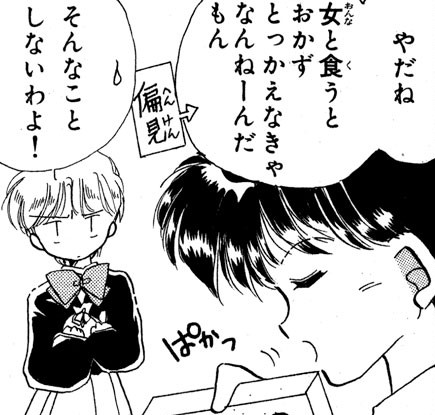
Rina asks Asuka Jr. if she can eat lunch with him.
- アスカ Jr.:
- 「やだね」
- “No way.”
- 「女と食うとおかずとっかえなきゃなんねーんだもん」
- “If I eat with a girl, I'd have to swap side dishes.”
- リナ:
- 「そんなことしないわよ!」
- “I wouldn't do that!”
試食 (ししょく) (Food tasting)
試食 means tasting a food to check it or offering a sample to customers.
It combines 試 (test) with 食 (eat) to show try out eating something.
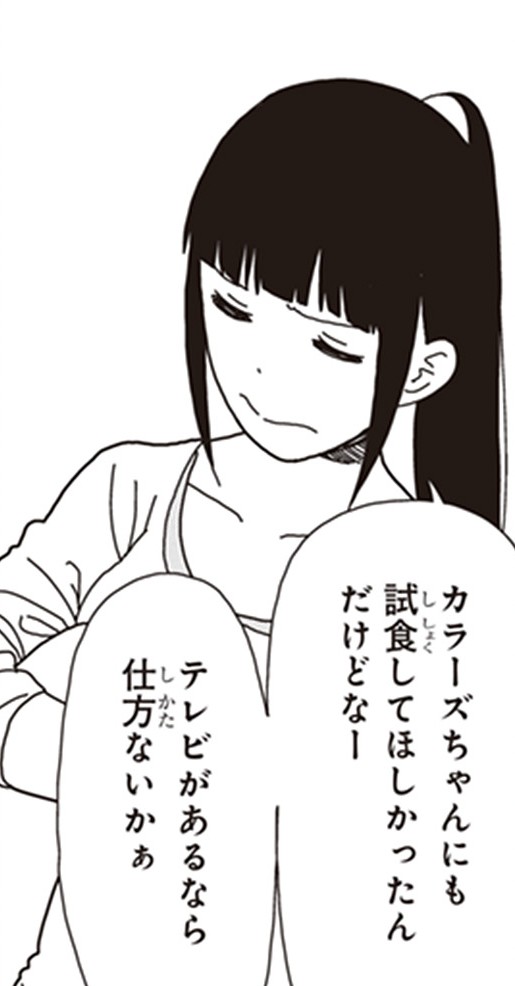
Momoka notices the trio Colors pestering a television cameraman. She intervenes to help him, telling the girls that she is heading to her family’s bakery to have taste-testing of her new type of rice ball.
- ももか:
- 「カラーズちゃんにも試食してほしかったんだけどなー」
- “I wanted you all to do some taste-testing as well, but...”
- 「テレビがあるなら仕方ないかぁ」
- “If it's television, it can't be helped, huh?”
食べかけ (たべかけ) (Half-eaten)
食べかけ describes food someone started eating and didn’t finish. It can modify a noun with の, as in 食べかけのパン.
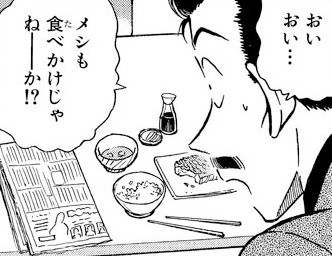
A woman has hired Kogoro to find Shibata Shiro, a man she knew thirty years ago, and they track him to his apartment. Nobody answers the bell, but Shibata’s friend Yoshikawa arrives for a mahjong game and insists Shibata must be asleep. They find the door unlocked and the TV on, so they go in.
- 小五郎:
- 「おいおい…」
- “Hey, hey...”
- 小五郎:
- 「メシも食べかけじゃね――か!?」
- “He even left his meal half-eaten!?”
Meals
食事 (しょくじ) (Meal)
食事 is a meal, or the act of eating one.
It combines 食 (eat) with 事 (matter) to show the matter of eating.
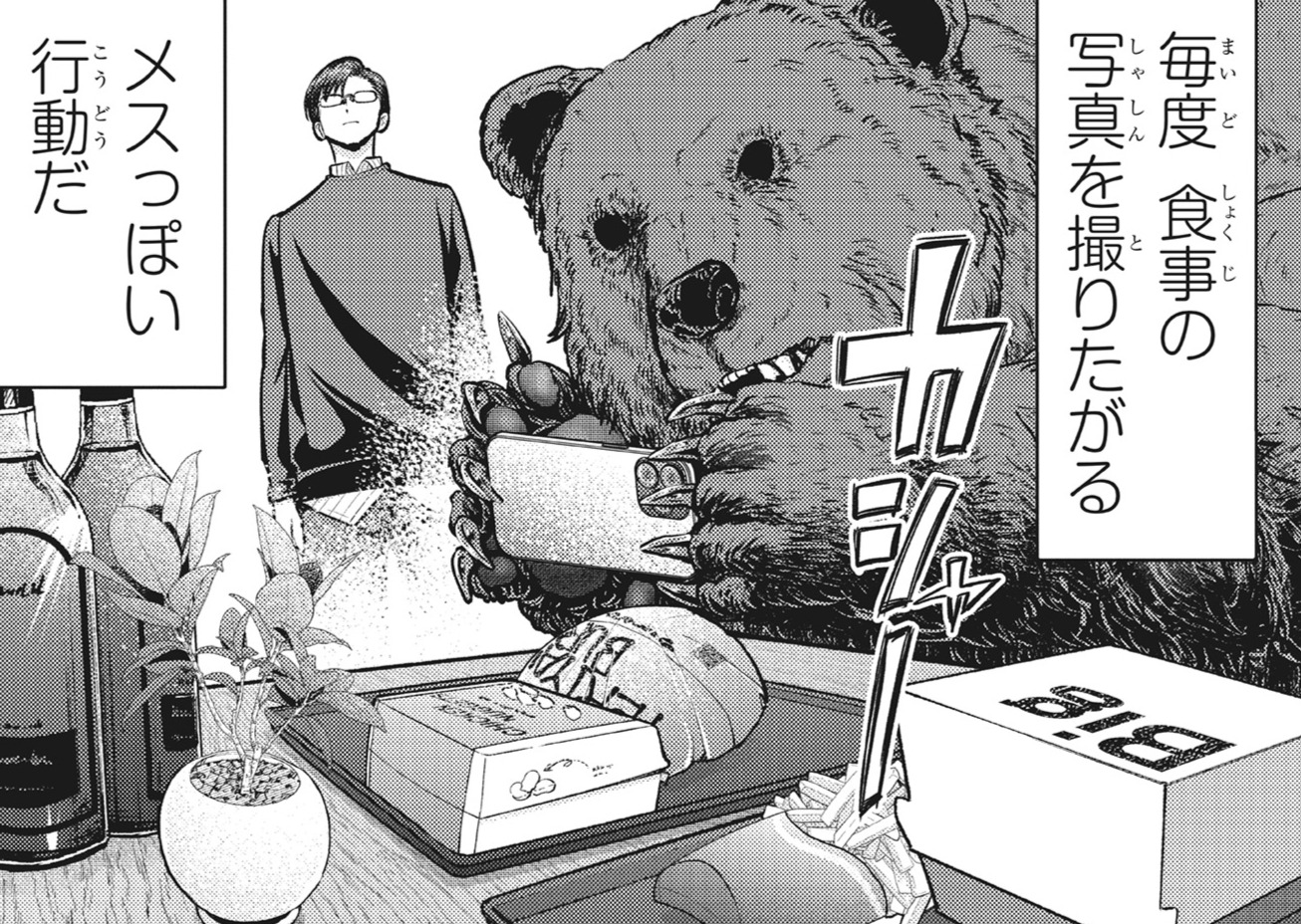
Kumada observes the bear that’s been living in his apartment for a while now, trying to determine from its personality traits whether it’s male or female.
- (熊田):
- 「毎度 食事の写真を撮りたがる」
- “It always wants to take photos of its meals.”
- 「メスっぽい行動だ」
- “That's female-like behavior.”
給食 (きゅうしょく) (School lunch)
給食 means meals regularly provided by a school, workplace, or hospital. It most often refers to Japanese school lunches.
It combines 給 (provide) with 食 (meal) to show a meal that is provided.
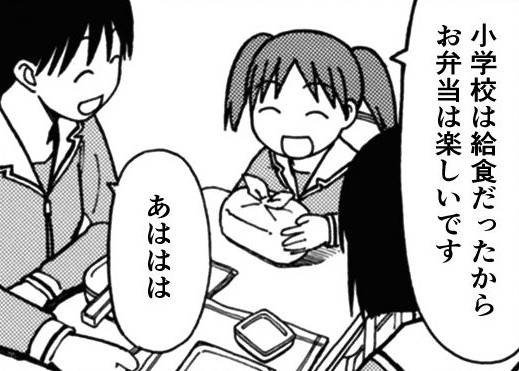
Chiyo is a child prodigy who’s skipped from elementary school to high school.
During her first day of class, Chiyo is invited by a couple of classmates to join them for lunch.
- ちよ:
- 「小学校は給食だったからお弁当は楽しいです」
- “Since we were provided lunches in elementary school, a boxed lunch is fun.”
給食当番 (きゅうしょくとうばん) (Lunch duty)
給食当番 is the job of serving school lunch to classmates, done in turns.
It combines 給食 (school lunch) with 当番 (duty) to show duty serving school lunch.
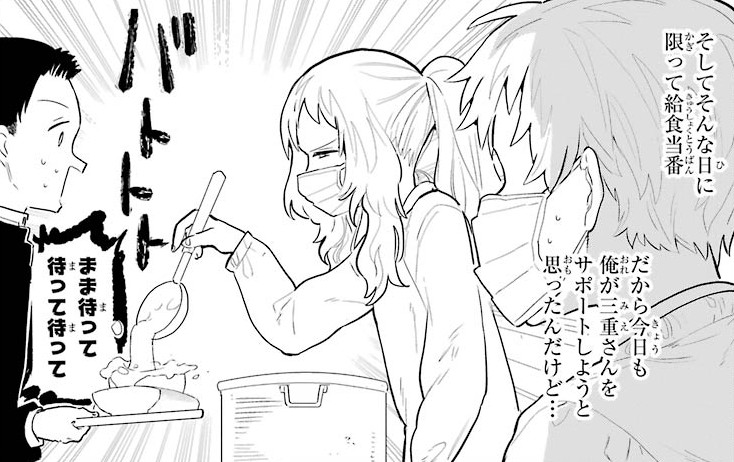
Komura and Mie have serving duty in the cafeteria. Normally this wouldn’t be an issue, except today Mie accidentally stepped on her glasses and broke them, and can barely see without them.
- 小村:
- 「そしてそんな日に限って給食当番」
- “Thus, on a day such as that (of all days), she has lunch duty.”
- 「だから今日も俺が三重さんをサポートしようと思ったんだけど…」
- “Therefore, I thought I'd support Mie today as well, but...”
- 男の子:
- 「まま待って待って待って」
- “W-w-wait, wait, wait!”
Food Supply
食品 (しょくひん) (Food product)
食品 refers to food as a product, including ingredients and ready-to-eat items.
It combines 食 (food) with 品 (product) to show food treated as a product.
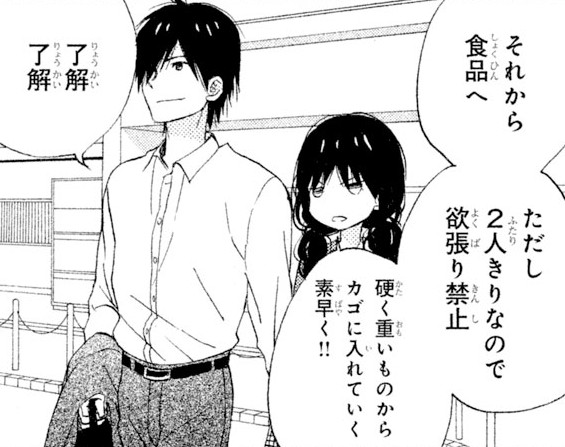
Mao needs Hiro to go grocery shopping with her due to a sale that’s limited per customer. She tells him the plan is to start by grabbing everyday household items first.
- 真魚:
- 「それから食品へ」
- “Then move on to food.”
- 「ただし2人きりなので欲張り禁止」
- “But since it's just the two of us, no hoarding allowed!”
- 「硬く重いものからカゴに入れていく素早く!!」
- “We'll fill the basket as we go, starting with the hard, heavy stuff. Fast!!”
- 基:
- 「了解 了解」
- “Roger that.”
食べもの (たべもの) (Food)
食べもの is anything people eat. It is a mixed spelling of 食べ物.
Ms. Hana has canceled lessons for a game of tag. She plays a man chasing the students, to teach them to run from men, and anyone she catches goes without dinner. While the girls hide, a drumstick of meat lies out in the open. Asagao leaps for it, ignoring a warning that it’s an obvious trap, and snakes wrap around her.
- ハナ先生:
- 「食べものに釣られすぎだアサガオ。」
- “You're way too easy to lure with food, Asagao.”
- 「飯抜き。」
- “No dinner for you.”
- アサガオ:
- 「せめて一口食べたいんだけど!!」
- “At least let me have one bite!”
Expressions
気に食わない (きにくわない) (Distasteful)
気に食わない describes someone or something one does not like and finds irritating.
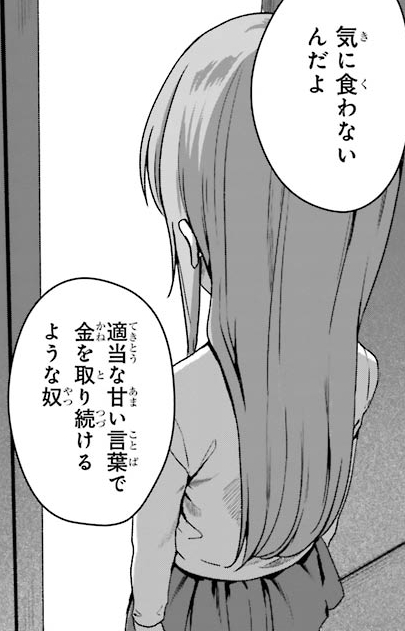
Following the death of their parents, Kanami’s big brother Kazutaka became secluded and abusive. Kanami begins to spend time with Makoto, a “rental big brother” whose advice gives her hope in restoring her brother’s former kindness. Kazutaka rebukes her attempts, suggesting that Makoto’s filling her with nonsense ideas.
- 一敬:
- 「気に食わないんだよ」
- “He gets on my nerves.”
- 「適当な甘い言葉で金を取り続けるような奴」
- “He's the kind of guy who keeps taking (rental) money while spouting alluring words.”
Building Bigger Words
These patterns come up again and again in manga. Learn the pattern and you can read words you've never seen.
食べ〜 たべ (eating)
- 食べ物 たべもの food
- 食べ方 たべかた how to eat something
- 食べ放題 たべほうだい all you can eat
〜食 しょく (a meal)
- 定食 ていしょく set meal
- 夜食 やしょく late-night snack
- 外食 がいしょく eating out
- 学食 がくしょく school cafeteria
〜食 しょく (a kind of food)
- 和食 わしょく Japanese food
- 洋食 ようしょく Western-style food
食〜 しょく (to do with meals)
- 食卓 しょくたく dinner table
- 食費 しょくひ food budget
- 食感 しょっかん how a food feels in the mouth
Where 食 Breaks the Pattern
The meaning above carries you through most words. These are the ones where it won't, or where the reading is a surprise.
- 餌食 (えじき) prey
Read じき, a reading you will rarely see elsewhere. Beyond animals, it is anyone who falls victim to a scheme.
Check Yourself
What does 食 mean?
Eating and food.
Read These Without Furigana
食べる
食う
試食
食べかけ
食事
給食
Work Out a New Word
放題 after a verb means “as much as you like”. Read 食べ放題 in this line. What do you get for 3,000 yen?
「たった3千円で飲み放題食べ放題だよ。」
Show the answer
食べ放題, all you can eat. “For only 3,000 yen it’s all you can drink and all you can eat.”
食べる and 食う both mean to eat. Read both. Which one is rougher?
Show the answer
食べる and 食う. 食う is the rough one.