Electricity and communication with 電
電 primarily means “lightning” or “electricity”. It is used to refer to electrical energy and devices powered by it.
Etymology
The kanji is a phono-semantic compound made from 雨 (rain) and 申 as the sound-giving element, with the combined sense of lightning.
Communication
電話 (Telephone)電話( でんわ ) means a telephone, phone call, or the act of calling someone.
It combines 電 (electric ) with 話 (talk ) to show talk carried by electricity .
Example 1 of 2: A kidnapped daughter with 誘拐 Example 1 of 2
名探偵コナン »
Volume 1 » Page 66
At Professor Agasa’s request, Ran takes Conan home to see if her father will let him stay over for a while. When they reach Ran’s place, her detective father bursts out of the front door, saying he’s heading out on a job.
小五郎( こごろ ) :「さっき電話( でんわ )
“I just got a call!!”
「娘( むすめ ) が黒( くろ ) ずくめの男( おとこ ) に誘拐( ゆうかい ) されたと、親( おや ) から依頼( いらい ) が来( き ) た!!」
“A request came from the parent, saying his daughter was kidnapped by a man dressed in all black!!”
「オレの力( ちから ) を借( か ) りたいってな!!」
“He wants my help!!”
Challenge Yourself
Show translation
Challenge
What case request has Kogoro just received?
Clues
娘( むすめ ) が黒( くろ ) ずくめの男( おとこ ) に誘拐( ゆうかい ) されたa daughter was kidnapped by a man dressed in black
親( おや ) から依頼( いらい ) が来( き ) たa request came from the parent
What does the speaker mean?
A parent wants help finding a daughter kidnapped by a black-clad man.
The quoted report identifies the daughter as the victim and the black-clad man as the kidnapper.
A daughter wants Kogoro to investigate her missing father.
The request comes from the parent and concerns the kidnapped daughter.
A black-clad man wants protection from a parent.
The man is identified as the person who carried out the kidnapping.
The police want Kogoro to question a runaway child.
Kogoro says a parent called with a kidnapping case, not that the police assigned it.
A parent has found the daughter and wants the case closed.
The call asks to borrow Kogoro's help because the daughter has been taken.
A daughter reports that Kogoro was kidnapped.
The daughter is the subject of the receptive 誘拐( ゆうかい ) された.
A parent has asked Kogoro to help after a black-clad man kidnapped his daughter. The receptive marks the daughter as the victim, while に marks the kidnapper.
View Full Example
Example 2 of 2: Preparing to contact Asuka Jr. with 連絡 Example 2 of 2
怪盗セイント・テール »
Volume 2 » Page 164
Takamiya suspects Meimi is the magical thief Saint Tail. When Meimi is asked to model a wedding dress for a design contest where Saint Tail is going to appear, Takamiya decides to keep a close eye on her at the event. As Takamiya looks around the dressing room, Meimi asks what she’s doing.
高宮( たかみや ) :「電話( でんわ ) 思( おも ) って」
“I was just wondering where the phone is.”
「アスカと連絡( れんらく ) をとることになってるの」
“I'm supposed to get in touch with Asuka.”
スタッフ:
「ちょっと…あなた!」
“Hey… you!”
Challenge Yourself
Show translation
Challenge
電話( でんわ ) はどこかなと思( おも ) ってshe explains that she was wondering where the phone is
アスカと連絡( れんらく ) をとることになってる
there is an arrangement for her to contact Asuka
What does the speaker mean?
She is supposed to get in touch with Asuka.
連絡をとる says she will make contact with Asuka, and ことになってる presents it as an arranged plan.
She expects Asuka to call and reveal where Saint Tail is.
Takamiya says that she is to contact Asuka. She does not say that she is waiting for his call or information.
She needs to ask Asuka where the dressing room is.
She is already in the dressing room. The place she claims to be looking for is the phone.
She plans to report Meimi to the contest staff.
The stated contact is with Asuka, not the staff, and no report appears in her explanation.
She wants to change the arrangements for the design contest.
ことになってる refers to the existing arrangement to contact Asuka, not a plan to change the event.
She is checking whether Meimi has hidden a phone.
Takamiya claims she is searching for a phone so she can contact Asuka, not accusing Meimi of hiding one.
Takamiya explains her search by saying that she is supposed to contact Asuka. 連絡をとる means to get in touch, while ことになってる makes that contact sound like a prior arrangement.
View Full Example
Power
電柱 (Utility pole)電柱( でんちゅう ) means a utility pole that supports overhead electrical and communication lines.
It combines 電 (electric ) with 柱 (pillar ) to express the idea of an electric utility pole .
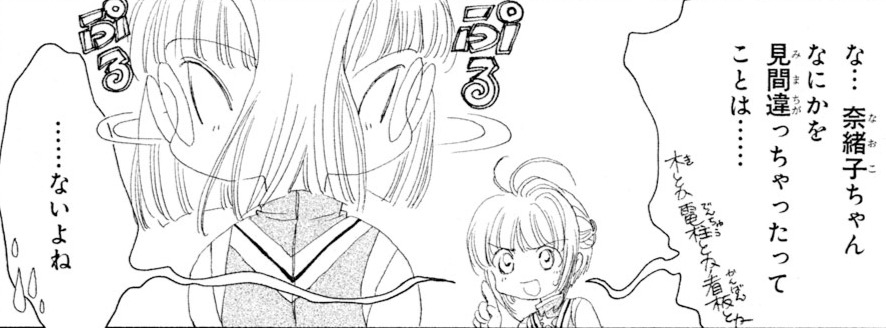
カードキャプターさくら »
Volume 1 » Page 131
After piano class, Naoko hurries home only to see a ghostly figure appear from within a lake at the park. She recalls the events to her friends at school.
桜( さくら ) :「な…奈緒子( なおこ ) ちゃん なにかを見( み ) 間( ま ) 違( ちが ) っちゃったってことは…… (木( き ) とか電柱( でんちゅう ) 看板( かんばん ) とか)」
“Na... Naoko, could it be that you ended up seeing something wrong...... (like a tree or a utility pole sign or something)?”
「……ないよね」
“......I guess not.”
Challenge Yourself
Show translation
Challenge
What possibility does Sakura hesitantly suggest?
Clues
なにかを見( み ) 間( ま ) 違( ちが ) っちゃった
Naoko accidentally mistook something she saw
木( き ) とか電柱( でんちゅう ) とか看板( かんばん ) とかexamples of ordinary objects such as a tree, utility pole, or sign
ってことは……ないよね
could it be that, followed by Sakura backing away from the suggestion
What does the speaker mean?
Naoko may have mistaken an ordinary object for the ghostly figure.
見( み ) 間( ま ) 違( ちが ) っちゃった suggests an accidental misidentification, and Sakura lists ordinary objects Naoko might have seen.
Naoko may have seen the ghost turn into a tree.
The tree is one possible object Naoko mistook for the figure. Sakura does not say the figure transformed.
Naoko may have invented the story to frighten her friends.
Sakura wonders whether Naoko misidentified what she saw, not whether she deliberately lied.
Naoko may have gone to the wrong park after class.
見( み ) 間( ま ) 違( ちが ) う concerns seeing something incorrectly. It does not mean choosing the wrong location.
Naoko may have read a warning on a sign incorrectly.
看板( かんばん ) is listed as an object she might have mistaken for the figure, not as text she misread.
Naoko may have confused Sakura with someone near the lake.
Sakura proposes a tree, utility pole, or sign as the mistaken object. She does not place herself at the lake.
Sakura wonders whether Naoko accidentally mistook an ordinary object for the ghostly figure. Her examples make the suggestion concrete, but ……ないよね shows that she doubts her own explanation.
View Full Example
懐中電灯 (Flashlight)懐中電灯( かいちゅうでんとう ) means a handheld, battery-powered flashlight.
It combines 懐中 (on one's person ) with 電灯 (electric lamp ) to show a portable lamp kept close at hand .
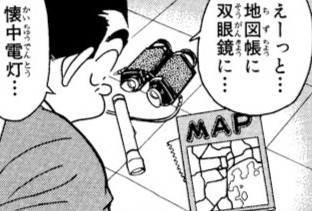
名探偵コナン »
Volume 4 » Page 117
Ayumi leaves the bag with her new Masked Yaiba doll outside while she’s in the restroom. When she returns, she finds the bag waiting for her, but the doll is gone. Ran suggests someone may have taken her bag by mistake. Genta decides to see what’s in the bag Ayumi brought back, dumping its contents onto the ground.
元太( げんた ) :「えーっと… 地図帳( ちずちょう ) に双眼鏡( そうがんきょう ) に…」
“Um... an atlas, binoculars...”
「懐中電灯( かいちゅうでんとう )
“...a flashlight...”
Challenge Yourself
Show translation
Challenge
What optical item does Genta find in the bag?
Clues
地図帳( ちずちょう ) にan atlas, and
双眼鏡( そうがんきょう ) にbinoculars, and
What does the speaker mean?
A pair of binoculars.
双眼鏡( そうがんきょう ) is the optical item in Genta's running list.
A microscope.
The listed viewing instrument is 双眼鏡( そうがんきょう ) , binoculars.
A pair of eyeglasses.
眼鏡( めがね ) would mean eyeglasses. The compound here is 双眼鏡( そうがんきょう ) .
A camera lens.
No camera is named among the bag's contents.
A telescope.
The item is a two-eyed handheld viewing instrument, binoculars.
A magnifying glass.
Genta explicitly names 双眼鏡( そうがんきょう ) , not a magnifier.
Genta finds binoculars along with an atlas and a flashlight. The repeated に lets him list the objects as he examines them.
View Full Example
Transport
電車 (Train)電車( でんしゃ ) means an electric train, especially an everyday passenger train.
It combines 電 (electric ) with 車 (vehicle ) to show a vehicle powered by electricity .
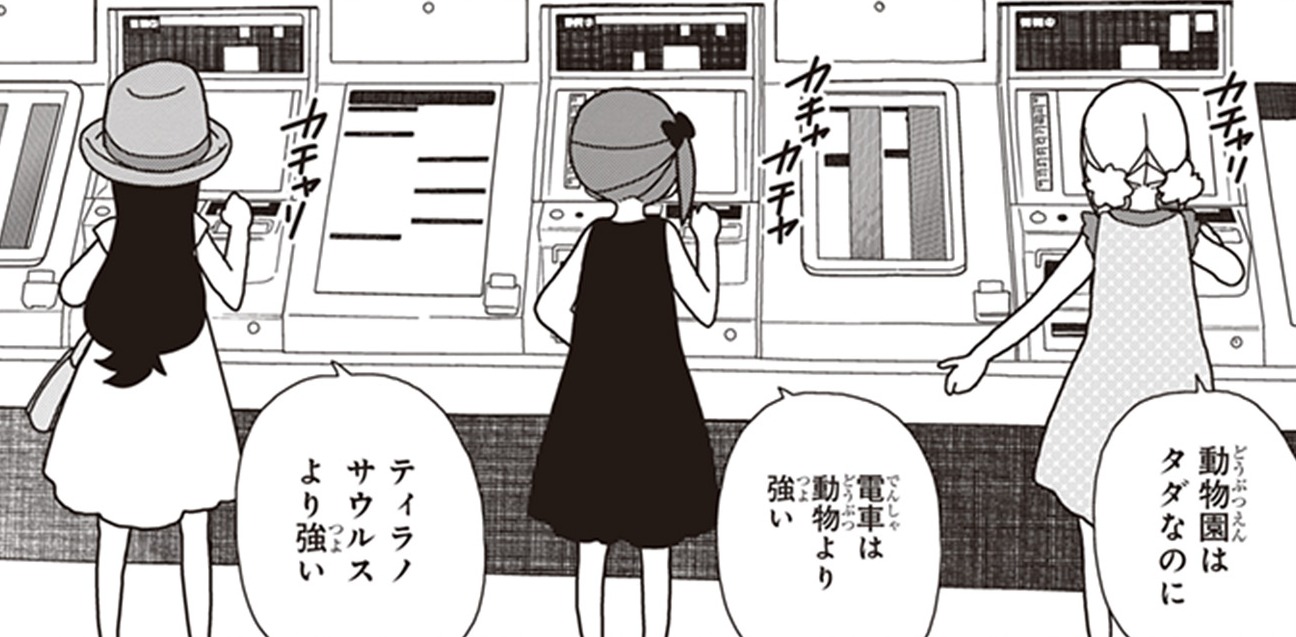
三ツ星カラーズ »
Volume 6 » Page 79
Yui and her friends get permission to ride the train to continue their search for the legendary giant robot. Tickets are listed as 70 yen for children.
さっちゃん:
「動物園( どうぶつえん ) はタダなのに」
“Even though the zoo is free...”
結衣( ゆい ) :「電車( でんしゃ ) 動物( どうぶつ ) より強( つよ ) い」
“Trains are stronger than animals.”
琴葉( ことは ) :「ティラノサウルスより強( つよ ) い」
“Stronger than a Tyrannosaurus.”
Challenge Yourself
Show translation
Challenge
What comparison do Yui and Kotoha make about the train?
Clues
電車( でんしゃ ) は動物( どうぶつ ) より強( つよ ) いthe train is stronger than animals
ティラノサウルスより強( つよ ) い
stronger than a Tyrannosaurus
What does the speaker mean?
The train is stronger than animals, even a Tyrannosaurus.
より marks animals and then a Tyrannosaurus as the things the train exceeds in strength.
Animals are stronger than the train.
In ⒶはⒷより強( つよ ) い, Ⓐ is the stronger item, so the comparison is not reversed.
The train is faster than every animal.
The adjective is 強( つよ ) い, strong, not 速( はや ) い, fast.
A Tyrannosaurus could ride the train for free.
The dinosaur appears as a strength comparison, not as a passenger.
The zoo charges more than the train.
Sacchan says the zoo is free. The others answer with a playful strength comparison rather than prices.
The train is powered by animals.
The line compares strength and does not describe how the train is powered.
Yui says the train is stronger than animals, and Kotoha raises the comparison to a Tyrannosaurus. Their childlike logic treats the fare as evidence of the train’s greater power.
View Full Example