Fear and intimidation with 恐
The core meaning of 恐 is fear . From there, the character spreads in three main directions:
being afraid, dreading, or finding something frightening
causing fear, intimidating, or threatening
shrinking back in awe, caution, or humility
Etymology This kanji is a phono-semantic compound comprised of 心 (heart) as the semantic component and 巩 as the phonetic component (キヨウ).
As the semantic part, 心 places this kanji in the field of feelings and states of mind.
Plain Fear 恐ろしい (Frightening)
恐(おそ) ろしい describes a state of anxiety or fear caused by a sense of danger or harm, or a situation that is so extreme as to be astonishing.Idiom Explanation: Having a bad experience with 〜目に遭う (Future entry)
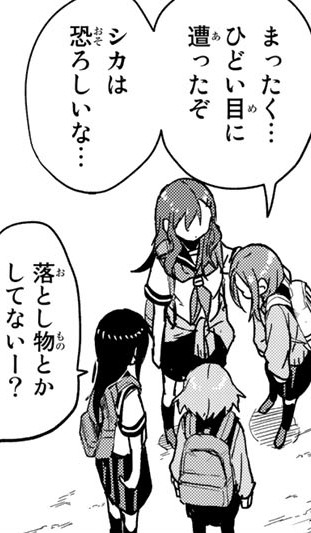
それでも歩は寄せてくる » Volume 8 » Page 27While in Nara on a class trip, Urushi and her friends stop to feed to deer. As the hungry animals completely surround Urushi, her friends discuss their schedule, ignoring Urushi’s plight. When Urushi finally returns to her group, she demands to know why no one came to her rescue.
うるし: 「まったく… ひどい目(め) に遭(あ) ったぞ」“Seriously… I had a terrible experience.”「シカは恐(おそ) ろしいな…」“Deer are scary…” ミク: 「落(お) とし物(もの) とかしてないー?」“Did you drop anything?” Challenge Yourself Show translation
Challenge
What terrible experience is Urushi complaining about? Clues ひどい目(め) に遭(あ) ったぞ "I had a terrible experience," emphatically complaining about what happened. シカは恐(おそ) ろしいな… "Deer are frightening..." identifying the source of the experience. What does the speaker mean? Hungry deer surrounded and overwhelmed her. Urushi calls the incident ひどい目(め) に遭(あ) った and follows by concluding that deer are frightening. She lost an important item somewhere in Nara. Miku asks whether she dropped anything, but Urushi's complaint concerns the deer encounter itself. Her friends refused to let her feed the deer. The problem was that the hungry deer crowded around her, not that she was prevented from feeding them. A deer stole every item she brought on the trip. The dialogue does not say anything was stolen. Miku only checks whether Urushi dropped something. She became separated from the class and missed the schedule. Her friends discussed the schedule while she dealt with the deer, but she complains about the frightening encounter. She was scolded for being afraid of the deer. No one scolds her in these lines. Urushi is the one forcefully voicing her complaint.
Urushi describes being surrounded by the deer as ひどい目(め) に遭(あ) った, a terrible experience. Her follow-up, シカは恐(おそ) ろしい, makes clear that the deer caused it.
View Full Example
恐怖症 (Phobia)
恐怖症(きょうふしょう) means a phobia or persistent, pathological fear.
It combines 恐怖 (fear ) with 症 (condition / syndrome ) to show a fear-based condition .
Grammar Explanation: Receptive verbs with 〜れる (Future entry)
ご注文はうさぎですか? » Volume 1 » Page 99A day of bad luck for Cocoa culminates with Syaro telling her to stay away.
ココア: 「私(わたし) そんな不運(ふうん) オーラ出(で) てたんだ!」“Was I giving off that much bad-luck energy!?” 千夜(ちや) :「小(ちい) さい頃(ころ) あんこによくかじられて以来(いらい) ちょっと恐怖症(きょうふしょう) で…」“Ever since she received bites by Anko a lot when she was little, she's a bit traumatized...” Challenge Yourself Show translation
Challenge
What does (千夜:ちや) mean in the highlighted line? Clues かじられて かじられて presents Syaro as the recipient of biting What does the speaker mean? Anko often bit Syaro when she was little, and she has been afraid ever since. The omitted subject is Syaro, while あんこに marks Anko as the animal that bit her. Chiya says Anko often bit Cocoa when Cocoa was little. The highlighted form is かじられて. Here かじられて presents Syaro as the recipient of biting, so this choice does not match the Japanese. Chiya says one recent bite caused Syaro's fear. The highlighted form is かじられて. Here かじられて presents Syaro as the recipient of biting, so this choice does not match the Japanese. Chiya says Syaro has been friendly with Anko ever since the childhood bites. The highlighted form is かじられて. Here かじられて presents Syaro as the recipient of biting, so this choice does not match the Japanese.
かじられて presents Syaro as the recipient of biting. The omitted subject is Syaro, while あんこに marks Anko as the animal that bit her.
View Full Example Causing Fear 恐竜 (Dinosaur)
恐竜(きょうりゅう) means dinosaur, literally a “fearsome dragon”.
It combines 恐 (fearsome ) with 竜 (dragon ) to show a terrifying dragon-like creature.
Grammar Explanation: Covered in with 〜だらけ (Future entry)
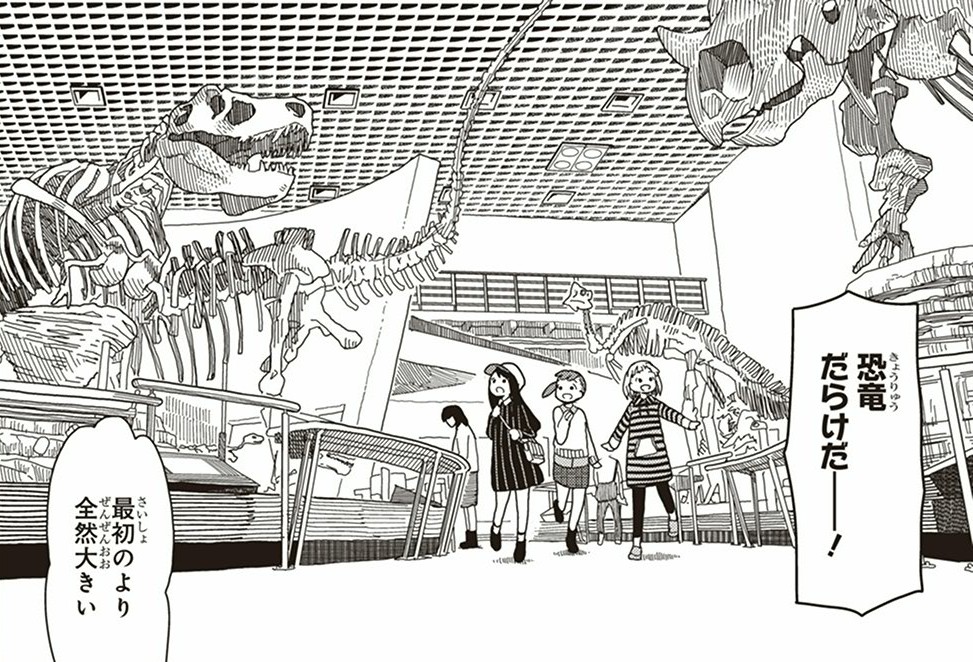
三ツ星カラーズ » Volume 2 » Page 126Kotoha, Yui, and Sacchan enter another exhibit room in the museum.
○: 「恐竜(きょうりゅう) だらけだーー!」“It's full of dinosaurs!” Challenge Yourself Show translation
Challenge
What does the speaker notice upon entering the exhibit room? Clues 恐竜(きょうりゅう) だらけ full of dinosaurs, with dinosaurs everywhere What does the speaker mean? The room is filled with dinosaurs. 恐竜(きょうりゅう) is the noun before だらけ, so dinosaurs fill the space. The room has no dinosaurs in it. だらけ expresses an abundance, not an absence. Only one dinosaur is on display. だらけ suggests dinosaurs throughout the room rather than a single specimen. The dinosaurs are covered in dirt. The noun before だらけ is what fills the room. There is no word for dirt. The museum is crowded with children. The line names 恐竜(きょうりゅう) , not children, as what is everywhere. The speaker asks where the dinosaur exhibit is. This is an excited declaration ending in だ, not a question about location.
The speaker exclaims that dinosaurs are everywhere in the room. Noun plus だらけ describes a place or thing filled with that noun.
View Full Example