Forms and appearances with 様
様 is most commonly used as a ‘honorific’ (〜さま) appended to names of people or organizations to express respect. It also conveys meanings such as “appearance or condition” and “method or type” of an object.
Etymology
This kanji is the simplified form of 樣. The older character connects with 木 (tree ) plus a phonetic element in the 羊 series, with an early sense tied to shape or pattern.
Appearance
様子 (State)様子( ようす ) is how someone or something looks, seems, or is doing. It can describe a person’s condition, the mood of a place, or the state of a situation.
It combines 様 (appearance ) with 子 (aspect ) to show the way something looks .
キラキラとギラギラ »
Volume 2 » Page 32
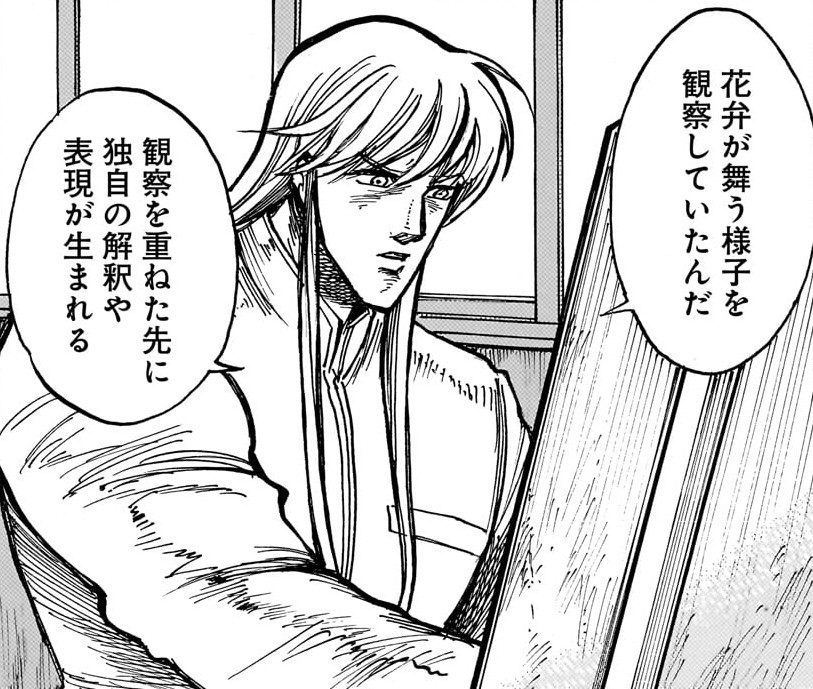
As she models for a sketch, Lulu recalls seeing Hideki blowing flower petals into the air. She brings it up to him.
秀樹( ひでき ) :「花弁( はなびら ) が舞( ま ) う様子( ようす ) 賢察( けんさつ ) していたんだ」
“I was observing the petals as they danced.”
「観察( かんさつ ) を重( かさ ) ねた先( さき ) に独自( どくじ ) の解釈( かいしゃく ) や表現( ひょうげん ) が生( う ) まれる」
“Through repeated observation, unique interpretations and expressions emerge.”
Challenge Yourself
Show translation
Challenge
What does Hideki say repeated observation can produce?
Clues
観察( かんさつ ) を重( かさ ) ねた先( さき ) にbeyond the stage of repeated observation
独自( どくじ ) の解釈( かいしゃく ) や表現( ひょうげん ) が生( う ) まれるone's own interpretations and expressions emerge
What does the speaker mean?
Original interpretations and ways of expressing them.
独自( どくじ ) marks the interpretations as one's own, and 解釈( かいしゃく ) や表現( ひょうげん ) names what repeated observation produces.
A perfectly literal copy of the flower petals.
Hideki says observation leads to 独自( どくじ ) の解釈( かいしゃく ) , a personal reading, rather than mere duplication.
An explanation of why the petals stopped moving.
The petals' movement is what he observes. The result he names is artistic interpretation and expression.
A faster method for finishing the sketch.
観察( かんさつ ) を重( かさ ) ねる stresses repeated looking, not saving time.
Proof that every artist sees the same thing.
独自( どくじ ) means unique or one's own, so the line points to individual readings.
A decision to stop observing and rely on memory.
Hideki treats repeated observation as the process that gives rise to the later interpretation.
Hideki says that sustained observation eventually gives an artist a personal interpretation and a way to express it. 先( さき ) に places those results beyond the repeated observation that produces them.
View Full Example
模様 (Pattern)模様( もよう ) means a pattern or design. It can also describe how a situation stands or what appears likely to happen.
It combines 模 (form ) with 様 (appearance ) to show the way a form appears .
ご注文はうさぎですか? »
Volume 1 » Page 94
Chino explains the steps to perform coffee fortune telling.
チノ:
「おじいちゃんのカフェ・ド・マンシーは当( あ ) たりすぎて怖( こわ ) いと有名( ゆうめい ) でした」
“Grandpa's Café de Mancy was famous for predictions so accurate they were scary.”
「飲( の ) み終( お ) わった後( あと ) に残( のこ ) ったコーヒーの模様( もよう ) 占( うらな ) うんです」
“After you've finished drinking it, we tell fortunes from the patterns left in the coffee.”
Challenge Yourself
Show translation
Challenge
Which interpretation best matches the highlighted line?
Clues
飲( の ) み終( お ) わった(飲:の)み(終:お)わる means finishing the act of drinking
What does the speaker mean?
After you've finished drinking it, we tell fortunes from the patterns left in the coffee.
The stem 飲( の ) み joins 終( お ) わる to mark the normal endpoint of drinking the coffee.
Chino says the fortune should be read before anyone drinks the coffee.
The highlighted form is 飲( の ) み終( お ) わった. Here 飲( の ) み終( お ) わる means finishing the act of drinking, so this choice does not match the Japanese.
Chino says the fortune appears while the person is still drinking.
The highlighted form is 飲( の ) み終( お ) わった. Here 飲( の ) み終( お ) わる means finishing the act of drinking, so this choice does not match the Japanese.
Chino says fresh coffee is used without waiting for the drink to be finished.
The highlighted form is 飲( の ) み終( お ) わった. Here 飲( の ) み終( お ) わる means finishing the act of drinking, so this choice does not match the Japanese.
飲( の ) み終( お ) わる means finishing the act of drinking. The stem 飲( の ) み joins 終( お ) わる to mark the normal endpoint of drinking the coffee.
View Full Example
異様 (Strangeness)異様( いよう ) describes something strange, unsettling, or conspicuously unlike the norm.
It combines 異 (strange ) with 様 (appearance ) to show a strange appearance or manner .
名探偵コナン »
Volume 21 » Page 119
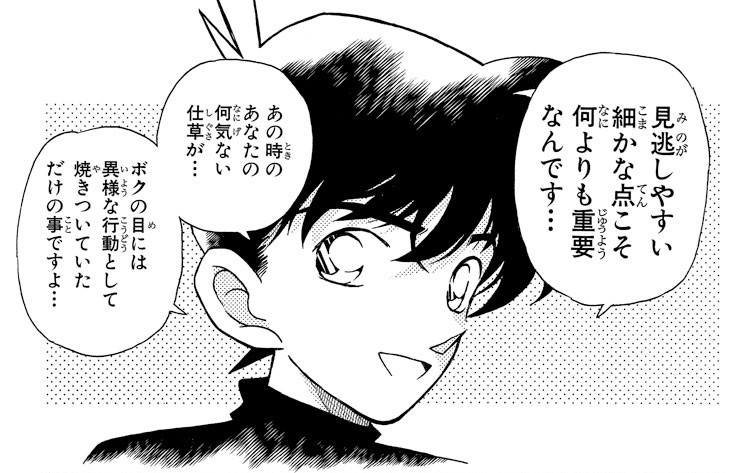
Shin’ichi reveals the details of a murder. The culprit asks how Shin’ichi discovered the hidden weapon, and he explains it was due to a specific movement the culprit made.
新一( しんいち ) :「見逃( みのが ) しやすい細( こま ) かな点( てん ) こそ何( なに ) よりも重要( じゅうよう ) なんです…」
“It's precisely those subtle details that are easy to overlook that matter most of all...”
「あの時( とき ) のあなたの何気( なにげ ) ない仕草( しぐさ ) が…」
“That casual gesture of yours back then...”
「僕( ぼく ) の目( め ) には異様( いよう ) 行動( こうどう ) として焼( や ) きついてただけの事( こと ) ですよ…」
“It's just that it was etched in my mind as strange behavior...”
Challenge Yourself
Show translation
Challenge
Why did the culprit's casual gesture stay in Shin'ichi's memory?
Clues
僕( ぼく ) の目( め ) には異様( いよう ) な行動( こうどう ) としてin my eyes, as strange behavior
焼( や ) きついてたit was etched into my memory
What does the speaker mean?
It struck him as unnaturally strange behavior.
異様( いよう ) な行動( こうどう ) explains why the otherwise casual gesture stood out.
It was the most ordinary action at the scene.
Shin'ichi says it appeared 異様( いよう ) , abnormal or out of place.
The culprit repeated it after confessing.
The line refers to the gesture at the earlier moment, not a later confession.
Someone photographed the movement for him.
焼( や ) きつく is figurative here, meaning the sight remained vividly in his mind.
It caused him to overlook all the smaller details.
He says small, easily missed details are especially important.
The gesture directly revealed the culprit's name.
It served as suspicious behavioral evidence, not a spoken identification.
The gesture looked casual, but Shin’ichi saw it as strangely out of place. That abnormal impression caused it to remain vividly etched in his memory.
View Full Example
Honorific Address
お嬢様 (Young lady)お嬢様( おじょうさま ) is a respectful term for someone’s daughter, especially one from a wealthy family. It can also suggest a sheltered young woman.
It combines 嬢 (young lady ) with 様 (honorific form ) to show a young lady spoken of with respect .
ご注文はうさぎですか? »
Volume 1 » Page 70
Chiya and Syaro unexpectedly have to stay the night at Chino’s home.
シャロ:
「チノちゃんにパジャマ借( か ) りたのはいいけどちょっとかわいすぎない?」
“Borrowing pajamas from Chino-chan is fine, but aren't they a little too cute?”
「いつもはジャージなのに」
“Even though she usually wears a tracksuit.”
千夜( ちや ) :「本物( ほんもの ) のお嬢様( じょうさま ) みたい♪」
“You look like a real young lady♪”
Challenge Yourself
Show translation
Challenge
What does シャロ mean in the highlighted line?
Clues
かわいすぎない
かわいすぎない? is a negative question about excess
What does the speaker mean?
Borrowing pajamas from Chino-chan is fine, but aren't they a little too cute?
Syaro asks whether the pajamas are too cute, inviting the others to agree with her discomfort.
Syaro complains that Chino's pajamas are not cute enough.
The highlighted form is かわいすぎない. Here かわいすぎない? is a negative question about excess, so this choice does not match the Japanese.
Syaro says she usually wears Chino's cute pajamas.
The highlighted form is かわいすぎない. Here かわいすぎない? is a negative question about excess, so this choice does not match the Japanese.
Syaro refuses the pajamas because they are the wrong size.
The highlighted form is かわいすぎない. Here かわいすぎない? is a negative question about excess, so this choice does not match the Japanese.
かわいすぎない? is a negative question about excess. Syaro asks whether the pajamas are too cute, inviting the others to agree with her discomfort.
View Full Example
奥様 (Madam)奥様( おくさま ) is a respectful term for another person’s wife, a female head of household, or a proprietress. The more casual form is 奥( おく ) さん; neither form normally refers to one’s own wife.
It combines 奥 (inner part ) with 様 (honorific form ) to show a lady of the inner household addressed respectfully .
ARIA The MASTERPIECE »
Volume 5 » Page 43
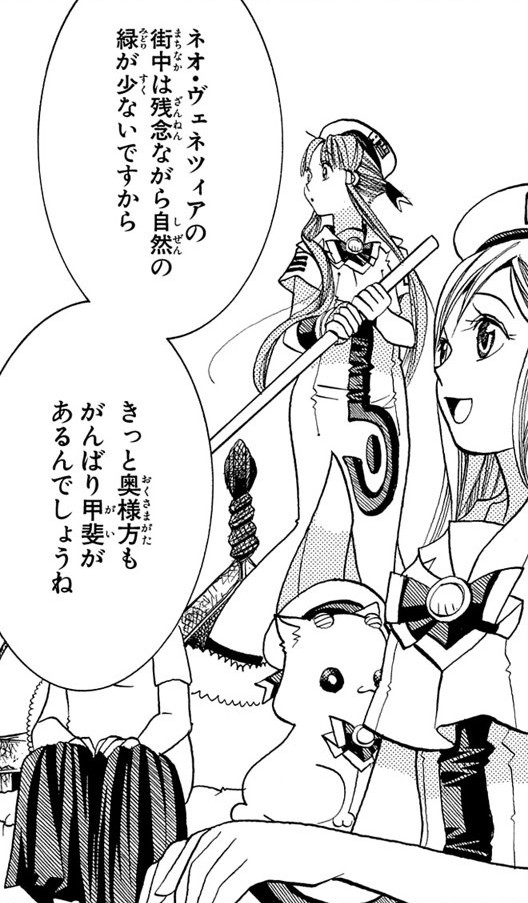
A customer asks Akari to stop the gondola as she sees a house with a fantastic flower garden. The customer asks if it’s a special place, to which Alicia explains it’s an ordinary house. She says the flower bed and gardening are a barometer to measure the caliber of the woman of the household.
アリシア:
「ネオ・ヴェネツィアの街中( まちなか ) は残念( ざんねん ) ながら自然( しぜん ) の緑( みどり ) が少( すく ) ないですから」
“Since there's regrettably little natural greenery in the city of Neo-Venezia...”
「きっと奥様( おくさま ) 方( がた ) もがんばり甲斐( がい ) があるんでしょうね」
“...surely the housewives also find it worth the effort.”
View Full Example