Going out and emerging with 出 出
出 means go out or come out .
Grade 1 JLPT N5 (estimate) WaniKani level 2 5 strokes 出 Mincho 出 Rounded 出 Heavy 出 Pen 出 Brush 出 Marker Contents Words with 出 How to Read 出 Going Out Putting Out Coming About Escapes Submissions Appearances Building Bigger Words Check Yourself Related Kanji ☰ ContentsWords with 出 How to Read 出 Going Out Putting Out Coming About Escapes Submissions Appearances Building Bigger Words Check Yourself Related Kanji Words with 出 Departures 出発 しゅっ ぱつDeparture 外出 がいしゅつ Going out The bold kana are the part 出 contributes. Words in a dashed box have no manga example yet.
How to Read 出 出発 (しゅっ ぱつ) 外出 (がいしゅつ ) 脱出 (だっしゅつ ) 提出 (ていしゅつ ) 出現 (しゅつ げん) 続出 (ぞくしゅつ ) and 2 more しゅつ in compounds, tightening to しゅっ before some sounds, as in 出発( しゅっぱつ ) and 出版( しゅっぱん ) .
The native verbs are 出( で ) る, to go or come out, and 出( だ ) す, to put out. After another verb, 出す means the action bursts outward or begins, as in 思( おも ) い出( だ ) す.
Going Out 出る (で る) (To go out)出( で ) る means to go out or leave. It is also used when something appears or is produced.
Example 1 of 10: According to the rules with 〜によると Example 1 of 10
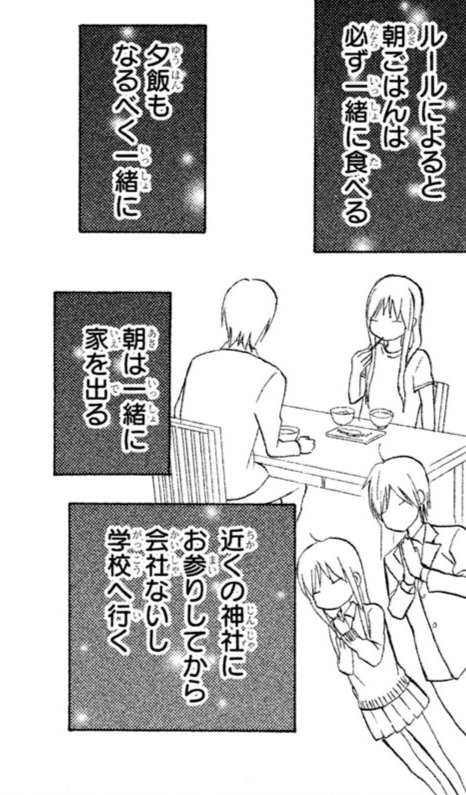
たいようのいえ » Volume 1 » Page 19Now that Mao is living at Hiro’s house, Hiro presents her with a list of rules. Before going to bed, Mao looks the list over.
真魚( まお ) :「ルールによると朝( あさ ) ごはんは必( かなら ) ず一緒( いっしょ ) に食( た ) べる」 “According to the rules, we must always eat breakfast together.” 「夕飯( ゆうはん ) もなるべく一緒( いっしょ ) に」 “We should eat dinner together too, as often as possible.” 「朝( あさ ) は一緒( いっしょ ) に家( いえ ) を出( で ) る “We leave the house together in the morning.” 「近( ちか ) くの神社( じんじゃ ) にお参( まい ) りしてから会社( かいしゃ ) ないし学校( がっこう ) へ行( い ) く」 “After praying at the nearby shrine, we go to work or school.” Challenge Yourself Show Translation
Challenge
How do the rules for breakfast and dinner differ?
真魚( まお ) :「ルール によると 朝( あさ ) ごはんは必( かなら ) ず一緒( いっしょ ) に食( た ) べる」 「夕飯( ゆうはん ) もなるべく一緒( いっしょ ) に」 「朝( あさ ) は一緒( いっしょ ) に家( いえ ) を出( で ) る」 「近( ちか ) くの神社( じんじゃ ) にお参( まい ) りしてから会社( かいしゃ ) ないし学校( がっこう ) へ行( い ) く」 Clues 必( かなら ) ずwithout fail; always なるべく as much as possible 夕飯( ゆうはん ) もdinner too What does the speaker mean? They must eat breakfast together and should eat dinner together when possible. 必( かなら ) ず makes breakfast together a firm rule. なるべく allows more flexibility for dinner. They should eat breakfast together when possible and must eat dinner together. This reverses the two adverbs. 必( かなら ) ず goes with breakfast, while なるべく goes with dinner. They must eat both breakfast and dinner together without exception. 夕飯( ゆうはん ) も includes dinner, but なるべく makes it something to do as much as possible. It does not require dinner together without exception.
The breakfast rule uses 必( かなら ) ず, “without fail”. The dinner rule uses なるべく, “as much as possible”, so it leaves room for their schedules.
View Full Example Example 2 of 10: Answering machine functionality with 機能 Example 2 of 10
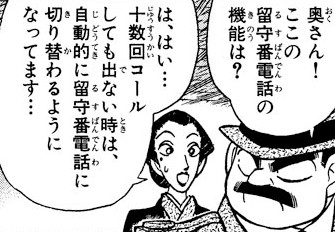
名探偵コナン » Volume 6 » Page 64After a suspect recalls that his call to the victim’s house rang many times before the answering machine picked up, Inspector Megure asks the woman of the house how the machine works.
目暮( めぐれ ) :「奥( おく ) さん!ここの留守番( るすばん ) 電話( でんわ ) の機能( きのう ) は?」 “Ma'am! How does this answering machine function?” 奥( おく ) さん:「は、はい… 十数回( じゅうすうかい ) コールしても出( で ) ない時( とき ) は、自動的( じどうてき ) に留守番( るすばん ) 電話( でんわ ) に切( き ) り替( か ) わるようになってます…」 “Well... When nobody answers even after a dozen or so rings, it automatically switches to the answering machine...” Challenge Yourself Show Translation
Challenge
How does the answering machine operate when nobody answers?
目暮( めぐれ ) :「奥( おく ) さん!ここの留守番( るすばん ) 電話( でんわ ) の機能( きのう ) 奥( おく ) さん:「は、はい… 十数回( じゅうすうかい ) コールしても出( で ) ない時( とき ) は、自動的( じどうてき ) に留守番( るすばん ) 電話( でんわ ) に切( き ) り替( か ) わるようになってます…」 Clues 十数回( じゅうすうかい ) コールしても出( で ) ない時( とき ) はwhen nobody answers after more than ten rings 自動的( じどうてき ) に留守番( るすばん ) 電話( でんわ ) に切( き ) り替( か ) わるit automatically switches to the answering machine What does the speaker mean? It switches automatically after the phone rings unanswered many times. The machine changes over automatically when no one answers after more than ten rings. It hangs up immediately after the first ring. The phone rings more than ten times before the automatic switch. It records every call before the telephone rings. The answering function begins only after the unanswered ringing. Someone must press a button to activate it. 自動的( じどうてき ) に means the switch happens automatically. It forwards the call to the police. The call switches to the answering machine, not to another recipient. It works only when someone answers the telephone. The condition is precisely that nobody answers.
If nobody answers after the phone rings more than ten times, the system automatically switches to the answering machine.
View Full Example Example 3 of 10: Don't take your focus off the lynx with 気が散る Example 3 of 10
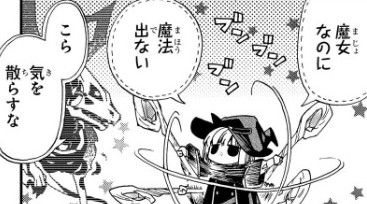
骨ドラゴンのマナ娘 » Volume 1 » Page 85In order to make money to survive and continue her path of becoming a mage, Eve takes on a request to defeat a fanged lynx that has been attacking a merchant in the forest. She attempts to use her new magick staff against the beast, but no magick materializes from it.
イブ: 「魔女( まじょ ) なのに 魔法( まほう ) 出( で ) ない」 “Even though I'm a mage, magick won't come out.” ネム: 「こら 気( き ) を散( ち ) らすな」 “Hey now, don't lose focus!” Challenge Yourself Show Translation
Challenge
What is Nemu warning Eve not to do during the fight?
イブ: 「魔女( まじょ ) なのに 魔法( まほう ) 出( で ) ない」 ネム: 「こら 気( き ) を散( ち ) らす Clues 魔女( まじょ ) なのに魔法( まほう ) 出( で ) ないEve is dwelling on her failed magick instead of the threat こら 気( き ) を散( ち ) らすな Nemu sharply tells her not to let her attention wander What does the speaker mean? Lose focus on the lynx because her magick failed. 気を散らすな forbids letting her attention scatter, while Eve's complaint shows what is distracting her. Use the new staff before learning another spell. Nemu's warning concerns Eve's attention during the fight, not whether she may use the staff. Run away from the lynx and abandon the request. Nemu tells Eve to stay focused, not to leave the battle. Admit that she is not really a mage. Eve is frustrated that magick will not appear, but Nemu does not challenge her identity. Watch Nemu instead of looking at the staff. The immediate danger is the lynx. 気を散らすな redirects Eve to the fight, not to Nemu. Attack the merchant who hired her. The merchant is the client. Nothing in the line directs Eve to attack the client.
Eve becomes preoccupied with the fact that her staff produces no magick. Nemu snaps her attention back to the fanged lynx with 気を散らすな, warning her not to lose focus during the fight.
View Full Example Example 4 of 10: Interrupted in a restroom stall with 話しかける Example 4 of 10
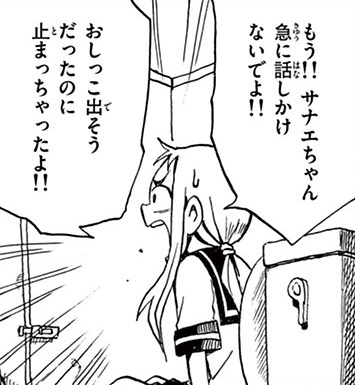
からかい上手の高木さん » Volume 1 » Page 152In the girls’ restroom, Sanae and Yukari wonder whether Nishikata and Takagi are dating. Sanae teases Yukari by calling out to Mina, who is inside a stall, that Yukari wants to flirt with boys. When Mina doesn’t answer, Sanae keeps shouting her name.
ミナ: 「もう!! サナエちゃん急( きゅう ) に話( はな ) しかけないでよ!!」 “Geez!! Sanae, don't talk to me out of nowhere!!” ミナ: 「おしっこ出( で ) そうだったのに止( と ) まっちゃったよ!!」 “I was just about to pee, and now it stopped!!” Challenge Yourself Show Translation
Challenge
Why is Mina upset with Sanae?
ミナ: 「もう!! サナエちゃん急( きゅう ) に話( はな ) しかけ ミナ: 「おしっこ出( で ) そうだったのに止( と ) まっちゃったよ!!」 Clues 急( きゅう ) にsuddenly, without warning 話( はな ) しかけるto speak to someone 〜ないでよ don't do that (casual request) What does the speaker mean? Sanae suddenly spoke to her while she was in the stall. 急( きゅう ) に話( はな ) しかけないで complains that Sanae started talking to her without warning, and the second line says what that interruption cost her. Sanae refused to talk to her. 〜ないで asks Sanae not to do something. Mina is complaining that Sanae did talk to her. Sanae told everyone a secret about her. Sanae's teasing was about Yukari. Mina's complaint is about being spoken to while she was busy. Sanae talked too quietly for her to hear. 急( きゅう ) に is about timing, "suddenly". It says nothing about volume. Sanae started a conversation with Yukari instead of her. 話( はな ) しかける here has Mina as its target. Sanae was calling out to her.
話( はな ) しかける means to speak to someone, usually to start talking to a person who wasn’t already in the conversation. Sanae kept calling Mina while she was in the stall, so Mina tells her, “Don’t talk to me out of nowhere.”
View Full Example Example 5 of 10: Leaving the zoo quickly after entering with 〜てから Example 5 of 10
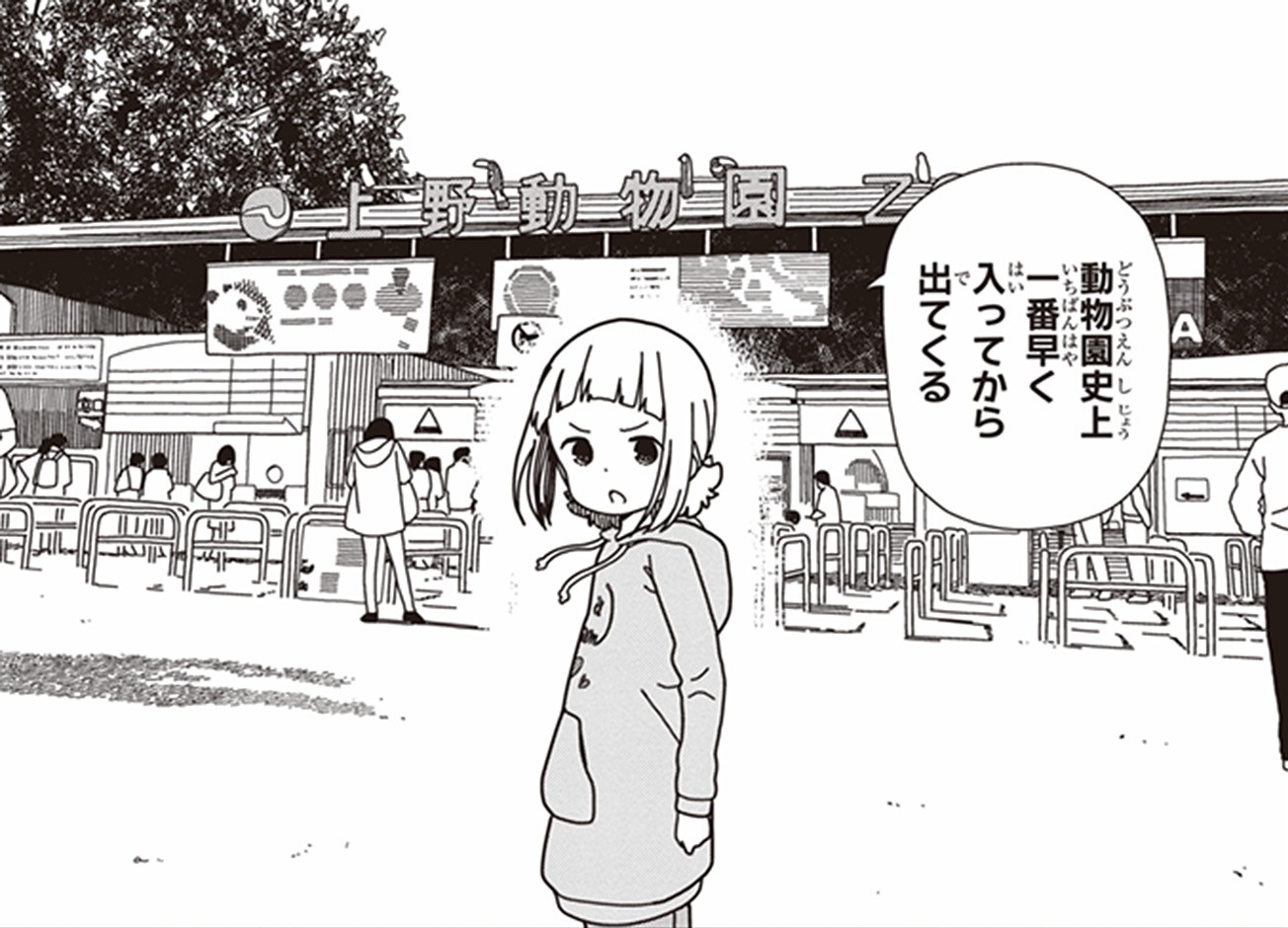
三ツ星カラーズ » Volume 5 » Page 87While trying to find something to do, Sacchan and her friends pass by the zoo, which is free for children to enter. Yui asks if Sacchan plans to enter the zoo.
さっちゃん: 「動物園( どうぶつえん ) 史上( しじょう ) 一番( いちばん ) 早( はや ) く入( はい ) ってから出( で ) てくる」 “The fastest in zoo history to enter and then leave.” Challenge Yourself Show Translation
Challenge
What record does Sacchan propose setting at the zoo?
さっちゃん: 「動物園( どうぶつえん ) 史上( しじょう ) 一番( いちばん ) 早( はや ) く入( はい ) ってから 出( で ) てくる Clues 動物園( どうぶつえん ) 史上( しじょう ) 一番( いちばん ) 早( はや ) くthe fastest in the zoo's history 入( はい ) ってから出( で ) てくるenter and then come back out What does the speaker mean? The fastest time entering the zoo and coming back out. 一番( いちばん ) 早( はや ) く sets the speed record, and 〜てから orders entering before coming out. The longest time spent inside the zoo. 一番( いちばん ) 早( はや ) く points to speed, and Sacchan plans to come out right after entering. The first person ever allowed into the zoo for free. 史上( しじょう ) modifies the speed claim. The line does not describe being first to receive free admission. The fastest route from the clubhouse to the zoo. The sequence begins with entering the zoo and ends with coming out, not traveling there. The most animals seen during one visit. No animals or viewing appear in the proposed record. The fastest time closing the zoo after entering. 出( で ) てくる means Sacchan comes back out. It does not mean she closes the zoo.
Sacchan wants to enter and then leave so quickly that it becomes the fastest such visit in the zoo’s history. 〜てから makes the two-step order explicit.
View Full Example Example 6 of 10: Limited edition with 限定 Example 6 of 10
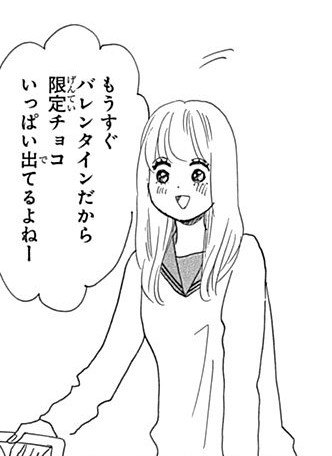
俺物語!! » Volume 6 » Page 103Takeo and Rinko meet up after school and stop somewhere for a drink and to chat. Rinko brings up February 14th, which is right around the corner.
凛子( りんこ ) :「もうすぐバレンタインだから限定( げんてい ) チョコいっぱい出( で ) てるよねー」 “Since it's almost Valentine's, a lot of limited edition chocolates have come out.” Challenge Yourself Show Translation
Challenge
What seasonal products does Rinko say are appearing?
凛子( りんこ ) :「もうすぐバレンタインだから限定( げんてい ) 出( で ) てるよねー」 Clues もうすぐバレンタインだから because Valentine's Day is coming soon 限定( げんてい ) チョコいっぱい出( で ) てるmany limited-edition chocolates are out What does the speaker mean? Many limited-edition chocolates for Valentine's Day. 限定( げんてい ) modifies チョコ, and いっぱい出( で ) てる says many have appeared. A single permanent chocolate flavor. いっぱい indicates many products, and 限定( げんてい ) makes them limited rather than permanent. Limited tickets for a Valentine's event. The noun after 限定( げんてい ) is チョコ, not tickets. Chocolate that will disappear before Valentine's Day. Rinko says the products are already out because the holiday is near. She does not give their removal date. Discounted drinks sold only after school. The line concerns seasonal chocolate and says nothing about drinks, discounts, or school hours. Homemade chocolate that Rinko has finished making. 出( で ) てる describes products appearing on the market, not Rinko completing her own batch.
Rinko notes that many limited-edition chocolates have appeared because Valentine’s Day is close. The omitted が would mark the chocolates as the things that are out.
View Full Example Example 7 of 10: Receiving a biting with 〜れる Example 7 of 10
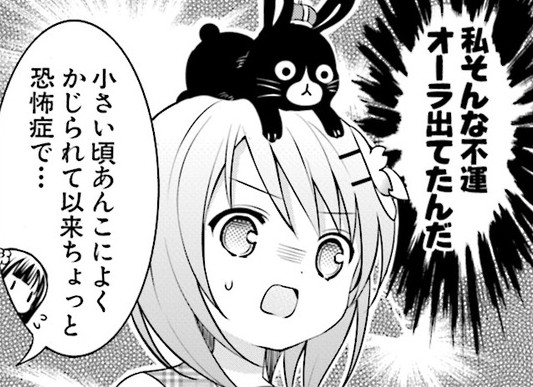
ご注文はうさぎですか? » Volume 1 » Page 99A day of bad luck for Cocoa culminates with Syaro telling her to stay away.
ココア: 「私( わたし ) そんな不運( ふうん ) オーラ出( で ) てたんだ!」 “Was I giving off that much bad-luck energy!?” 千夜( ちや ) :「小( ちい ) さい頃( ころ ) あんこによくかじられて以来( いらい ) ちょっと恐怖症( きょうふしょう ) で…」 “Ever since she received bites by Anko a lot when she was little, she's a bit traumatized...” Challenge Yourself Show Translation
Challenge
What does 千夜 mean in the highlighted line?
ココア: 「私( わたし ) そんな不運( ふうん ) オーラ出( で ) てたんだ!」 千夜( ちや ) :「小( ちい ) さい頃( ころ ) あんこによくかじら れて 以来( いらい ) ちょっと恐怖症( きょうふしょう ) で…」 Clues かじられて かじられて presents Syaro as the recipient of biting What does the speaker mean? Anko often bit Syaro when she was little, and she has been afraid ever since. The omitted subject is Syaro, while あんこに marks Anko as the animal that bit her. Chiya says Anko often bit Cocoa when Cocoa was little. The highlighted form is かじられて. Here かじられて presents Syaro as the recipient of biting, so this choice does not match the Japanese. Chiya says one recent bite caused Syaro's fear. The highlighted form is かじられて. Here かじられて presents Syaro as the recipient of biting, so this choice does not match the Japanese. Chiya says Syaro has been friendly with Anko ever since the childhood bites. The highlighted form is かじられて. Here かじられて presents Syaro as the recipient of biting, so this choice does not match the Japanese.
かじられて presents Syaro as the recipient of biting. The omitted subject is Syaro, while あんこに marks Anko as the animal that bit her.
View Full Example Example 8 of 10: Save Rei while it's foggy with 〜うちに Example 8 of 10
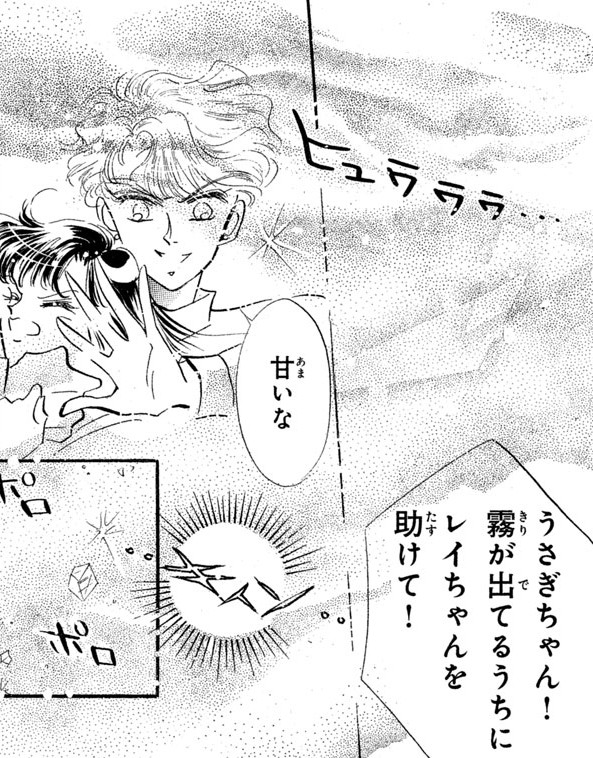
美少女戦士セーラームーン » Volume 1 » Page 117Jadeite captures the priestess Rei. Ami uses an ability to fill the area with fog, giving Usagi a chance to act.
亜美( あみ ) :「うさぎちゃん!霧( きり ) が出( で ) てるうちにレイちゃんを助( たす ) けて!」 “Usagi! (Take the opportunity to) rescue Rei while it's foggy!” Challenge Yourself Show Translation
Challenge
What does Ami tell Usagi to do while the fog remains?
亜美( あみ ) :「うさぎちゃん!霧( きり ) が出( で ) てるうちに レイちゃんを助( たす ) けて!」 Clues 霧( きり ) が出( で ) てるうちにthe fog creates a limited window before the condition changes レイちゃんを助( たす ) けて Ami tells Usagi to rescue Rei What does the speaker mean? Rescue Rei before the fog clears. 霧が出てるうちに sets the temporary window, and レイちゃんを助けて gives the action Usagi must take. Wait inside the fog until Rei escapes by herself. Ami directly tells Usagi to rescue Rei. She does not ask her to wait. Clear the fog so that Rei can see the enemy. The fog is helping conceal Usagi's action, so うちに means she should act while it is still present. Ask Rei to create more fog before attacking. Ami created the opportunity and addresses Usagi. The requested action is rescuing Rei. Leave Rei behind and escape while visibility is poor. レイちゃんを助けて explicitly tells Usagi to save Rei, not abandon her. Find out whether the fog has already disappeared. 出てる describes the fog as currently present. The line urges immediate action during that state.
Ami tells Usagi to use the fog as temporary cover and rescue Rei before it clears. 霧が出てるうちに marks the limited opportunity, and 助けて gives the urgent action.
View Full Example Example 9 of 10: Watery daikon syrup with 〜っぽい Example 9 of 10
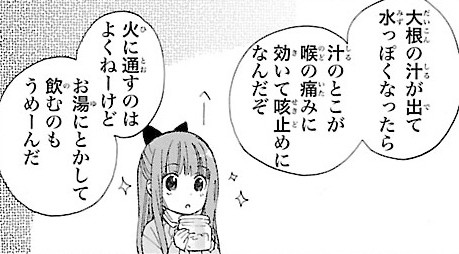
老女的少女ひなたちゃん » Volume 1 » Page 20Moka has a sore throat. Hinata brings her chopped daikon that was left to steep in honey in a sealed jar. Moka tastes it and is surprised that it’s sweet.
日向( ひなた ) :「大根( だいこん ) の汁( しる ) が出( で ) て水( みず ) っぽくなったら 汁( しる ) のとこが喉( のど ) の痛( いた ) みに効( き ) いて咳止( せきど ) めになんだぞ」 “Once the daikon juice comes out and it gets watery, the juice is good for a sore throat and works as cough medicine.” 「火( ひ ) に通( とお ) すのはよくねーけど お湯( ゆ ) にとかして飲( の ) むのもうめーんだ」 “Heating it's no good, but it's tasty stirred into hot water, too.” Challenge Yourself Show Translation
Challenge
According to Hinata, when is the daikon syrup ready to help a sore throat?
日向( ひなた ) :「大根( だいこん ) の汁( しる ) が出( で ) て水( みず ) っぽく なったら 汁( しる ) のとこが喉( のど ) の痛( いた ) みに効( き ) いて咳止( せきど ) めになんだぞ」 「火( ひ ) に通( とお ) すのはよくねーけど お湯( ゆ ) にとかして飲( の ) むのもうめーんだ」 Clues 汁( しる ) juice 出( で ) るto come out 水( みず ) っぽくなるto become watery 〜たら once, when 効( き ) くto be effective, to work on What does the speaker mean? Once juice has come out of the daikon and the syrup has turned watery. 水( みず ) っぽくなったら is "once it gets watery". The juice that thins the honey is the part that helps. As soon as the daikon goes into the honey. The たら in なったら waits for a change. The juice has to come out first, which is why the jar sits in the fridge for hours. Once it has been boiled down until it looks like water. Hinata says 火( ひ ) に通( とお ) すのはよくねー, "heating it's no good". The water comes from the daikon itself. Once it's mixed with water so it's less sweet. The wateriness comes from the daikon's own juice. Hot water is an optional way to drink it, and she mentions it in her second line.
As the daikon sits in the honey, its juice seeps out and the thick honey turns watery. 水( みず ) っぽくなったら is “once it gets watery”, and that liquid is what soothes a sore throat.
View Full Example Example 10 of 10: When I took my eyes off her for just a minute with 目を離す Example 10 of 10
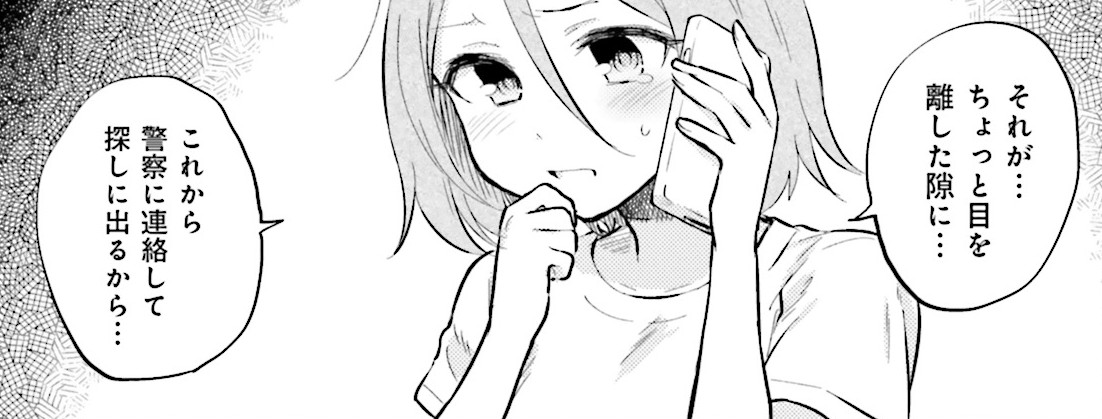
にじいろフォトグラフ » Volume 1 » Page 92Satsuki leaves Sara, the young girl she’s watching, alone to go heat up lunch. When she returns with the food, Sara is nowhere to be found. Satsuki calls her sister to let her know what’s happened.
皐( さつき ) :「それが… ちょっと目( め ) を離( はな ) した隙( すき ) に…」 “The thing is, I took my eyes off her for a just a minute...” 「これから警察( けいさつ ) に連絡( れんらく ) して探( さが ) しに出( で ) る “I'm going to call the police, then I'm heading out to look for her...” Challenge Yourself Show Translation
Challenge
What lapse does Satsuki admit?
皐( さつき ) :「それが… ちょっと目( め ) を離( はな ) した隙( すき ) に…」 「これから警察( けいさつ ) に連絡( れんらく ) して探( さが ) しに出( で ) るから…」 Clues ちょっと目( め ) を離( はな ) した she stopped watching Sara for a brief moment 隙( すき ) にduring the unguarded opening that this created What does the speaker mean? She briefly took her eyes off Sara. 目( め ) を離( はな ) す means to look away or stop watching, and ちょっと makes the lapse sound brief. She deliberately sent Sara outside by herself. Satsuki says she stopped watching for a moment. She does not say that she gave Sara permission to leave. She forgot to call Sara before leaving the house. The lapse is expressed by 目( め ) を離( はな ) した, which concerns watching Sara, not making a phone call. She kept watching Sara but failed to hear her. 目( め ) を離( はな ) した says Satsuki's visual attention lapsed. It does not describe a problem with hearing. She stopped searching for Sara after calling the police. The first line describes what happened before the search. The next line says she is about to contact the police and go look. She left Sara in her sister's care for a short time. Nothing in the line says another person was watching Sara. Satsuki admits that her own attention slipped.
Satsuki admits that she took her eyes off Sara for a brief moment. 隙( すき ) に frames that lapse as the opening during which Sara disappeared, and Satsuki says she will now contact the police and search for her.
View Full Example 出かける (で かける) (To go out)出( で ) かける is to leave home to go somewhere.
Example 1 of 2: Checking on a drunk angler with 渓流釣り Example 1 of 2
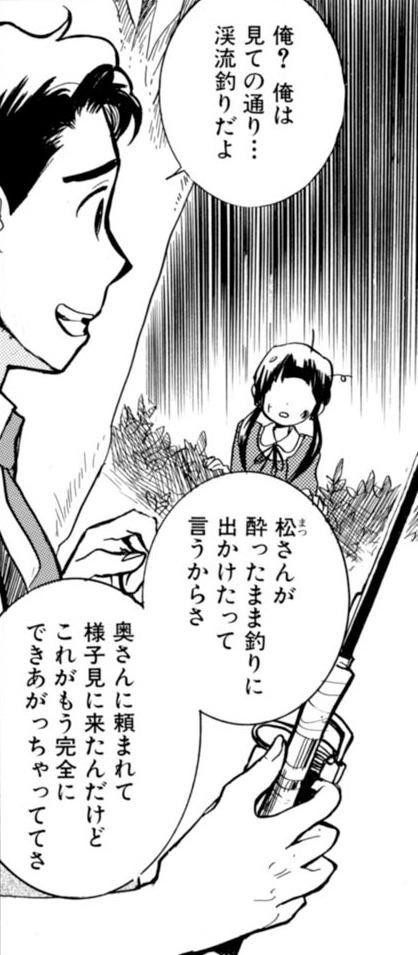
くまみこ » Volume 1 » Page 128Machi sets out for the Uniqlo in town on an errand, but the heavy bicycle she borrowed falls apart on the mountain road. She decides to cut straight across the mountain on foot and climbs down a steep slope to a stream, where she runs into Yoshio holding a fishing rod. He asks what she’s doing on such a steep slope.
良夫( よしお ) :「俺( おれ ) ? 俺( おれ ) は見( み ) ての通( とお ) り…渓流( けいりゅう ) 釣( づ ) りだよ」 “Me? Well, as you can see... I'm stream fishing.” 「松( まつ ) さんが酔( よ ) ったまま釣( つ ) りに出( で ) かけたって言( い ) うからさ」 “I heard Matsu went off fishing while he was still drunk.” 「奥( おく ) さんに頼( たの ) まれて様子( ようす ) 見( み ) に来( き ) たんだけど これがもう完全( かんぜん ) にできあがっちゃっててさ」 “His wife asked me to come check on him, but he's totally plastered.” Challenge Yourself Show Translation
Challenge
What kind of fishing is Yoshio doing?
良夫( よしお ) :「俺( おれ ) ? 俺( おれ ) は見( み ) ての通( とお ) り…渓流( けいりゅう ) 釣( づ ) り 「松( まつ ) さんが酔( よ ) ったまま釣( つ ) りに出( で ) かけたって言( い ) うからさ」 「奥( おく ) さんに頼( たの ) まれて様子( ようす ) 見( み ) に来( き ) たんだけど これがもう完全( かんぜん ) にできあがっちゃっててさ」 Clues 渓流( けいりゅう ) a mountain stream 釣( づ ) りfishing 見( み ) ての通( とお ) りas you can see What does the speaker mean? Fishing in a mountain stream. 渓流 is a stream running through a mountain valley, and 釣り after it names where the fishing happens. Fishing out at sea. That would be 海釣り. Yoshio is standing by a stream in the mountains. Fishing at a stocked pond. A fishing pond is a 釣り堀. 渓流 is a natural stream. Fishing with a net in a river. 渓流釣り says where Yoshio fishes, not how. He's holding a rod and reel, not a net.
Yoshio says he’s doing 渓流釣り, fishing in a mountain stream. He holds up the rod as proof, then explains that he’s only there because of Matsu.
View Full Example Example 2 of 2: Koto lessons with 稽古 Example 2 of 2
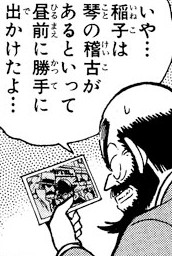
名探偵コナン » Volume 6 » Page 27Hired to confirm whether a client’s wife is having an affair, Kogoro reveals a candid photo he took of the wife with another man. The client mentions he let his staff take a break so they wouldn’t know about Kogoro’s visit. Kogoro asks if that includes the client’s wife.
伝次郎( でんじろう ) :「いや… 稲子( いねこ ) は琴( こと ) の稽古( けいこ ) があるといって昼前( ひるまえ ) に勝手( かって ) に出( で ) かけたよ」 “No... Ineko said she had a koto lesson and went out on her own before noon.” Challenge Yourself Show Translation
Challenge
What reason did Ineko give for leaving before noon?
伝次郎( でんじろう ) :「いや… 稲子( いねこ ) は琴( こと ) の稽古( けいこ ) 昼前( ひるまえ ) に勝手( かって ) に出( で ) かけたよ」 Clues 琴( こと ) の稽古( けいこ ) があるといってsaying that she had a koto lesson 昼前( ひるまえ ) に勝手( かって ) に出( で ) かけたshe went out on her own before noon What does the speaker mean? She said that she had a koto lesson. といって reports the koto lesson as the reason Ineko stated before leaving. She said that she needed to buy a new koto. The line names 稽古( けいこ ) , a lesson or training session, not shopping. She left to dismiss the household staff. Her stated destination concerns her own koto training. She was invited to lunch by Kogoro. She left before noon on her own, and Kogoro was visiting for the investigation. She stayed home to practice alone. 出( で ) かけた says that she went out. She refused to explain why she was leaving. The speaker reports the reason she gave, whether or not it was truthful.
Ineko said she had a koto lesson and went out on her own before noon. 稽古( けいこ ) suits structured training in a traditional art.
View Full Example 出て来る (で てくる) (To come out)出( で ) て来( く ) る is to come out of a place toward the speaker. It can also mean to appear or turn up. It’s often written 出てくる.
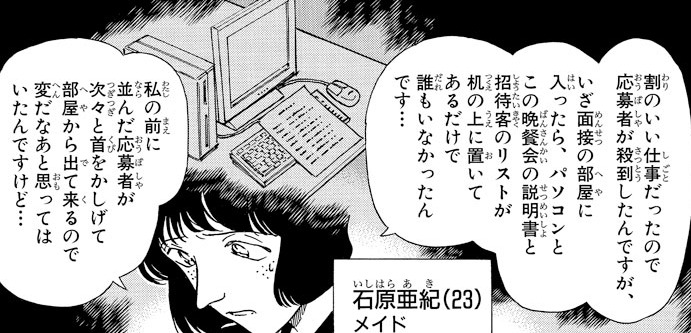
名探偵コナン » Volume 30 » Page 66Kogoro, Ran, and Conan have arrived at a remote mansion whose owner has invited several famous detectives to dinner. The maid who greets them admits she has never met the owner. Asked about the guest list, she says she was given it at her job interview, and that the interview was a strange one.
亜紀( あき ) :「割( わり ) のいい仕事( しごと ) だったので応募者( おうぼしゃ ) が殺到( さっとう ) したんですが、いざ面接( めんせつ ) の部屋( へや ) に入( はい ) ったら、パソコンとこの晩餐会( ばんさんかい ) の説明書( せつめいしょ ) と招待客( しょうたいきゃく ) のリストが机( つくえ ) の上( うえ ) に置( お ) いてあるだけで誰( だれ ) もいなかったんです…」 “It paid well, so applicants came flooding in. But when I actually went into the interview room, there was just a computer, instructions for this dinner party, and the guest list on the desk. Nobody was there…” 「私( わたし ) の前( まえ ) に並( なら ) んだ応募者( おうぼしゃ ) が次々( つぎつぎ ) と首( くび ) をかしげて部屋( へや ) から出( で ) て来( く ) る変( へん ) だなあと思( おも ) ってはいたんですけど…」 “The applicants in line ahead of me came out of the room one after another, looking puzzled, so I did think it was odd…” Info Card: 「石原亜紀( いしはらあき ) (23) メイド」 “Aki Ishihara (23), maid” Challenge Yourself Show Translation
Challenge
What does Aki mean by いざ面接の部屋に入ったら?
亜紀( あき ) :「割( わり ) のいい仕事( しごと ) だったので応募者( おうぼしゃ ) が殺到( さっとう ) したんですが、いざ 面接( めんせつ ) の部屋( へや ) に入( はい ) ったら 、パソコンとこの晩餐会( ばんさんかい ) の説明書( せつめいしょ ) と招待客( しょうたいきゃく ) のリストが机( つくえ ) の上( うえ ) に置( お ) いてあるだけで誰( だれ ) もいなかったんです…」 「私( わたし ) の前( まえ ) に並( なら ) んだ応募者( おうぼしゃ ) が次々( つぎつぎ ) と首( くび ) をかしげて部屋( へや ) から出( で ) て来( く ) るので変( へん ) だなあと思( おも ) ってはいたんですけど…」 Info Card: 「石原亜紀( いしはらあき ) (23) メイド」 Clues いざ actually, when the moment came 面接( めんせつ ) interview 入( はい ) ったらwhen (I) went in 置( お ) いてあるだけでonly set out, and nothing more 誰( だれ ) もいなかったnobody was there What does the speaker mean? When her turn finally came and she walked in, she found the room had no interviewer. いざ marks the moment the interview was really happening, and たら leads to what she found when she went in. If she ever gets an interview, she expects the room to be empty. いなかった is past. She is telling what happened, so たら isn't a condition here. She lost her nerve at the door and never went into the room. 入( はい ) った says she did go in. いざ marks the moment she did, not hesitation. She went in before the other applicants and found the room empty. Her second bubble says the applicants 私( わたし ) の前( まえ ) に並( なら ) んだ, lined up ahead of her, went in first.
After waiting in line with a crowd of applicants, Aki finally walked into the interview room. いざ marks that moment, when the interview was supposed to start for real, and the たら clause tells what she found there. Instead of an interviewer, there was only a computer and some papers.
View Full Example 乗り出す (のりだ す) (To lean out)乗( の ) り出( だ ) す is to lean forward out of something. It also means to set out on a new venture.
It combines 乗り (riding ) with 出す (put out ) to show leaning out .
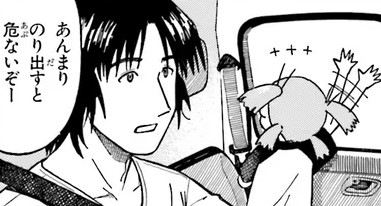
よつばと! » Volume 1 » Page 8Yotsuba and her father are driving to their new home. As they pass a school letting out, Yotsuba waves to a student.
父( とう ) さん:「あんまりのり出( だ ) すと危( あぶ ) ないぞー」 “It's dangerous to lean out too far.” Challenge Yourself Show Translation
Challenge
What warning does Yotsuba's father give her?
父( とう ) さん:「あんまりのり出( だ ) すと 危( あぶ ) ないぞー」 Clues あんまりのり出( だ ) すと if she leans too far out 危( あぶ ) ないぞhe firmly warns that it is dangerous What does the speaker mean? Leaning too far out is dangerous. と links excessive leaning to 危( あぶ ) ない as its natural result, and ぞ adds force to the warning. Waving at students is prohibited. Her father warns about how far she leans out, not about the act of waving. She should get out of the vehicle immediately. 乗( の ) り出( だ ) す means leaning or sticking out. It does not tell Yotsuba to exit. The road ahead is too dangerous to use. The danger follows Yotsuba's action in the conditional clause, not the choice of road. She must lean farther out to be seen. あんまり marks the leaning as excessive, so her father wants her to do less of it. The student outside is behaving dangerously. The warning addresses Yotsuba's position in the vehicle, not the student she sees.
Yotsuba’s father warns that leaning too far out will put her in danger. The conditional と presents danger as the predictable result of that action.
View Full Example Putting Out 出す (だ す) (To put out)出( だ ) す is to take something out, send it out, or hand it in. After a verb stem, it means to start doing something.
Example 1 of 2: Drawing a conclusion about a murder with 結論 Example 1 of 2
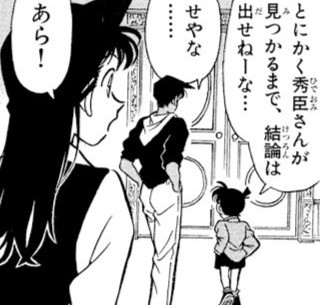
名探偵コナン » Volume 16 » Page 18Conan and Heiji end up staying at the same mansion when a murder occurs. They decide to put their heads together to try and determine who the culprit is.
コナン: 「とにかく秀臣( ひでおみ ) さんが見( み ) つかるまで、結論( けつろん ) は出( だ ) せねーな…」 “Anyway, I guess we can't come to a conclusion until we find Hideomi...” 平次( へいじ ) :「せやな……」 “That's right.” 蘭( らん ) :「あら!」 “Oh!” Challenge Yourself Show Translation
Challenge
Why do Conan and Heiji hold off on reaching a conclusion?
コナン: 「とにかく秀臣( ひでおみ ) さんが見( み ) つかるまで、結論( けつろん ) 出( だ ) せねーな…」 平次( へいじ ) :「せやな……」 蘭( らん ) :「あら!」 Clues 秀臣( ひでおみ ) さんが見( み ) つかるまでuntil Hideomi is found 結論( けつろん ) は出( だ ) せねーwe cannot reach a conclusion What does the speaker mean? They need Hideomi to be found first. 〜まで with the negative says they cannot conclude the case before Hideomi is found. They have already agreed on the culprit. 結論( けつろん ) は出( だ ) せねー says they cannot yet settle on an answer. They are waiting for Ran to choose between their theories. The stated condition is finding Hideomi, not Ran's judgment. They need the police to leave the mansion. No departure by the police is tied to their conclusion. They cannot understand each other's dialect. Heiji immediately agrees with Conan using せやな. They have decided there was no murder. They are still investigating the murder and lack a final conclusion.
Conan says they cannot draw a conclusion until Hideomi is found, and Heiji agrees. The negative potential 出( だ ) せねー means they are not yet able to reach one.
View Full Example Example 2 of 2: Figuring out the password with 見つけ出す Example 2 of 2
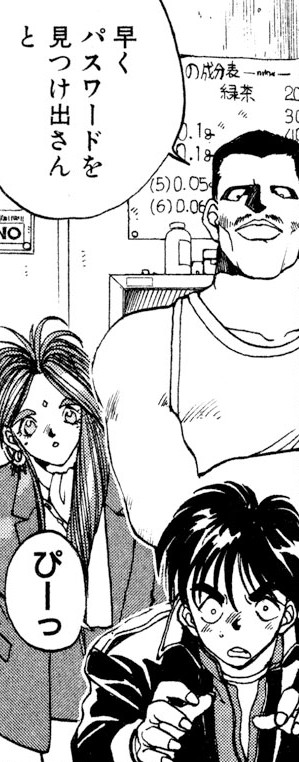
ああっ女神さまっ » Volume 1 » Page 85Kei’ichi must enter the university system to add a record showing Belldandy is enrolled. He only has a brief window of opportunity before Professor Ozawa logs into the system and discovers she isn’t enrolled. The only thing standing in Kei’ichi’s way is the university’s enrollment records password protection.
田宮( たみや ) :「早( はや ) く パスワードを見( み ) つけ出( だ ) さんと」 “If you don't hurry and figure out that password...” Challenge Yourself Show Translation
Challenge
What urgent task does Tamiya leave unfinished?
田宮( たみや ) :「早( はや ) く パスワードを見( み ) つけ出( だ ) さん Clues 早( はや ) くquickly パスワードを the password, marked as the object 見( み ) つけ出( だ ) すto find or uncover after effort 〜んと a casual form of 〜ないと, if we do not What does the speaker mean? They must figure out the password quickly, or there will be trouble. 見( み ) つけ出( だ ) さんと contracts 見( み ) つけ出( だ ) さないと, and the unfinished conditional leaves the bad consequence understood. They have already found the password faster than expected. 見( み ) つけ出( だ ) さんと is not a completed past action. It means that they need to find it before an unstated consequence follows. They need to create a new password immediately. 見( み ) つけ出( だ ) す means to find or uncover something. Creating a password would require a verb such as 作( つく ) る. They should stop searching because the password is unnecessary. The negative element belongs to the condition 〜ないと, meaning if they do not find it. It does not tell them to stop. They must enter a password that Tamiya already knows. The verb is 見( み ) つけ出( だ ) す, to uncover. The line does not use a verb for entering or typing the password. They should ask Professor Ozawa to reveal the password. No request to Professor Ozawa appears in the line. Tamiya presses the group to find the password before time runs out.
Tamiya uses the casual conditional 見( み ) つけ出( だ ) さんと, from 見( み ) つけ出( だ ) さないと. He trails off after saying that they must uncover the password quickly, leaving the looming consequence unstated.
View Full Example 思い出す (おもいだ す) (To remember)思( おも ) い出( だ ) す is to recall something you had forgotten, or to have a memory come back.
It combines 思い (thought ) with 出す (bring out ) to show bringing a thought back out .
Example 1 of 2: All that murder planning for nothing with 水の泡になる Example 1 of 2
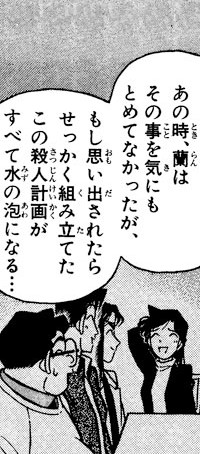
名探偵コナン » Volume 5 » Page 83After discovering who the murderer is, Conan explains why the murderer went after Ran. He pinpoints when Ran unknowingly discovered a vital clue.
コナン: 「あの時( とき ) 、蘭( らん ) はその事( こと ) を気( き ) にもとめてなかったが、もし思( おも ) い出( だ ) されたらせっかく組( く ) み立( た ) てたこの殺人( さつじん ) 計画( けいかく ) がすべて水( みず ) の泡( あわ ) になる…」 “Ran didn't think anything of it at the time, but if she remembered it, all the murderous plans he worked so hard on putting together would go up in smoke.” Challenge Yourself Show Translation
Challenge
What would happen if Ran remembered the clue?
コナン: 「あの時( とき ) 、蘭( らん ) はその事( こと ) を気( き ) にもとめてなかったが、もし思( おも ) い出( だ ) されたらせっかく組( く ) み立( た ) てたこの殺人( さつじん ) 計画( けいかく ) がすべて水( みず ) の泡( あわ ) になる Clues もし思( おも ) い出( だ ) されたら if she were to remember it この殺人( さつじん ) 計画( けいかく ) がすべて水( みず ) の泡( あわ ) になる the entire murder plan would come to nothing What does the speaker mean? The culprit's carefully prepared plan would be ruined. 水( みず ) の泡( あわ ) になる means that all the effort put into the plan would be wasted. Ran would forget the clue permanently. The condition is that Ran remembers it, not that she forgets it. The culprit would have time to rebuild the plan. The idiom describes the existing plan collapsing, not a chance to begin again. The murder would be mistaken for an accident. Remembering the clue would threaten the culprit's concealment rather than strengthen it. Conan's investigation would have to stop. The wasted effort belongs to the culprit's murder plan. Ran would become part of the plan willingly. Her memory would expose a clue and undermine the plan.
If Ran remembered what she had noticed, the culprit’s carefully assembled murder plan would fall apart. 水( みず ) の泡( あわ ) になる says that the invested effort would come to nothing.
View Full Example Example 2 of 2: Suddenly remembering with 思い出す Example 2 of 2
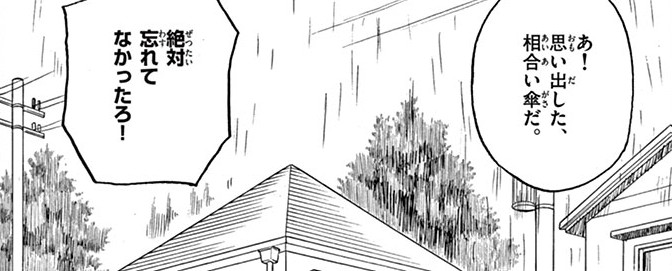
からかい上手の高木さん » Volume 1 » Page 114Takagi and Nishikata share an umbrella to walk home after school. Takagi says she completely forgot the term for two people sharing an umbrella. Nishika, with embarrassment, mutters that it’s あいあいがさ. When Takagi asks him to repeat it louder, he keeps quiet in his embarrassment.
高木( たかぎ ) :「あ! 思( おも ) い出( だ ) した、相合( あいあ ) い傘( がさ ) だ。」 “Ah, I just remembered, it's 相合( あいあ ) い傘( がさ ) .” 西片( にしかた ) :「絶対( ぜったい ) 忘( わす ) れてなかったろ!」 “You totally didn't forget it!” Challenge Yourself Show Translation
Challenge
What does Takagi claim to have just remembered?
高木( たかぎ ) :「あ! 思( おも ) い出( だ ) した相合( あいあ ) い傘( がさ ) だ。」 西片( にしかた ) :「絶対( ぜったい ) 忘( わす ) れてなかったろ!」 Clues 思( おも ) い出( だ ) したremembered or recalled 相合( あいあ ) い傘( がさ ) だthe term is sharing an umbrella 絶対( ぜったい ) 忘( わす ) れてなかったyou definitely had not forgotten, Nishikata's accusation What does the speaker mean? The term for two people sharing an umbrella is 相合( あいあ ) い傘( がさ ) . Takagi announces 思( おも ) い出( だ ) した and identifies the recalled term as 相合( あいあ ) い傘( がさ ) . She remembered that she left her own umbrella at school. The item recalled is a word for their situation, not the location of another umbrella. She remembered Nishikata's name after forgetting it. No name is supplied after 思( おも ) い出( だ ) した. She supplies 相合( あいあ ) い傘( がさ ) . She remembered that they promised not to walk together. The recalled content is a term, not a promise. She suddenly decided to buy a new umbrella. 思( おも ) い出( だ ) す means recall here, not begin a purchase. She admits she knew the term the whole time. Takagi claims she just remembered it. Nishikata is the one who accuses her of never forgetting.
Takagi says she has just recalled the term 相合( あいあ ) い傘( がさ ) . Nishikata suspects that she knew it all along and was teasing him.
View Full Example 呼び出す (よびだ す) (To call out)呼( よ ) び出( だ ) す is to call someone and get them to come out or come to a certain place, such as summoning someone to an office or paging them.
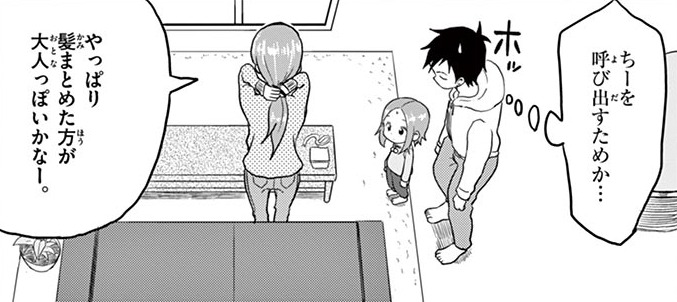
からかい上手の(元)高木さん » Volume 2 » Page 130Chii has run off with Takagi’s hair tie. On Christmas Eve, Takagi calls out that a scatterbrained Santa left a present behind. When Chii opens the box, a knitted bear springs out at her. Takagi wonders aloud whether Santa found out about the hair tie, and Chii hands it back.
西片( にしかた ) :「ちーを呼( よ ) び出( だ ) す “So it was to get Chii to come out...” 高木( たかぎ ) :「やっぱり髪( かみ ) まとめた方( ほう ) が大人( おとな ) っぽいかなー。」 “I guess I do look more grown-up with my hair tied back, huh?” Challenge Yourself Show Translation
Challenge
What is Takagi wondering about?
西片( にしかた ) :「ちーを呼( よ ) び出( だ ) すためか…」 高木( たかぎ ) :「やっぱり髪( かみ ) まとめた方( ほう ) が大人( おとな ) っぽい かなー。」 Clues 髪( かみ ) (を)まとめるto gather up or tie back one's hair Verb (た-form) + 方( ほう ) が more so when doing that 大人( おとな ) っぽいgrown-up, mature-looking かなー I wonder What does the speaker mean? Whether she looks more grown-up with her hair tied back. 髪( かみ ) まとめた方( ほう ) が compares her hair tied back with her hair down, and 大人( おとな ) っぽい is the look she gets from it. Whether she looks childish with her hair tied back. That would be 子供( こども ) っぽい. 大人( おとな ) っぽい is the opposite, "grown-up". Whether she has finally become an adult. っぽい is about having the feel of something, not being it. Takagi is already an adult and a mother. She's talking about how her hairstyle looks. Whether Chii looks more grown-up wearing the hair tie. Chii has just handed the hair tie back, and Takagi is holding her own hair. She's talking about herself. Whether she should cut her hair short. まとめる means to gather something together. Takagi is holding her hair back to show the tied look, not talking about cutting it.
Now that she has her hair tie back, Takagi holds her hair together behind her neck. 髪( かみ ) まとめた方( ほう ) が大人( おとな ) っぽい means “it looks more grown-up with my hair tied back”. やっぱり presents this as something she’d already thought, and かなー turns it into musing out loud with Nishikata standing right there.
View Full Example 出汁 (だ し, だし) (Soup stock)出汁( だし, ダシ ) means dashi, Japanese soup stock. It is the extracted liquid base that gives dishes depth of flavor.
It combines 出 (draw out ) with 汁 (liquid extract ) to show liquid drawn out from ingredients .
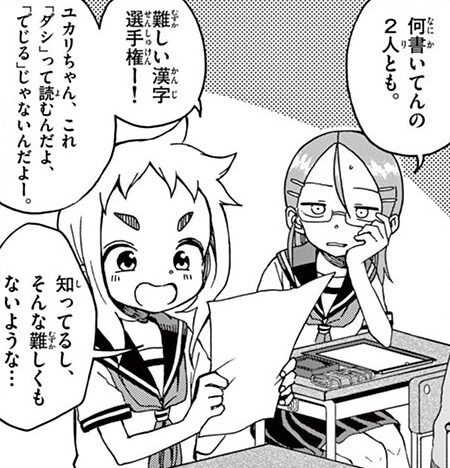
恋に恋するユカリちゃん » Volume 3 » Page 69In calligraphy class, the teacher tells everyone to write a word they like and hand it in by the end of class. Yukari settles on something plain. Then Mina shouts that she’s done, and she and Sanae hold up their sheets. Mina’s reads 出汁 and Sanae’s reads 韋駄天.
ユカリ: 「何( なに ) 書( か ) いてんの2人( り ) とも。」 “What are you two writing?” ミナ: 「難( むずか ) しい漢字( かんじ ) 選手権( せんしゅけん ) ー!」 “The hard kanji championship!” 「ユカリちゃん、これ「ダシ」って読( よ ) むんだよ、「でじる」じゃないんだよー。」 “Yukari, this is read "dashi", not "dejiru"!” ユカリ: 「知( し ) ってるし、そんな難( むずか ) しくもないような…」 “I know that, and it's not even that hard...” Challenge Yourself Show Translation
Challenge
How does Mina explain what she and Sanae are doing?
ユカリ: 「何( なに ) 書( か ) いてんの2人( り ) とも。」 ミナ: 「難( むずか ) しい漢字( かんじ ) 選手権( せんしゅけん ) 「ユカリちゃん、これ「ダシ」って読( よ ) むんだよ、「でじる」じゃないんだよー。」 ユカリ: 「知( し ) ってるし、そんな難( むずか ) しくもないような…」 Clues 難( むずか ) しい漢字( かんじ ) hard kanji 選手権( せんしゅけん ) a championship; a contest to decide the best What does the speaker mean? They're competing to see who can write the hardest kanji. 選手権( せんしゅけん ) turns their calligraphy into a contest, and 難( むずか ) しい漢字( かんじ ) says what they're competing over. They're practicing for a real kanji test. A 選手権( せんしゅけん ) is a championship, not a test. Mina is making up a game. They're picking athletes for a sports team. 選手( せんしゅ ) means an athlete, but 選手権( せんしゅけん ) is the championship itself, and here it's about kanji. They're writing the names of famous champions. The sheets say 出汁 and 韋駄天. Neither is a champion's name, and Mina says the contest is about hard kanji.
Mina announces that she and Sanae are holding a 難( むずか ) しい漢字( かんじ ) 選手権( せんしゅけん ) , a “hard kanji championship”. Then she explains her own kanji to Yukari, who already knew it.
View Full Example Coming About 出来る (で きる) (To be able to)出来( でき ) る means to be able to do something. It can also mean that something is made, completed, or comes into existence.
Example 1 of 5: An invitation to go smelt fishing with ワカサギ釣り Example 1 of 5
アオのハコ » Volume 12 » Page 52Chinatsu is spending the New Year holidays at her grandparents’ house in Nagano. One morning she sits at the kotatsu with her mother, who tells her they’ll head home on the sixth and can take it easy until then. Then her grandfather calls to her from the doorway.
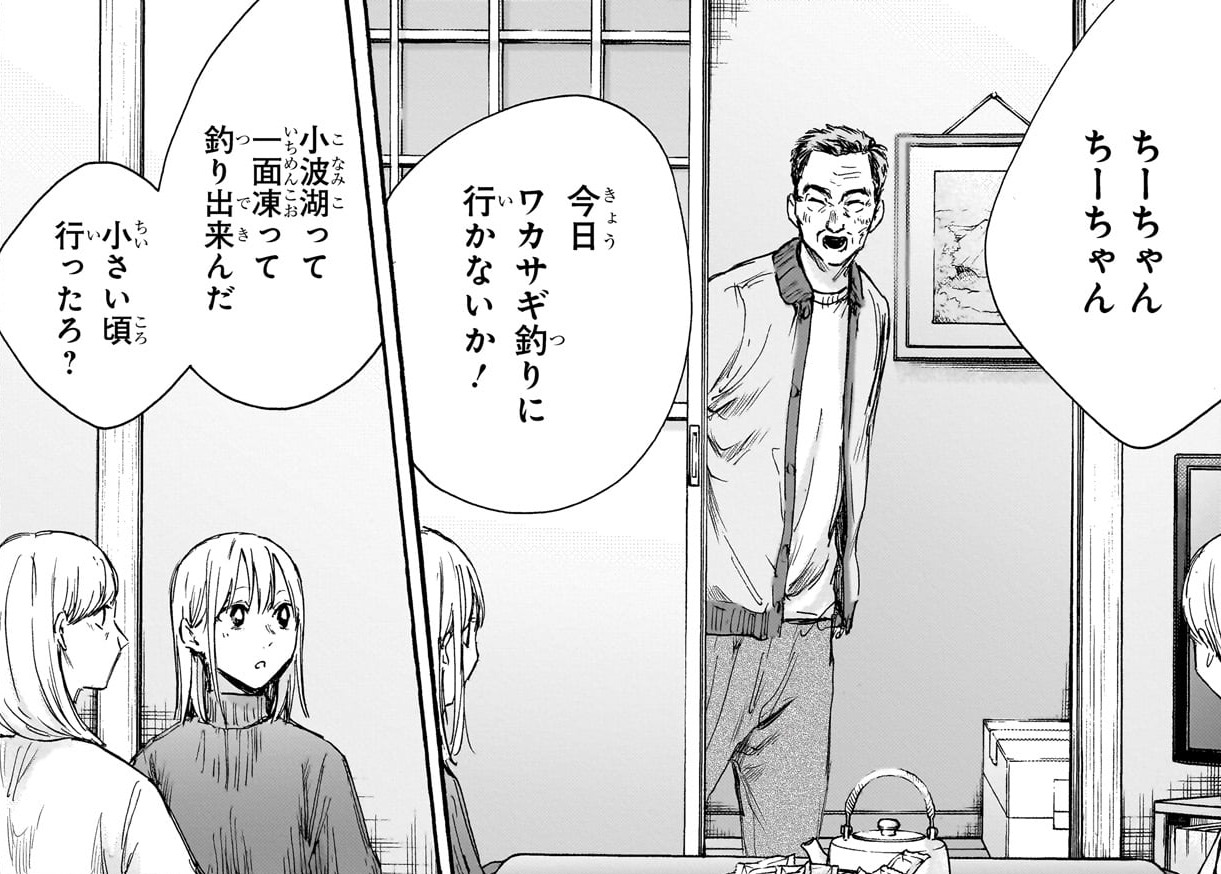
おじいちゃん: 「ちーちゃん ちーちゃん」 “Chii, Chii!” 「今日( きょう ) ワカサギ釣( つ ) りに行( い ) かないか!」 “Want to go smelt fishing today?” 「小波湖( こなみこ ) って一面( いちめん ) 凍( こお ) って釣( つ ) り出来( でき ) んだ」 “Konami Lake freezes over end to end, so you can fish right on it.” 「小( ちい ) さい頃( ころ ) 行( い ) ったろ?」 “We went when you were little, remember?” Challenge Yourself Show Translation
Challenge
What is Chinatsu's grandfather inviting her to do?
おじいちゃん: 「ちーちゃん ちーちゃん」 「今日( きょう ) ワカサギ釣( つ ) り行( い ) かないか!」 「小波湖( こなみこ ) って一面( いちめん ) 凍( こお ) って釣( つ ) り出来( でき ) んだ」 「小( ちい ) さい頃( ころ ) 行( い ) ったろ?」 Clues ワカサギ pond smelt, a small lake fish 〜釣( つ ) りに行( い ) く to go fishing for... 一面( いちめん ) 凍( こお ) ってfrozen over completely What does the speaker mean? Go ice fishing for smelt on a frozen lake. ワカサギ釣り is fishing for smelt, and the lake is frozen over, so they'll fish through the ice. Go ice skating on the frozen lake. The lake is frozen, but what he says you can do there is 釣り. Buy smelt at the market for dinner. 釣り is catching fish yourself. Nobody is shopping. Remember a fishing trip without going anywhere today. 小さい頃行ったろ? is a reminder, but the invitation is 今日…行かないか, to go today.
Putting the name of a fish before 釣り names what you’re fishing for, so ワカサギ釣り is smelt fishing. Smelt fishing in winter happens through holes cut in a frozen lake. That’s why he mentions the lake freezing over. 行かないか is a casual invitation, “want to go?”
View Full Example Example 2 of 5: Basil jam heated through lightly with 火を通す Example 2 of 5
ハクメイとミコチ » Volume 4 » Page 75Mikochi wants to sell a jam-and-bread set at the festival, and she and Hakumei have cooked a big pot of raspberry jam through the night. Mikochi had Hakumei fetch a small pot for a test batch, added a splash of rum, then chopped basil leaves fine and put them into the jam.
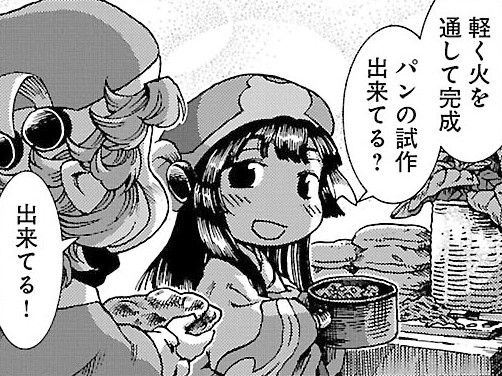
ミコチ: 「軽( かる ) く火( ひ ) を通( とお ) して完成( かんせい ) 」 “Heat it through lightly, and it's done.” 「パンの試作( しさく ) 出来( でき ) てる?」 “Is the test bread ready?” ハクメイ: 「出来( でき ) てる!」 “It's ready!” Challenge Yourself Show Translation
Challenge
What does Mikochi do to the jam to finish it?
ミコチ: 「軽( かる ) く火( ひ ) を通( とお ) して完成( かんせい ) 」 「パンの試作( しさく ) 出来( でき ) てる?」 ハクメイ: 「出来( でき ) てる!」 Clues 軽( かる ) くlightly 火( ひ ) を通( とお ) すto cook through, to heat through 完成( かんせい ) completion, done What does the speaker mean? She heats it briefly so the basil cooks into it. 火( ひ ) を通( とお ) す means to let the heat pass through the food. 軽( かる ) く keeps it short, so the basil just cooks a little before the jam is done. She takes it off the heat and lets it cool. Taking a pot off the heat is 火( ひ ) から下( お ) ろす. 火( ひ ) を通( とお ) す puts heat into the food. She boils it down for a long time. 軽( かる ) く means lightly, so the heating is brief. Long simmering would be 煮詰( につ ) める or じっくり煮( に ) る. She lights the fire under the big pot. Lighting a fire is 火( ひ ) をつける. 火( ひ ) を通( とお ) す is about the food, not the fire, and here it's the small test pot of jam.
火( ひ ) を通( とお ) す means to cook something through by letting heat reach into it. With 軽( かる ) く, Mikochi gives the basil jam a short heating, and then it’s 完成( かんせい ) , finished.
View Full Example Example 3 of 5: Hoping baked bread is tasty with 〜といい Example 3 of 5
ご注文はうさぎですか? » Volume 1 » Page 40After teaching her friends how to bake bread, Cocoa surprises them with a special menu item she created.
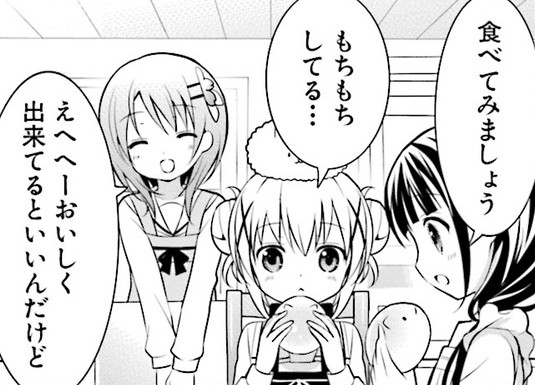
千夜( ちや ) :「食( た ) べてみましょう」 “Let's try it.” チノ: 「もちもちしてる…」 “It's so soft and chewy...” ココア: 「えへへーおいしく出来( でき ) てるといいんだけど」 “I hope it came out tasty, but...” Challenge Yourself Show Translation
Challenge
What does ココア mean in the highlighted line?
千夜( ちや ) :「食( た ) べてみましょう」 チノ: 「もちもちしてる…」 ココア: 「えへへーおいしく出来( でき ) てるといいんだ けど」 Clues といいんだ おいしく出来( でき ) てるといい expresses Cocoa's hope What does the speaker mean? I hope it came out tasty, but... The literal condition "if it came out tasty, that would be good" becomes "I hope it came out tasty." Cocoa knows that the bread came out badly. The highlighted form is といいんだ. Here おいしく出来( でき ) てるといい expresses Cocoa's hope, so this choice does not match the Japanese. Cocoa asks Chino to make the bread taste better. The highlighted form is といいんだ. Here おいしく出来( でき ) てるといい expresses Cocoa's hope, so this choice does not match the Japanese. Cocoa says everyone has already confirmed that the bread is delicious. The highlighted form is といいんだ. Here おいしく出来( でき ) てるといい expresses Cocoa's hope, so this choice does not match the Japanese.
おいしく出来( でき ) てるといい expresses Cocoa’s hope. The literal condition “if it came out tasty, that would be good” becomes “I hope it came out tasty.”
View Full Example Example 4 of 5: Letting daikon syrup sit in the fridge with 寝かせる Example 4 of 5
老女的少女ひなたちゃん » Volume 1 » Page 19Moka has a sore throat. Hinata scolds her so harshly that Moka cries, then makes up for it with a jar of daikon syrup. Moka tastes it and is surprised that it’s sweet and nothing like daikon.
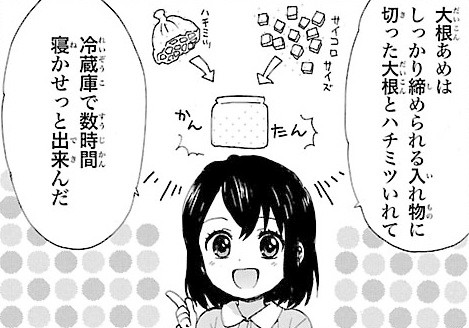
日向( ひなた ) :「大根( だいこん ) あめはしっかり締( し ) められる入( い ) れ物( もの ) に切( き ) った大根( だいこん ) とハチミツいれて」 “For daikon syrup, you put cut daikon and honey in a container that seals tight...” 「冷蔵庫( れいぞうこ ) で数時間( すうじかん ) 寝( ね ) かせっと出来( でき ) んだ」 “...and once you let it sit in the fridge for a few hours, it's ready.” Challenge Yourself Show Translation
Challenge
What does Hinata do with the jar after filling it?
日向( ひなた ) :「大根( だいこん ) あめはしっかり締( し ) められる入( い ) れ物( もの ) に切( き ) った大根( だいこん ) とハチミツいれて」 「冷蔵庫( れいぞうこ ) で数時間( すうじかん ) 寝( ね ) かせ出来( でき ) んだ」 Clues 冷蔵庫( れいぞうこ ) refrigerator 数時間( すうじかん ) several hours 寝( ね ) かせるto put to bed; to let rest 〜と when, once 出来( でき ) るto be done, to be ready What does the speaker mean? She leaves it in the fridge for a few hours. 寝( ね ) かせる is "to put to bed". In the kitchen, it means leaving food alone so it can settle. Here the daikon sits in the honey. She chills it in the fridge, then heats it for a few hours. Nothing is heated. The jar just sits in the fridge. She drinks it right away before bed. 寝( ね ) かせる is about the food resting, not about anyone going to sleep. The syrup isn't ready until hours later. She stirs it every few hours in the fridge. 寝( ね ) かせる means leaving it alone. Stirring would be かき混( ま ) ぜる.
寝( ね ) かせる is the causative of 寝( ね ) る, “to make sleep” or “to put to bed”. With food, it means letting something sit untouched while it changes. The daikon gives off its juice into the honey, and that juice is what makes the syrup.
View Full Example Example 5 of 5: Stuck serving the rice with ご飯をよそう Example 5 of 5
ホリミヤ » Volume 7 » Page 136In cooking class, Sakura is in the same group as Remi and Sengoku, who can barely cook. Sakura has banned Remi from using a knife, and Sengoku peeled the potatoes and onions until nothing was left. The rest of the class saw this coming and gave the group a little of their own curry.
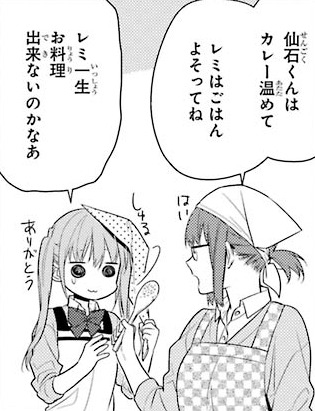
桜( さくら ) :「仙石( せんごく ) くんはカレー温( あたた ) めて レミはごはんよそってね」 “Sengoku, you heat up the curry. Remi, you serve the rice, okay?” 綾崎( あやさき ) :「レミ一生( いっしょう ) お料理( りょうり ) 出来( でき ) ないのかなあ」 “Am I never going to be able to cook?” 桜( さくら ) :「はい」 “Here.” 綾崎( あやさき ) :「ありがとう」 “Thanks.” Challenge Yourself Show Translation
Challenge
What job does Sakura give Remi?
桜( さくら ) :「仙石( せんごく ) くんはカレー温( あたた ) めて レミはごはんよそって ね」 綾崎( あやさき ) :「レミ一生( いっしょう ) お料理( りょうり ) 出来( でき ) ないのかなあ」 桜( さくら ) :「はい」 綾崎( あやさき ) :「ありがとう」 Clues ごはん cooked rice, a kana spelling of ご飯( はん ) よそって the て-form of よそう, to scoop food into a bowl 〜てね a friendly request, "do ~, okay?" What does the speaker mean? Scoop the rice into everyone's bowls. よそう is the verb for dishing up rice or soup from the pot into individual bowls. Sakura hands her the rice paddle to do it. Cook the rice. Cooking rice is ご飯を炊く. よそう comes later, when the rice is done and goes into bowls. Wash the rice before it goes in the cooker. Washing rice is 米を研ぐ or 米を洗う. Sakura uses ごはん, cooked rice, and よそう, serving it. Heat up the curry. That's Sengoku's job. 仙石くんは marks the first instruction as his, and レミは starts a new one for Remi.
Sakura splits the last jobs between her two groupmates. 仙石くんは goes with カレー温めて, and レミは goes with ごはんよそってね. よそう means to scoop food from the pot into bowls, so Remi gets the one job that needs no knife and no stove.
View Full Example 出来事 (で きごと) (Event)出来事( できごと ) is something that happened, an event or incident.
It combines 出来 (coming about ) with 事 (thing ) to show something that happened .
ご注文はうさぎですか? » Volume 1 » Page 99After Cocoa has a string of bad luck throughout the day, Chiya takes her to the tea shop where Syaro works to get her mind off everything that happened.
Just as Cocoa’s finally cheered up, Syaro comments to herself about her own bad luck, returning Cocoa to gloom.
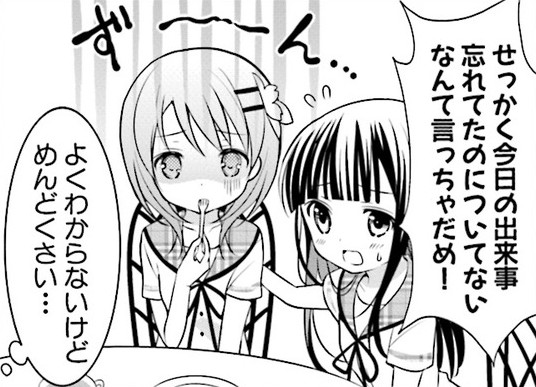
千夜( ちや ) :「せっかく今日( きょう ) の出来事( できごと ) 忘( わす ) れてたのについてないなんて言( い ) っちゃだめ!」 “We went through the trouble to forget about today, so don't say bad luck!” シャロ: 「よくわからないけどめんどくさい…」 “I don't really understand, but this is a pain...” Challenge Yourself Show Translation
Challenge
What does 千夜( ちや ) mean in the highlighted line?
千夜( ちや ) :「せっかく 今日( きょう ) の出来事( できごと ) 忘( わす ) れてたのに ついてないなんて言( い ) っちゃだめ!」 シャロ: 「よくわからないけどめんどくさい…」 Clues せっかくのに せっかく〜のに marks a spoiled good result What does the speaker mean? She had finally forgotten what happened today, so don't remind her that she has bad luck! Cocoa had reached the welcome state of forgetting the day's bad events, but Syaro's comment threatens to undo that progress. Chiya says Cocoa has been lucky all day and Syaro should remind her. The highlighted form is せっかくのに. Here せっかく〜のに marks a spoiled good result, so this choice does not match the Japanese. Chiya asks Syaro to help Cocoa remember every bad event from the day. The highlighted form is せっかくのに. Here せっかく〜のに marks a spoiled good result, so this choice does not match the Japanese. Chiya says Syaro may complain about bad luck because Cocoa is still gloomy. The highlighted form is せっかくのに. Here せっかく〜のに marks a spoiled good result, so this choice does not match the Japanese.
せっかく〜のに marks a spoiled good result. Cocoa had reached the welcome state of forgetting the day’s bad events, but Syaro’s comment threatens to undo that progress.
View Full Example 出来上がり (で きあがり) (Finished)出来上( できあ ) がり is the point when something is finished, or the finished result. Said alone, as in “出来上( できあ ) がり!”, it announces that food or work is done.
のんのんびより » Volume 10 » Page 128Komari insisted on making dinner by herself to prove to her sister Natsumi that she can cook. She settled on curry, using last night’s leftover meat and potato stew as the base, but while she was searching the kitchen for sugar, the pot began to smoke. Her mother came in, turned off the burner, and told her a little smoke was nothing to panic over.
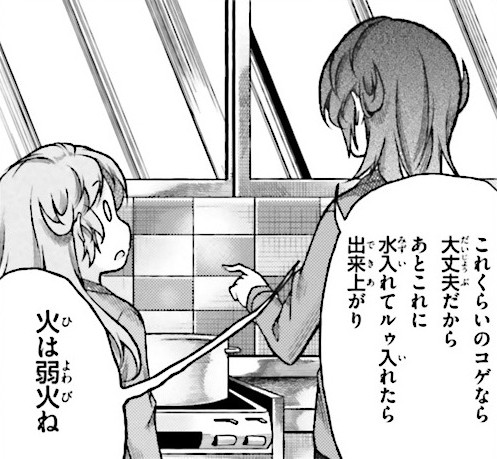
お母( かあ ) さん: 「これくらいのコゲなら大丈夫( だいじょうぶ ) だから あとこれに水( みず ) 入( い ) れてルゥ入( い ) れたら出来上( できあ ) がり “This little bit of scorching is fine. Now just add water and the roux, and it's done.” 「火( ひ ) は弱火( よわび ) ね」 “Keep it on low heat, okay?” Challenge Yourself Show Translation
Challenge
What does Komari's mother tell her to do with the burner?
お母( かあ ) さん: 「これくらいのコゲなら大丈夫( だいじょうぶ ) だから あとこれに水( みず ) 入( い ) れてルゥ入( い ) れたら出来上( できあ ) がり」 「火( ひ ) は弱火( よわび ) Clues 火( ひ ) fire; in the kitchen, the burner's flame 弱火( よわび ) low heat, the weakest normal burner setting ね okay?, a reminder that asks the listener to go along What does the speaker mean? Cook the curry over low heat. 弱火( よわび ) is the low setting on a burner. She's telling Komari how to set the flame when she turns it back on to finish the curry. Turn the heat up so the curry finishes faster. That would be 強火( つよび ) , high heat. 弱 means weak, and the pot has just burned once already. Leave the burner off for good. Turning off the burner is 火( ひ ) を止( と ) める, which her mother already did. The curry still has to cook once the water and roux go in. The flame is too weak, so the pot won't burn again. 弱火( よわび ) here is an instruction, not a description of the current flame. The burner is off right now, and ね makes the line a reminder of what Komari should do.
火( ひ ) は sets the burner’s flame as the topic, and 弱火( よわび ) names the setting it should be on. The verb is left out, as it often is in instructions, and ね turns the line into a friendly reminder. Curry thickened with roux sticks to the bottom of the pot easily, and Komari has just scorched this one, so her mother wants a low flame.
View Full Example Escapes 脱出 (だっしゅつ ) (Escape)脱出( だっしゅつ ) means escaping from a place or getting out of a dangerous situation.
It combines 脱 (escape ) with 出 (go out ) to show getting out by slipping free .
名探偵コナン » Volume 24 » Page 160To allay Haibara’s fears of being recognized at an event, Conan lets her wear his fake glasses as a disguise. After she’s kidnapped, Conan communicates with her through the wireless communication device built into the glasses, in hope of discovering where she’s being held. Once Haibara confirms she cannot escape the room she’s in, she tells Conan to listen carefully and starts listing off the details of her research around the drug that caused the two of them to become children.
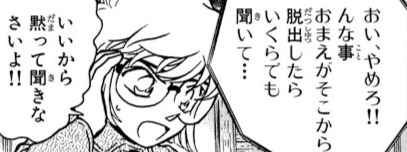
コナン: 「おい、やめろ!! んな事( こと ) おまえがそこから脱出( だっしゅつ ) 聞( き ) いて…」 “Hey, stop it!! I'll listen after we get you out of there...” 灰原: 「いいから黙( だま ) って聞( き ) きなさいよ!!」 “Just shut up and listen to me!!” Challenge Yourself Show Translation
Challenge
How does Haibara respond when Conan tells her to stop?
コナン: 「おい、やめろ!! んな事( こと ) おまえがそこから脱出( だっしゅつ ) したら聞( き ) いて…」 灰原: 「いいから 黙( だま ) って聞( き ) きなさいよ!!」 Clues いいから enough about that, just 黙( だま ) って聞( き ) きなさいよbe quiet and listen What does the speaker mean? She cuts him off and orders him to listen quietly. いいから dismisses his objection before the firm command 黙( だま ) って聞( き ) きなさい. She agrees to wait until after her rescue. She rejects Conan's proposed delay and insists on speaking now. She asks him to stop listening. 聞( き ) きなさい is a command to listen. She apologizes for interrupting him. Her tone is forceful and dismissive, not apologetic. She tells him to explain the drug first. Haibara is the one about to give the information and wants Conan silent. She says that escaping is no longer important. いいから pushes aside his immediate objection. It does not evaluate the importance of escape.
Haibara refuses to postpone the information and sharply tells Conan to be quiet and listen. いいから works as “enough, just…” before the command.
View Full Example Submissions 提出 (ていしゅつ ) (Submission)提出( ていしゅつ ) is handing in something, such as homework, a report, or a form.
It combines 提 (put forward ) with 出 (put out ) to show putting something forth .
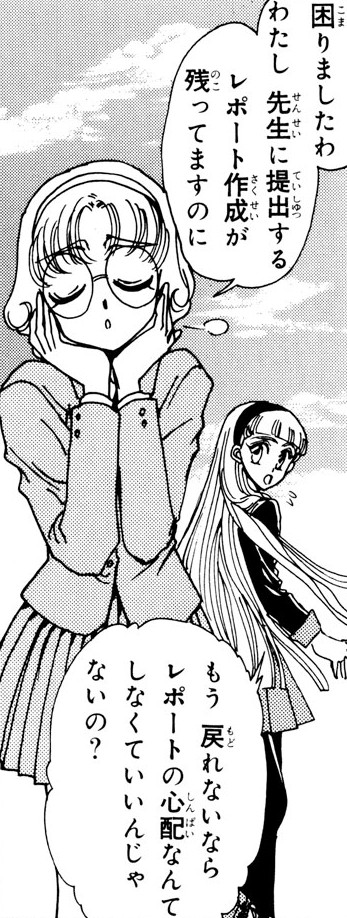
魔法騎士レイアース » Volume 1 » Page 47Fuu finds herself spirited away to another world, along with two other girls. A wizard appears before them, saying they cannot return home until they accomplish a specific goal.
風( ふう ) :「困( こま ) りましたわ。 わたし 先生( せんせい ) に提出( ていしゅつ ) 作成( さくせい ) が残( のこ ) ってますのに」 “Oh dear. I've still got to write that report to hand in to the teacher...” 海( うみ ) :「もう 戻( もど ) れないならレポートの心配( しんぱい ) なんてしなくていいんじゃないの?」 “If we can't go back anyway, isn't there no point worrying about the report?” Challenge Yourself Show Translation
Challenge
Why does Umi say Fuu does not need to worry about her unfinished report?
風( ふう ) :「困( こま ) りましたわ。 わたし 先生( せんせい ) に提出( ていしゅつ ) するレポート作成( さくせい ) 残( のこ ) ってますのに」 海( うみ ) :「もう 戻( もど ) れないならレポートの心配( しんぱい ) なんてしなくていいんじゃないの?」 Clues 先生( せんせい ) に提出( ていしゅつ ) するレポート作成( さくせい ) が残( のこ ) ってますのにFuu still has a report to finish and submit to her teacher もう戻( もど ) れないなら Umi treats being unable to return home as the condition What does the speaker mean? If they cannot return home, Fuu cannot submit it to her teacher. 戻れないなら sets up the possibility that they cannot go home. The report is meant for Fuu's teacher, so she would have no way to submit it. The wizard has agreed to finish the report for Fuu. Umi does not mention the wizard doing the work. Her point depends on whether they can return home. Fuu's teacher has canceled the assignment. Fuu says the report remains unfinished. Nothing in either line says the teacher canceled it. 作成 shows that Fuu has already completed the report. 作成が残ってます means the work of preparing the report still remains. It is not complete. Umi plans to return alone and submit the report for Fuu. 戻れない refers to their inability to go back. Umi does not offer to deliver the report herself. The report matters only if Fuu becomes a mage. Umi links the report to returning home, not to whether Fuu becomes a mage.
Fuu is worried because she still has to finish a report for her teacher. Umi reasons that if they cannot return home, Fuu cannot submit it anyway, so worrying about it serves no purpose.
View Full Example Appearances 続出 (ぞくしゅつ ) (One after another)続出( ぞくしゅつ ) describes similar things appearing or happening one after another. News reports often use it for a string of problems or incidents.
It combines 続 (continue ) with 出 (come out ) to show things coming out continuously .
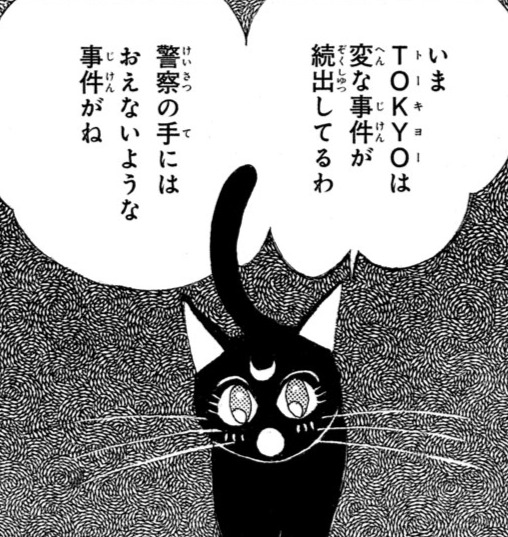
美少女戦士セーラームーン » Volume 1 » Page 28Luna introduces herself to Usagi, but Usagi thinks she’s dreaming if a cat is speaking to her. Luna gives Usagi a special brooch, then proceeds to explain the dire situation that has brought them together.
ルナ: 「いまTOKYOは変( へん ) な事件( じけん ) が続出( ぞくしゅつ ) “Strange incidents are popping up all over Tokyo these days.” 「警察( けいさつ ) の手( て ) にはおえないような事件( じけん ) がね」 “Incidents that seem beyond the police's control, you know.” Challenge Yourself Show Translation
Challenge
What situation does Luna say Tokyo is facing?
ルナ: 「いまTOKYOは変( へん ) な事件( じけん ) が続出( ぞくしゅつ ) 「警察( けいさつ ) の手( て ) にはおえないような事件( じけん ) がね」 Clues 変( へん ) な事件( じけん ) が続出( ぞくしゅつ ) してるstrange incidents are continuing to appear one after another 警察( けいさつ ) の手( て ) にはおえないような事件( じけん ) the incidents seem beyond what the police can handle What does the speaker mean? Strange incidents are appearing in succession beyond police control. 続出してる describes repeated new incidents, and 警察の手にはおえない says they seem too much for the police to handle. One old case has kept the police busy for years. 続出 means multiple incidents are appearing one after another, not one case continuing for a long time. The police are causing strange incidents throughout Tokyo. The police are described as unable to handle the incidents, not as their cause. Tokyo has returned to normal after a series of crimes. してる presents the incidents as an ongoing situation now, not something that has ended. Only Luna and Usagi have noticed a single minor problem. Luna describes repeated serious incidents that exceed ordinary police control. The police have solved each incident as soon as it appeared. 手にはおえない means the cases appear beyond their ability to manage, not that they solved them promptly.
Luna tells Usagi that strange incidents are appearing one after another across Tokyo. She adds that these cases seem beyond the police, which explains why Usagi’s new role is necessary.
View Full Example むき出し (むきだ し) (Bare)むき出( だ ) し describes something exposed, without any covering. It also describes feelings shown openly. It is also written 剥( む ) き出( だ ) し.
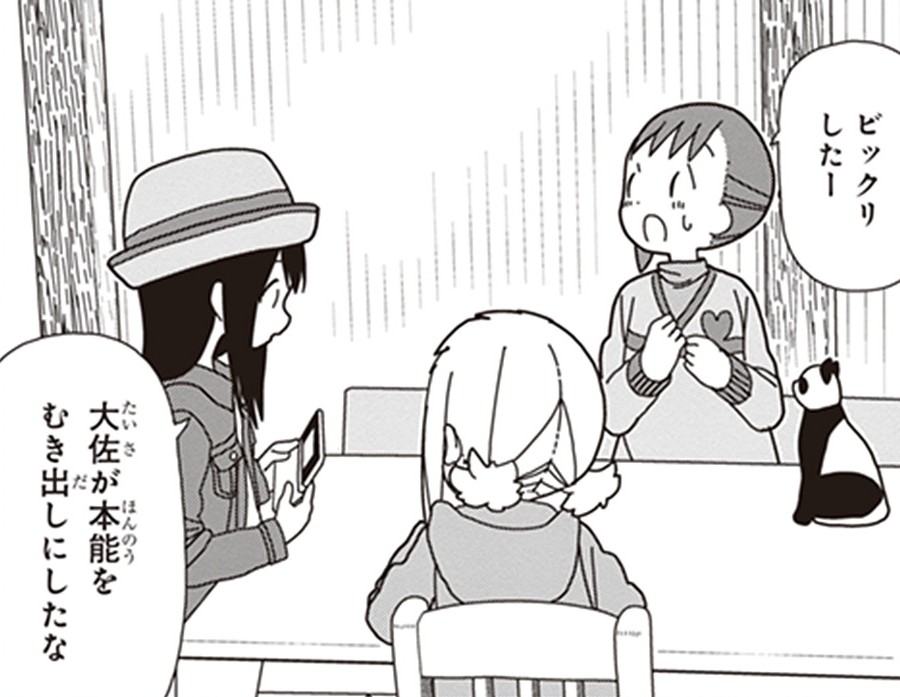
三ツ星カラーズ » Volume 7 » Page 20Yui and her friends are in their secret base when a pigeon flies in and lands on the table between them. The group’s cat, Colonel Monochrome, leaps after it, but the pigeon escapes.
結衣( ゆい ) :「ビックリしたー」 “That surprised me!” 琴葉( ことは ) :「大佐( たいさ ) が本能( ほんのう ) をむき出( だ ) し にしたな」 “The Colonel laid bare his instincts.” Challenge Yourself Show Translation
Challenge
What does Kotoha say the Colonel's leap after the pigeon revealed?
結衣( ゆい ) :「ビックリしたー」 琴葉( ことは ) :「大佐( たいさ ) が本能( ほんのう ) 出( だ ) しにしたな」 Clues 大佐( たいさ ) が本能( ほんのう ) をむき出( だ ) しにしたthe Colonel laid his instincts bare What does the speaker mean? His natural hunting instincts. 本能( ほんのう ) is the instinct that the Colonel exposed when he leapt after the bird. His fear of birds. The Colonel pursues the pigeon, and Kotoha calls the reaction instinct rather than fear. His ability to obey Yui's commands. No command causes the leap. The phrase describes an inborn drive coming out. His wish to leave the clubhouse. The object marked by を is 本能( ほんのう ) , not a desire to leave. His surprise at seeing the girls. Yui is the one who says she was surprised. Kotoha comments on the cat's instinct. His habit of sleeping on the table. The comment follows his leap after the pigeon, not an act of sleeping.
Kotoha says the Colonel laid bare his natural instincts when he chased the pigeon. 本能( ほんのう ) is what he exposed, marked as the object by を.
View Full Example 露出度 (ろしゅつ ど) (Degree of exposure)露出度( ろしゅつど ) means the amount of skin exposed or the degree of public or media visibility.
It combines 露出 (exposure ) with 度 (degree ) to show the measured extent of exposure .
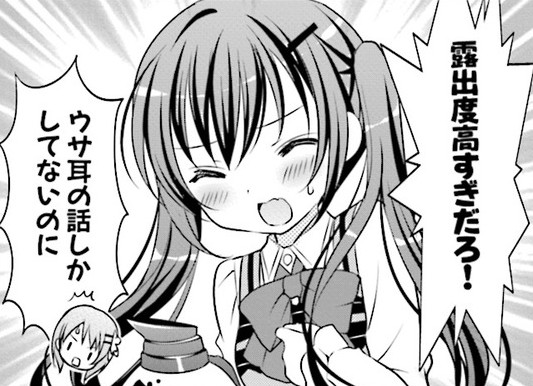
ご注文はうさぎですか? » Volume 1 » Page 18Rize misunderstands Cocoa’s suggesting the staff of Rabbit House wear bunny ears. She imagines herself in a skimpy bunny girl outfit.
リゼ: 「露出度( ろしゅつど ) 高( たか ) すぎだろ!」 “That's way too revealing!” ココア: 「ウサ耳( みみ ) の話( はなし ) しかしてないのに」 “Even though we haven't talked about anything but bunny ears...” Challenge Yourself Show Translation
Challenge
What does リゼ mean in the highlighted line?
リゼ: 「露出度( ろしゅつど ) 高( たか ) すぎ だろ!」 ココア: 「ウサ耳( みみ ) の話( はなし ) しかしてないのに」 Clues 高( たか ) すぎ露出度( ろしゅつど ) is how revealing the outfit isWhat does the speaker mean? That's way too revealing! 露出度( ろしゅつど ) literally means "degree of exposure". Rize complains that the bunny ears themselves are too large. The highlighted form is 高( たか ) すぎ. Here 露出度( ろしゅつど ) is how revealing the outfit is, so this choice does not match the Japanese. Rize says Cocoa explicitly proposed a full bunny-girl outfit. The highlighted form is 高( たか ) すぎ. Here 露出度( ろしゅつど ) is how revealing the outfit is, so this choice does not match the Japanese. Rize asks whether the imagined costume is still too modest. The highlighted form is 高( たか ) すぎ. Here 露出度( ろしゅつど ) is how revealing the outfit is, so this choice does not match the Japanese.
露出度( ろしゅつど ) is how revealing the outfit is. 露出度( ろしゅつど ) literally means “degree of exposure”.
View Full Example Building Bigger Words These patterns come up again and again in manga. Learn the pattern and you can read words you've never seen.
出 read で で (coming out)思い出 おもいで a memory 出会い であい a first meeting 出番 でばん your turn to act 出口 でぐち exit 家出 いえで running away from home 出 read だ だ (putting out)買い出し かいだし a shopping run 手を出す てをだす to lay a hand on, to meddle 手出し てだし meddling 出〜 しゅつ (going out to do something)出場 しゅつじょう taking part in a tournament 出身 しゅっしん where you come from 出張 しゅっちょう business trip 出席 しゅっせき attendance 出世 しゅっせ getting ahead in life 〜出 しゅつ (bringing out)演出 えんしゅつ staging a show 進出 しんしゅつ moving into a new field or round Check Yourself What does 出 mean? Read These Without Furigana Work Out a New Word 番 is a turn. Read 出番 in this line. What does she think is coming soon?
「そろそろアタシの出番も近( ちか ) そうだわ!!」
ポケットモンスタースペシャル, volume 5 Show the answer 出番( でばん ) , your turn to act. “It looks like my turn is coming up soon too!!”
How is 出 read in 出口, and how in 出発?
Show the answer 出口( でぐち ) and 出発( しゅっぱつ ) . The native word takes で. The compound takes しゅつ, tightened to しゅっ.