Hands and skill with 手
手 refers to the part of the human body from the shoulder to the fingertips. It also has a wide range of meanings, such as skill, method, and a person who works.
Etymology
This kanji is an ancient pictogram. It is the shape of a hand , old forms as a drawing of fingers and palm.
Ability
苦手 (Weak point)苦手( にがて ) means something one is bad at or someone one finds difficult to deal with.
It combines 苦 (difficult ) with 手 (skill ) to show a skill area that feels difficult .
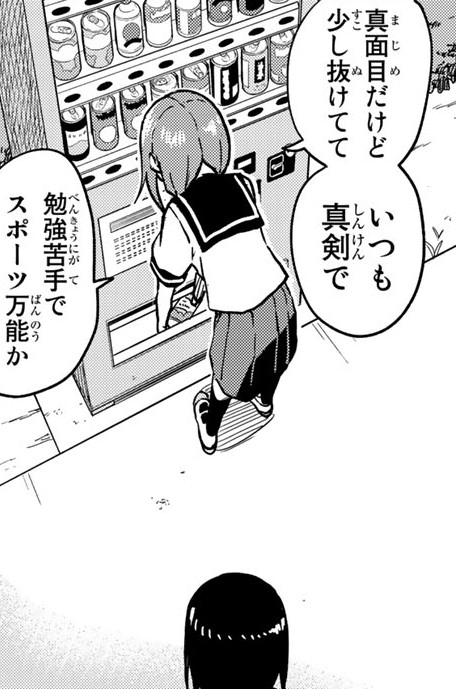
それでも歩は寄せてくる »
Volume 10 » Page 84
Urushi asks Rin about what Ayumu was like in middle school.
うるし:
「真面目( まじめ ) だけど少( すこ ) し抜( ぬ ) けてていつも真剣( しんけん ) で勉強( べんきょう ) 苦手( にがて ) 万能( ばんのう ) か」
“Serious but a bit absent-minded, always earnest, struggles with academics, but excels at sports, huh?”
Challenge Yourself
Show translation
Challenge
What does Urushi learn about Ayumu's abilities?
Clues
勉強( べんきょう ) 苦手( にがて ) で"he is poor at studying," limiting the scope of the praise that follows
スポーツ万能( ばんのう )
"good at every kind of sport" or "an all-around athlete"
What does the speaker mean?
He struggles with academics but excels across sports.
勉強( べんきょう ) 苦手( にがて ) gives his academic weakness, while スポーツ万能( ばんのう ) describes broad athletic ability.
He is equally skilled at studying and every sport.
Urushi explicitly includes 勉強( べんきょう ) 苦手( にがて ) , so 万能( ばんのう ) is limited to sports here.
He is talented only at kendo.
スポーツ万能( ばんのう ) describes all-around athletic ability, not skill in a single sport.
He takes sports seriously but performs poorly in them.
万能( ばんのう ) gives a positive assessment of his ability across sports.
He studies well but is absent-minded during sports.
This reverses the academic description and incorrectly ties 抜( ぬ ) けてて only to sports.
He is capable at everything without exception.
The compound is スポーツ万能( ばんのう ) , so the scope is athletics, and the line separately says studying is difficult for him.
Urushi’s rapid list includes both a weakness and a strength. Ayumu is 勉強( べんきょう ) 苦手( にがて ) , poor at studying, but スポーツ万能( ばんのう ) , an all-around athlete.
View Full Example
Control and Conduct
勝手 (One's own way)勝手( かって ) means one’s own way or convenience. 勝手( かって ) に often describes acting on one’s own, especially without permission or regard for others.
勝手 is a conventional compound whose modern senses are not a direct combination of its kanji.
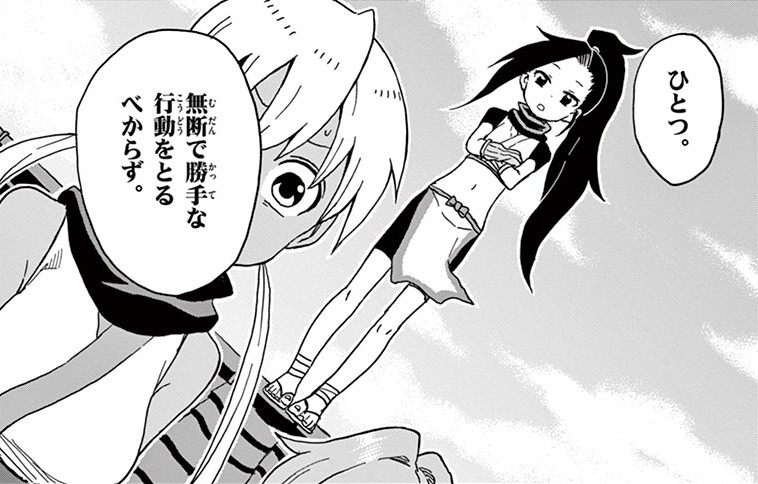
くノ一ツバキの胸の内 »
Volume 1 » Page 106
Sazanka sneaks out of class, leaving the teacher to send Asagao to bring her back. As Asagao chases Sazanka across the rooftops near the upper grade classroom, Tsubaki spots them. She meets them up on the roof and recites the school’s first rule.
ツバキ:
「ひとつ。無断( むだん ) で勝手( かって ) 行動( こうどう ) をとるべからず。」
“One: Doing as you please without permission is strictly forbidden.”
Challenge Yourself
Show translation
Challenge
What does the school rule forbid?
Clues
無断( むだん ) で"without permission" or "without authorization"
勝手( かって ) な行動( こうどう ) をとる"to take self-directed action"
〜べからず
a formal rule stating that an action is strictly forbidden
What does the speaker mean?
Acting on one's own without permission.
無断( むだん ) で supplies the lack of permission, and 勝手( かって ) な行動( こうどう ) をとる names the forbidden conduct.
Going onto a rooftop during training.
The scene happens on a roof, but the rule names unauthorized, self-directed action in general.
Leaving class after receiving permission.
無断( むだん ) で means without permission, so approved action is not what the rule describes.
Chasing another student across school grounds.
The chase prompts Tsubaki to cite the rule, but the wording prohibits acting as one pleases without approval.
Reciting school rules in casual language.
べからず gives the rule a formal tone. The rule does not ban casual speech.
Taking action unless a classmate comes along.
The line concerns authorization, not whether someone acts alone or with a classmate.
Tsubaki recites a rule against 無断( むだん ) で勝手( かって ) な行動( こうどう ) をとる, taking unauthorized action on one’s own judgment. The formal べからず marks it as strictly forbidden.
View Full Example
Gestures
握手 (Handshake)握手( あくしゅ ) means a handshake.
It combines 握 (grip ) with 手 (hand ) to show hands gripping each other .
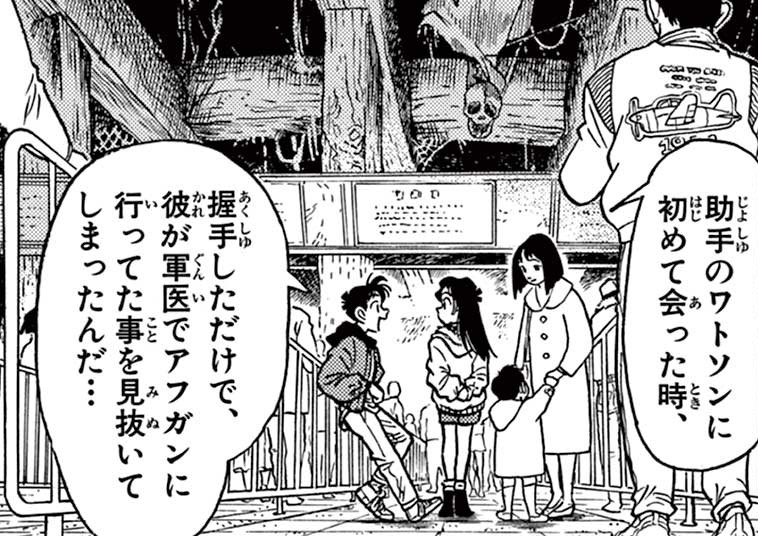
名探偵コナン »
Volume 1 » Page 17
Shin’ichi treats Ran to a day at Tropical Land as a reward for winning the city karate tournament. As they wait in line for a ride on the roller coaster, Shin’ichi explains all the reasons why Sherlock Holmes was the greatest detective.
新一( しんいち ) :「助手( じょしゅ ) のワトソンに初( はじ ) めて会( あ ) った時( とき ) 、握手( あくしゅ ) 彼( かれ ) が軍医( ぐんい ) でアフガンに行( い ) ってた事( こと ) を見( み ) 抜( ぬ ) いてしまったんだ…」
“The first time he met his assistant Watson, Holmes could tell just from a handshake that he was a military doctor who had been stationed in Afghanistan...”
Challenge Yourself
Show translation
Challenge
What did Holmes deduce merely from shaking Watson's hand?
Clues
握手( あくしゅ ) しただけでmerely by shaking hands
彼( かれ ) が軍医( ぐんい ) でアフガンに行( い ) ってた事( こと ) that he was a military doctor who had been to Afghanistan
What does the speaker mean?
Watson was a military doctor who had been to Afghanistan.
The long 事( こと ) clause gives the fact Holmes saw through from the handshake alone.
Watson had never worked as a doctor.
Shin'ichi identifies him specifically as a 軍医( ぐんい ) , military doctor.
Watson planned to travel to Afghanistan next.
行( い ) ってた describes a past experience, not a future plan.
Watson wanted to become Holmes's enemy.
The scene concerns their first meeting and Holmes's deduction, not hostility.
Watson injured Holmes during the handshake.
The handshake provides evidence. No injury occurs.
Watson had served as a detective in London.
The role named in the deduction is military doctor.
Holmes inferred from a single handshake that Watson was a military doctor who had been to Afghanistan. だけで stresses how little evidence he needed.
View Full Example
Handheld Objects
手鏡 (Hand mirror)手鏡( てかがみ ) means a small handheld mirror.
It combines 手 (hand ) with 鏡 (mirror ) to show a mirror held in the hand .
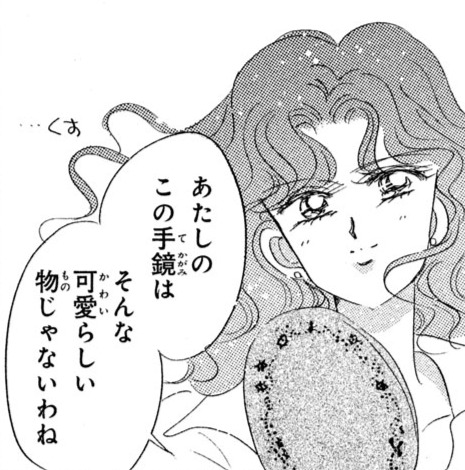
美少女戦士セーラームーン »
Volume 5 » Page 160
Seeing Chibausa leaving Hotaru’s house, Haruka and Michiru stop over to pick her up. Michiru asks what the two were talking about, and Chibausa explains that it was a conversation about amulets and their mysterious protective powers. She asks if Michiru has one. Michiru says her mirror may be protective, to which Chibausa says it must be an amulet.
みちる:
「あたしのこの手鏡( てかがみ ) 可愛( かわい ) らしい物( もの ) じゃないわね」
“This hand mirror of mine isn't something that cute.”
Challenge Yourself
Show translation
Challenge
What does Michiru say about her hand mirror?
Clues
あたしのこの手鏡( てかがみ )
she singles out the particular hand mirror she carries
そんな可愛( かわい ) らしい物( もの ) じゃないわね
she denies that it is the same kind of cute object Chibiusa described
What does the speaker mean?
It is not the sort of cute charm Chibiusa has in mind.
そんな points back to Chibiusa's idea, and 可愛らしい物じゃない rejects that description of Michiru's mirror.
It is a cute hand mirror that Chibiusa gave her.
じゃない negates the cute classification, and Michiru identifies the mirror as her own.
It has no protective power because it is only a mirror.
Michiru distinguishes its appearance from a cute charm. She does not deny that it may protect her.
It belongs to Usagi rather than Michiru.
あたしの explicitly identifies the hand mirror as Michiru's.
It is too large to hold in one hand.
手鏡 means a hand mirror. The contrast concerns whether it is a cute object, not its size.
It is prettier than Chibiusa's amulet.
Michiru says it is not that sort of cute thing. She does not compare which object is prettier.
Michiru says that her hand mirror is not the kind of cute object Chibiusa has been describing. The line rejects the appearance and category, not the possibility that the mirror has protective power.
View Full Example
Methods
手術 (Surgery)手術( しゅじゅつ ) means surgery, a medical procedure performed with instruments to treat an illness or injury.
It combines 手 (hand ) with 術 (technique ) to show a hand-performed medical technique .
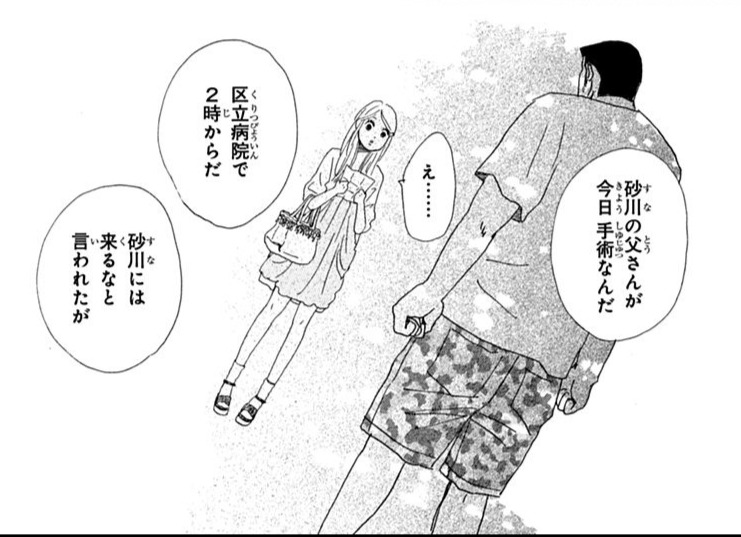
俺物語!! »
Volume 2 » Page 159
Takeo and Yamato go out on a date for Yamato’s birthday. They have a great time spending the day together, but when Yamato asks Takeo what his friend Sunakawa is doing, Takeo becomes silent. He says Suna helped him plan the date’s events, and Takeo gives her the tickets to the date’s finale. He tells Yamato to take a friend, because he needs to go be with Suna.
猛男( たけお ) :「砂川( すな ) の父( とう ) さんが今日( きょう ) 手術( しゅじゅつ )
“Suna's dad is having surgery today.”
大和( やまと ) :「え……」
“Eh......”
猛男( たけお ) :「区立( くりつ ) 病院( びょういん ) で2時( じ ) からだ」
“It's at the municipal hospital at 2 o'clock.”
猛男( たけお ) :「砂川( すな ) には来( く ) るなと言( い ) われたが」
“Suna told me not to come, but...”
Challenge Yourself
Show translation
Challenge
What did Suna tell Takeo about the surgery?
Clues
砂川( すな ) にはfrom Suna, marking him as the source of the instruction
来( く ) るなと言( い ) われたがI was told not to come, but
What does the speaker mean?
Do not come to the hospital.
来( く ) るな is the prohibitive command Suna gave, and 言( い ) われた reports Takeo receiving it.
Come to the hospital before two o'clock.
来( く ) るな forbids coming. The time describes the surgery, not a requested arrival.
Bring Yamato to visit his father.
Suna's quoted instruction contains only the command not to come.
Wait until the surgery is over, then call.
No waiting or calling instruction appears in the quote.
Tell Yamato nothing about the surgery.
The command concerns Takeo coming to the hospital, not what he may tell Yamato.
Go to the municipal hospital in Suna's place.
Suna tells Takeo not to come rather than asking him to substitute for anyone.
Suna told Takeo not to come to the hospital. Takeo reports the command with 来( く ) るなと言( い ) われた, then leaves the contrast hanging with が because he still wants to be there for Suna.
View Full Example
Roles
助手 (Assistant)助手( じょしゅ ) means an assistant, especially in professional or academic work.
It combines 助 (help ) with 手 (hand ) to show a helping hand .
名探偵コナン »
Volume 1 » Page 17
Shin’ichi treats Ran to a day at Tropical Land as a reward for winning the city karate tournament. As they wait in line for a ride on the roller coaster, Shin’ichi explains all the reasons why Sherlock Holmes was the greatest detective.
新一( しんいち ) :「助手( じょしゅ ) 初( はじ ) めて会( あ ) った時( とき ) 、握手( あくしゅ ) しただけで、彼( かれ ) が軍医( ぐんい ) でアフガンに行( い ) ってた事( こと ) を見( み ) 抜( ぬ ) いてしまったんだ…」
“The first time he met his assistant Watson, Holmes could tell just from a handshake that he was a military doctor who had been stationed in Afghanistan...”
Challenge Yourself
Show translation
Challenge
What did Holmes deduce merely from shaking Watson's hand?
Clues
握手( あくしゅ ) しただけでmerely by shaking hands
彼( かれ ) が軍医( ぐんい ) でアフガンに行( い ) ってた事( こと ) that he was a military doctor who had been to Afghanistan
What does the speaker mean?
Watson was a military doctor who had been to Afghanistan.
The long 事( こと ) clause gives the fact Holmes saw through from the handshake alone.
Watson had never worked as a doctor.
Shin'ichi identifies him specifically as a 軍医( ぐんい ) , military doctor.
Watson planned to travel to Afghanistan next.
行( い ) ってた describes a past experience, not a future plan.
Watson wanted to become Holmes's enemy.
The scene concerns their first meeting and Holmes's deduction, not hostility.
Watson injured Holmes during the handshake.
The handshake provides evidence. No injury occurs.
Watson had served as a detective in London.
The role named in the deduction is military doctor.
Holmes inferred from a single handshake that Watson was a military doctor who had been to Afghanistan. だけで stresses how little evidence he needed.
View Full Example