Humility and modesty with 謙
The kanji 謙 means to be humble, restrain one’s attitude, or show deference.
- Secondary School
- JLPT N1 (estimate)
- WaniKani level 39
- 17 strokes
Words with 謙
- Character
- Honorific Speech
- Social Conduct
The bold kana are the part 謙 contributes.
How to Read 謙
Every word on this page reads 謙 as けん.
Etymology
This kanji is a phono-semantic compound comprised of 言 (speech) as the semantic component and 兼 as the phonetic component (ケン).
Etymology Research
謙 is a phono-semantic character. 言 supplies the semantic connection with speech, and 兼 supplies the sound. Kanjipedia’s account, drawn from Kadokawa’s Shinjigen, associates the formation with respectful behavior. This supports an early sense of deference without requiring a picture story based on the modern parts. Kanjipedia
Heibonsha’s Jitsū independently identifies 兼 as the phonetic component. It reports that the Shuowen explains 謙 through restraint or reverence, and that the Yupian explains it through yielding. It also cites the Book of Changes’ commentary on 謙, where humility contrasts with fullness. These are transmitted textual witnesses to the meaning, rather than proof of the character’s first appearance. Heibonsha, Jitsū
Kanjipedia displays an older Japanese glyph alongside the modern form and counts both as seventeen strokes. Its formation account preserves the same semantic and phonetic components. The consulted entries do not supply enough dated forms to reconstruct a complete graphic history. Writing the Japanese verb へりくだる with 謙 reflects their shared meaning; the Chinese character’s formation does not explain the origin of that Japanese word. Kanjipedia
Character
謙虚 (けんきょ) (Humble)
謙虚 means humble or modest. It describes a person who does not puff themselves up and leaves their ego empty of boastfulness.
It combines 謙 (modest) with 虚 (empty) to show an emptied, unboastful attitude.
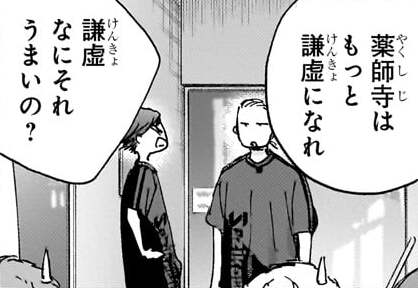
Sachigawa’s top players are on an overseas tour, so they missed the first-year tournament back home. In the lobby of a stadium, they hear that their teammate Mochizuki lost in the semifinals to Taiki of Eimei. Yakushiji laughs that Mochizuki has a self-deprecating streak and would be stronger if he were more straightforward with himself.
- 部員:
- 「薬師寺はもっと謙虚になれ」
- “Yakushiji, you should be more humble.”
- 薬師寺:
- 「謙虚 なにそれ うまいの?」
- “Humble? What's that? Does it taste good?”
Honorific Speech
謙譲語 (けんじょうご) (Humble language)
謙譲語 means humble language, the register used to lower the speaker or in-group relative to the listener. It is one major part of Japanese honorific speech.
It combines 謙 (humble) with 譲語 (yielding language) to show speech that lowers oneself respectfully.
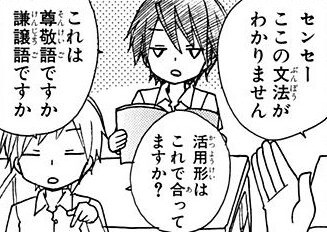
Students ask their teacher, Mittan, how long she has gone without a boyfriend. Mittan declares it top secret and tells them the only thing they may ask their teacher about is their studies.
- 生徒:
- 「センセー ここの文法がわかりません」
- “Miss, I don't understand the grammar here.”
- 淳平:
- 「活用形はこれで合ってますか?」
- “Is this the right conjugation?”
- 結心:
- 「これは尊敬語ですか謙譲語ですか」
- “Is this honorific language or humble language?”
Social Conduct
謙遜 (けんそん) (Humility)
謙遜 means humility or modesty. It is the standard positive word for holding oneself back respectfully.
It combines 謙 (modest) with 遜 (yield / humble oneself) to show deliberate modesty.
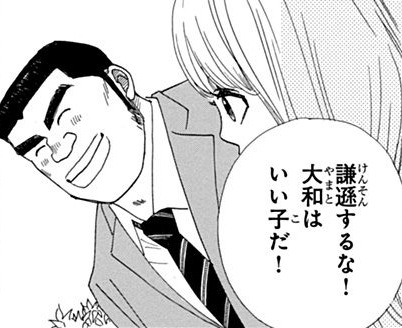
Sunakawa’s older sister couldn’t believe Takeo had a girlfriend and insisted on meeting her. Yamato brings cookies she baked and offers the sister some. When Takeo and the sister call her a good girl, Yamato waves the praise away and says she isn’t a good girl at all.
- 猛男:
- 「謙遜するな! 大和はいい子だ!」
- “Don't be so modest! Yamato, you're a good girl!”
Check Yourself
What does 謙 mean?
Humility and modesty.
Read These Without Furigana
謙虚
謙譲語
謙遜