Investigation and inspection with 査
査 means “to investigate” or “to clarify”. It is used when examining something in detail to uncover the truth or when verifying whether something is correct or incorrect by comparing it to a standard.
Etymology This kanji is a phono-semantic compound comprised of 木 (wood) as the semantic component and 且 as the phonetic component (サ).
It originally referred to a wooden raft, before making a semantic shift from checking a constructed object piece by piece to examining things carefully.
Evaluations 検査 (Inspection)
検査(けんさ) means an inspection, examination, or test for defects, suitability, or health problems.
It combines 検 (check ) with 査 (inspect ) to show a close inspection .
Kanji Explanation: Investigation and inspection with 査 (Future entry)
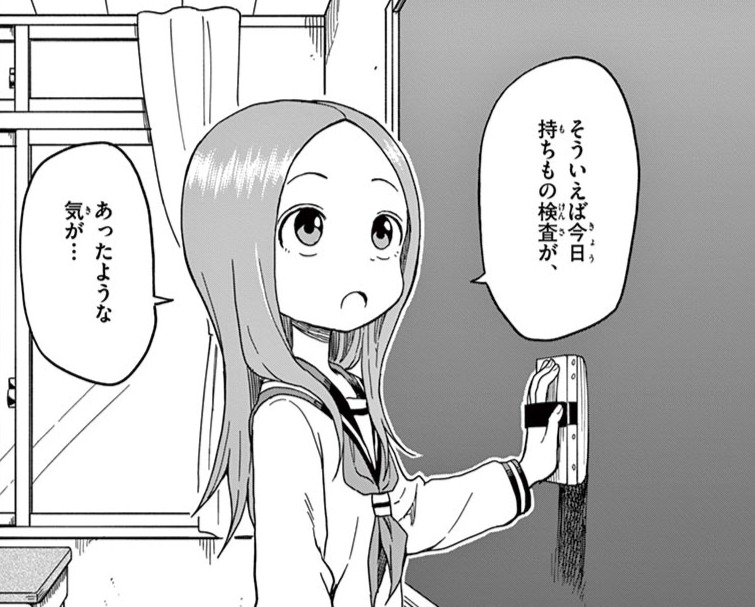
からかい上手の高木さん » Volume 11 » Page 22Nishikata and Takagi are on duty preparing the classroom before class.
高木(たかぎ) :「そういえば今日(きょう) 持(も) ちもの検査(けんさ) があったような気が…」“Come to think of it, I think we have a bag inspection today…” Challenge Yourself Show translation
Challenge
What does Takagi vaguely remember? Clues そういえば "come to think of it," introducing something just remembered 今日(きょう) 持(も) ちもの検査(けんさ) "today's belongings inspection" あったような気(き) が… a trailing "I feel like there was..." that marks uncertainty What does the speaker mean? There may be an inspection of students' belongings today. 今日(きょう) 持(も) ちもの検査(けんさ) names today's belongings inspection, and ような気(き) が makes the memory uncertain. The teacher inspected their belongings yesterday. 今日(きょう) means today, and the sentence does not mention the teacher. They need to inspect the classroom before class. 持(も) ちもの検査(けんさ) is an inspection of belongings, not the classroom. She definitely left something at home. The line recalls a possible inspection. It does not say she forgot an item. The inspection has been canceled. There is no word for cancellation. Takagi is unsure whether the inspection was scheduled. Students may bring anything they want today. A belongings inspection suggests checking what students brought, not unrestricted permission.
そういえば introduces Takagi’s recollection. She thinks there was a 今日(きょう) 持(も) ちもの検査(けんさ) , but あったような気(き) が… leaves that memory uncertain.
View Full Example Investigations 調査 (Investigation)
調査(ちょうさ) means an investigation, survey, or detailed examination of the facts.
It combines 調 (examine ) with 査 (investigate ) to show a careful investigation .
Kanji Explanation: Secrecy and hiddenness with 秘 (Future entry)
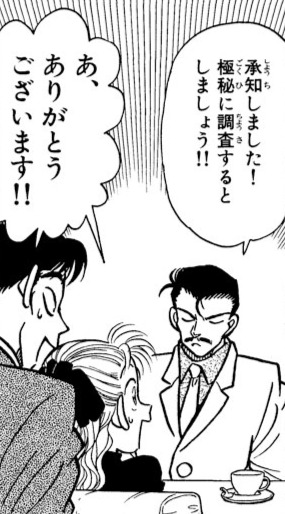
名探偵コナン » Volume 1 » Page 129Detective Mouri’s favorite idol, Yoko, comes to his agency after receiving threatening calls and candid photos. Her manager hopes to keep the matter quiet to protect her image.
毛利(もうり) :「承知(しょうち) しました!極秘(ごくひ) に調査(ちょうさ) するとしましょう!!」“Got it! Let's investigate this discreetly!!” ヨーコ: 「あ、ありがとうございます!!」“Thank you very much!!” Challenge Yourself Show translation
Challenge
How does Mouri agree to handle the investigation? Clues 極秘(ごくひ) に in strict secrecy 調査(ちょうさ) するとしましょう let us proceed with the investigation What does the speaker mean? He will investigate it in strict confidence. 極秘(ごくひ) に modifies the investigation as something kept highly confidential. He will announce the case to the press. That would contradict the promise of 極秘(ごくひ) , strict secrecy. He will refuse the case unless it becomes public. 承知(しょうち) しました shows that he accepts the request. He will ask the police to lead the investigation. Mouri says that he himself will proceed with the confidential inquiry. He will investigate only after the client's career ends. No delay is stated. He agrees to begin under conditions of secrecy. He will conceal the result from the client. The secrecy protects the client from publicity, not from receiving the findings.
Mouri accepts the case and promises to investigate discreetly. 極秘(ごくひ) に says that the work will remain strictly confidential.
View Full Example 捜査 (Investigation)
捜査(そうさ) means a criminal investigation by police or prosecutors to identify suspects and gather evidence.
It combines 捜 (search ) with 査 (investigate ) to show a thorough search and investigation .
Kanji Explanation: Investigation and inspection with 査 (Future entry)
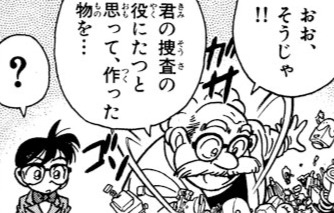
名探偵コナン » Volume 1 » Page 122Conan is now staying with Detective Mouri in hopes of finding a case related to the men responsible for his becoming a child. He stops by Professor Agasa’s place to discuss the situation.
阿笠(あがさ) :「おお、そうじゃ!!」“Oh, that's right!!”「君(きみ) の捜査(そうさ) の役(やく) にたつと思(おも) って、作(つく) った物(もの) を…」“I made this thinking it might help with your investigation...” Challenge Yourself Show translation
Challenge
Why did Agasa make the item he is about to show Conan? Clues 君(きみ) の捜査(そうさ) の役(やく) にたつ be useful for your investigation と思(おも) って、作(つく) った I made it thinking that What does the speaker mean? He thought it would help Conan's investigation. 捜査(そうさ) の役(やく) にたつ gives the purpose Agasa had in mind while making it. He wanted Conan to stop investigating. Agasa expects the invention to assist the investigation, not end it. He needed a gift for Ran's father. The person addressed as 君(きみ) is Conan, and the intended use is his investigation. He was repairing an item Conan had broken. Agasa says he made something new with a helpful purpose in mind. He wanted to test whether Conan recognized it. The planned benefit concerns case investigation, not object recognition. He thought it would disguise Conan as an adult. No disguise function is stated in this line.
Agasa made the invention because he thought it would be useful in Conan’s investigation. と思って gives the thought that motivated the work.
View Full Example