Joining and fitting with 合 合
合 means join , fit , or come together .
Grade 2 JLPT N3 (estimate) WaniKani level 12 6 strokes 合 Mincho 合 Rounded 合 Heavy 合 Pen 合 Brush 合 Marker Contents Words with 合 How to Read 合 Circumstances Joining Competition Fitting Standards Sound-Based Spellings Building Bigger Words Where 合 Breaks the Pattern Same Reading, Different Kanji Check Yourself Related Kanji ☰ ContentsWords with 合 How to Read 合 Circumstances Joining Competition Fitting Standards Sound-Based Spellings Building Bigger Words Where 合 Breaks the Pattern Same Reading, Different Kanji Check Yourself Related Kanji Words with 合 Combination 総合 そうごう Comprehensive whole 合計 ごう けいTotal The bold kana are the part 合 contributes. Words in a dashed box have no manga example yet.
How to Read 合 都合 (つごう ) 集合 (しゅうごう ) 合同 (ごう どう) 連合 (れんごう ) 集合場所 (しゅうごう ばしょ) 合格 (ごう かく) and 2 more ごう in most compounds, tightening to がっ before some sounds, as in 合宿( がっしゅく ) and 合体( がったい ) .
The verb is 合( あ ) う, to fit or to match. After another verb it means doing something with each other, as in 話( はな ) し合( あ ) う, to talk it over. Its noun form あい hides in 場合( ばあい ) , 試合( しあい ) , and 具合( ぐあい ) .
Circumstances 場合 (ばあい ) (Case)場合( ばあい ) means a case, situation, or set of circumstances. It often follows a condition to mean “if” or “in the case of”.
It combines 場 (place / situation ) with 合 (fit ) to show a set of conditions that come together .
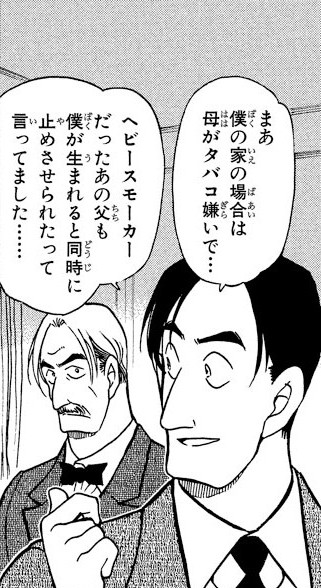
名探偵コナン » Volume 37 » Page 50Four actors filming a mystery drama at a mansion are suspects in a real murder. While they wait with Kogoro, he lights a cigarette, and the actress Ruri says her father’s dislike of smoking rubbed off on her. Nobuharu, who acts alongside his father, Akatsuki, says it’s the same in his family.
伸晴( のぶはる ) :「まあ 僕( ぼく ) の家( いえ ) の場合( ばあい ) 母( はは ) がタバコ嫌( ぎら ) いで…」 “Well, in my family's case, it's my mother who hates cigarettes...” 「ヘビースモーカーだったあの父( ちち ) も僕( ぼく ) が生( う ) まれると同時( どうじ ) に止( や ) めさせられたって言( い ) ってました……」 “Even my dad there, who used to be a heavy smoker, told me she made him quit the moment I was born...” Challenge Yourself Show Translation
Challenge
According to Nobuharu, why did his father stop smoking?
伸晴( のぶはる ) :「まあ 僕( ぼく ) の家( いえ ) の場合( ばあい ) は母( はは ) がタバコ嫌( ぎら ) いで…」 「ヘビースモーカーだったあの父( ちち ) も僕( ぼく ) が生( う ) まれると同時( どうじ ) に止( や ) めさせられた言( い ) ってました……」 Clues 母( はは ) がタバコ嫌( ぎら ) いでmy mother hates cigarettes, and so… 止( や ) めさせられたwas made to quit って言( い ) ってました he said that… What does the speaker mean? His mother made him quit when Nobuharu was born. 止( や ) めさせられた makes the father the one who quit, under pressure. The previous sentence names the mother, who hates cigarettes, as the one behind it. He made Nobuharu's mother quit when Nobuharu was born. That would be the plain causative, 止( や ) めさせた. With させられた, the father is the one who had to quit. He decided on his own to quit for his son's health. させられる says someone else brought it about. The father didn't choose this on his own. He could finally quit once Nobuharu was born. Here させられた isn't the potential "was able to". The father was the one made to quit, and it wasn't his idea.
止( や ) める is “quit”, 止( や ) めさせる is “make someone quit”, and 止( や ) めさせられる is “be made to quit”. The father is the subject, and the mother from the previous sentence is the one who made him quit, though she isn’t named in this sentence. って言( い ) ってました reports what the father has said about it.
View Full Example Joining 知り合い (しりあ い) (Acquaintance)知( し ) り合( あ ) い is someone you know.
It combines 知り (knowing ) with 合い (each other ) to show people who know each other .
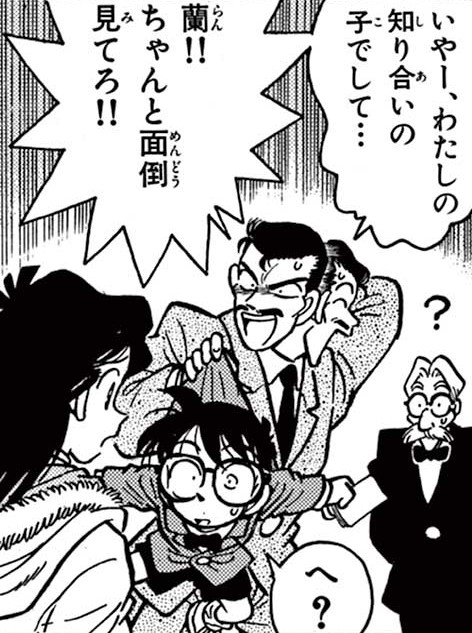
名探偵コナン » Volume 1 » Page 71Conan and Ran end up with Kogoro investigating a kidnapping case. As Kogoro questions the butler, Conan steps in with his own questions. The butler asks who the child is.
小五郎( こごろう ) :「いやー、わたしの知( し ) り合( あ ) い子( こ ) でして…」 “Well, it's the child of an acquaintance, and...” 「蘭( らん ) !! ちゃんと面倒( めんどう ) 見( み ) てろ!!」 “Ran! Properly look after him!” Challenge Yourself Show Translation
Challenge
What does Kogoro order Ran to do?
小五郎( こごろう ) :「いやー、わたしの知( し ) り合( あ ) いの子( こ ) でして…」 「蘭( らん ) !! ちゃんと 面倒( めんどう ) 見( み ) てろ!!」 Clues ちゃんと properly 面倒( めんどう ) 見( み ) てろkeep looking after him What does the speaker mean? Watch Conan properly. ちゃんと modifies the rough command 面倒( めんどう ) 見( み ) てろ, with Conan as the understood object. Introduce Conan as her own child. Kogoro has just described Conan as an acquaintance's child. Let Conan question the butler alone. He wants Ran to supervise Conan and keep him out of the questioning. Ask the butler to look after Conan. Kogoro addresses Ran directly and assigns the supervision to her. Take Conan home immediately. The command is to keep an eye on him, not necessarily to leave. Explain the kidnapping case to Conan. 面倒( めんどう ) 見( み ) る means to look after someone, not explain a case.
Kogoro orders Ran to supervise Conan properly. The object is omitted because everyone knows that Conan is the child he means.
View Full Example 合わせる (あ わせる) (To match)合( あ ) わせる is to make something fit or match something else, or to put things together.
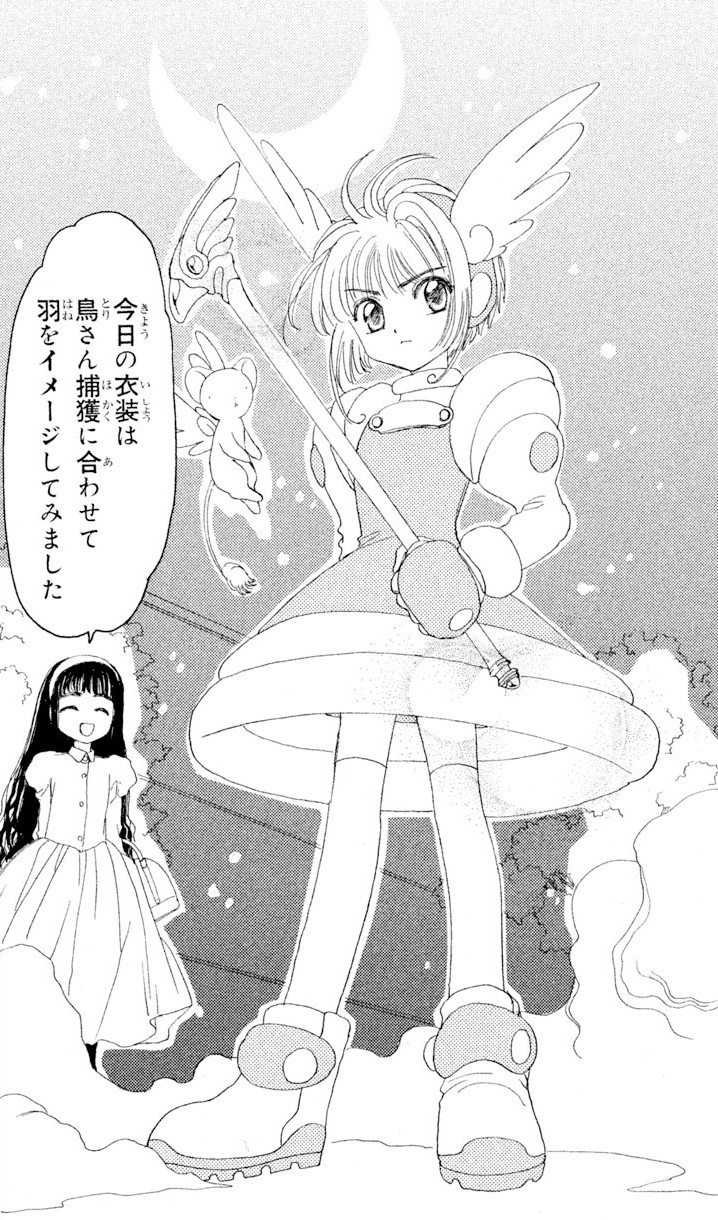
カードキャプターさくら » Volume 1 » Page 80A magical bird appears at Sakura’s school and causes trouble with strong winds. Recognizing it as a Clow Card, Sakura returns at night to try to capture it. After she fails, she returns the next night to try again, sporting a new Cardcaptor outfit designed by her friend Tomoyo.
知世( ともよ ) :「今日( きょう ) の衣装( いしょう ) は鳥( とり ) さん捕獲( ほかく ) に合( あ ) わせて羽( はね ) をイメージしてみました」 “For today's outfit, I went with a feather-inspired look to match the bird-catching theme.” Challenge Yourself Show Translation
Challenge
What inspired Tomoyo's design for Sakura's outfit?
知世( ともよ ) :「今日( きょう ) の衣装( いしょう ) 鳥( とり ) さん捕獲( ほかく ) に合( あ ) わせて羽( はね ) をイメージしてみました」 Clues 鳥( とり ) さん捕獲( ほかく ) に合( あ ) わせてto match the task of capturing the bird 羽( はね ) をイメージしてみましたshe tried using feathers or wings as the design image What does the speaker mean? Feathers chosen to match the capture of the bird. 捕獲( ほかく ) に合( あ ) わせて connects the design to catching the bird, and 羽( はね ) names the image Tomoyo used. The uniform worn by students at Sakura's school. Tomoyo presents a special 衣装( いしょう ) based on feathers. She does not copy the school uniform. A costume Sakura wore while catching a different animal. 今日( きょう ) の衣装( いしょう ) and the bird capture both refer to the present mission. The colors of the bird's nest at the school. Tomoyo names 羽( はね ) , feathers or wings, as the image. The line does not mention a nest or its colors. Clothes designed to make Sakura look less noticeable. The line explains a themed design that matches the bird. It does not mention concealment. An outfit that allows Sakura to fly without magic. Feathers provide the visual theme. Tomoyo does not claim that the outfit itself grants flight.
Tomoyo designs the outfit around feathers so it matches Sakura’s attempt to capture the bird. 〜に合( あ ) わせて links the costume to the mission, while イメージしてみました presents the design choice politely.
View Full Example 合同 (ごう どう) (Combined)合同( ごうどう ) means joining together or acting jointly, as in a combined group or event.
It combines 合 (join ) with 同 (together ) to show joining into one .
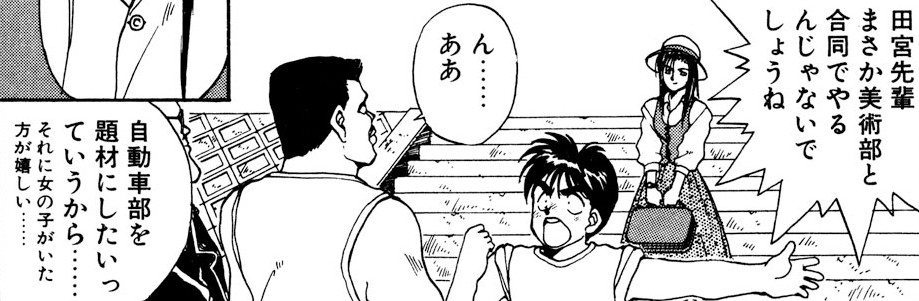
ああっ女神さまっ » Volume 2 » Page 75Kei’ichi is excited to spend four days at the beach with his university automobile club and Belldandy. His mood changes when he hears Sayoko call out to him.
螢一( けいいち ) :「田宮( たみや ) 先輩( せんぱい ) まさか美術部( びじゅつぶ ) と合同( ごうどう ) “Tamiya, don't tell me we're doing this with the art club!” 田宮( たみや ) :「ん……ああ。自動車部( じどうしゃぶ ) を題材( だいざい ) にしたいっていうから…… それに女( おんな ) の子( こ ) がいた方( ほう ) が嬉( うれ ) しい…」 “It's because they said they wanted to use the automobile club as a subject... Additionally, I'm happier having girls here.” Challenge Yourself Show Translation
Challenge
What reason does Tamiya add for welcoming the joint trip?
螢一( けいいち ) :「田宮( たみや ) 先輩( せんぱい ) まさか美術部( びじゅつぶ ) と合同( ごうどう ) でやるんじゃないでしょうね」 田宮( たみや ) :「ん……ああ。自動車部( じどうしゃぶ ) を題材( だいざい ) にしたいっていうから…… それに 女( おんな ) の子( こ ) がいた方( ほう ) が嬉( うれ ) しい…」 Clues それに besides that, in addition 女( おんな ) の子( こ ) がいたgirls were there 〜方( ほう ) が the option that is preferable 嬉( うれ ) しいhappy or pleased What does the speaker mean? He would be happier if girls were there too. それに adds Tamiya's personal reason, and 女( おんな ) の子( こ ) がいた方( ほう ) が嬉( うれ ) しい says he would prefer having girls there. He thinks the art club would be happier without the automobile club. The line does not say the art club wants to be separate. Tamiya says that he would welcome having girls present. He wants the girls to use the automobile club as their art subject. That belongs to the earlier reason given by the art club. それに introduces Tamiya's separate reason for liking the plan. He is relieved that the two clubs canceled their joint trip. 合同( ごうどう ) でやる describes doing the trip jointly. Nothing in the exchange says it has been canceled. He tells Kei'ichi to be happy that Sayoko called out. 嬉( うれ ) しい describes Tamiya's reaction to having girls along, not an instruction to Kei'ichi. He would rather replace the automobile club members with girls. 女( おんな ) の子( こ ) がいた方( ほう ) が compares having girls present with not having them present. It does not say anyone will be replaced.
Tamiya first states the art club’s reason for joining the trip. With それに, he adds his own reason. He would be happier with girls there.
View Full Example 集合場所 (しゅうごう ばしょ) (Meeting place)集合場所( しゅうごうばしょ ) means a meeting place or designated spot where people gather.
It combines 集合 (gathering ) with 場所 (place ) to show a designated place to gather .
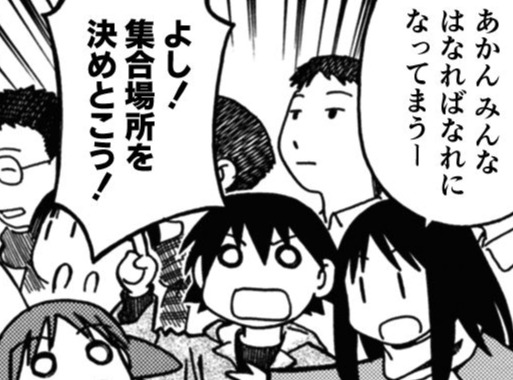
あずまんが大王 » Volume 3年生 » Page 175Chiyo and her friends from class go on a New Year’s shrine visit together. Chiyo remarks on how crowded it is.
歩( あゆむ ) :「あかんみんなはなればなれになってまうー」 “Oh no, everyone's going to end up separated!” とも: 「よし!集合( しゅうごう ) 場所( ばしょ ) 決( き ) めとこう!」 “All right! Let's decide on a meeting spot!” Challenge Yourself Show Translation
Challenge
What does Tomo propose before anyone gets separated?
歩( あゆむ ) :「あかんみんなはなればなれになってまうー」 とも: 「よし!集合( しゅうごう ) 場所( ばしょ ) 決( き ) めとこう!」 Clues はなればなれになってまう will end up separated 集合( しゅうごう ) 場所( ばしょ ) meeting place 決( き ) めとこうlet's decide in advance What does the speaker mean? The group should choose a meeting place in advance. 集合( しゅうごう ) 場所( ばしょ ) names the meeting place, and 決( き ) めとこう proposes deciding it as preparation. Everyone should split up and meet again at home. Becoming separated is the problem they want to guard against, not Tomo's plan. The group should leave the crowded shrine immediately. Tomo proposes choosing a location. She does not tell the group to leave. Chiyo should decide where each person stands in line. The proposal is collective and concerns a fallback meeting place, not positions in a line. They should wait until they are lost before choosing a place. 〜とこう marks preparation in advance, before the unwanted separation occurs. Everyone should gather at the spot where they are standing now. The line says to decide on a 集合( しゅうごう ) 場所( ばしょ ) ; it does not identify the current spot as that place.
Ayumu worries that the crowd will separate them. Tomo responds by proposing that they choose a meeting place ahead of time.
View Full Example 合宿 (がっ しゅく) (Training camp)合宿( がっしゅく ) is a group staying together for several days to train or study, as school clubs do in the holidays.
It combines 合 (together ) with 宿 (lodging ) to show staying together in one place .
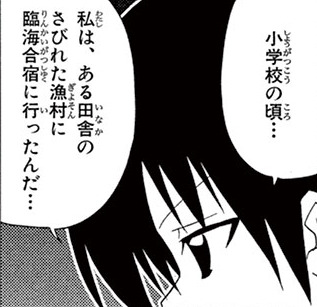
ハヤテのごとく! » Volume 12 » Page 157Hayate tried to slip away on an errand, but the Video Research Club girls stopped him. Their clubroom is gone, so they are starting over with new videos, and the first project is an “Ordinary Story Contest”. When Nagi asks what that is supposed to be, Risa says she’ll show them and starts telling a story.
理沙( りさ ) :「小学校( しょうがっこう ) の頃( ころ ) …」 “Back in elementary school...” 理沙( りさ ) :「私( わたし ) は、ある田舎( いなか ) のさびれた漁村( ぎょそん ) に臨海( りんかい ) 合宿( がっしゅく ) 行( い ) ったんだ…」 “I went to a seaside camp in a run-down fishing village out in the countryside...” Challenge Yourself Show Translation
Challenge
What kind of place did Risa go to for her seaside camp?
理沙( りさ ) :「小学校( しょうがっこう ) の頃( ころ ) …」 理沙( りさ ) :「私( わたし ) は、ある田舎( いなか ) のさびれた漁村( ぎょそん ) 臨海( りんかい ) 合宿( がっしゅく ) に行( い ) ったんだ…」 Clues 田舎( いなか ) the countryside, a rural area さびれた run-down, past its better days 漁村( ぎょそん ) fishing village 臨海( りんかい ) 合宿( がっしゅく ) a group stay by the sea What does the speaker mean? A small, declining fishing village in the countryside. 漁村( ぎょそん ) is a village that lives by fishing, and さびれた says it has lost the life it once had. A busy fishing port in a big city. 田舎( いなか ) puts the village in the countryside, and さびれた rules out busy. A fish market near her school. 村 means village. Risa traveled to the coast, not to a market near home. A mountain village far from the sea. 漁 is fishing, and 臨海( りんかい ) means by the sea. This village is on the coast. A brand-new resort built for school trips. さびれた describes a place in decline, the opposite of new.
Risa went to a 漁村( ぎょそん ) , a fishing village, for a school camp by the sea. 田舎( いなか ) の places it in the countryside, and さびれた says it was run-down. It’s a good setting for the spooky story she’s about to tell.
View Full Example Competition 試合 (しあい ) (Match)試合( しあい ) means a match or contest in sports, martial arts, or games.
It combines 試 (test ) with 合 (meet ) to show a competitive meeting .
Example 1 of 2: A radio or something with 〜か何か Example 1 of 2
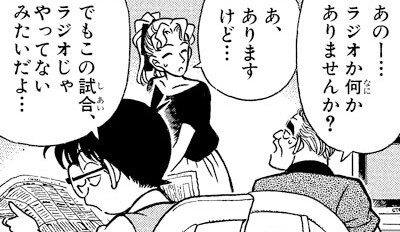
名探偵コナン » Volume 13 » Page 30A news broadcast interrupts the baseball game Tetsuhiro is watching over at his neighbor’s beach house.
哲浩( てつひろ ) :「あのー… ラジオか何( なに ) かありませんか?」 “Um... Do you have a radio or something?” 綾子( あやこ ) :「あ、ありますけど…」 “Ah, there is...” コナン: 「でもこの試合( しあい ) “But it seems this game isn't being broadcast on the radio.” Challenge Yourself Show Translation
Challenge
What is Tetsuhiro asking to borrow?
哲浩( てつひろ ) :「あのー… ラジオ か何( なに ) か ありませんか?」 綾子( あやこ ) :「あ、ありますけど…」 コナン: 「でもこの試合( しあい ) ラジオじゃやってないみたいだよ…」 Clues ラジオか何( なに ) か a radio or something like one ありませんか? do you have one? What does the speaker mean? A radio or a similar way to hear the broadcast. ラジオか何( なに ) か names a radio while allowing a similar alternative. Only that exact radio, with no substitute. か何( なに ) か leaves room for something similar rather than insisting on one exact item. A television schedule for the baseball game. He asks whether they have a radio or something like it, not for a schedule. A ticket to attend the game in person. The request concerns a device for following the broadcast. A telephone so he can call the players. The item he names is ラジオ, and nothing suggests calling anyone. Permission to turn off the news. ありませんか asks whether an item is available. It is not a request to stop the broadcast.
Tetsuhiro asks whether there is a radio or something similar available. 〜か何( なに ) か makes the named item an example rather than a strict requirement.
View Full Example Example 2 of 2: Training for a judo match with 稽古 Example 2 of 2
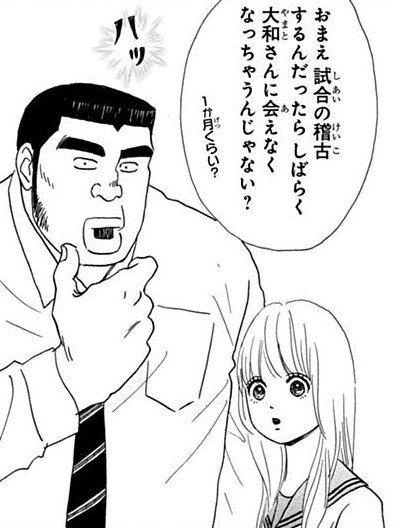
俺物語!! » Volume 2 » Page 56Members of the judo team plea for Takeo to help them in their upcoming match against a rival high school. Takeo quickly accepts their request, but Sunakawa considers how this will impact Takeo’s new relationship with Yamato.
砂川( すなかわ ) :「おまえ試合( しあい ) 稽古( けいこ ) するんだったら しばらく大和( やまと ) さんに会えなくなっちゃうんじゃない? 1( いっ ) か月( げつ ) くらい?」 “When you're training for the match, won't you be unable to see Yamato for a while? For about a month.” Challenge Yourself Show Translation
Challenge
What consequence does Sunakawa warn Takeo about if he trains for the match?
砂川( すなかわ ) :「おまえ試合( しあい ) の稽古( けいこ ) 大和( やまと ) さんに会えなくなっちゃうんじゃない? 1( いっ ) か月( げつ ) くらい?」 Clues 試合( しあい ) の稽古( けいこ ) するんだったらif he is going to train for the match しばらく大和( やまと ) さんに会( あ ) えなくなっちゃうんじゃない he may end up unable to see Yamato for a while What does the speaker mean? He may be unable to see Yamato for about a month. 会( あ ) えなくなる means become unable to meet, and Sunakawa estimates the period as about one month. He will have to stop seeing the judo team permanently. The person he may not see for a while is Yamato, and the duration is temporary. Yamato will join the judo training every day. The line predicts less time with Yamato, not her participation in practice. The match will be postponed for one month. The month estimate concerns Takeo and Yamato not meeting, not the match date. He will become unable to compete in the match. The training creates a relationship cost. It does not remove his ability to compete. Sunakawa will train in Takeo's place. Sunakawa asks Takeo to consider the consequence of Takeo's own training.
Sunakawa warns that training for the judo match could leave Takeo unable to see Yamato for roughly a month. 会( あ ) えなくなっちゃう presents that as an unfortunate result.
View Full Example Fitting 似合う (にあ う) (To suit)似( に ) 合( あ ) う is for clothes, a style, or a color to look good on someone.
It combines 似 (resemble ) with 合う (fit ) to show matching well .
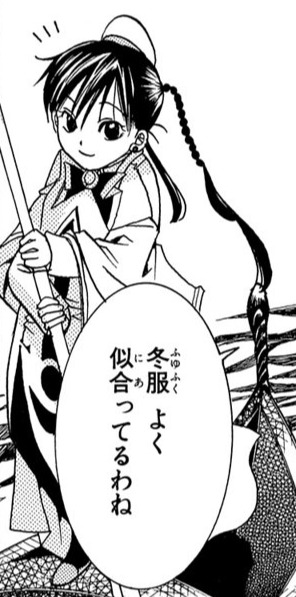
Example 1 of 4: Good-looking winter uniform with 冬服 Example 1 of 4
ARIA The MASTERPIECE » Volume 2 » Page 44Winter has arrived, and Alicia and Akari have switched to wearing their winter uniforms. The two greet Aika outside.
アリシア: 「冬服( ふゆふく ) よく似( に ) 合( あ ) ってるわね」 “Your winter uniform looks really good on you.” Challenge Yourself Show Translation
Challenge
アリシア: 「冬服( ふゆふく ) よく似( に ) 合( あ ) ってるわね」 似合( にあ ) うto suit someone or look good on them よく well; describes how well something suits someone here 〜てる casual 〜ている; describes a current state here What does the speaker mean? It looks really good on Aika. よく似合( にあ ) ってる compliments how well the uniform suits Aika. Aika wears it often. よく can mean often, but here it modifies 似合( にあ ) う, meaning to suit someone, rather than a verb meaning to wear. It used to look good on Aika. 似合( にあ ) ってる describes the present. A past description would use 似合( にあ ) っていた or casual 似合( にあ ) ってた.
Alicia says Aika’s winter uniform looks really good on her. よく strengthens the compliment, and わね gives it a warm, conversational tone.
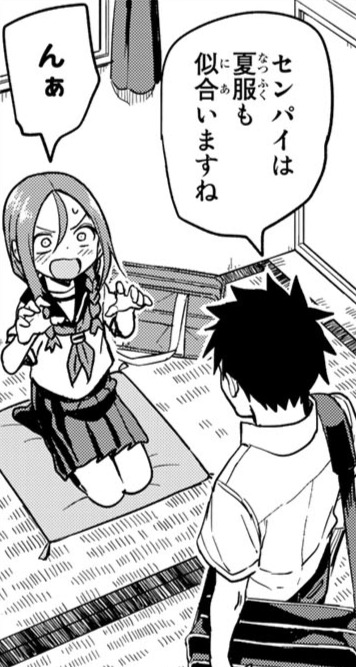
View Full Example Example 2 of 4: Looking good in a summer uniform as well with 夏服 Example 2 of 4
それでも歩は寄せてくる » Volume 7 » Page 101Ayumu goes to the shogi club room after school. There, he and Urushi find they’ve both switched from their winter uniform to their summer uniform on the same day.
歩( あゆむ ) :「センパイは夏服( なつふく ) も似( に ) 合( あ ) いますね」 “You look good in your summer uniform too.” Challenge Yourself Show Translation
Challenge
歩( あゆむ ) :「センパイは夏服( なつふく ) 似( に ) 合( あ ) いますね」 夏服( なつふく ) もthe summer uniform too 似( に ) 合( あ ) いますsuits someone or looks good on them What does the speaker mean? Her summer uniform suits her, just as her winter uniform does. も follows 夏服( なつふく ) , adding the summer uniform to the clothing that suits her. The summer uniform suits him as well as her. も marks 夏服( なつふく ) , not Ayumu. センパイは keeps the compliment about Urushi. Her summer uniform suits her better than her winter uniform. も means that the summer uniform suits Urushi too. It does not rank the two uniforms.
Ayumu says that Urushi looks good in her summer uniform too. With も after 夏服( なつふく ) , he implies that her winter uniform also suits her.
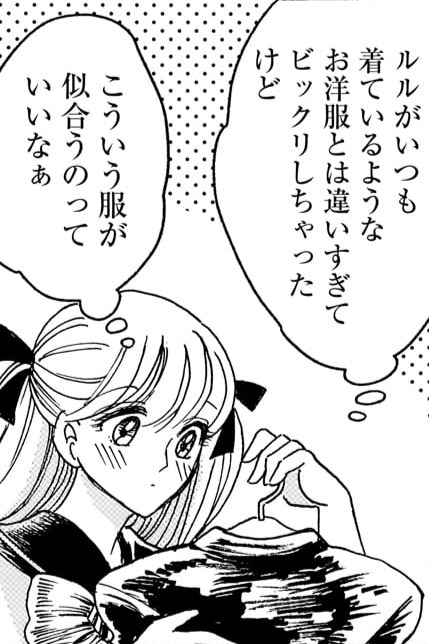
View Full Example Example 3 of 4: Very different Western clothing with 洋服 Example 3 of 4
キラキラとギラギラ » Volume 2 » Page 127Lulu goes clothes shopping with her friends from class. The outfits at the clothing shop are glaring, but Kyouko tries one on and Lulu finds it very suited to her.
ルル: 「ルルがいつも着( き ) ているようなお洋服( ようふく ) とは違( ちが ) いすぎてビックリしちゃったけど」 “They were so different from the clothes I usually wear that I was surprised, but...” 「こういう服( ふく ) が似合( にあ ) う “It must be nice to look good in clothes like these.” Challenge Yourself Show Translation
Challenge
How does Lulu feel about the clothes?
ルル: 「ルルがいつも着( き ) ているようなお洋服( ようふく ) とは違( ちが ) いすぎてビックリしちゃったけど」 「こういう服( ふく ) が似合( にあ ) うのっていいなぁ」 Clues 違( ちが ) いすぎてso different that... ビックリしちゃったけど was surprised, but... 似合( にあ ) うto suit someone or look good on them いいなぁ how nice; expresses admiration or longing What does the speaker mean? They surprised her, but she admires how they suit Kyouko. けど connects her surprise to the admiring comment 似合( にあ ) うのっていいなぁ. They surprised her because they are just like her usual clothes. 違( ちが ) いすぎて says they are very different from what she usually wears. They surprised her, and she thinks they look bad on Kyouko. 似合( にあ ) う means the clothes suit someone, and いいなぁ expresses admiration.
The clothes are very different from Lulu’s usual style, which surprises her. She then admires how they suit Kyouko.
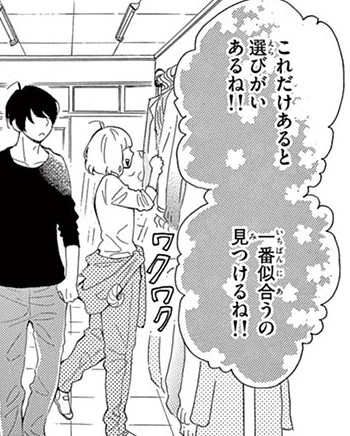
View Full Example Example 4 of 4: Worth selecting a costume with 〜がいある Example 4 of 4
藤原くんはだいたい正しい » Volume 1 » Page 172As a member of the student council, Hitsuji comes up with the idea of having a cosplay theme to help build up excitement among students for the school’s sports day. However, Fujiwara, the student council president, fails to dress up. Upon hearing him say he doesn’t have a costume prepared, one of the drama club students suggests he pick from their club’s costumes. While Fujiwara isn’t enthusiastic at the prospect of dressing up, Hitsuji is excited by the club’s wide selection.
ヒツジ: 「これだけあると選( えら ) びがいあるね!!一番( いちばん ) 似( に ) 合( あ ) う見( み ) つけるね!」 “When there are this many, it's worth it to choose from! I'll find the one that suits you best!” Challenge Yourself Show Translation
Challenge
Why does Hitsuji think choosing a costume will be worthwhile?
ヒツジ: 「これだけあると選( えら ) びがいある ね!!一番( いちばん ) 似( に ) 合( あ ) うの見( み ) つけるね!」 Clues これだけあると the drama club has this many costumes available 選( えら ) びがいあるね! 一番( いちばん ) 似( に ) 合( あ ) うの見( み ) つけるねthe large selection makes choosing rewarding as they look for the best fit What does the speaker mean? There are many costumes to choose from, so they can find the best one. これだけあると points to the large selection, and 一番似合うの identifies finding the costume that suits Fujiwara best. There are only a few costumes, so the decision will be quick. これだけあると emphasizes how many choices the club has, not a limited selection. Fujiwara has already selected the costume he likes most. Hitsuji is excited to begin choosing and promises to find the best match. The choice is not settled yet. The drama club requires Fujiwara to make a costume himself. The club offers its existing costume collection. No one asks Fujiwara to sew a new one. Choosing is worthwhile because every costume fits him equally well. 一番似合うの means they are looking for the one that suits him best, not treating all choices as equal. The sports day costume theme has been canceled. Hitsuji remains excited about dressing Fujiwara for the event. The line does not cancel the theme.
The drama club has a large costume collection, which makes the search itself satisfying for Hitsuji. She wants to use all those options to find the costume that suits Fujiwara best.
View Full Example 合う (あ う) (To fit)合( あ ) う is to fit or match something, or to suit someone. It also means for things to agree, like answers or tastes.
Example 1 of 2: Honorific or humble language with 謙譲語 Example 1 of 2
ひよ恋 » Volume 6 » Page 177Students ask their teacher, Mittan, how long she has gone without a boyfriend. Mittan declares it top secret and tells them the only thing they may ask their teacher about is their studies.
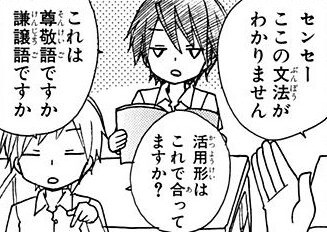
生徒( せいと ) :「センセー ここの文法( ぶんぽう ) がわかりません」 “Miss, I don't understand the grammar here.” 淳平( じゅんぺい ) :「活用形( かつようけい ) はこれで合( あ ) ってますか?」 “Is this the right conjugation?” 結心( ゆうしん ) :「これは尊敬語( そんけいご ) ですか謙譲語( けんじょうご ) ですか」 “Is this honorific language or humble language?” Challenge Yourself Show Translation
Challenge
What is the last student asking about this expression?
生徒( せいと ) :「センセー ここの文法( ぶんぽう ) がわかりません」 淳平( じゅんぺい ) :「活用形( かつようけい ) はこれで合( あ ) ってますか?」 結心( ゆうしん ) :「これは尊敬語( そんけいご ) ですか謙譲語( けんじょうご ) Clues 尊敬語( そんけいご ) honorific language 謙譲語( けんじょうご ) humble language AですかBですか is it A or B? What does the speaker mean? Whether the expression raises the other person or lowers the speaker. 尊敬語 respects someone by raising their actions, and 謙譲語 shows respect by lowering the speaker's own. The student wants to know which kind this is. Whether the expression is polite or casual. Both 尊敬語 and 謙譲語 are kinds of respectful speech. The question is which of the two this is, not whether it's polite at all. Whether the teacher is being humble about her love life. The students have moved on to grammar questions, the only kind Mittan allowed. Whether the verb is in the past tense. That would be a question about conjugation, which a different student asks. This one is about kinds of respectful language.
謙譲語( けんじょうご ) is humble language, the kind of 尊敬語( そんけいご ) where speakers lower their own actions to show respect. 尊敬語( そんけいご ) raises the other person’s actions instead. Asking AですかBですか, the student wants to know which kind the textbook expression is. Told they may only ask about studying, the class now does exactly that.
View Full Example Example 2 of 2: Might get along with 〜かもしれない Example 2 of 2
ご注文はうさぎですか? » Volume 1 » Page 24Tippy remarks on how Cocoa adapted immediately to working in the café.
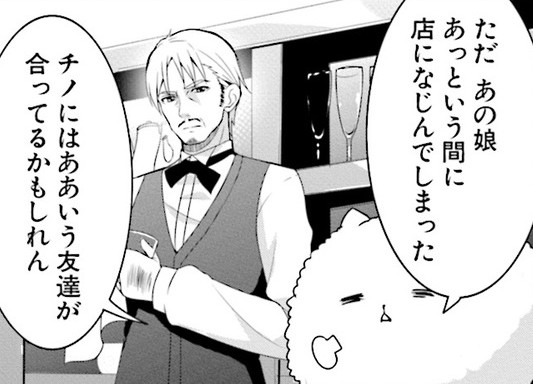
お父( とう ) さん: 「ただあの娘( こ ) あっという間( ま ) に店( みせ ) になじんでしまった」 “Still, that girl settled into the café in no time.” ティッピー: 「チノにはああいう友達( ともだち ) が合( あ ) ってるかもしれん」 “Maybe a friend like that suits Chino.” Challenge Yourself Show Translation
Challenge
What does ティッピー mean in the highlighted line?
お父( とう ) さん: 「ただあの娘( こ ) あっという間( ま ) に店( みせ ) になじんでしまった」 ティッピー: 「チノにはああいう友達( ともだち ) が合( あ ) ってるかもしれん 」 Clues かもしれん かもしれん is a contracted form of かもしれない What does the speaker mean? Maybe a friend like that suits Chino. Tippy uses the shorter かもしれん to say that a friend like Cocoa may suit Chino. Tippy says a friend like Cocoa definitely does not suit Chino. The highlighted form is かもしれん. Here かもしれん is a contracted form of かもしれない, so this choice does not match the Japanese. Tippy says that he, rather than Cocoa, should be Chino's friend. The highlighted form is かもしれん. Here かもしれん is a contracted form of かもしれない, so this choice does not match the Japanese. Tippy says Cocoa has failed to settle into the café. The highlighted form is かもしれん. Here かもしれん is a contracted form of かもしれない, so this choice does not match the Japanese.
かもしれん is a contracted form of かもしれない. Tippy uses the shorter かもしれん to say that a friend like Cocoa may suit Chino.
View Full Example 気が合う (きがあ う) (To get along)気( き ) が合( あ ) う is for people to have the same tastes or feelings and get along well.
Example 1 of 2: Kindred spirits in drinking tea with 気が合う Example 1 of 2
老女的少女ひなたちゃん » Volume 3 » Page 104Hinata escorts a classmate to the school nurse. There, she meets an elderly man sipping tea. Seeing her interest, the old man offers her a cup.
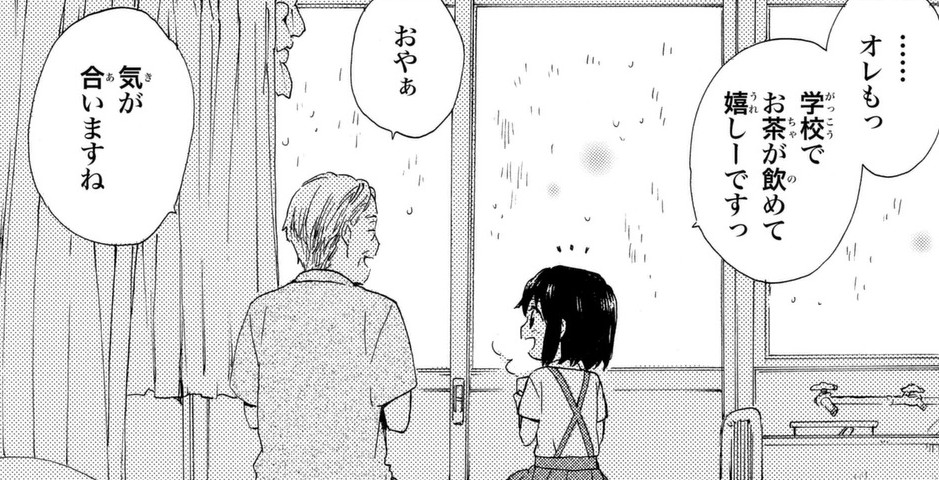
日向( ひなた ) :「……オレもっ 学校( がっこう ) でお茶( ちゃ ) が飲( の ) めて嬉( うれ ) しーですっ」 “It also makes me happy when I can drink tea at school.” おじいさん: 「おやぁ 気( き ) が合( あ ) いますね」 “Oh, we're kindred spirits, huh?” Challenge Yourself Show Translation
Challenge
Why does the elderly man say that he and Hinata are kindred spirits?
日向( ひなた ) :「……オレもっ 学校( がっこう ) でお茶( ちゃ ) が飲( の ) めて嬉( うれ ) しーですっ」 おじいさん: 「おやぁ 気( き ) が合( あ ) います Clues 学校( がっこう ) でお茶( ちゃ ) が飲( の ) めて嬉( うれ ) しーですHinata is happy that she can drink tea at school 気( き ) が合( あ ) いますねhe notices that their tastes or temperaments match What does the speaker mean? They both enjoy drinking tea at school. Hinata says that having tea at school makes her happy, and the man responds 気が合いますね because he shares that interest. They both came to the nurse because they feel ill. Hinata escorted a classmate, and the man is already enjoying tea. Their connection concerns tea, not matching illnesses. They attended the same school when they were young. Nothing in the exchange gives them a shared school history. The agreement comes from their enjoyment of tea. Hinata brought the tea that the man is drinking. The man offers Hinata tea after noticing her interest. She does not say that she supplied his cup. They use the same first-person pronoun. Hinata uses オレ, but the man's comment follows her enthusiasm for tea, not a comparison of pronouns. They both want to leave the nurse's office immediately. The scene shows them settling into a shared tea moment. Neither says that they want to leave.
Hinata says she is happy to drink tea at school, matching the elderly man’s own enjoyment. His 気が合いますね means that their tastes click, and ね warmly invites her to recognize the connection too.
View Full Example Example 2 of 2: Kindred spirits in golf with 気が合う Example 2 of 2
俺物語!! » Volume 3 » Page 170Takeo’s girlfriend Rinko visits to study with him, but Takeo’s parents take turns interrupting them to get to know her better. Takeo’s father, Yutaka, asks if she watches golf.
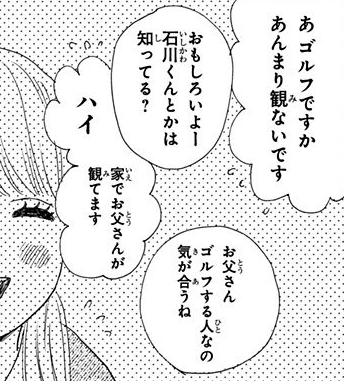
凛子( りんこ ) :「あ ゴルフですか。あんまり観( み ) ないです」 “Ah, golf? I don't watch a lot of it.” 豊( ゆたか ) :「おもしろいよー!石川( いしかわ ) くんとかは知( し ) ってる?」 “It's fun! Do you know about Ishikawa-kun?” 凛子( りんこ ) :「ハイ。家( いえ ) でお父( とう ) さんが観( み ) てます」 “I do. My father watches it at home.” 豊( ゆたか ) :「お父( とう ) さん ゴルフする人( ひと ) なの。気( き ) が合( あ ) う “So your dad's a golf guy. We're kindred spirits, eh?” Challenge Yourself Show Translation
Challenge
Why does Yutaka say he and Rinko's father would get along?
凛子( りんこ ) :「あ ゴルフですか。あんまり観( み ) ないです」 豊( ゆたか ) :「おもしろいよー!石川( いしかわ ) くんとかは知( し ) ってる?」 凛子( りんこ ) :「ハイ。家( いえ ) でお父( とう ) さんが観( み ) てます」 豊( ゆたか ) :「お父( とう ) さん ゴルフする人( ひと ) なの。気( き ) が合( あ ) う Clues お父( とう ) さんが観( み ) てます Rinko's father watches golf お父( とう ) さん ゴルフする人( ひと ) なの。気( き ) が合( あ ) うね her father is a golf person, so their interests match What does the speaker mean? They share an interest in golf. Yutaka connects Rinko's father being a golf person with 気( き ) が合( あ ) う, having compatible interests. They attended the same school. The conversation establishes a golf connection, not a shared school. They both dislike watching sports. Rinko says her father watches golf, and Yutaka is enthusiastic about it. Rinko's father knows Ishikawa personally. Knowing about the golfer does not establish a personal acquaintance. The shared interest is golf itself. They work together at a golf course. No workplace is mentioned. Yutaka infers compatibility from the hobby. They have already played golf together. Yutaka is drawing a new conclusion about someone he has not been shown meeting.
Yutaka learns that Rinko’s father watches or plays golf and immediately decides their interests would match. 気( き ) が合( あ ) う describes people whose temperaments or interests fit well.
View Full Example 肌に合う (はだにあ う) (To suit)肌( はだ ) に合( あ ) う is for a place, way of life, or product to suit someone.
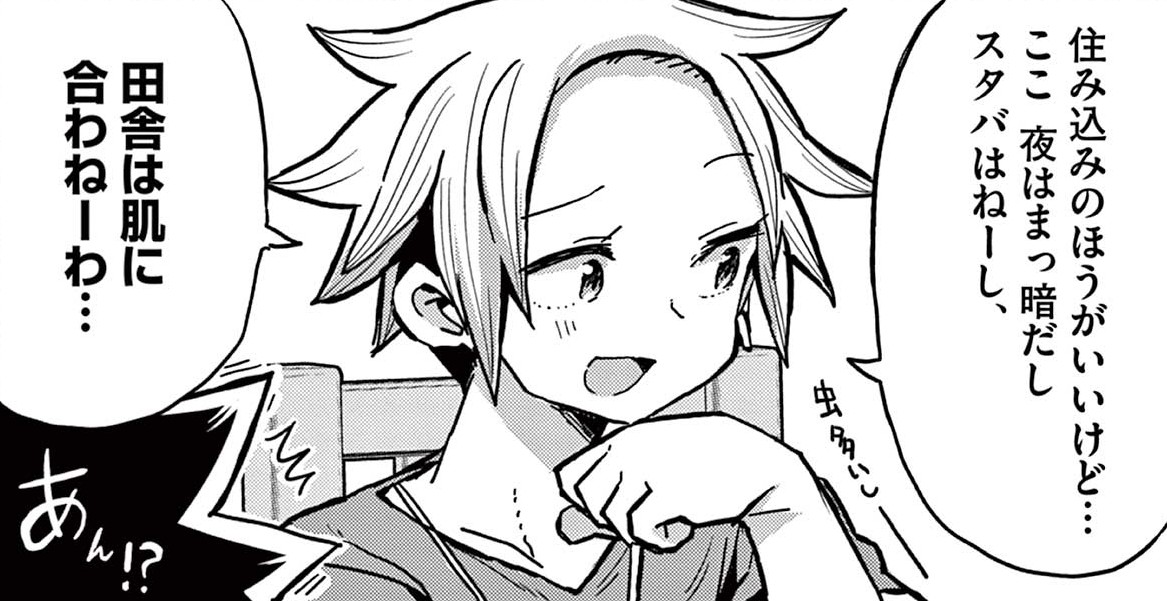
ぼくの魔なむすめ » Volume 2 » Page 118Sami answers a phone call from her uncle. He thinks his friend’s son Nishi would be a good assistant for Sami’s father. Since her father’s busy trying to meet a deadline, Sami accepts on her father’s behalf. When the assistant arrives, he’s completely unwilling to adjust to Sami’s father’s workstyle, then he stays overnight in their bed and wears Sami’s father’s clothes. After all this, Sami’s father is still willing to take Nishi on, but not as a live-in assistant.
西( にし ) :「住( す ) み込( こ ) みのほうがいいけど… ここ 夜( よる ) はまっ暗( くら ) だしスタバはねーし、(虫( むし ) 多( おお ) いしーーー)」 “A live-in arrangement would be better, but... it gets pitch dark here at night, there's no Starbucks, and there are tons of bugs...” 「田舎( いなか ) は肌( はだ ) に合( あ ) わねーわ…」 “Country life just doesn't suit me...” Challenge Yourself Show Translation
Challenge
Why does Nishi say country life does not suit him?
西( にし ) :「住( す ) み込( こ ) みのほうがいいけど… ここ 夜( よる ) はまっ暗( くら ) だしスタバはねーし、(虫( むし ) 多( おお ) いしーーー)」 「田舎( いなか ) は肌( はだ ) に合( あ ) わねーわ…」 Clues 夜( よる ) はまっ暗( くら ) だし"it gets pitch dark at night, and..." スタバはねーし "there is no Starbucks, and..." 虫( むし ) 多( おお ) いし"there are lots of bugs, and..." 肌( はだ ) に合( あ ) わねー"it does not suit me" What does the speaker mean? Because the place feels too rural and inconvenient for him. His three **し** complaints build up the evidence, and 肌( はだ ) に合( あ ) わねー sums it up as "this kind of place is not for me." Because he thinks the pay for live-in work is too low. He never mentions money. His complaints are about the place itself. Because he says Sami's father would be too strict to live with. No person is blamed in these lines. He complains about darkness, Starbucks, and bugs. Because he only wants daytime work and refuses to stay overnight. 住( す ) み込( こ ) み comes up, but his stated reasons are about the rural setting, not his work hours. Because he thinks the house is too small for another person. The line says nothing about the size of the house. It focuses on the countryside around it.
Nishi strings together three complaints with し , then sums them up with 肌( はだ ) に合( あ ) わねー. He is saying that the rural live-in environment just does not work for him.
View Full Example 不釣り合い (ふつりあ い) (Mismatched)不( ふ ) 釣( つ ) り合( あ ) い describes things or people that don’t suit each other or are out of balance, such as a couple who seem poorly matched.
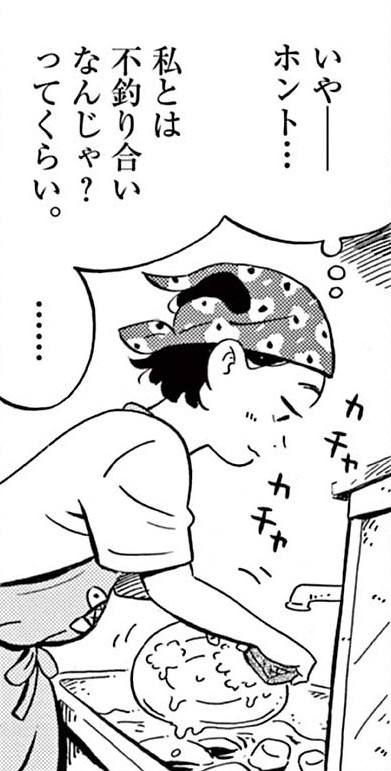
ひらやすみ » Volume 2 » Page 41Natsumi has started a part-time job at the Chinese restaurant where her university friend Akari works. When the steam fogs Akari’s glasses and she takes them off, Natsumi realizes Akari is gorgeous, a fact she’d missed because Akari usually looks plain. Then the cook sends Natsumi off to wash dishes.
なつみ: 「いや――ホント… 私( わたし ) とは不( ふ ) 釣( つ ) り合( あ ) い “I mean, seriously... she's so pretty I have to wonder if we're kind of mismatched.” Challenge Yourself Show Translation
Challenge
What is Natsumi thinking about Akari?
なつみ: 「いや――ホント… 私( わたし ) とは不( ふ ) 釣( つ ) り合( あ ) い Clues 私( わたし ) とはwith me, compared to me 不( ふ ) 釣( つ ) り合( あ ) いbadly matched, not suited to each other なんじゃ?ってくらい so much that I wonder if... What does the speaker mean? Akari is so pretty that Natsumi wonders if they're a poor match. 不釣り合い means two people don't suit each other, and くらい says how far her thought goes. Akari is bad at her job and doesn't fit in at the restaurant. Natsumi was just admiring Akari, and とは compares Akari with Natsumi herself, not with the workplace. Natsumi wants to go fishing with Akari. 釣 appears in the word, but 不釣り合い has nothing to do with fishing. It means mismatched. Natsumi is sure the two of them are perfect for each other. The 不 at the front negates the word. 釣り合い is balance or a good match, so 不釣り合い is the opposite.
不釣り合い means two things or people don’t suit each other. Natsumi has just noticed how pretty Akari is, and she half-jokingly wonders if she’s even in the same league. The trailing ってくらい shows how far her thoughts have run.
View Full Example 釣り合う (つりあ う) (To be well matched)釣( つ ) り合( あ ) う is to balance or be in proportion. Said of people, it means they suit each other, and 釣( つ ) り合( あ ) わない means one feels out of the other’s league.
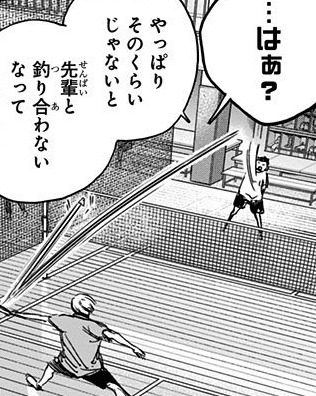
アオのハコ » Volume 1 » Page 73Chinatsu turned down moving abroad with her parents so she could stay in Japan and aim for the Inter-High in basketball. She now lives with Taiki’s family. During badminton practice, Kyo tells Taiki he’s lucky to be living with the girl he likes and might even end up dating her. Taiki says he can’t just ask her out after seeing that kind of resolve, so he has decided to aim for the Inter-High himself this summer.
匡( きょう ) :「…はぁ?」 “...Huh?” 大喜( たいき ) :「やっぱりそのくらいじゃないと先輩( せんぱい ) と釣( つ ) り合( あ ) わないなって」 “I figured I'd need at least that much to be good enough for her.” Challenge Yourself Show Translation
Challenge
What does Taiki mean by 先輩と釣り合わない?
匡( きょう ) :「…はぁ?」 大喜( たいき ) :「やっぱりそのくらいじゃないと先輩( せんぱい ) と釣( つ ) り合( あ ) わない Clues そのくらい about that much, that level 〜じゃないと unless it's... 釣( つ ) り合( あ ) うto be well matched, to balance What does the speaker mean? Without reaching the Inter-High, he wouldn't be a match for Chinatsu. 釣り合わない says the two aren't balanced. He wants to reach her level before he deserves to stand beside her. Chinatsu won't go fishing with him unless he plays better. 釣 appears here, but 釣り合う is about balance between two people. Nobody is going fishing. He and Chinatsu don't get along. He likes her and they're on good terms. 釣り合わない is about being equal, not about getting along. Chinatsu said he wasn't good enough to date her. This is Taiki's own judgment. Chinatsu never said anything like it.
釣り合う means two things balance, like the pans of a scale. Said of people, it means they’re a good match. Taiki feels that unless he reaches something like the Inter-High, the level Chinatsu is aiming for, he won’t be on equal footing with her.
View Full Example Standards 合格 (ごう かく) (Passing)合格( ごうかく ) means passing an exam or meeting the standard for acceptance.
It combines 合 (match ) with 格 (standard ) to show matching the standard .
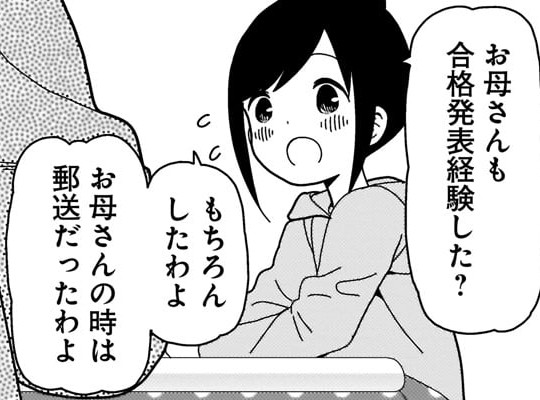
ひとりぼっちの○○生活 » Volume 8 » Page 55Bocchi’s mother confirms with Bocchi that her exam results will be available online.
ぼっち: 「お母( かあ ) さん合格( ごうかく ) 発表( はっぴょう ) 経験( けいけん ) した?」 “Mom, have you ever been through the experience of waiting for exam results?” お母( かあ ) さん: 「もちろん したわよ」 “Of course!” 「お母( かあ ) さんの時( とき ) は郵送( ゆうそう ) だったわよ」 “Back in my day, it was sent by mail.” Challenge Yourself Show Translation
Challenge
How did Bocchi's mother receive her exam results?
ぼっち: 「お母( かあ ) さん合格( ごうかく ) 発表( はっぴょう ) 経験( けいけん ) した?」 お母( かあ ) さん: 「もちろん したわよ」 「お母( かあ ) さんの時( とき ) は郵送( ゆうそう ) Clues お母( かあ ) さんの時( とき ) は sets up the method used when her mother took the exam 郵送( ゆうそう ) だったsays the results came through postal delivery What does the speaker mean? They were sent by mail. 郵送( ゆうそう ) means delivery through the postal service, and だった places that method in the past. She checked them online. Bocchi can use an online announcement, but her mother says her own results arrived by 郵送( ゆうそう ) . The school called her by phone. The delivery method named in the line is 郵送( ゆうそう ) , not a phone call. A teacher told her in person. 郵送( ゆうそう ) refers to sending something through the mail, so the result was not delivered face to face. She received them by email. The line specifies postal delivery. It does not refer to electronic mail. She read them in a newspaper announcement. 郵送( ゆうそう ) だった identifies mail as the old delivery method. No newspaper is mentioned.
Bocchi’s mother says that exam results were sent by mail when she took the exam. 郵送( ゆうそう ) だった contrasts that older method with Bocchi’s ability to check her result online.
View Full Example Sound-Based Spellings 合羽 (かっ ぱ) (Raincoat)合羽( かっぱ ) is a raincoat or rain cape worn to keep dry. The word comes from Portuguese, and its kanji were chosen for their sound.
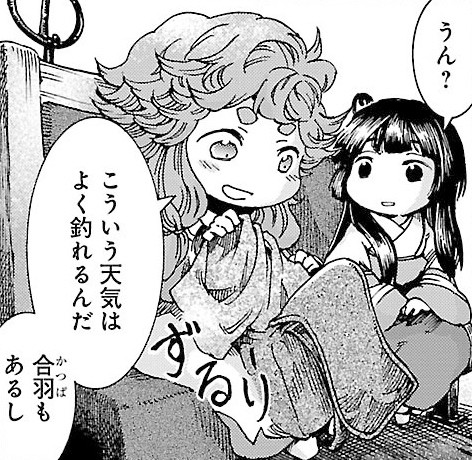
ハクメイとミコチ » Volume 4 » Page 180Hakumei and Mikochi take an overnight train to Lake Kanokan, which Hakumei has heard is a great place to fish. Near the end of the trip, it starts to rain. Mikochi says it’s a shame they won’t be able to fish, but Hakumei tells her they’re fishing anyway.
ミコチ: 「うん?」 “Huh?” ハクメイ: 「こういう天気( てんき ) はよく釣( つ ) れるんだ」 “The fish bite well in weather like this.” 「合羽( かっぱ ) “And I brought raincoats.” Challenge Yourself Show Translation
Challenge
Why does Hakumei still want to fish in the rain?
ミコチ: 「うん?」 ハクメイ: 「こういう天気( てんき ) はよく釣( つ ) れる 「合羽( かっぱ ) もあるし」 Clues こういう天気( てんき ) this kind of weather よく釣( つ ) れる the fish bite well, you catch a lot 合羽( かっぱ ) raincoat What does the speaker mean? She says fish bite well in rainy weather, and they have raincoats. よく釣れる says the fishing is good in this weather, and 合羽もあるし adds a second reason. She says the rain will be over before they reach the lake. Hakumei doesn't predict the weather. She's pulling out raincoats because she expects to fish in the rain. She says the fish can't see them when it rains. Hakumei only says the fishing is good in this weather. She doesn't explain why. She wants Mikochi to catch fish for her. 釣れる says nothing about who catches the fish. It describes how well the fishing goes.
Hakumei says こういう天気はよく釣れる, “fish bite well in weather like this”, and adds that she has raincoats. To her, the rain is a reason to fish, not a reason to stay inside.
View Full Example Building Bigger Words These patterns come up again and again in manga. Learn the pattern and you can read words you've never seen.
Verb + 合う あう (with each other)付き合う つきあう to go out with, to keep someone company 話し合い はなしあい talking it over 間に合う まにあう to be in time 〜合い あい (a state or a match)具合 ぐあい condition, how something is doing 気合い きあい fighting spirit お見合い おみあい a meeting arranged with marriage in mind 付き合い つきあい a relationship, socializing 〜合わせ あわせ (bringing things together)打ち合わせ うちあわせ a planning meeting 組み合わせ くみあわせ combination 問い合わせ といあわせ inquiry 合〜 ごう (joining together)合宿 がっしゅく training camp 合流 ごうりゅう meeting up 合体 がったい merging into one 合コン ごうコン group date Where 合 Breaks the Pattern The meaning above carries you through most words. These are the ones where it won't, or where the reading is a surprise.
合戦 (かっせん ) battle Read かっ, a third on reading that few other words use. It is a battle between armies, and playfully any contest, as in 雪合戦( ゆきがっせん ) , a snowball fight.
Same Reading, Different Kanji Some words can be written with more than one kanji. The word is the same, and the kanji shows which part of its meaning the writer has in mind. 合 shares these. How the spellings are chosen .
あう 会 会う
meet a person
客( きゃく ) と会う人( ひと ) に会いに行( い ) く
合 合う this page
match, fit, or suit; do something to each other
意見( いけん ) が合う答( こた ) えが合う
遭 遭う
run into something unexpected, usually something bad
災難( さいなん ) に遭う事故( じこ ) に遭う
逢 逢う off-list
meet someone; another spelling of 会う that can add feeling, as with a lover or a fated reunion
君( きみ ) に逢いたい出( で ) 逢い
Meeting and matching with あう compares these spellings with manga examples.
あわせる 合 合わせる this page
put together into one; match; add up
手( て ) を合わせて拝( おが ) む力( ちから ) を合わせる
併 併せる
do two separate things alongside each other
両者( りょうしゃ ) を併せ考( かんが ) える交通費( こうつうひ ) を併せて支給( しきゅう ) する
An off-list spelling uses a reading the 常用漢字表( じょうようかんじひょう ) doesn't give that kanji, or a kanji that isn't on it. Newspapers and textbooks avoid it, but manga use it often. A kanji in a dashed box has no page yet.
Check Yourself What does 合 mean? Read These Without Furigana Work Out a New Word 宿 is lodging. Read 合宿 in this line. What needs a consent form?
「新入生( しんにゅうせい ) 合宿の同意書( どういしょ ) っていつまでだっけ?」
ブラザー・トラップ, volume 10 Show the answer 合宿( がっしゅく ) , a camp where a group stays and trains together. “When was the consent form for the new-student camp due again?”
話す is to talk. What do people do when they 話し合う?
Show the answer They talk something over together. 話( はな ) し合( あ ) う.
あう can take 会, 合, or 遭. Why does 気があう take 合?
「…気が合う友達見つけられて喜んでるみたいだし」
ご注文はうさぎですか?, volume 2 Show the answer 気( き ) が合( あ ) う, to get along. 合 is for things that match, and here two people’s temperaments match. 会う is people meeting face to face. “…and they seem happy to have found a friend they get along with.”