Learning and schooling with 学
学 means to learn or study, the knowledge organized through study, and a school or educational institution. It can also refer to a person who studies. The standard readings are ガク and まなぶ.
Etymology
The kanji 学 is the simplified form of the older character 學.
Etymology Research
学 is the simplified Japanese form of 學. Kanjipedia’s account, from Kadokawa’s Shinjigen, classifies the fuller original form as 会意形声. It combines a teaching element, 冂 interpreted as covered darkness and ignorance, and 𦥑, two hands, with a sound connection given as キヨク to カク. It explains learning through imitation of taught actions and describes successive abbreviation into 學 and 学. Those component sound labels are historical analysis, not extra modern readings of 学. Kanjipedia, 学
The Chinese University of Hong Kong database presents an account of early forms as hands manipulating counting or divination rods. It describes variants containing 五 and 六, or 爻 with a phonetic role, and notes the addition of 子 in bronze forms to indicate children. It also reports Shirakawa Shizuka’s alternative interpretation of crossed roof timbers on a school building. These accounts disagree about the original scene and component functions. CUHK, 學 discussion under 爻
CUHK cites an oracle-bone inscription recording a ritual at 大學 and the Jing gui bronze inscription concerning learning and teaching archery at a 學宮. Such evidence places schooling, learning, and teaching in early Chinese usage. It does not establish a neat progression from personal study to institutions, or explain the origin of Japanese まなぶ. CUHK, early uses of 學
Learning
学生 (Student)学生( がくせい ) means a student, especially at a school or university.
It combines 学 (study ) with 生 (person / life ) to show a person who studies .
美少女戦士セーラームーン »
Volume 5 » Page 235
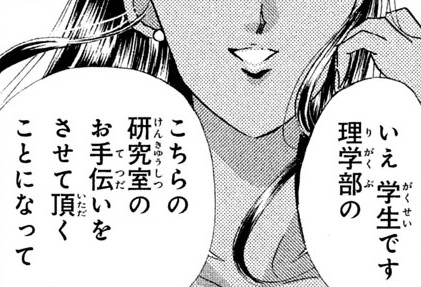
Reika sees an unknown person in the old lab next to her class’s. She asks to woman if she’s an assistant.
せつな:
「いえ 学生( がくせい ) 理学部( りがくぶ ) の」
“No, I'm a student, in the science department.”
「こちらの研究室( けんきゅうしつ ) のお手伝( てつだ ) いをさせて頂( いただ ) くことになって」
“It's arranged for me to help out in this lab.”
Challenge Yourself
Show translation
Challenge
What arrangement does Setsuna explain?
Clues
こちらの研究室( けんきゅうしつ ) のお手伝( てつだ ) いをさせて頂( いただ ) く
she will humbly assist with the work in this laboratory
ことになって
presents her role as something already decided or arranged
What does the speaker mean?
She is supposed to assist in the laboratory.
研究室のお手伝い names the work, and ことになって presents it as an existing arrangement.
She has been appointed to lead the science department.
Setsuna identifies herself as a student and says she will help in the lab, not lead the department.
She came to ask whether the laboratory needs an assistant.
ことになって shows that the arrangement already exists. She is not asking whether help is needed.
She is visiting the laboratory to conduct her own experiment.
Her stated role is お手伝い, assisting, rather than pursuing a separate experiment.
She was told to stop helping in the laboratory.
The phrase describes being allowed or arranged to help. It contains no negative instruction to stop.
She works there as a full-time laboratory assistant.
Setsuna says she is a student and frames the assistance as an arranged role, not full-time employment.
Setsuna says she is a science student who has been arranged to help in the nearby laboratory. させて頂く makes the assistance humble, and ことになって presents it as a decision already in effect.
View Full Example
小学生 (Elementary school student)小学生( しょうがくせい ) means an elementary school student. In Japan, this usually means a child in grades 1 through 6.
It combines 小学 (elementary schooling ) with 生 (student ) to show a elementary school student .
ご注文はうさぎですか? »
Volume 1 » Page 19
Talking about drawing, Cocoa is boastful of her own ability.
ココア:
「これでも金賞( きんしょう ) もらったことあるんだ」
“Believe it or not, I've actually won a gold medal before.”
リゼ:
「町内会( ちょうないかい ) の小学生( しょうがくせい ) 低学年( ていがくねん ) の部( ぶ ) とかいうのはナシな」
“And don't tell me it was in the neighborhood association's lower-elementary division.”
Challenge Yourself
Show translation
Challenge
What does ココア mean in the highlighted line?
Clues
もらったことある
もらったことある presents the prize as past experience
What does the speaker mean?
Believe it or not, I've actually won a gold medal before.
Cocoa says that receiving a gold prize is part of her experience, without locating the award at a stated past time.
Cocoa says she expects to win a gold prize in the future.
The highlighted form is もらったことある. Here もらったことある presents the prize as past experience, so this choice does not match the Japanese.
Cocoa says she once borrowed someone else's gold prize.
The highlighted form is もらったことある. Here もらったことある presents the prize as past experience, so this choice does not match the Japanese.
Cocoa admits that she has never entered an art contest.
The highlighted form is もらったことある. Here もらったことある presents the prize as past experience, so this choice does not match the Japanese.
もらったことある presents the prize as past experience. Cocoa says that receiving a gold prize is part of her experience, without locating the award at a stated past time.
View Full Example
Schools and Enrollment
学校 (School)学校( がっこう ) means a school, where teachers provide organized instruction to students.
It combines 学 (study ) with 校 (school building / institution ) to show a place for learning .
キラキラとギラギラ »
Volume 1 » Page 195
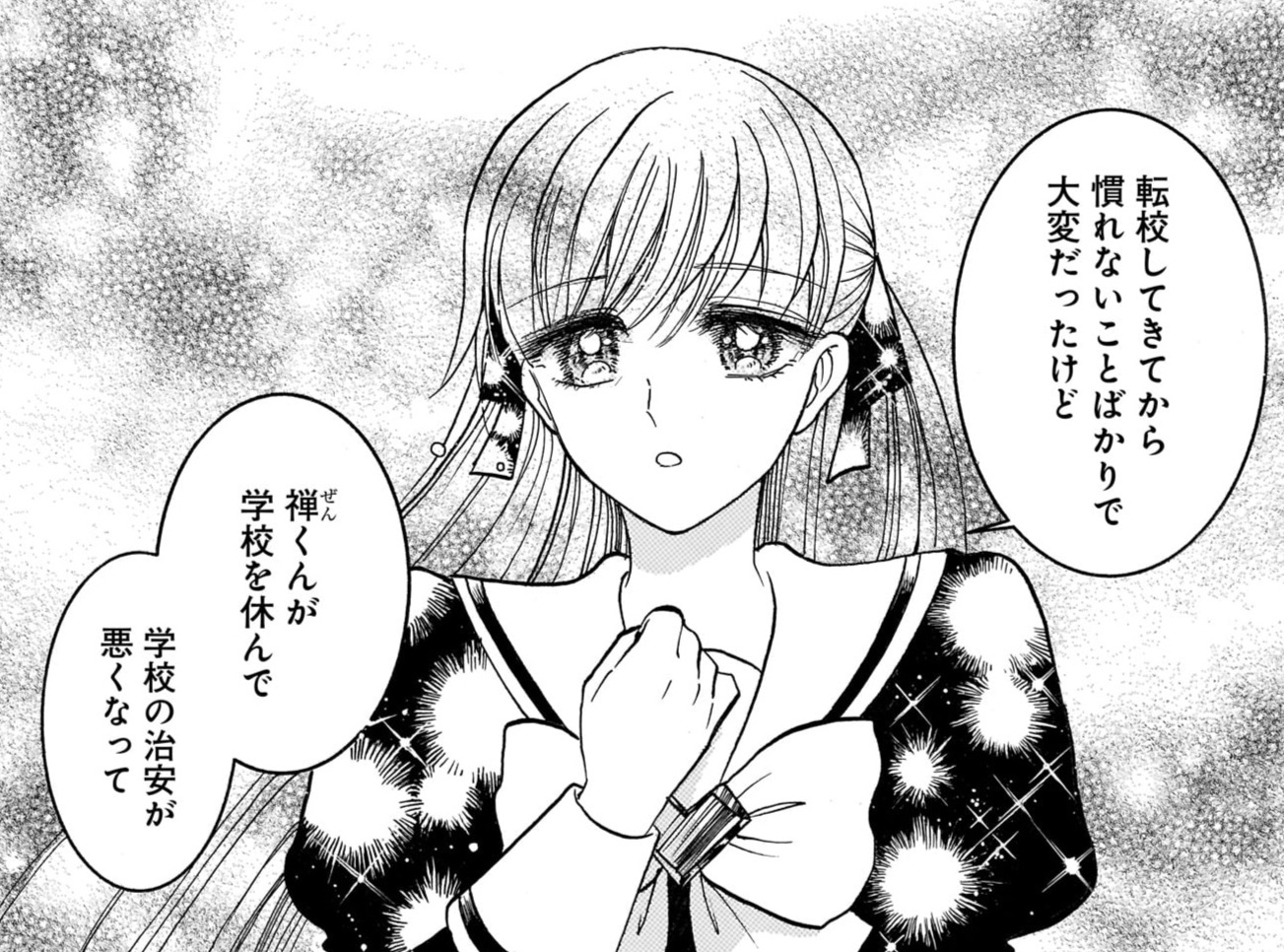
Following Zen’s absence from school for a while, fights and disobedience have taken over the school grounds. When Lulu learns Zen hasn’t been at home either during this time, she travels to the mountains in search of him. After finding him, she explains the situation at school.
ルル:
「転校( てんこう ) してきてから慣( な ) れないことばかりで大変( たいへん ) だったけど禅( ぜん ) くんが学校( がっこう ) 休( やす ) んで学校( がっこう ) 治安( ちあん ) が悪( わる ) くなって」
“Since I transferred to this school, everything has been unfamiliar and difficult, but ever since you've started missing school, the school's security has gotten worse...”
Challenge Yourself
Show translation
Challenge
What happened at school while Zen was absent?
Clues
禅( ぜん ) くんが学校( がっこう ) を休( やす ) んでZen was absent from school
学校( がっこう ) の治安( ちあん ) が悪( わる ) くなってthe school's public order became worse
What does the speaker mean?
Fighting and disorder made the school less safe.
治安( ちあん ) が悪( わる ) くなって says the school's order and safety deteriorated during Zen's absence.
The school became calmer because Zen was gone.
悪( わる ) くなって means the situation became worse, not calmer.
The school closed while everyone searched for Zen.
Lulu says the school's public order worsened. She does not say the school closed.
Students stopped attending because they transferred away.
転校( てんこう ) してきて refers to Lulu's earlier transfer. The later problem is disorder at the school.
Zen was suspended for causing fights at school.
Zen was absent, and the disorder grew without him. The line does not say he caused it or was suspended.
Lulu became accustomed to everything at the school.
She says she had faced many unfamiliar things, then explains that conditions grew worse.
Lulu tells Zen that order at school broke down while he was away. 治安( ちあん ) covers the school’s general safety and discipline, and 悪( わる ) くなって marks the change for the worse.
View Full Example
小学校 (Elementary school)小学校( しょうがっこう ) means elementary school or primary school. The 小 here reflects the lower, earlier stage of schooling.
It combines 小 (small / elementary ) with 学校 (school ) to show an elementary-level school .
あずまんが大王 »
Volume 1年生 » Page 6
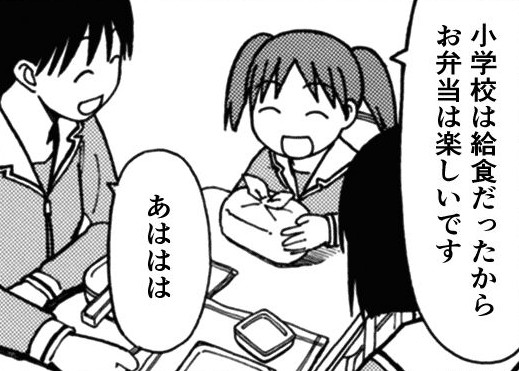
Chiyo is a child prodigy who’s skipped from elementary school to high school.
During her first day of class, Chiyo is invited by a couple of classmates to join them for lunch.
ちよ:
「小学校( しょうがっこう ) 給食( きゅうしょく ) だったからお弁当( べんとう ) は楽( たの ) しいです」
“Since we were provided lunches in elementary school, a boxed lunch is fun.”
Challenge Yourself
Show translation
Challenge
Why does Chiyo find bringing a boxed lunch enjoyable?
Clues
小学校( しょうがっこう ) は給食( きゅうしょく ) だったelementary school had provided lunches
〜から
because, giving the reason
お弁当( べんとう ) は楽( たの ) しい
boxed lunches are enjoyable
What does the speaker mean?
Her elementary school provided lunch, so bringing a boxed lunch feels new and fun.
給食( きゅうしょく ) だったから gives Chiyo's earlier school-lunch experience as the reason お弁当( べんとう ) is enjoyable now.
Her elementary school required every student to cook lunch.
給食( きゅうしょく ) means the school provided the meal. It does not mean students cooked it.
She thinks boxed lunches taste better than all school lunches.
Chiyo says boxed lunches are fun. She does not compare their taste.
She is relieved that high school provides free boxed lunches.
The contrast is between past 給食( きゅうしょく ) and the boxed lunch she now brings.
She disliked eating lunch during elementary school.
The line explains why boxed lunches are enjoyable now, but it does not say she disliked her old meals.
She plans to return to elementary school for lunch.
給食( きゅうしょく ) だった is past background, not a future destination.
Chiyo used to receive school-provided lunches in elementary school. Because bringing a boxed lunch is a new experience for her, she finds it fun.
View Full Example
学び舎 (School building)学び舎( まなびや ) refers to a place of learning, such as a school or school building.
ご注文はうさぎですか? »
Volume 1 » Page 32
Chiya takes Cocoa to see where her new school is located. Coca is filled with excitement to see it.
ココア:
「あれが私( わたし ) の新( あたら ) しい 学( まな ) び舎( や ) かぁ」
“So that over there is my new schoolhouse.”
「見( み ) てるだけでわくわくしてくるよ」
“Just looking at it makes me excited.”
Challenge Yourself
Show translation
Challenge
What does ココア mean in the highlighted line?
Clues
あれ
あれ identifies the distant schoolhouse
What does the speaker mean?
So that over there is my new schoolhouse.
Cocoa can see the building away from her position, so あれ means "that over there".
Cocoa points to a schoolhouse beside Chiya rather than one in the distance.
The highlighted form is あれ. Here あれ identifies the distant schoolhouse, so this choice does not match the Japanese.
Cocoa says the distant building is her old school.
The highlighted form is あれ. Here あれ identifies the distant schoolhouse, so this choice does not match the Japanese.
Cocoa doubts that the building is a school at all.
The highlighted form is あれ. Here あれ identifies the distant schoolhouse, so this choice does not match the Japanese.
あれ identifies the distant schoolhouse. Cocoa can see the building away from her position, so あれ means “that over there”.
View Full Example
Knowledge and Academic Study
理学部 (Faculty of Science)理学部( りがくぶ ) is a university department where students study natural sciences, which involves researching and elucidating the mechanisms and laws of the natural world.
It combines 理学 (physical science ) with 部 (department ) to show a department of science .
美少女戦士セーラームーン »
Volume 5 » Page 235
Reika sees an unknown person in the old lab next to her class’s. She asks to woman if she’s an assistant.
せつな:
「いえ 学生( がくせい ) です理学部( りがくぶ )
“No, I'm a student, in the science department.”
「こちらの研究室( けんきゅうしつ ) のお手伝( てつだ ) いをさせて頂( いただ ) くことになって」
“It's arranged for me to help out in this lab.”
Challenge Yourself
Show translation
Challenge
What arrangement does Setsuna explain?
Clues
こちらの研究室( けんきゅうしつ ) のお手伝( てつだ ) いをさせて頂( いただ ) く
she will humbly assist with the work in this laboratory
ことになって
presents her role as something already decided or arranged
What does the speaker mean?
She is supposed to assist in the laboratory.
研究室のお手伝い names the work, and ことになって presents it as an existing arrangement.
She has been appointed to lead the science department.
Setsuna identifies herself as a student and says she will help in the lab, not lead the department.
She came to ask whether the laboratory needs an assistant.
ことになって shows that the arrangement already exists. She is not asking whether help is needed.
She is visiting the laboratory to conduct her own experiment.
Her stated role is お手伝い, assisting, rather than pursuing a separate experiment.
She was told to stop helping in the laboratory.
The phrase describes being allowed or arranged to help. It contains no negative instruction to stop.
She works there as a full-time laboratory assistant.
Setsuna says she is a student and frames the assistance as an arranged role, not full-time employment.
Setsuna says she is a science student who has been arranged to help in the nearby laboratory. させて頂く makes the assistance humble, and ことになって presents it as a decision already in effect.
View Full Example
Class Roles
学級委員長 (Class president)学級委員長( がっきゅういいんちょう ) a student who serves as the leader of a school class. This student leads the class representatives and is entrusted with significant responsibilities.
It combines 学級 (class group ) with 委員長 (committee chair ) to show the leader of the class representatives .
あしたは土曜日 »
Volume 春・夏 » Page 122
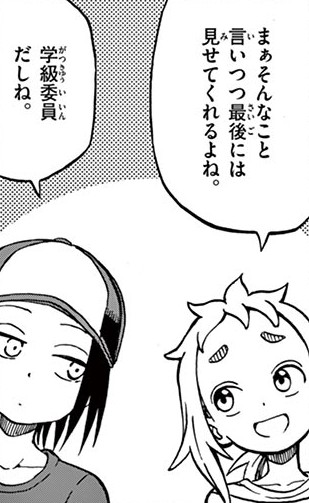
As summer break is half over, talk of summer homework comes up. Yukari says she won’t let Mina copy off of hers.
ミナ:
「まぁそんなこと言( い ) いつつ最後( さいご ) には見( み ) せてくれるよね」
“Well, even though she says that, she'll show it to me in the end, you know.”
サナエ:
「学級委員長( がっきゅういいん )
“She is the class representative, after all.”
Challenge Yourself
Show translation
Challenge
What does Mina expect Yukari to do despite her refusal?
Clues
そんなこと言( い ) いつつ
even while saying that
最後( さいご ) にはin the end
見( み ) せてくれるshow it as a favor to the speaker
よね
states an expectation and seeks agreement
What does the speaker mean?
Yukari will eventually show Mina her homework.
言( い ) いつつ contrasts Yukari's refusal with the expected result, and 最後( さいご ) には見( み ) せてくれる says she will show it in the end.
Yukari will stand by her refusal and never show it.
言( い ) いつつ introduces a contrast. Mina expects Yukari's eventual action to differ from what she says now.
Mina will show Yukari her own homework.
The giver-oriented くれる presents the showing as something Yukari will do for Mina, not the reverse.
Yukari will complete Mina's homework for her.
見( み ) せる means to show. The line does not say Yukari will write or complete Mina's work.
The teacher will show both girls the answers.
The omitted subject remains Yukari from the preceding refusal. No teacher is introduced in these lines.
Sanae will use her class position to demand the homework.
Sanae mentions the class representative afterward, but Mina's expectation is that Yukari will voluntarily show the homework.
Mina treats Yukari’s refusal as something she says now but will not maintain. She expects Yukari to show her the homework in the end.
View Full Example