Matters and events with 事
The kanji 事 refers to things, events, work, or abstract concepts.
Etymology
This kanji is an ancient pictogram associated with a hand carrying out a task with a tool, with a focuses on doing or handling something rather than on an object itself.
Circumstances
事情 (Circumstances)事情( じじょう ) means the circumstances of a situation, including what led to it and why.
It combines 事 (matter ) with 情 (real condition ) to show the circumstances of a matter .
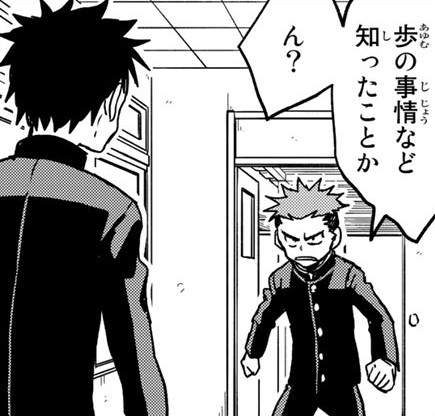
Example 1 of 3: Nothing to do with Ayumu's situation with 知ったことか Example 1 of 3
それでも歩は寄せてくる »
Volume 2 » Page 97
Sakurako tells Takeru not to go to the shogi club as he’ll get in the way of Ayumu being with Urushi. However, as a new member of shogi club, and as a man, Takeru feels it’s his duty to show up.
タケル:
「歩( あゆむ ) の事情( じじょう ) 知( し ) ったことか」
“This has nothing to do with Ayumu's situation.”
Challenge Yourself
Show translation
Challenge
How does Takeru respond to Sakurako's concern about Ayumu?
Clues
歩( あゆむ ) の事情( じじょう ) など"Ayumu's circumstances and such," dismissively framing the concern
知( し ) ったことかa rhetorical dismissal, "What do I care?" or "That is none of my concern."
What does the speaker mean?
He dismisses Ayumu's circumstances as none of his concern.
など distances Takeru from Ayumu's situation, and 知( し ) ったことか rejects any obligation to care about it.
He agrees to stay away from the shogi club for Ayumu's sake.
Takeru rejects Sakurako's concern and remains determined to attend the club.
He asks Sakurako to explain Ayumu's situation in detail.
知( し ) ったことか is not a sincere request for information. It dismisses the topic.
He denies that Ayumu has any personal circumstances.
Takeru does not say the situation is unreal. He says it does not matter to him.
He promises to help Ayumu speak with Urushi.
The line rejects involvement in Ayumu's situation rather than offering help.
He says Sakurako should handle the matter herself.
Takeru brushes the entire concern aside. He does not assign it to Sakurako.
Takeru responds with 歩( あゆむ ) の事情( じじょう ) など知( し ) ったことか. He treats Ayumu’s romantic circumstances as irrelevant to his own duty to attend the shogi club.
View Full Example
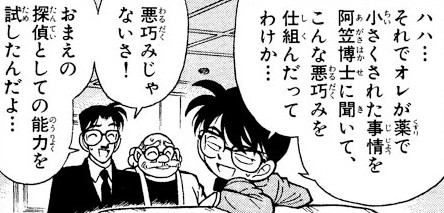
Example 2 of 3: Testing one's detective ability with 能力 Example 2 of 3
名探偵コナン »
Volume 6 » Page 18
Conan finds himself in the clutches of dangerous pair, only to discover it’s his parents in disguise.
コナン:
「ハハ… それでオレが薬( くすり ) で小( ちい ) さくされた事情( じじょう ) 阿笠( あがさ ) 博士( はかせ ) に聞( き ) いて、こんな悪巧( わるだく ) みを仕組( しく ) んだってわけか…」
“So you heard from Dr. Agasa about how I was shrunk by a drug and cooked up this evil scheme, huh...”
父( とう ) さん:「悪巧( わるだく ) みじゃないさ! おまえの探偵( たんてい ) としての能力( のうりょく ) を試( ため ) してんだよ…」
“It's not an evil scheme! I'm just testing your abilities as a detective...”
Challenge Yourself
Show translation
Challenge
What does Conan's father say the scheme was meant to test?
Clues
おまえの探偵( たんてい ) としての
your ability in your role as a detective
能力( のうりょく ) を試( ため ) してんだI am testing your ability
What does the speaker mean?
Conan's ability as a detective.
探偵( たんてい ) としての能力( のうりょく ) names the specific capacity being tested.
Agasa's ability to keep a secret.
Agasa supplied information, but the test is directed at Conan.
Conan's tolerance for the shrinking drug.
The drug explains his condition. The staged scheme tests his detective work.
His parents' skill at inventing medicine.
They use disguises and a false danger to examine Conan's reasoning.
Conan's willingness to obey his parents.
The role marked by として is detective, not son.
Whether the police can find Agasa.
No police search is being tested in the father's explanation.
Conan’s father denies that the setup was merely an evil scheme. He says it was designed to test Conan’s ability in his role as a detective.
View Full Example
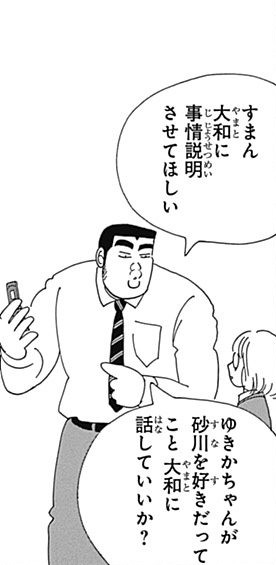
Example 3 of 3: Want you to let me explain with 〜させてほしい Example 3 of 3
俺物語!! »
Volume 7 » Page 73
Takeo tries helping the girl who likes his friend Sunakawa. When Takeo receives a call from his own girlfriend, he realizes he’s alone with another girl.
猛男( たけお ) :「すまん大和( やまと ) に事情( じじょう ) 説明( せつめい ) させてほしい」
“Sorry, I'd like you to let me explain the situation to Yamato.”
「ゆきかちゃんが砂川( すな ) を好( す ) きだってこと大和( やまと ) に話( はな ) していいか?」
“Is it all right if I tell Yamato you like Suna?”
Challenge Yourself
Show translation
Challenge
What permission does Takeo ask Yukika to give him?
Clues
大和( やまと ) に事情( じじょう ) 説明( せつめい ) させてほしいhe wants her to let him explain the situation to Yamato
ゆきかちゃんが砂川( すな ) を好( す ) きだってこと... 話( はな ) していいか
may he tell Yamato that Yukika likes Suna
What does the speaker mean?
Let him explain to Yamato that Yukika likes Suna.
説明( せつめい ) させてほしい asks to be allowed to explain, and the next line states the fact he wants permission to share.
Let him tell Suna that Yamato likes him.
The recipient is Yamato, and the person who likes Suna is Yukika.
Let Yamato explain the situation to Suna.
Takeo is the person asking to perform the explanation. Yamato is the recipient.
Allow him to leave without explaining anything.
させてほしい expresses his wish to explain, not avoid the conversation.
Give him permission to date Yukika.
The requested permission concerns sharing her feelings with Yamato, not dating her.
Ask Suna whether he already knows the situation.
Takeo asks Yukika directly for permission to speak to Yamato.
Takeo wants Yukika’s permission to explain the situation to Yamato, including that Yukika likes Suna. The causative させてほしい asks the listener to allow Takeo to perform the explanation.
View Full Example
Events
事件 (Incident)事件( じけん ) means an incident or event that attracts public attention.
It combines 事 (matter ) with 件 (case ) to show a distinct case or incident .
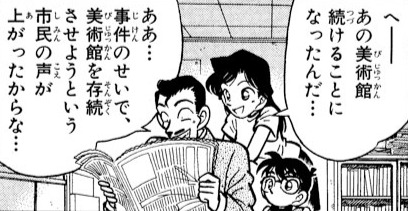
Example 1 of 2: Keeping a museum from shutting down with 事件 Example 1 of 2
名探偵コナン »
Volume 4 » Page 52
Following the solving of a murder case, Detective Mouri reads an article about the museum where the murder took place.
蘭( らん ) :「へーーー あの美術館( びじゅつかん ) 続( つづ ) けることになったんだ…」
“Wow... So they decided to keep the art museum open after all...”
毛利( もうり ) :「ああ… 事件( じけん ) 美術館( びじゅつかん ) を存続( そんぞく ) させようという市民( しみん ) の声( こえ ) が上( あ ) がったからな…」
“Yeah... Because of the incident, there was a public outcry to keep the art museum open...”
Challenge Yourself
Show translation
Challenge
Why was the museum kept open?
Clues
事件( じけん ) のせいでbecause of the incident
美術館( びじゅつかん ) を存続( そんぞく ) させようという市民( しみん ) の声( こえ ) が上( あ ) がったcitizens called for the museum to remain in operation
What does the speaker mean?
The incident prompted citizens to demand its preservation.
The public voices calling for 存続( そんぞく ) arose because of the incident.
The owner finished repairing it after the incident.
The line credits public pressure, not completed repairs.
The city had already planned to expand it.
The decision followed citizens speaking up to keep it from closing.
The murder case was proven to be fictional.
The real incident drew attention and created support for the museum.
Visitors stopped discussing the museum entirely.
Citizens actively raised their voices in favor of continued operation.
Ran personally bought the museum.
Ran observes the outcome. She is not identified as its purchaser.
The incident caused citizens to call for the museum to keep operating, and that public response led to the decision not to close it.
View Full Example
Example 2 of 2: Strange incidents on after another in Tokyo with 続出 Example 2 of 2
美少女戦士セーラームーン »
Volume 1 » Page 28
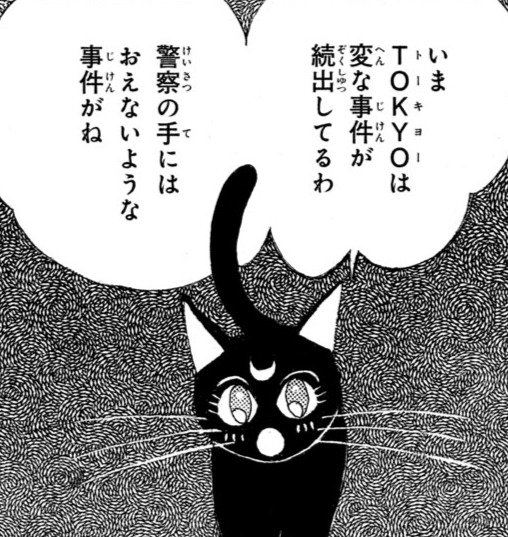
Luna introduces herself to Usagi, but Usagi thinks she’s dreaming if a cat is speaking to her. Luna gives Usagi a special brooch, then proceeds to explain the dire situation that has brought them together.
ルナ:
「いまTOKYOは変( へん ) な事件( じけん ) 続出( ぞくしゅつ ) してるわ」
“Strange incidents are popping up all over Tokyo these days.”
「警察( けいさつ ) の手( て ) にはおえないような事件( じけん )
“Incidents that seem beyond the police's control, you know.”
Challenge Yourself
Show translation
Challenge
What situation does Luna say Tokyo is facing?
Clues
変( へん ) な事件( じけん ) が続出( ぞくしゅつ ) してるstrange incidents are continuing to appear one after another
警察( けいさつ ) の手( て ) にはおえないような事件( じけん ) the incidents seem beyond what the police can handle
What does the speaker mean?
Strange incidents are appearing in succession beyond police control.
続出してる describes repeated new incidents, and 警察の手にはおえない says they seem too much for the police to handle.
One old case has kept the police busy for years.
続出 means multiple incidents are appearing one after another, not one case continuing for a long time.
The police are causing strange incidents throughout Tokyo.
The police are described as unable to handle the incidents, not as their cause.
Tokyo has returned to normal after a series of crimes.
してる presents the incidents as an ongoing situation now, not something that has ended.
Only Luna and Usagi have noticed a single minor problem.
Luna describes repeated serious incidents that exceed ordinary police control.
The police have solved each incident as soon as it appeared.
手にはおえない means the cases appear beyond their ability to manage, not that they solved them promptly.
Luna tells Usagi that strange incidents are appearing one after another across Tokyo. She adds that these cases seem beyond the police, which explains why Usagi’s new role is necessary.
View Full Example
食事 (Meal)食事( しょくじ ) refers to the act of eating a set number of times each day to obtain the nutrients the body needs, or to the food itself.
It combines 食 (eat ) with 事 (matter ) to show the matter of eating .
くまぐらし »
Volume 4 » Page 22
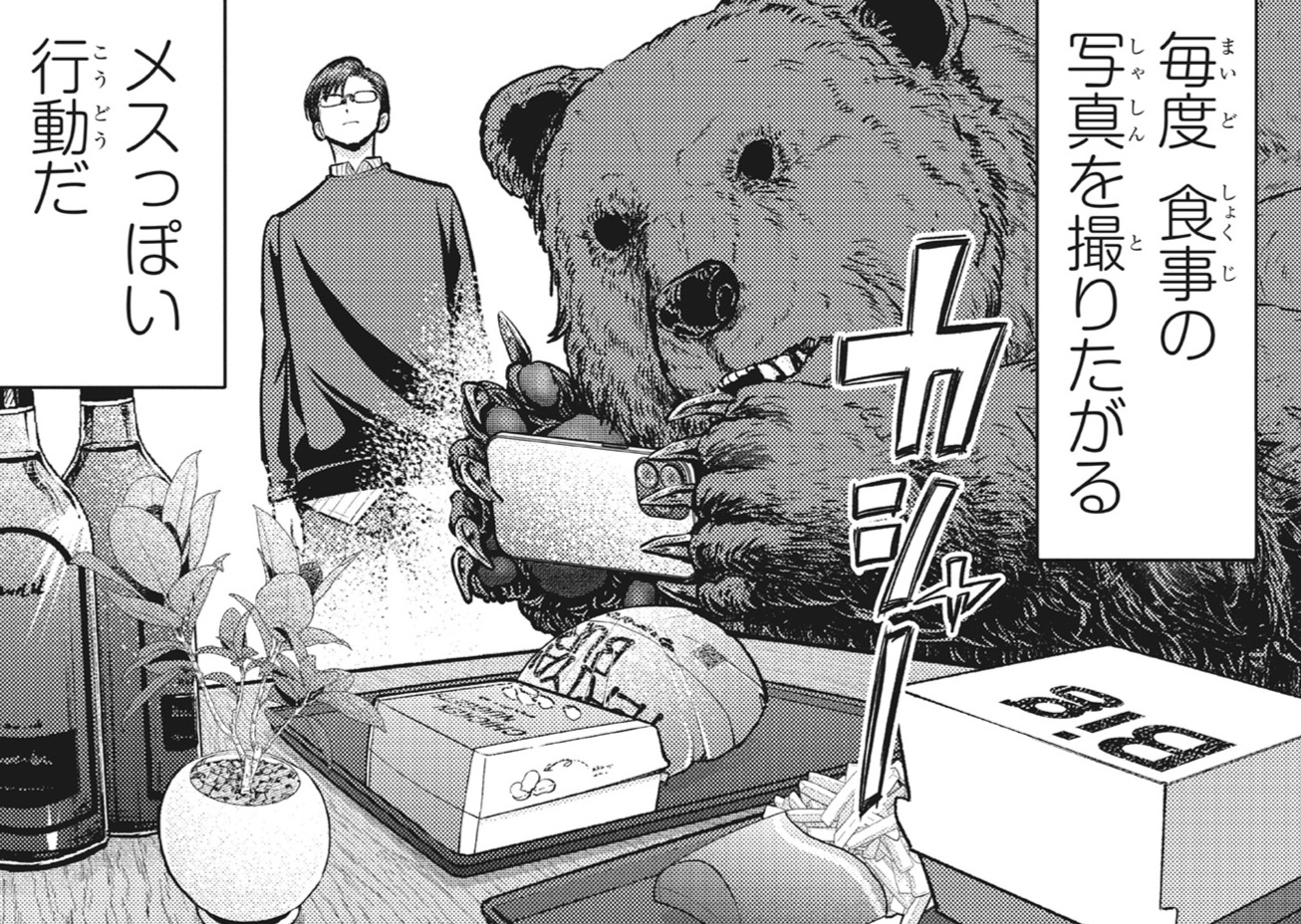
Kumada observes the bear that’s been living in his apartment for a while now, trying to determine from its personality traits whether it’s male or female.
(熊田( くまだ ) ):
「毎度( まいど ) 食事( しょくじ ) 写真( しゃしん ) を取( と ) りたがる」
“It always wants to take photos of its meals.”
「メスっぽい行動( こうどう ) だ」
“That's pretty feminine behavior.”
Challenge Yourself
Show translation
Challenge
What habit does Kumada describe as feminine?
Clues
毎度( まいど ) "every time," marking a repeated habit
食事( しょくじ ) の写真( しゃしん ) を取( と ) りたがるthe bear appears to want to take photos of its meals
メスっぽい行動( こうどう ) だ
"That is behavior that seems feminine."
What does the speaker mean?
The bear wants to photograph its meals every time.
毎度( まいど ) marks the repeated habit, and 食事( しょくじ ) の写真( しゃしん ) を取( と ) りたがる describes the bear's apparent desire.
Kumada wants to photograph the bear while it eats.
The bear is the unspoken subject of 取( と ) りたがる. Kumada is observing its desire, not stating his own.
The bear wants Kumada to photograph every meal.
〜たがる reports the bear's apparent desire to perform the action itself. It does not ask Kumada to do it.
The bear refuses to be photographed during meals.
There is no negation or refusal. The line says the bear appears to want photos.
The bear only eats after Kumada takes a photo.
毎度( まいど ) describes how often the habit occurs. The line gives no condition for eating.
The bear takes photographs only when it sees a female bear.
メスっぽい is Kumada's judgment of the behavior. It does not identify what appears in the photos.
Kumada observes that the bear appears to want a photograph of each meal. He labels that repeated habit メスっぽい行動( こうどう ) , behavior that seems feminine to him.
View Full Example
Significance
無事 (Safety)無事( ぶじ ) means safe, unharmed, or without incident.
It combines 無 (without ) with 事 (incident ) to show being without incident .
ストロボ・エッジ »
Volume 1 » Page 23
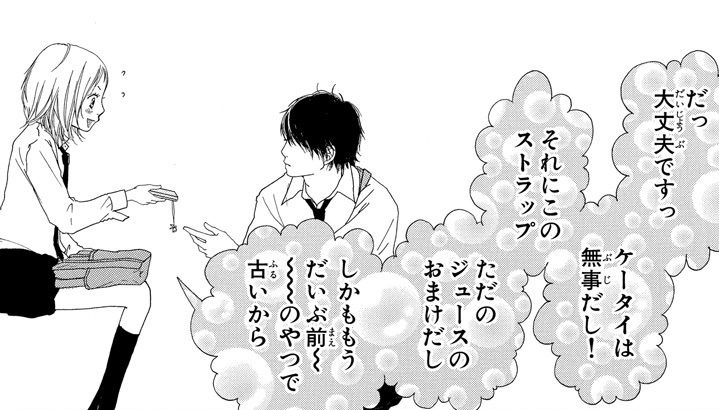
After school, Ninako notices Ren sleeping a few seats away on the train. When Ren wakes and rushes for his stop, he knocks Ninako’s phone from her hand. The phone hits the floor, and the strap charm breaks. Ren misses his exit while apologizing and offers to replace the charm.
仁奈子( になこ ) :「だっ 大丈夫( だいじょうぶ ) ですっ」
“I—it's all right.”
「ケータイは無事( ぶじ )
“Since my cell phone is safe!”
「それにこのストラップただのジュースのおまけだし」
“Furthermore, this strap is just a juice prize.”
「しかももうだいぶ前( まえ ) 〜〜〜〜のやつで古( ふる ) いから」
“Plus, it's from way back when, so it's old.”
Challenge Yourself
Show translation
Challenge
Why does Ninako say Ren does not need to replace the broken charm?
Clues
ケータイは無事( ぶじ ) だし
her phone itself is unharmed, offered as one reason
それにこのストラップただのジュースのおまけだし
besides that, the strap was only a free extra from a juice purchase
しかももうだいぶ前( まえ ) のやつで古( ふる ) いから
what is more, it is old and from a long time ago
What does the speaker mean?
The phone is safe, and the charm was only an old promotional extra.
Ninako stacks three reasons: the phone is unharmed, the strap was a mere おまけ, and it was already old.
The charm did not break when the phone hit the floor.
Ninako is minimizing the loss after the charm breaks. She does not deny that it was damaged.
She has another identical charm waiting at home.
She says the broken one was cheap and old. No replacement charm appears in her explanation.
Ren already paid her for the damage.
Ren offers to replace the charm, but Ninako argues that replacement is unnecessary.
The charm belongs to the juice company rather than to her.
おまけ explains how she obtained the charm. It does not mean the company still owns it.
She wanted an excuse to throw the charm away.
Ninako reassures Ren by downplaying the charm's value and age. She does not say she wanted it broken.
Ninako piles up reasons to ease Ren’s guilt. Her phone is fine, the broken strap was only a free juice bonus, and it was already old. それに adds the second reason to the first.
View Full Example
刑事 (Detective)刑事( けいじ ) means a police detective who investigates crimes and arrests suspects.
It combines 刑 (criminal law ) with 事 (matter ) to show someone who deals with criminal matters .
名探偵コナン »
Volume 7 » Page 8
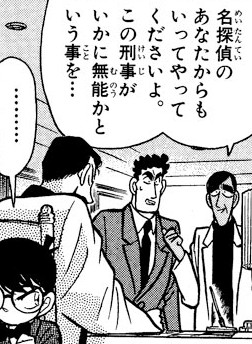
Police detective Yokomizo isn’t about to let Sasai, his prime murder suspect, leave. Sasai reminds the officer that he has photographic proof that he wasn’t near the victim at the time of the murder. He calls for Detective Mouri to back him up.
笹井( ささい ) :「名探偵( めいたんてい ) のあなたからもいってやってくださいよ。 この刑事( けいじ ) 無能( むのう ) かという事( こと ) を…」
“You, the great detective, should tell him yourself. Just how incompetent this police detective is...”
Challenge Yourself
Show translation
Challenge
What does Sasai want Mouri to tell the police detective?
Clues
いってやってくださいよ
please tell him
この刑事( けいじ ) がいかに無能( むのう ) か
just how incompetent this detective is
What does the speaker mean?
That the detective is thoroughly incompetent.
いかに無能( むのう ) か emphasizes the degree of the officer's supposed incompetence.
That the detective has solved the case correctly.
無能( むのう ) is a direct insult meaning incompetent.
That Mouri should take over the police department.
Sasai asks Mouri to support his criticism, not accept a new position.
That the detective is refusing to examine a photograph.
The photograph motivates Sasai's confidence, but his request is a broader insult about ability.
That Sasai has confessed to the murder.
Sasai insists that his photographic evidence proves his innocence.
That every officer is equally capable.
この刑事( けいじ ) singles out the officer Sasai is attacking.
Sasai asks the famous detective Mouri to confirm just how incompetent the police detective is. 無能( むのう ) bluntly says that the officer lacks ability.
View Full Example
Work
仕事 (Work)仕事( しごと ) means work, a job, or a particular task.
It combines 仕 (do ) with 事 (matter ) to show a task one performs .
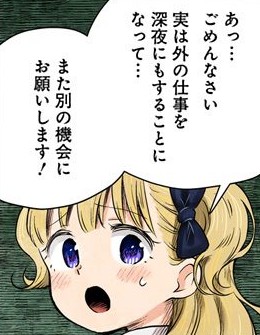
シャドーハウス »
Volume 2 » Page 66
Kate says she wants to study together with Emiriko before bedtime.
エミリコ:
「あっ… ごめんなさい。実( じつ ) は外( そと ) の仕事( しごと ) 深夜( しんや ) にもすることになって…」
“Ah, I'm sorry. The truth is, I'm scheduled to do late-night work outside...”
「また別( べつ ) の機会( きかい ) にお願( ねが ) いします!」
“Please ask again another time!”
Challenge Yourself
Show translation
Challenge
Why can Emiriko not study with Kate now?
Clues
外( そと ) の仕事( しごと ) を深夜( しんや ) にもすることになってshe has been assigned outside work late at night too
また別( べつ ) の機会( きかい ) に
on another occasion, postponing the plan
What does the speaker mean?
She is scheduled to work outside late at night.
することになって presents the late-night outside work as an assigned plan, and Emiriko asks to study on another occasion.
She has decided that she no longer wants to study with Kate.
Emiriko postpones the invitation politely. She does not reject the idea of studying together.
Kate has been assigned to work outside instead.
Emiriko is explaining her own schedule. Kate is the person whose invitation she cannot accept.
She already finished the outside work earlier that night.
The work is the upcoming conflict that prevents her from studying now, not a completed task.
She must study alone before starting her daytime work.
The assigned task is outside work in the middle of the night. No separate study requirement appears.
She wants Kate to join her for the outside work.
Emiriko asks Kate to try the study invitation another time. She does not invite Kate to work with her.
Emiriko cannot study because she has been scheduled for outside work late at night. ことになって shows that the arrangement has already been decided, and また別( べつ ) の機会( きかい ) に moves their plan to another time.
View Full Example
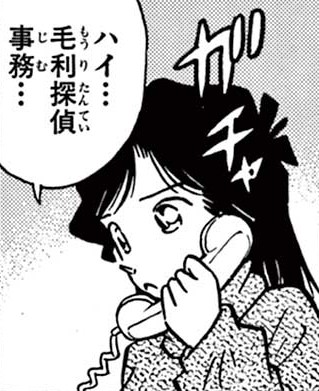
事務 (Office work)事務( じむ ) refers to the general office tasks performed in companies and government offices to ensure smooth operations, such as preparing and organizing documents, data entry, and handling phone calls and visitors.
It combines 事 (matter ) with 務 (duty ) to show duties dealing with practical matters.
名探偵コナン »
Volume 1 » Page 180
After returning home from a case, Kogoro celebrates by drinking himself to sleep. Ran sits alone, pondering Shin’ichi’s whereabouts, as she hasn’t heard from him since the day he mysteriously vanished. The phone rings. With her father asleep, Ran answers it.
蘭( らん ) :「ハイ… 毛利( もうり ) 探偵( たんてい ) 事務( じむ )
“Hello... Mouri Detective Agenc--”
Challenge Yourself
Show translation
Challenge
What is Ran beginning to say when her phone greeting is cut off?
Clues
毛利( もうり ) 探偵( たんてい ) Mouri Detective
事務( じむ ) …the beginning of the word for office or agency
What does the speaker mean?
Mouri Detective Agency.
The cut-off 事務( じむ ) … is the beginning of 事務所( じむしょ ) , completing the office name.
Mouri Police Headquarters.
The organization is a private detective agency, not police headquarters.
Mouri Family Residence.
Ran answers with the business name rather than a household greeting.
Mouri Detective Training School.
事務所( じむしょ ) means office or agency, not a school.
Mouri Legal Services.
The named profession is 探偵( たんてい ) , detective.
Mouri Investigation Report.
Ran is identifying the office on the telephone, not introducing a document.
Ran starts the standard telephone greeting for the Mouri Detective Agency, but the line cuts off during 事務所( じむしょ ) .
View Full Example