Members and personnel with 員
The kanji 員 has two common senses: a number of people or things , and a member of a group or someone assigned a job.
Etymology
Etymology Research
The oracle-bone and bronze forms combine a circular outline above 鼎, a vessel for food and ritual offerings. CUHK follows Lin Yiguang in identifying roundness as the original meaning. It also treats the circle as a sound element. This account gives the circle both a meaning and a phonetic role. CUHK Multi-function Chinese Character Database, 員
Later forms changed the vessel into the shape now written 貝. Some bronze forms add a dot inside the upper circle, producing a 日-like outline. Those variants explain why modern components can obscure the older structure. CUHK, 員
Kanjipedia, drawing on Kadokawa’s revised Shinjigen, classifies 員 as a pictograph of a round cauldron and explains the number sense through counting cauldrons. Kanjipedia, 員
Shirakawa Shizuka’s Jitsu connects counting with the offerings made using them. Heibonsha Jitsu, 員 These are attributed explanations of semantic development rather than a dated chain of attested changes.
CUHK records oracle-bone use as a place name and bronze use as a personal name. Warring States bamboo texts borrow 員 for 損, damage or decrease, and 云, say. A Mawangdui silk text uses it for 圓 when describing heaven as round. These examples show several early uses without dating the arrival of the personnel sense. CUHK, 員
圓, the older form corresponding to Japanese 円, developed as a separate graph for roundness. Heibonsha Jitsu, 員 In 圓, the outer 囗 marks the circular meaning, and 員 supplies sound. That historical phonetic role does not predict the modern Japanese reading イン. CUHK, 圓
Shuowen Jiezi glosses 員 as a number of things and analyzes it as 貝 with 囗 supplying sound. Jitsu rejects that analysis of the upper part and identifies the lower part as a shortened 鼎. This separates the later dictionary’s analysis from the interpretation of earlier inscriptions. Heibonsha Jitsu, 員
Staff and Duties
委員 (Committee member)委員( いいん ) means a committee member or appointed member of a body. It is someone entrusted with a defined role.
It combines 委 (entrust ) with 員 (member ) to show a member entrusted with responsibility .
からかい上手の高木さん »
Volume 19 » Page 88
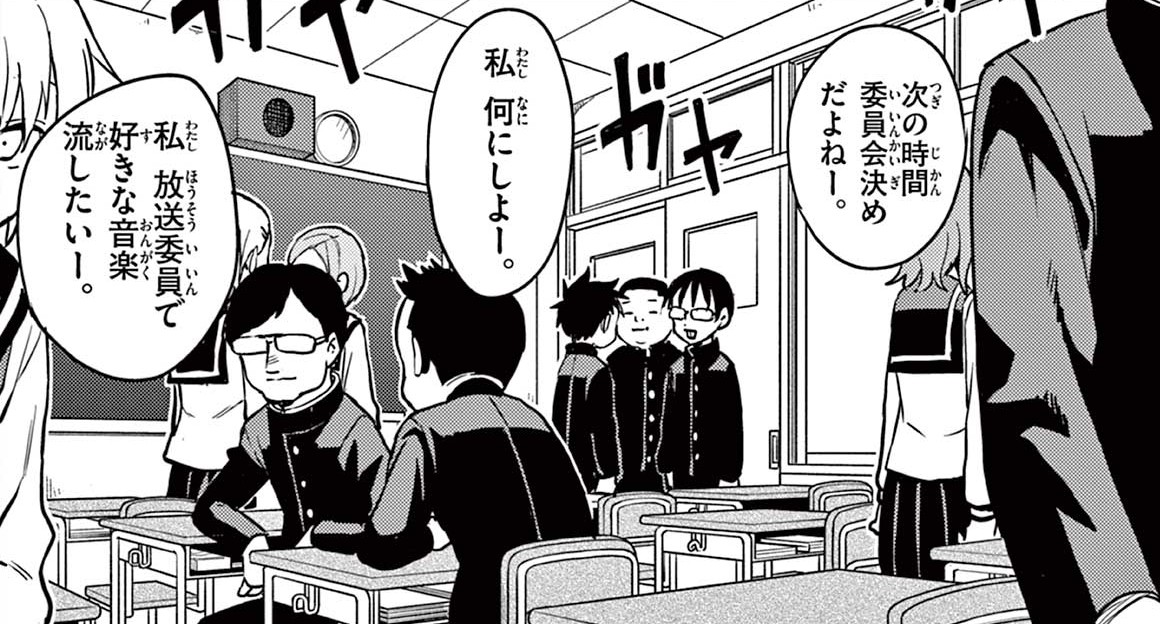
Nishika and Takagi’s class discusses what committees they plan to join.
生徒( せいと ) :「次( つぎ ) の時間( じかん ) 委員会( いいんかい ) 決( ぎ ) めだよねー。」
“Next up is deciding the committee schedule, right?”
生徒( せいと ) :「私( わたし ) 何( なに ) にしよー」
“What should I pick?”
生徒( せいと ) :「私( わたし ) 放送( ほうそう ) 委員( いいん ) 好( す ) きな音楽( おんがく ) 流( なが ) したいー。」
“I want to play my favorite music as a member of the broadcasting committee.”
Challenge Yourself
Show translation
Challenge
Which committee does the student want, and why?
Clues
放送( ほうそう ) 委員( いいん ) で"as a member of the broadcasting committee"
好( す ) きな音楽( おんがく ) 流( なが ) したい"want to play music I like," with the object marker を omitted
What does the speaker mean?
The broadcasting committee, so she can play music she likes.
放送( ほうそう ) 委員( いいん ) names the committee, and 流( なが ) したい states what she wants to do there.
The music committee, so she can perform her own songs.
She says 放送( ほうそう ) 委員( いいん ) , not a music committee, and 流( なが ) す means to play or broadcast music here.
The broadcasting committee, so she can make school announcements.
The committee is right, but her stated goal is to play music she likes.
The class committee, so she can choose the schedule.
委員会( いいんかい ) 決( ぎ ) め is the class activity. It is not the committee she chooses.
The library committee, so she can listen to music while working.
The line names the broadcasting committee and says she wants to send music over the system.
She has not decided which committee she wants.
Her earlier question is followed by a specific choice, 放送( ほうそう ) 委員( いいん ) .
The student settles on the 放送( ほうそう ) 委員( いいん ) , the broadcasting committee. Her reason is 好( す ) きな音楽( おんがく ) 流( なが ) したい, she wants to play music she likes.
View Full Example
学級委員長 (Class president)学級委員長( がっきゅういいんちょう ) a student who serves as the leader of a school class. This student leads the class representatives and is entrusted with significant responsibilities.
It combines 学級 (class group ) with 委員長 (committee chair ) to show the leader of the class representatives .
あしたは土曜日 »
Volume 春・夏 » Page 122
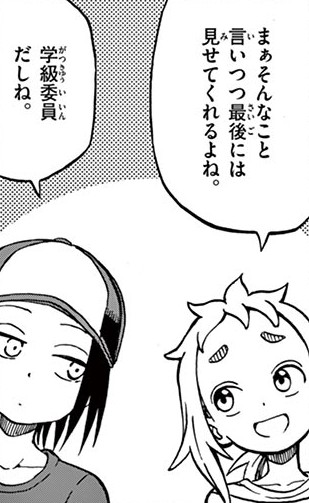
As summer break is half over, talk of summer homework comes up. Yukari says she won’t let Mina copy off of hers.
ミナ:
「まぁそんなこと言( い ) いつつ最後( さいご ) には見( み ) せてくれるよね」
“Well, even though she says that, she'll show it to me in the end, you know.”
サナエ:
「学級委員長( がっきゅういいん )
“She is the class representative, after all.”
Challenge Yourself
Show translation
Challenge
What does Mina expect Yukari to do despite her refusal?
Clues
そんなこと言( い ) いつつ
even while saying that
最後( さいご ) にはin the end
見( み ) せてくれるshow it as a favor to the speaker
よね
states an expectation and seeks agreement
What does the speaker mean?
Yukari will eventually show Mina her homework.
言( い ) いつつ contrasts Yukari's refusal with the expected result, and 最後( さいご ) には見( み ) せてくれる says she will show it in the end.
Yukari will stand by her refusal and never show it.
言( い ) いつつ introduces a contrast. Mina expects Yukari's eventual action to differ from what she says now.
Mina will show Yukari her own homework.
The giver-oriented くれる presents the showing as something Yukari will do for Mina, not the reverse.
Yukari will complete Mina's homework for her.
見( み ) せる means to show. The line does not say Yukari will write or complete Mina's work.
The teacher will show both girls the answers.
The omitted subject remains Yukari from the preceding refusal. No teacher is introduced in these lines.
Sanae will use her class position to demand the homework.
Sanae mentions the class representative afterward, but Mina's expectation is that Yukari will voluntarily show the homework.
Mina treats Yukari’s refusal as something she says now but will not maintain. She expects Yukari to show her the homework in the end.
View Full Example
委員会 (Committee)委員会( いいんかい ) means a committee formed to handle a particular duty.
It combines 委員 (entrusted members ) with 会 (association ) to show an assembly of entrusted members .
からかい上手の高木さん »
Volume 19 » Page 88
Nishika and Takagi’s class discusses what committees they plan to join.
生徒( せいと ) :「次( つぎ ) の時間( じかん ) 委員会( いいんかい ) 決( ぎ ) めだよねー。」
“Next up is deciding the committee schedule, right?”
生徒( せいと ) :「私( わたし ) 何( なに ) にしよー」
“What should I pick?”
生徒( せいと ) :「私( わたし ) 放送( ほうそう ) 委員( いいん ) で好( す ) きな音楽( おんがく ) 流( なが ) したいー。」
“I want to play my favorite music as a member of the broadcasting committee.”
Challenge Yourself
Show translation
Challenge
Which committee does the student want, and why?
Clues
放送( ほうそう ) 委員( いいん ) で"as a member of the broadcasting committee"
好( す ) きな音楽( おんがく ) 流( なが ) したい"want to play music I like," with the object marker を omitted
What does the speaker mean?
The broadcasting committee, so she can play music she likes.
放送( ほうそう ) 委員( いいん ) names the committee, and 流( なが ) したい states what she wants to do there.
The music committee, so she can perform her own songs.
She says 放送( ほうそう ) 委員( いいん ) , not a music committee, and 流( なが ) す means to play or broadcast music here.
The broadcasting committee, so she can make school announcements.
The committee is right, but her stated goal is to play music she likes.
The class committee, so she can choose the schedule.
委員会( いいんかい ) 決( ぎ ) め is the class activity. It is not the committee she chooses.
The library committee, so she can listen to music while working.
The line names the broadcasting committee and says she wants to send music over the system.
She has not decided which committee she wants.
Her earlier question is followed by a specific choice, 放送( ほうそう ) 委員( いいん ) .
The student settles on the 放送( ほうそう ) 委員( いいん ) , the broadcasting committee. Her reason is 好( す ) きな音楽( おんがく ) 流( なが ) したい, she wants to play music she likes.
View Full Example
Headcounts and Capacity
全員 (Everyone)全員( ぜんいん ) means everyone or every member of a group, without exception.
ひとりぼっちの○○生活 »
Volume 1 » Page 36
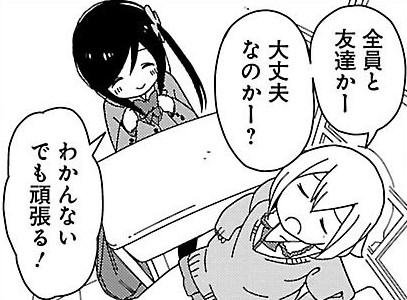
Nako learns of Bocchi’s necessity to become friends with everyone in class.
なこ:
「全員( ぜんいん ) 友達( ともだち ) かー」
“Friends with the whole class, huh?”
「大丈夫( だいじょうぶ ) なのかー?」
“Will you be okay...?”
ぼっち:
「わかんないでも頑張( がんば ) る!」
“I don't know, but I'll try my best!”
Challenge Yourself
Show translation
Challenge
How does Bocchi respond to Nako's concern?
Clues
わかんない
she does not know whether she will be okay
でも頑張( がんば ) る!
but she will do her best
What does the speaker mean?
She is unsure, but she will try her best.
わかんない admits uncertainty, while でも頑張( がんば ) る shows that Bocchi intends to try anyway.
She knows she cannot do it, so she gives up.
Bocchi does not claim certain failure. She says she does not know, then commits to doing her best.
She is certain that making friends will be easy.
わかんない expresses uncertainty, not confidence about the outcome.
She asks Nako to make friends with everyone for her.
頑張( がんば ) る describes Bocchi's own decision to try. She does not pass the task to Nako.
She plans to wait until she knows she will succeed.
でも connects her uncertainty directly to action. Bocchi will try despite not knowing the result.
She says Nako should not worry about the class.
The response concerns Bocchi's uncertainty and effort. It does not tell Nako how to feel.
Bocchi cannot say whether she will be okay, but that does not stop her. でも contrasts わかんない with her firm decision to do her best and try to befriend everyone.
View Full Example